USA National Phenology Network

Courtesy USA National Phenology Network

The study of recurring plant and animal life cycle events is phenology. It is the calendar of nature. This includes when plants flower, when birds migrate and when crops mature. Phenology is relevant to interactions between organisms, seasonal timing and large-scale cycles of water and carbon. Phenology is important to us for many reasons. Farmers need to know when to plant and harvest crops and when to expect pests to emerge. Resource managers use it to monitor and predict drought and assess fire risk. Vacationers want to know when the best fall colors will be or when the wildflower blooms will peak. Timing varies but we can discern patterns.

The USA National Phenology Network monitors the influence of climate on the phenology of plants, animals and landscapes. They encourage people to observe phenological events such as flowering, migrations and egg laying. The Phenology Network provides a place to enter, store and share these observations, which are then compiled and analyzed nationwide. Participants range from individual observers in their own backyards to professional scientists monitoring long-term plots. My husband and I monitor leafing and flowering of lilacs, a key species in the program.

These observations support a wide range of decisions made routinely by citizens, managers, scientists and others. This includes decisions related to allergies, wildfires, pest control, and water management.

I urge you to participate. The National Phenology Network has many public, private and citizen partners. It is a great way to become involved in a nation-wide effort to better understand our environment. All this information and much more is available at the National Phenology website, to which there is a link from our Wild About Utah website.

This is Linda Kervin for Bridgerland Audubon Society.

Credits:

Text: Linda Kervin, Bridgerland Audubon Society
Additional Reading:

Linda Kervin’s pieces on Wild About Utah

Phenology Tools for Community Science
USA National Phenology Network, https://www.usanpn.org/
Nature’s Notebook Education Program, US National Phenology Network, https://www.usanpn.org/nn/education

North American Bird Phenology Program, USGS Patuxent Wildlife Research Center, https://www.pwrc.usgs.gov/bpp/BecomeAParticipant.cfm

eBird, https://www.ebird.org/

iNaturalist, https://www.inaturalist.org/

Grow Native!

Fire ChaliceCopyright 2010 Annalisa Paul
Stokes Nature Center

With the beginning of summer at our doorstep, many of us look out over our green grass yards and dread the coming heat that will endeavor to turn it brown and stale. One might begin to ponder if there is an alternative to these plants that fill our yards and demand so much of our water. In fact, there is.

Utah may be a desert, but not one naturally devoid of vegetation. Many plants have evolved to live within the bounds of the climate, insect pests, microbes and soil types specific to our region. Once established, many native plants need minimal irrigation beyond normal rainfall. And because they have coexisted for eons, natives have developed their own defenses against many pests and diseases, resulting in minimal pesticide use.

Backyards, gardens, parks, and roadsides planted with native plants also provide wildlife with a “bridge” to the natural areas that remain, interspersed among our heavily developed communities. As the cornerstone of biological diversity, native plants also do the best job of providing food and shelter for our local animals. Ready to get planting? Here are two natives that would be easy, attractive, and low-maintenance additions to many Utah yards or gardens.

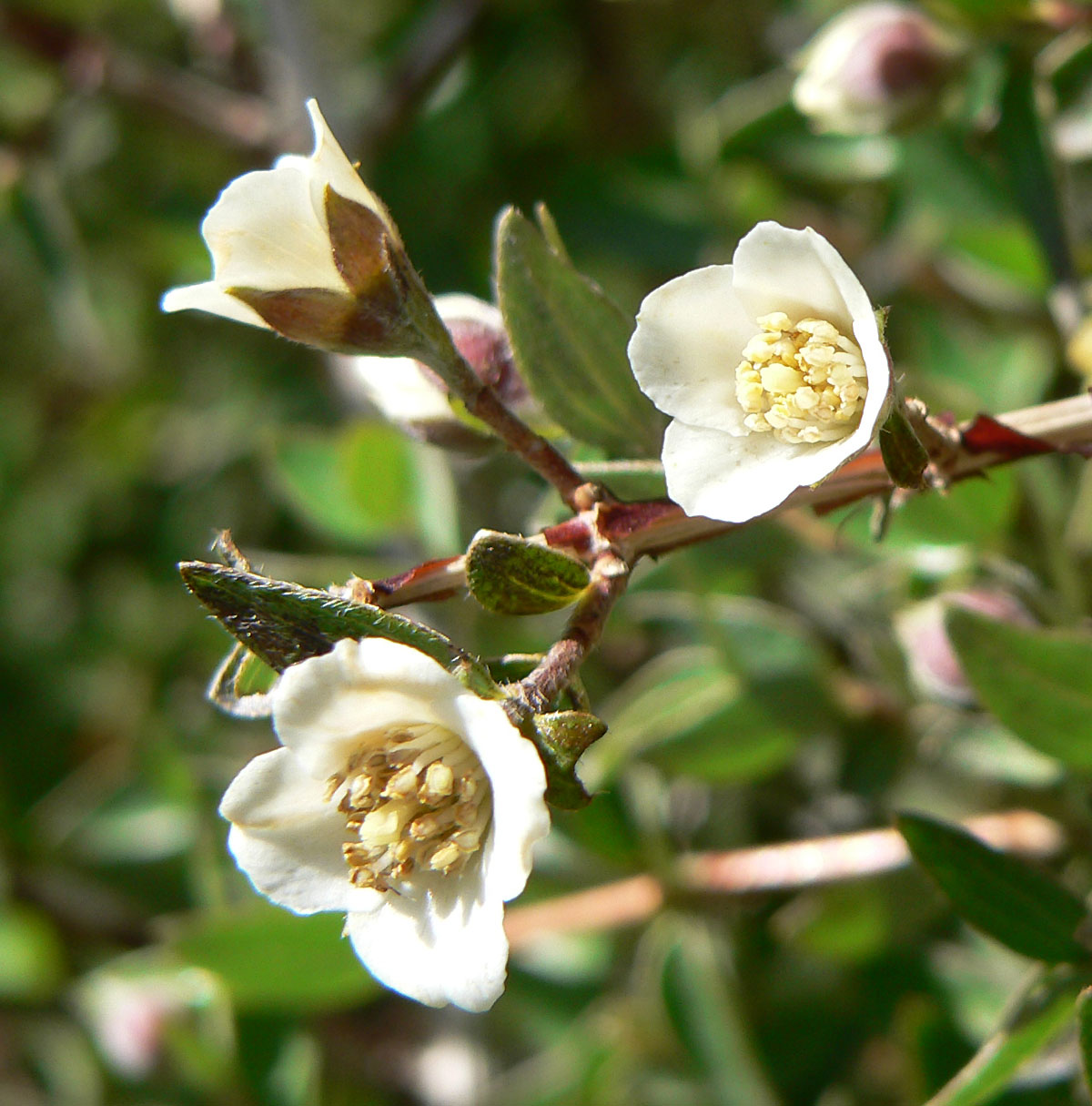
Littleleaf Mock Orange is a compact shrub which produces clusters of wonderfully fragrant white blossoms. In the wilds of Utah, it is often found growing in rock crevices and dry, gravelly areas, so it will likely do well in those bare, difficult parts of your yard. It is browsed by mule deer and also provides shelter for native birds.

Little leaf Mock Orange
Philadelphus microphyllus
Image licensed under the Creative Commons Attribution-Share Alike 3.0 Unported license.
Photographer: Stan Shebs

Fire Chalice, alternately known as hummingbird flower, is a low-profile plant with bright red tube-shaped flowers. The plant’s nectar is irresistible to hummingbirds and can help attract a number of native pollinators to your yard.

As with all plants, the right native must be matched with the right spot. Thankfully, there are native plants that thrive in every habitat imaginable. And the best thing is, natives include all different types of plants from mosses and ferns to wildflowers, shrubs and trees. A little bit of research should help you find the best species for your hot, dry slope, that wet swale in the back, or the dry shade under your trees.

For those interested in learning more, the Alterniscapes Garden Tour on June 25 provides an opportunity to view gardens in Millville, Nibley and Providence that feature water-wise and native plants. For more information on native plants or the Alterniscapes Tour, please visit us online at www.wildaboututah.org.

For the Stokes Nature Center and Wild About Utah, this is Andrea Liberatore.

Credits:

Photos: Courtesy & Copyright Annalisa Paul, Stokes Nature Center, logannature.org
Courtesy & Copyright: Intermountain Native Plant Growers Association, inpga.org
Little leaf Mock Orange image licensed under the
Creative Commons Attribution-Share Alike 3.0 Unported license. Photographer: Stan Shebs
Text:    Andrea Liberatore, Stokes Nature Center, logannature.org
For more information about the upcoming Alternascapes Garden Tour:
Cache Master Gardeners, Alternascapes Garden Tour, Saturday, Jun 25 – 11:00AM to 4:00PM, https://extension.usu.edu/cache/files/uploads/Alterniscapes%20Handout%20Bi-fold%20for%20Web.pdf

For more information about Utah’s native plants:

Utah Native Plant Society: https://www.unps.org

Utah Master Gardeners: https://extension.usu.edu/mastergardener/
Additional Reading:

United States Department of Agriculture, Plants Profile: Littleleaf Mock Orange. Found online at: https://plants.usda.gov/java/profile?symbol=PHMI4

United States Department of Agriculture, Plants Profile: Garrett’s Fire Chalice. Found online at: https://plants.usda.gov/java/profile?symbol=EPCAG


Cryptobiotic Soil Crusts

Cryptobiotic Soil Crust
Photo Courtesy & Copyright 2009
Mark Larese-Casanova

Hi, this is Mark Larese-Casanova from the Utah Master Naturalist Program at Utah State University Extension.

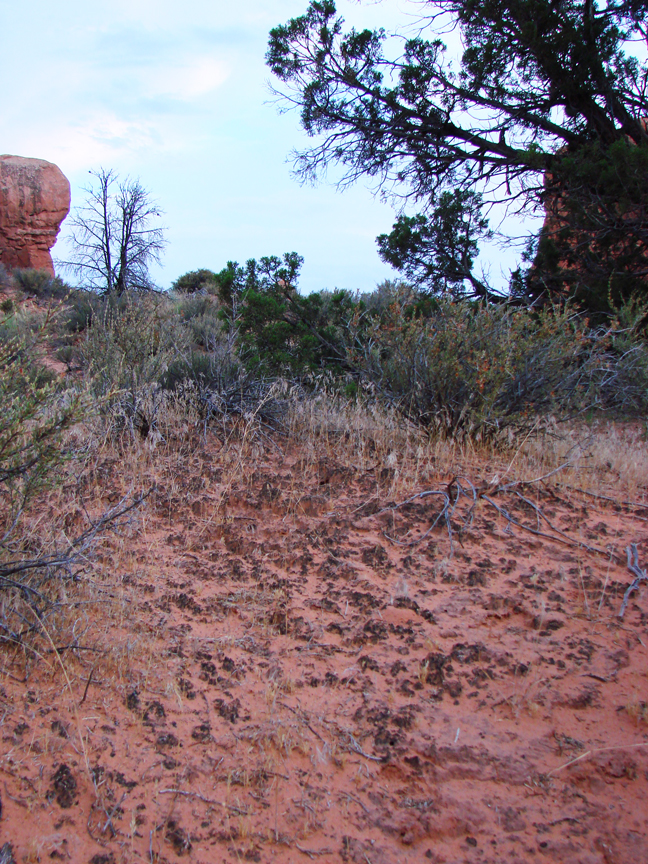
Looking out over a Utah desert, we might see relatively few plants- perhaps some sagebrush, maybe a few junipers or Joshua trees, or even some small wildflowers or cacti. What is less noticeable, though, is the living soil crust that holds this entire landscape together. It’s not just sand, but rather an important and vast partnership between bacteria, lichens, algae, and fungi. These soil crusts are often referred to as ‘cryptobiotic’, which means ‘living in suspended animation’. This is a fitting description, considering that water can be so rare in Utah’s deserts.

Cyanobacteria, which is often called blue-green algae, is the backbone of cryptobiotic soil crust. Vast networks of long, microscopic filaments of cyanobacteria and fungi grow in length when they are wet, and leave behind a casing that literally binds the soil together. So, what might otherwise be loose sand not only is less likely to be washed away by water or blown away by wind, but also is able to hold much more water for plants.

Cryptobiotic Soil Crust
Photo Courtesy & Copyright 2009
Mark Larese-Casanova

Cyanobacteria is also extremely useful to desert landscapes for its ability to take Nitrogen out of the air and make it available to plant roots in the soil. Desert soils typically have relatively low nutrients, so this is especially important to desert plants.

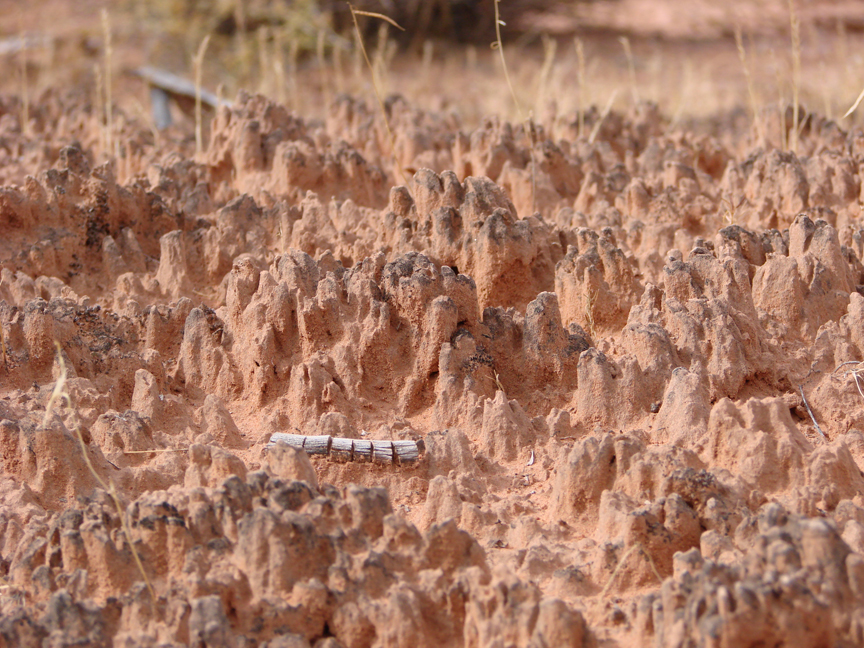
In many Utah deserts, cryptobiotic soil crusts can cover up to 70% of the ground surface. Old soil crust can often look like small mountain ranges with black or white peaks inhabited by lichens or mosses. The little valleys in between the tiny mountains of crust are perfect spots for the seeds of desert plants to grow. Over time, the above ground crust can grow up to ten centimeters, or four inches, thick!

However, cryptobiotic soil crust grows at an alarmingly slow rate of about one millimeter per year. So, any soil crust that is disturbed can take a very long time to recover. Depending on the amount of moisture a desert receives, it can take anywhere between 20 and 250 years for soil crust to grow back.

Next time you’re out in the desert, kneel down and have a close look at the telltale peaks and valleys of cryptobiotic soil crust. If you bring a magnifying glass, you just might be able to see some of the lichens and mosses. Be sure to stay on trail, though, and whatever you do, don’t bust that crust!

For Wild About Utah, I’m Mark Larese-Casanova.

Credits:

Images: Courtesy and copyright Mark Larese-Casanova
Text:     Mark Larese-Casanova, Utah Master Naturalist Program at Utah State University Extension.
Additional Reading:

US Department of Interior. 2001. Biological Soil Crusts: Ecology and Management. Bureau of Land Management Technical Reference 1730-2., https://www.blm.gov/nstc/library/pdf/CrustManual.pdf
Rosentreter, R., M. Bowker, and J. Belnap. 2007. A Field Guide to Biological Soil Crusts of Western U.S. Drylands. U.S. Government Printing Office, Denver, Colorado., https://www.soilcrust.org/

Dandelions

Dandelions
Copyright © 2002 Roger Banner, Intermountain Herbarium, USU

Hi I’m Holly Strand.

The snow has barely melted yet Dandelions are pushing their way up through the grass. The flowers delight my daughter who eagerly gathers them by the fistful into cheerful but quickly droopy bouquets. However, not everyone shares her enthusiasm. The common dandelion is listed as an invasive and noxious weed by the USDA. Lawnowners spend a lot of time pulling them up and a lot of money on herbicides. There is even a Facebook group called Dandelion Haters United!

The Flora of North America recognizes 15 species of dandelion and four of these occur in Utah. Two native species are found in the mountains. The dandelion that you see in your lawn is an immigrant from Eurasia. If it has olive green seeds it the “Common Dandelion”. If it has brick-red seeds and leaves lobed to the tip it is the so called” Red seeded dandelion. “ This red-seeded dandelion is also common.

The word dandelion comes from the French dent de lion or “lion’s tooth,” referring to the serrated leaves of the plant. The French however, use another name “pissenlit” (pis’seau-li) or bedwetter, referring to the diuretic properties of the plant.

Throughout the ages, people have used dandelions to treat various ailments such as dyspepsia, heartburn, spleen and liver complaints, and hepatitis. Modern pharmacaological studies indicate both dandelion extracts or individual compounds of dandelion leaves or roots really do have significant health-promoting properties. They appear to be especially beneficial for treating digestive disorders, inflammation and as an anti-oxidant.

But the main reason you shouldn’t reach for that pesticide is that dandelions are delicious! The young fresh leaves taste great in a salad, or you can sauté them as you would spinach. You can make dandelion soup or even wine. The greens have 50% more vitamin C than tomatoes, double the protein content of eggplant, and twice the fiber of asparagus. They are also rich in potassium and iron. If harvesting from your yard, just make sure you pick the leaves before the flowers appear.

For information sources and a recipe for dandelion salad go to www.wildaboututah.org

For Wild About Utah, I’m Holly Strand.

Credits:

Photos: Courtesy and Copyright 2002 Roger Banner, Intermountain Herbarium, USU
Text: Holly Strand

Sources & Additional Reading:

Fertig, W. 2011.
Can‘t Beat ‘em? Eat ‘em ! (Sidebar to “Consider the Dandelion Before You Dig”) Sego Lily (newsletter of the Utah native Plant Society. March. Vol. 34, No. 2. P. 8 https://www.unps.org/segolily/Sego2011MarApr.pdf

Lesica, Peter 2011. Consider the Dandelion Before You Dig. Sego Lily (newsletter of the Utah native Plant Society. March. Vol. 34, No. 2. P. 8 https://www.unps.org/segolily/Sego2011MarApr.pdf

Schutz, Katrin, Reinhold Carle, Andreas Schieber Reinhold Carle, Andreas Schieber. 2006. Taraxacum—A review on its phytochemical and pharmacological profile Journal of Ethnopharmacology. Vol. 107, pp. 313–323

Dandelions, Range Plants of Utah, Forbs, Mindy Pratt, Jim Bowns, Roger Banner, Allen Rasmussen, USU Extension, 2002, https://extension.usu.edu/range/forbs/dandelion.htm

Dandelion Salad (from Allrecipes.com)

Ingredients

1/2 pound torn dandelion greens

1/2 red onion, chopped

2 tomatoes, chopped

1/2 teaspoon dried basil

salt and pepper to taste

Directions:

In a medium bowl, toss together dandelion greens, red onion, and tomatoes.

Season with basil, salt, and pepper.