Sage Steppe

Mountain big sagebrush (Artemisia tridentata subsp. Vaseyana) in flower - Photo Courtesy and Copyright Dr. Leila Shultz
Mountain big sagebrush (Artemisia tridentata subsp. Vaseyana) in flower – Photo Courtesy and Copyright Dr. Leila Shultz

Three-tip sage (Artemisia tripartite) with visible yellow flowers. - Photo Courtesy and Copyright Dr. Leila ShultzThree-tip sage (Artemisia tripartite) with visible yellow flowers. – Photo Courtesy and Copyright Dr. Leila Shultz

Zane Gray’s “Riders of the Purple Sage” and Steve Tremble’s “Sage Brush Ocean” are book titles that may invoke excitement from your literary past. Or you may be traveling along the interstates and side roads of our great state as monotony sets in and drowsiness tightens your grip on the wheel while you nod your way through endless miles of this seemingly drab landscape.

In science jargon it’s referred to as sage steppe, the dominant landscape throughout much of Utah and the Great Basin. Much of this maligned biotic community has been degraded or lost through various mismanagement practices. Sage Steppe is considered an endangered ecosystem despite the seemingly large area it inhabits, primarily due to fragmentation. And the iconic Gunnison sage grouse has followed its demise having recently been placed on the threatened species list.
I just returned from spending a day of study in the field with 16 college students running transects for the Grand Teton N.P. The park is spending millions in sage steppe restoration work to reclaim this critical plant community.

Sagebrush is an important member of an ecosystem that helps support many birds, reptiles, amphibians, and mammals, as well as an abundance of insects and microbes. One study found nearly 300 arthropod species directly living on just a few plants including- 72 spider, 237 insect, 42 of which were gall-forming, amongst many other species. Such diversity also indicates that sage is playing an important part in maintaining the health of the environment providing ecosystem services such as soil protection, water conservation and nutrient cycling.
Sage is well adapted to the demands of semi-arid deserts. It has tap roots that can go over 15 feet deep to suck up any ground water that might exist and forms extensive webs of surface roots in association with symbiotic fungal hyphae to efficiently gather any rain that might fall. Oftentimes, sagebrush grows in clonal communities with members that can live over 100 years!

Aromatic odors emanating from sage, especially following a downpour of rain, comes from a mix of chemicals including camphor, terpenoids, and a cocktail of other volatile compounds. Some of the chemicals have anti-herbivory action by killing the gut bacteria of carious browsers although pronghorn antelope seem to have evolved resistance to these toxins. Other browsers like cattle, sheep, and mule deer can only eat sagebrush in small doses or whan the leaves are young and tender.

It is this mixture of molecules that sagebrush produces which come into play for communication. Sagebrush is eaten by many mammals and insects. When sagebrush is browsed on by a pronghorn or grasshopper volatile compounds are released from the wound that warn other branches of the same sagebrush as well as the neighboring sage about the potential threat. The sagebrush in the area react to the warning by metabolizing toxins that make them taste unappealing and that cause digestive discomfort for future herbivores who try to make a meal of them.

Native Americans considered sage a sacred plant. It offered medicine, clothing, shelter, and was commonly used in their ceremonial sweat lodges. Last but not least, my lovely granddaughter was given the name Sage. So the next time you find yourself surrounded by our “sagebrush ocean” pay tribute to this vibrant and intricate community of life.

Jack Greene, a lover of sagebrush.

Credits:

Pictures: Courtesy and Copyright Dr. Leila Shultz
Text: Jack Greene, Bridgerland Audubon Society

Additional Reading:

A Safari through Utah’s Ice Age

Wave-cut platforms from
Lake Bonneville preserved on
Antelope Island, Great Salt Lake, Utah.
Photo Courtesy Wikimedia, Mark A. Wilson (Department of Geology, The College of Wooster), Photographer

Ground sloth of the Pleistocene
Paramylodon harlani
Texas Memorial Museum
University of Texas at Austin.
Photo Courtesy Wikimedia
Licensed CCA Share Alike 3.0 Unported

Lake Bonneville compared to the
State of Utah.
Photo Courtesy https://wildlife.utah.gov/gsl/history/


Hi, I’m Ru Mahoney with Stokes Nature Center in Logan Canyon. As winter approaches I find myself anticipating the first really good snow, when our valley floors and mountain passes will be transformed overnight, relinquishing autumn’s riot of color for a glacial monochrome. As little as 12,000 years ago winter white was Utah’s perennial favorite, donned at the launch of the Pleistocene Epoch, a roughly 2 million year long period (give or take 10,000 years) marked by widely recurring glaciations.

The west has a reputation for being vast, but Ice Age Utah was even bigger. The mountains where higher and sharper. And the Great Salt Lake was submerged beneath the glacial waters of Lake Bonneville. At its largest, this massive body of water covered 20,000 square miles and was more than 980 feet deep. To put that into perspective, that measures about 9.5 million football fields wide by 4.5 Salt Lake Temples deep. And the Ice Age wildlife? Well it was much more akin to an African safari than anything you’re likely to find on your favorite shoreline trail these days.

The megafauna of Pleistocene Utah included a menagerie of beasts that are the stuff of legend. Familiar species like bison and big-horn sheep grazed among herds of mammoths and mastodons. Camels and horses – destined for extinction in North America – were the prehistoric prey of dire wolves and saber-toothed cats. Giant ground sloths the size of modern day elephants stood on two powerful hind legs to browse on shoreline foliage. And herds of muskoxen kept a wary eye on Arctodus, the Short-faced bear, a formidable predator more than 50% larger than any bear species living today.

The last 30,000 years of Utah’s Ice Age were characterized by increasingly volatile shifts in climate. The changing norms in temperature and abundance of liquid water created cyclical periods of transitioning habitat. Forests and forest dwellers gave way to deserts and their specialist species, before shifting back to forests again, all in mere millennia. While nomadic and highly adaptable species like muskoxen eventually moved north to more stable climates, the less adaptable fauna of the Ice Age were increasingly relegated to sharing shoreline habitat diminished by the swollen banks of Lake Bonneville.

As fluctuating glaciers pushed southward and then retreated, canyons like Big and Little Cottonwood were gouged into existence. Spring and summer glacier melt carried an abundance of freshwater into the lake, sometimes sweeping along with it the remains of prehistoric animals that had not lasted through the winter, laying them to rest in shoreline deltas where their fossilized remains are now uncovered and studied in alluvial sediment. For many of Utah’s Ice Age animals, the end of the Pleistocene brought extinction.

Today the ancient shoreline of Lake Bonneville is one of the most distinguishable geological features along the Wasatch front. This “bench”, as it’s now commonly known, is easily identifiable in cities all along the Wasatch and frequently boasts fine homes and even finer views. Which might go to show that lakeside property retains its value whether the lake is still there or not. So as you enjoy a winter hike or cross country ski along a shoreline trail this season, think about Utah’s last Ice Age and how our rich fossil record, with some of earth’s largest land mammals, paints a picture of an even wilder west.

For Wild About Utah and Stokes Nature Center, I’m Ru Mahoney.

Credits:
Image1: Courtesy Wikimedia, Mark A. Wilson (Department of Geology, The College of Wooster), Photographer
Image2: Courtesy Wikimedia,as licensed through Creative Commons Attribution-Share Alike 3.0 Unported
Image3: Courtesy https://wildlife.utah.gov/gsl/history/
Text:     Ru Mahoney, Stokes Nature Center in Logan Canyon.

Additional Reading:
https://geology.utah.gov/popular/general-geology/ice-age/ice-age-animals-of-utah/

https://serc.carleton.edu/vignettes/collection/37942.html

https://hugefloods.com/Bonneville.html

https://geology.utah.gov/surveynotes/archives/snt42-3.pdf

https://geology.utah.gov/surveynotes/articles/pdf/pleistocene_fossils_42-3.pdf

Pickleweed Spendor

Click for a closer view of Pickleweed in Cache Valley, Courtesy and Copyright 2010 Linda Kervin
Pickleweed in Cache Valley
Courtesy & Copyright 2010 Linda Kervin

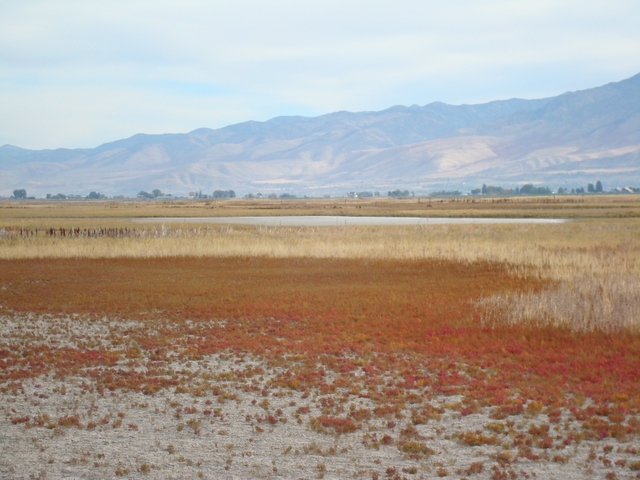
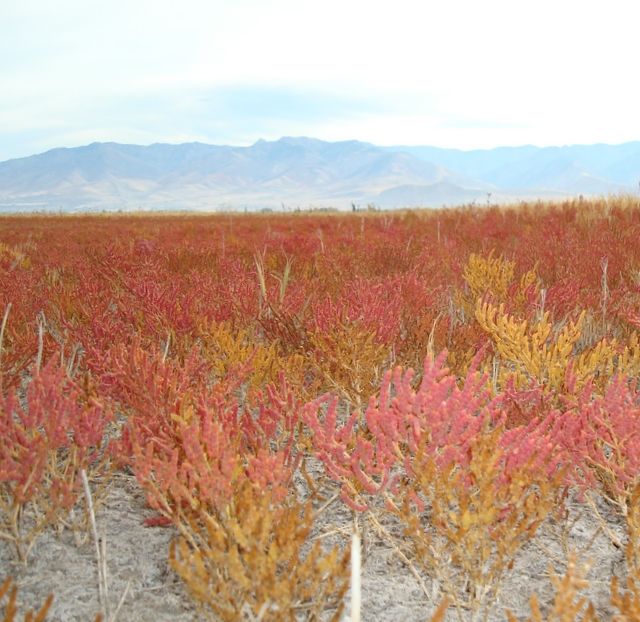
Utah’s mountains and foothills blaze with the brilliant foliar colors of aspens, maples, sumacs and more. But autumn colors can be found in less likely habitats too, even across our flat, desolate salt pans. There the usually drab stage has been given a splash of deep, dusty rose color by its sole botanical performers, the pickleweeds.

Also known as glassworts or samphire, our two species of pickleweed are in the genus Salicornia. They belong to the same plant family as beets, chard and spinach., but you’d never guess that from their appearance. The ankle-high Salicornia’s leaves are reduced to tiny scales that hug the green, branching, cylindrical stems. Pickleweeds are halophytic, or salt loving. Due to their unique physiology, they can thrive in extremely saline environments that kill normal plants. Pickleweed roots filter out some of the salt before it can move into the plant. The remaining excess salt is stored in balloon-like cavities in their cells called vacuoles. When its vacuole is full, a cell ruptures, and newer younger cells continue to accumulate incoming salt.

Click for a closer view of Pickleweed in Cache Valley, Courtesy and Copyright 2010 Linda Kervin
Pickleweed in Cache Valley
Courtesy & Copyright 2010 Linda Kervin

The common name, pickleweed, derives from the taste of the salt stored in the vacuoles of the succulent, crisp stems. You may be surprised to learn that gourmet websites report that pickleweeds are all the rage in Europe as a salad garnish or pickled vegetable.

[Kevin Colver recording: Songbirds of the Southwestern Canyon Country]

In the Great Basin, winter flocks of Horned Larks forage in the snow for Salicornia’s tiny oil-rich seeds as do other birds. The seeds’ proteins and oils are valuable dietary supplement in the sparse salt pan habitat where the picklweed’s unique physiological adaptations allow them to thrive. If your travels this fall take you by a salt pan, take the time to enjoy the rosy glow of the humble pickleweed or view pictures on the Wild About Utah website.

Click for a closer view of Pickleweed in Cache Valley, Courtesy and Copyright 2010 Linda Kervin
Pickleweed in Cache Valley
Courtesy & Copyright 2010 Linda Kervin

This is Linda Kervin for Bridgerland Audubon Society.
Credits:

Photos: Courtesy & Copyright Linda Kervin

Text: Jim Cane and Linda Kervin, Bridgerland Audubon Society

Additional Reading:

https://plants.usda.gov/java/profile?symbol=SALIC

https://en.wikipedia.org/wiki/Salicornia_oil

https://www.efloras.org/florataxon.aspx?flora_id=1&taxon_id=129055

https://people.westminstercollege.edu/faculty/tharrison/gslplaya99/pickleweed.htm

Encountering Cheatgrass

Encountering Cheatgrass: Click to view an article about cheatgrass, Cheatgrass Photo Courtesy NPS, Photographer Tom Heutte, USDA Forest Service, Bugwood.org
Cheatgrass
Photo Courtesy NPS, Photographer:
Tom Heutte, USDA Forest Service,
Bugwood.org

Click to view an article about cheatgrass, Photo Courtesy NPS, Neal Herbert, PhotographerA grassland inundated by cheatgrass
Photo Courtesy NPS
Neal Herbert, Photographer

Hi, this is Mark Larese-Casanova from the Utah Master Naturalist Program at Utah State University Extension.

It’s difficult to visit a landscape in the West without encountering cheatgrass. While cheatgrass’ small stature might make it hard to notice, it’s impossible to forget its sharp, spiny seeds. One hike through a cheatgrass meadow can render a good pair of socks unsalvageable.Encountering Cheatgrass

Although cheatgrass, a nonnative grass scientifically known as Bromus tectorum, is an annual grass- germinating, growing, producing seeds, and dying each year- it is particularly effective at colonizing disturbed areas because it grows and produces seeds much earlier in the spring than many perennial native grasses. Cheatgrass monopolizes water and nutrients by germinating and establishing itself during the previous fall and winter, when many native plants have become dormant. Over time, cheatgrass has become the dominant ground cover in many of Utah’s sagebrush ecosystems.

The dense, dry, fine stalks of cheatgrass, which sets seeds and dries out by June, are particularly flammable fuel for wildfires. Fire roars through the carpet-like cover of cheatgrass, and wildfires are now at least twice as frequent as they were in the 1800’s. This has caused a loss of sagebrush habitat that is particularly important to a wide diversity of wildlife. More frequent fires create an even greater challenge for rare species such as the black-footed ferret and desert tortoise to survive. Native grasses are slower to recover from fire, and cheatgrass is particularly effective at recolonizing burned areas. Utah State University researchers Dr. Peter Adler and Aldo Compagnoni have found that reduced snowpack and warmer temperatures promote the growth of cheatgrass, which could potentially increase its distribution and fire risk into previously colder areas of Utah.

Researchers and managers are continually working to find ways to control cheatgrass in Utah. Effective control usually involves a combination of mechanical pulling or tilling, grazing, burning, spraying with a chemical herbicide, and replanting with native grasses. USU researchers Dr Eugene Schupp and his former graduate student Jan Summerhays found that applying a pre-emergent herbicide to prevent the germination of cheatgrass seeds, as well as temporarily limiting Nitrogen in the soil, gave native grasses and perennials a better chance of establishing. When faced with such a large management problem in Utah and throughout the West, we can use all of the helpful tools we can get.

For Wild About Utah, I’m Mark Larese-Casanova.

Credits:

Images: Courtesy NPS, Neal Herbert Photographers
and NPS, USDA Forest Service, Bugwood.org, Tom Heutte Photographer
Text:     Mark Larese-Casanova, Utah Master Naturalist Program at Utah State University Extension.

Additional Reading:
Beck, George. Cheatgrass and Wildfire. Fact Sheet No. 6.310. Colorado State University Extension. https://www.ext.colostate.edu/pubs/natres/06310.html
Cheatgrass. Range Plants of Utah. https://extension.usu.edu/range/Grasses/cheatgrass.htm

Fairchild, John. Cheatgrass: threatening homes, stealing rangelands. Utah Division of Wildlife Resources. https://wildlife.utah.gov/watersheds/links/cheatgrass.php

Opsahl, Kevin. USU study: Climate shift could trigger cheatgrass. Herald Journal . October 21, 2012. https://news.hjnews.com/allaccess/article_f1436aee-1a3c-11e2-935a-0019bb2963f4.html

Forero, Leslie, Plants Surviving Cheatgrass Invasion May Improve Restoration Chances, Study Shows, UPR Utah Public Radio, Feb 26, 2018 https://www.upr.org/post/plants-surviving-cheatgrass-invasion-may-improve-restoration-chances-study-shows

Larese-Casanova, Mark, Cheatgrass, Wild About Utah, October 25, 2012 https://wildaboututah.org/cheatgrass/