American Invasion

Eurasian Collared Dove, Courtesy invasivespecies.org, Joy Viola, Northwestern University, Photographer
Eurasian Collared Dove
Streptopelia decaocto
Courtesy & © invasivespecies.org/bugwood.org
Joy Viola, Northwestern University, Photographer

Colorado Potato Bug, Courtesy insectimages.org/bugwood.org, USDA ARS, PhotographerColorado Potato Beetle Adult
Leptinotarsa decemlineata
Courtesy IPMimages.org/bugwood.org
USDA ARS, Photographer

Hi, I’m Holly Strand from the Quinney College of Natural Resources at Utah State University.

More and more you are likely to hear this sound in Utah yards, parks and fields. [Eurasian Collared Dove, Courtesy Ryan O’Donnell, www.xeno-canto.org/98068] That’s the call of the Eurasian collared dove. Originally from Asia, this dove has been expanding its territory around the world at an incredible rate. The first sighting in Utah was in Orem in 1997. And now the doves are everywhere. So far, it doesn’t look like our native mourning dove is affected. But such rapid population explosions rarely occur without some sort of undesirable ecological consequence.

In America, the Eurasian collared dove is an invasive species. But not all non-native species are invasive. “Invasive” only applies when species spread far beyond the area where they are first introduced. Luckily, not all invasive species turn out to be serious pests. Ecologist Mark Williamson suggested the tens rule. About 10% of introduced species establish lasting populations and 10% of those go on to become problems.

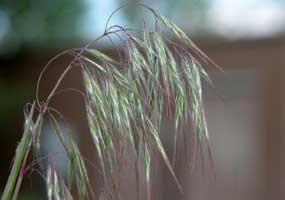
There’s a long list of Eurasian invasives in Utah. Among them is the highly flammable cheat grass that comes from southwestern Asia. Those massive clouds of starlings? They come from Europe. Tamarisk from Eurasian deserts lines the Colorado River and tributaries. The common carp is an unwelcome Eurasian colonist of our lakes and large rivers. And the American west’s iconic tumbleweed is an invader from the Russian steppe.

Why so many invaders from Eurasia? Well for the last 500 years, there has been a net outflow of Eurasians—especially Europeans—to other parts of the world. And this human population carried its biological baggage along with it—in the form of animals, plants and diseases. Some ecologists believe that the physical geography and human history of Eurasia has conditioned its species in such a way that they will consistently outcompete the species of other continents. But that’s debatable. For in the last decades the New World has started to lob some pretty competitive species over to Eurasia.

For example, the American mink was brought to the Eurasian continent in the 1920s for use on fur farms. But–because of deliberate releases and accidental escapes–the mink is now common in the European wild. And it’s a pest. The American mink is taking the place of the European mink which is now threatened with extinction. Furthermore, the American mink is gobbling up populations of many ground-nesting birds.

Unless you are involved in agriculture, you might not have heard of the Colorado potato beetle. But potato growers around the globe know this striped orange and brown beetle from the American southwest very well. It has a voracious appetite for potato leaves and quickly develops resistance to any chemicals used against it.

And a final example: the American bullfrog is considered one of the world’s most damaging invasives. The bullfrog does amazingly well in a variety of habitats –even artificial ones like millponds, irrigation ditches and reservoirs. Its incredible adaptability helps it spread and outcompete native frogs. Moreover, it has been transmitting a deadly fungus to previously unaffected populations of frogs, toads and salamanders.

Thanks to Lyle Bingham for information on the Eurasian collared dove. And to Ryan ODonnell for his audio recording from xeno-canto.org. For more information on the Eurasian collared dove and other invasive species go to www.wildaboututah.org.

For Wild About Utah, and the Quinney College of Natural Resouces, I’m Holly Strand.

Credits:

Theme: Courtesy & Copyright Don Anderson Leaping Lulu
1. Photographer Joy Viola, Northwestern University, Bugwood.org https://www.invasive.org/browse/detail.cfm?imgnum=5413582
2. USDA ARS Photo Unit, USDA Agricultural Research Service, Bugwood. https://www.insectimages.org/browse/detail.cfm?imgnum=1321015

Audio of Eurasian collared dove:
Ryan P. O’Donnell, XC98068. Accessible at www.xeno-canto.org/98068.
Creative Commons Attribution-NonCommercial-NoDerivs 2.5

Text & Voice: Stokes Nature Center: Holly Strand

Sources & Additional Reading:

Bingham, Lyle. 2009. The New Dove in the Neighborhood. Wild About Utah Program https://wildaboututah.org/the-new-dove-in-the-neighborhood/ October 8, 2009.

di Castri F. 1989. History of biological invasions with special emphasis on the Old World. In: Drake JA, Mooney HA, di CastriF, Groves RH, Kruger FJ, Rejma´nek M, Williamson M, eds. Biological invasions: a global perspective. Chichester, UK: John Wiley and Sons.

European Environment Agency, 2012. The impacts of invasive alien species in Europe EEA Technical report No. 16/2012. EEA, Copenhagen.

National Invasive Species Information Center (NISIC): Gateway to invasive species information; covering Federal, State, local, and international sources.
https://www.invasivespeciesinfo.gov/index.shtml

Simberloff, Daniel. 2013. Invasive Species: What Everyone Needs to Know. Oxford University Press

Wind and Sagebrush

Wind and Sagebrush

Wind and Sagebrush: Mountain big sagebrush (Artemisia tridentata subsp. Vaseyana) in flower - Photo Courtesy and Copyright Dr. Leila Shultz
Mountain big sagebrush (Artemisia tridentata subsp. Vaseyana) in flower – Photo Courtesy and Copyright Dr. Leila Shultz

Wind and Sagebrush:Three-tip sage (Artemisia tripartite) with visible yellow flowers. - Photo Courtesy and Copyright Dr. Leila ShultzThree-tip sage (Artemisia tripartite) with visible yellow flowers. – Photo Courtesy and Copyright Dr. Leila Shultz

Hi, I’m Holly Strand of the Quinney College of Natural Resources at Utah State University.

By late summer, most of Utah’s flowering plants have fizzled out for the year—those that remain are looking pretty spent. But not true for the sagebrush. It’s show time for over 20 types of sagebrush of the Intermountain West.

Like grasses and conifers, sagebrush plants are pollinated by the wind. They have no need for the specialized traits designed to attract live pollinators. Instead, they have evolved other strategies to survive and multiply.

For instance, wind-pollinated plants don’t need showy, colorful petals to attract insects or birds. The wind is going to do its job anyway regardless of visual cues. Thus sagebrush flowers are very small and nondescript. In fact, when passing by flowering sagebrush you might not even notice that it’s in bloom. Look for long spikes with clusters of tiny flower heads. The pale yellow flowers are concealed by petal-like bracts, which are the very same color as the rest of the plant.

While the flowers of sagebrush lack in beauty, they make up in quantity. A single flowering stem of the most common sagebrush—known simply as big sagebrush–can hold hundreds of flower heads that produce a massive amount of pollen. Most wind-blown pollen grains won’t end up anywhere near the female part of another plant. So to make up for this risky method of fertilization, individual plants must produce greater volumes of pollen. In contrast, plants with live pollinators get door to door service during fertilization. Far less pollen is needed to get the same job done.

Scent is another way for plants to attract live pollinators. Species pollinated by bees and flies have sweet scents, whereas those pollinated by beetles have strong musty, spicy, or fruity odors. However, the iconic western scent of the sagebrush has absolutely nothing to do with pollination. Instead, the pungent aroma of the sagebrush is a by-product of certain chemicals produced in the leaves. These chemicals evolved to repel animals and to reduce the odds of being eaten or grazed.

The chemicals—bitter terpenes, camphors and other secondary compounds–—peak in early spring. But as the late-summer flowering period approaches, the chemicals start to break down. By winter, browsers like deer and elk can nibble on the protein-rich seed heads without getting a nasty aftertaste.

Thanks to botanist Leila Shultz for sharing her knowledge of sagebrush. For a link to the online version of Leila’s book Pocket Guide to Sagebrush, go to www.wildaboututah.org
If you’d like a hard copy of this Pocket Guide, send an email to wildaboututah@gmail.com We have 5 copies to give away to listeners from across the state.

For Wild About Utah and the Quinney College of Natural Resources, I’m Holly Strand.

NOTE: The copies are gone. You can view the book as a .pdf here or check here for the next printing from https://www.sagestep.org/pubs/brushguide.html.

Credits:

Photo Courtesy & Copyright 2007 Dr. Leila Shultz
Text: Holly Strand, Quinney College of Natural Resources at Utah State University

Additional Reading:

Dudareva, Natalia. 2005. Why do flowers have scents? Scientific American April 18. https://www.scientificamerican.com/article/why-do-flowers-have-scent/

Shultz, Leila. 2012. Pocket Guide to Sagebrush. PRBO Conservation Science. https://digitalcommons.usu.edu/sagestep_reports/20/
As pdf: https://rdjzr2agvvkijm6n3b66365n-wpengine.netdna-ssl.com/wp-content/uploads/2018/06/sagebrush_pock_guide_reduced.pdf

Shultz, L. M. 2006. The Genus Artemisia (Asteraceae: Anthemideae). In The Flora of North America north of Mexico, vol. 19: Asterales, pp. 503–534. Flora of North America Editorial Committee, eds. Oxford University Press. New York and Oxford.

USDA, NRCS. 2012. The PLANTS Database, National Plant Data Team, United States Department of Agriculture (USDA), Natural Resource Conservation Service (NRCS): https://www.plants.usda.gov

VanBuren, R., J. C. Cooper, L. M. Shultz and K. T. Harper. 2011. Woody Plants of Utah. Utah State University Press & Univ. Colorado. 513 pp. https://upcolorado.com/utah-state-university-press/woody-plants-of-utah

Cryptobiotic Soil Crusts

Click to view larger image of Cryptobiotic Soil Crust, Photo Courtesy and Copyright Mark Larese-Casanova
Cryptobiotic Soil Crust
Photo Courtesy & Copyright 2009
Mark Larese-Casanova

Hi, this is Mark Larese-Casanova from the Utah Master Naturalist Program at Utah State University Extension.

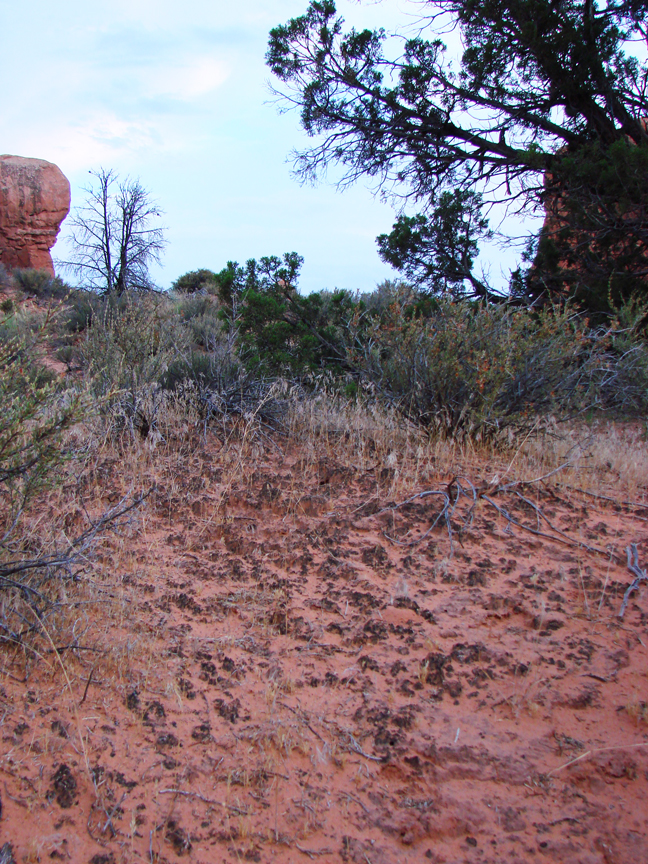
Looking out over a Utah desert, we might see relatively few plants- perhaps some sagebrush, maybe a few junipers or Joshua trees, or even some small wildflowers or cacti. What is less noticeable, though, is the living soil crust that holds this entire landscape together. It’s not just sand, but rather an important and vast partnership between bacteria, lichens, algae, and fungi. These soil crusts are often referred to as ‘cryptobiotic’, which means ‘living in suspended animation’. This is a fitting description, considering that water can be so rare in Utah’s deserts.

Cyanobacteria, which is often called blue-green algae, is the backbone of cryptobiotic soil crust. Vast networks of long, microscopic filaments of cyanobacteria and fungi grow in length when they are wet, and leave behind a casing that literally binds the soil together. So, what might otherwise be loose sand not only is less likely to be washed away by water or blown away by wind, but also is able to hold much more water for plants.

Click to view larger image of Cryptobiotic Soil Crust, Photo Courtesy and Copyright Mark Larese-Casanova
Cryptobiotic Soil Crust
Photo Courtesy & Copyright 2009
Mark Larese-Casanova

Cyanobacteria is also extremely useful to desert landscapes for its ability to take Nitrogen out of the air and make it available to plant roots in the soil. Desert soils typically have relatively low nutrients, so this is especially important to desert plants.

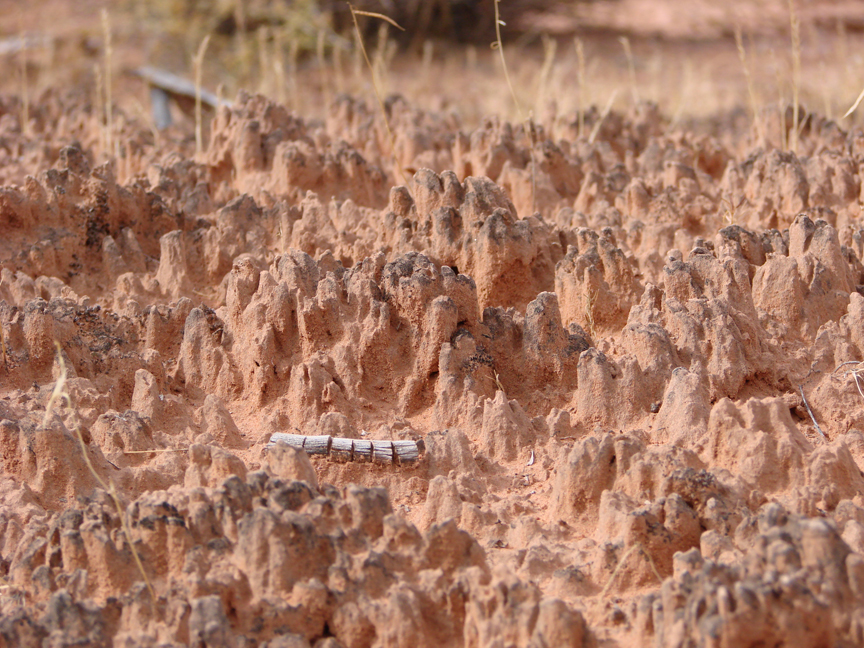
In many Utah deserts, cryptobiotic soil crusts can cover up to 70% of the ground surface. Old soil crust can often look like small mountain ranges with black or white peaks inhabited by lichens or mosses. The little valleys in between the tiny mountains of crust are perfect spots for the seeds of desert plants to grow. Over time, the above ground crust can grow up to ten centimeters, or four inches, thick!

However, cryptobiotic soil crust grows at an alarmingly slow rate of about one millimeter per year. So, any soil crust that is disturbed can take a very long time to recover. Depending on the amount of moisture a desert receives, it can take anywhere between 20 and 250 years for soil crust to grow back.

Next time you’re out in the desert, kneel down and have a close look at the telltale peaks and valleys of cryptobiotic soil crust. If you bring a magnifying glass, you just might be able to see some of the lichens and mosses. Be sure to stay on trail, though, and whatever you do, don’t bust that crust!

For Wild About Utah, I’m Mark Larese-Casanova.

Credits:

Images: Courtesy and copyright Mark Larese-Casanova
Text:     Mark Larese-Casanova, Utah Master Naturalist Program at Utah State University Extension.
Additional Reading:

US Department of Interior. 2001. Biological Soil Crusts: Ecology and Management. Bureau of Land Management Technical Reference 1730-2., https://www.blm.gov/nstc/library/pdf/CrustManual.pdf
Rosentreter, R., M. Bowker, and J. Belnap. 2007. A Field Guide to Biological Soil Crusts of Western U.S. Drylands. U.S. Government Printing Office, Denver, Colorado., https://www.soilcrust.org/

Gardening for Hummingbirds

Gardening for Hummingbirds

Gardening for Hummingbirds: Heuchera, hummingbird host. Courtesy and copyright Jim Cane, Photographer
Huechera
Courtesy & © Jim Cane, Photographer

 
Gardening for Hummingbirds: Penstemon hummingbird host Courtesy & © Jim Cane, PhotographerPenstemon eatonii
Courtesy & © Jim Cane, Photographer

 
At long last, summer has returned as have the hummingbirds who zip around my garden, visiting flowers and chasing off intruders. (Kevin Colver: Songbirds of Rocky Mountain Foothills. Broad-tailed Hummingbird) Hummingbirds are a delight in the yard and so we plant flowers specifically to attract and feed them. In general, hummingbirds prefer long tubular flowers especially those that are red, orange or violet. But not all these flowers are created equally.Gardening for Hummingbirds

Hummingbirds visit flowers for their nectar which fuels their flight. Their long tongue reaches well beyond the tip of their needle like bill when they lap up nectar; capillary action then draws the sweet liquid up tiny grooves along the length of the tongue.

Floral nectar evolved to attract potential pollinators. The floral nectary is generally found inside the flower, at the base. When probing for nectar, floral visitors brush by the reproductive structures. Pollen adheres to parts of their body and then at the next flower of the same species, some pollen sticks to the female stigma. This transfer is pollination.

Many nectar-rich flowers grow well in Utah gardens. In the xeric garden, Penstemons are a good choice, as are Red Hot Pokers and Zauschneria, sometimes called Hummingbird Trumpet. In more moist sites, red flowered Heuchera is popular. Some red flowered cacti and Trumpet Creeper are good choices, as are Agastache and many Salvias.

Watch which flowers hummers visit. They will check out many blooms, but the ones they routinely return to are the ones yielding generous nectar. Many flowers produce little or no nectar, including some that look to us like good hummingbird flowers. Also, many horticultural hybrids and doubled flowers produce paltry amounts of nectar.

To encourage hummingbirds to remain in your garden, you can grow trees and shrubs for cover. Nectar is only part of their diet. For protein, they regularly eat insects and spiders small enough for their tiny bill so a garden free of insects is not desirable. They also appreciate a place to perch where they can digest, wait for a tasty insect to fly by and keep an eye out for potential rivals. So grab your trowel and lets feed those hummers.(Kevin Cover: Songbirds of Rocky Mountain Foothills. Broad-tailed Hummingbird)

This is Linda Kervin for Bridgerland Audubon Society.

Credits:

Images: Courtesy and Copyright Jim Cane, Photographer
Theme: Courtesy & Copyright Don Anderson as performed by Leaping Lulu
Text & Voice: Linda Kervin, Bridgerland Audubon Society

Additional Reading:

Linda Kervin’s pieces on Wild About Utah

Hummingbirds and How to Attract Them, Washington Department of Fish & Wildlife, https://wdfw.wa.gov/living/hummingbirds/

Hummingbirds 101, The Hummingbird Society, https://www.hummingbirdsociety.org/hummingbirds-101/

Coro Arizmendi Arriaga, Maria del, Hummingbirds of
Mexico and North America, In Spanish and English, CONABIO, 2014, https://www.biodiversidad.gob.mx/Difusion/pdf/colibries_mexico_y_norteamerica.pdf

Gardening for Hummingbirds