To Grow Your Own Bird Food, Native Plants Are Key!

Native Plants Are Key: Black-chinned Hummingbird, Archilochus alexandri Courtesy US FWS, Alan Schmierer, Photographer
Hummingbirds Eat Insects
and Drink Nectar From Flowers
Black-chinned Hummingbird
Archilochus alexandri
Courtesy US FWS, Alan Schmierer, Photographer
Did you know that hummingbirds eat aphids and mosquitoes?Native Plants Are Key
When we think about landscaping for the birds we might think of the National Wildlife Federation guidelines to include food, water, shelter and places to raise young, but chances are the foods we think of first are berries, nuts, and seeds, when in fact the single most important food to ensure the survival of songbirds are the insects hosted by native plants. The Bridgerland Audubon Society website includes a wealth of resources on many aspects of Bird_Friendly Living, not least of which native plants for Utah gardens.

Douglas Tallamy’s website “Bringing Nature Home” states that most songbirds need insect protein for their young, and the top plant species that host the caterpillars birds need are oak, cherry and willow. Just one of many plants to share with birds is the Chokecherry, preferably with green leaves, as the red-leafed cultivars are not attractive to insects. Chokecherry fruits are great for people and birds, and the leaves will host insects for baby birds. Remember, those little hummingbirds aren’t just sipping nectar and pollinating flowers, they’re eating aphids and mosquitoes, serving an important pest management role in your garden!

I will now read the Mayor’s Proclamation to Grow Native for Birds, a timeless summary of the reasons to err toward native plants:

Proclamation To Grow Native For Birds:

Whereas, growing native plant communities in our residential, municipal and commercial landscapes promotes and enhances our sense of place; and Whereas, increased awareness and use of native plants is fundamental to water conservation, water quality, habitat preservation and successful gardening; and

Whereas, gardens and landscapes composed of Utah’s native plants require little or no fertilizers, soil amendments, or pesticides; and

Whereas, using firewise plants native in our landscape is often the safest option; and

Whereas, landscaping choices have meaningful effects on the native insects that bird populations need to survive; and

Whereas, a diversity of birds is indicative of a healthy ecosystem, including biological control of pests, carrion regulation, seed dispersal, and nutrient cycling; and
Whereas, birdwatching can be a fun, relaxing, multigenerational, educational family wellness activity;

Now, Therefore, we do hereby declare this Proclamation to Grow Native for Birds and encourage everyone to actively foster and support the use of Utah native plants in their gardens and landscapes.

I’m Hilary Shughart with the Bridgerland Audubon Society, and I’m Wild About Utah

Credits:
Photo: Courtesy US FWS, Alan Schmierer, Photographer, https://images.fws.gov/
Featured Audio: Courtesy & Copyright © Kevin Colver, https://wildstore.wildsanctuary.com/collections/special-collections/kevin-colver
Text: Hilary Shughart, President, https://bridgerlandaudubon.org/
Additional Reading: Hilary Shughart and Lyle Bingham, https://bridgerlandaudubon.org/

Additional Reading

Grow Native For Birds Project, Bridgerland Audubon Society, https://bridgerlandaudubon.org/our-projects/grow-native-for-birds/

Logan, UT Mayor Holly Daines, Proclamation to Grow Native for Birds,
Facebook Live, https://www.facebook.com/watch/?v=2627914670831507
Text: https://bridgerlandaudubon.org/wp-content/uploads/2020/04/Proclamation.pdf

Grow Native For Birds, Bridgerland Audubon Society, https://bridgerlandaudubon.org/our-projects/grow-native-for-birds/

Liberatore, Andrea, Grow Native!, Wild About Utah, June 9, 2011, https://wildaboututah.org/grow-native/

Hellstern, Ron, Attracting Birds and Butterflies to Your Yard, Wild About Utah, May 28, 2018, https://wildaboututah.org/attracting-birds-and-butterflies-to-your-yard/

Hellstern, Ron, Build a Certified Wildlife Habitat at Home, Wild About Utah, Jul 17, 2017, https://wildaboututah.org/build-community-wildlife-habitats/

National Audubon Native Plant Finder, Coleman and Susan Burke Center for Native Plants, Audubon.org, https://www.audubon.org/plantsforbirds


Native Plants For Birds, National Audubon Society
Nov 20, 2017

Cane, James, Gardening for Native Bees in Utah and Beyond, (includes a flowering calendar for cultivated bee plants), https://extension.usu.edu/files/publications/factsheet/plants-pollinators09.pdf

RESOURCES: Water-Wise and Native Plants, Center for Water Efficient Landscaping, Utah State University Extension, https://cwel.usu.edu/plants

Kuhns, MIchael, Are Native Trees Always the Best Choices?, Forestry, Utah State University Extension, https://forestry.usu.edu/trees-cities-towns/tree-selection/native-trees

Creating Landscapes for Wildlife… A Guide for Backyards in Utah, Written by Sue Nordstrom and Illustrated by Kathlyn Collins Department of Landscape Architecture and Environmental Planning, Utah State University with Margy Halpin, Utah Division of Wildlife Resources; Second Printing 2001,
Updated for the Utah Division of Wildlife Resources, by Frank Howe, DWR Avian coordinator; Ben Franklin, DWR–Utah Natural Heritage Program botanist; Randy Brudnicki, DWR publications editor; and landscape planning illustrations by Stephanie Duer.,
Published by:
State of Utah Natural Resources, Division of Wildlife Resources,
Utah State University Cooperative Extension Service and
Utah State University Department of Landscape Architecture and Environmental Planning;
1991 updated 8/2025 https://wildlife.utah.gov/pdf/landscapingforwildlife.pdf

Handbook on Riparian Restoration, Utah Division of Wildlife Resources, Utah Department of Natural Resources, State of Utah, https://wildlife.utah.gov/pdf/riparian.pdf

Kirchner, Jane, Meet the Squad of Mosquito-Eating Species, National Wildlife Federation, August 24, 2020, https://blog.nwf.org/2020/08/meet-the-squad-of-mosquito-eating-species/

A Questionably Lodgepole Pine

A Questionably Lodgepole Pine: Lodgepole Pine stand Yellowstone Collection Courtesy US National Parks Service, Bob Stevensoon, Photographer October 27, 1988
Lodgepole Pine stand
Yellowstone Collection
Courtesy US National Parks Service,
Bob Stevensoon, Photographer
October 27, 1988
Sometimes I have a hard time coming up with fun or fancy things to say for the radio. It’s just a thing that happens. A Questionably Lodgepole Pine

When that happens, sometimes I’ll just go outside and pick something happening around me, or something I think of when outside and write about that. Sometimes or almost always, creativity for me is not clean-cut. It can be kinda formulaic: talk about things you see, feel, and think in a way that hopefully helps folks balance listening, their imagination, and hopefully hope all at the same time. It’s at least an ideal.

But sometimes instead what comes out when you’re outdoors, is stuff that is kinda dumb and pretty funny. Truth be told, I prefer dumb funny things. I think stuff that is funny is better than stuff that isn’t funny. Funny stuff is fun.

And so, here’s me sitting in a big gold puffy coat and well-napkined Carhartts in a foldable lawn chair under gray winter sky, and jack is happening around me. No birds tweeting. No fresh tracks. Not even no dim ray of sunshine. Just hands as cold as cold hands can be. Then I see a dead skyward and questionably lodgepole pine. I thought it could maybe have a second life as a flagpole, the name I thought it could be and all. And then I wondered…

If trees wove a flag
What color would they fly
Regardless I doubt they’d much care if it was green
Beings they’ve got no eyes

No eyes no ears no tongue no nose
Not even fully developed human hands which spring from their roots so

And then I thought…

If ducks could sing opera
Like dark Verdi arias
I think they’d quack less good
But dig in no less mud

No lips no fur lays eggs webbed toes
Brains like walnuts, only knows where south goes

And then…

If clouds could pick
What unit of measure that they preferred
I’d reckon volume’d be tricky
Be hard to pin down where the mass does now occur

No lungs no feet bring snow turns sleet
Don’t even got clocks to keep time.

And that’s where it ended. Stream ran Utah dry. And that’s ok.

And even though when I read what I wrote to my partner she gave me that look of, “you sure?” I couldn’t help but think, “yup!” so I laughed and smiled wide.

So here’s me saying to you that sometimes, when you go looking for inspiration about the world from that old all-about-us well that is the world, don’t turn up your nose on silly things. Funny things that pop into your mind, even if they are dumb. Because once, someone probably thought something wild and dumb that ended up being kind of neat. Or something that they thought about. And who knows, maybe one day we’ll have to ask ourselves again…

If trees wove a flag
What color would they fly?
Would they measure it in cubits,
Or some other unit from the sky?

I’m Patrick Kelly, and I’m Wild About Utah.
 
Credits:

Images: Image Courtesy US National Park Service, Yellowstone Collection, Bob Stevensoon, Photographer https://www.nps.gov/features/yell/slidefile/plants/conifers/pine/Page-3.htm
Audio: Contains audio Courtesy & Copyright Kevin Colver https://wildstore.wildsanctuary.com/collections/special-collections
Text:    Patrick Kelly, Director of Education, Stokes Nature Center, https://logannature.org/
Included Links: Lyle Bingham, Webmaster, WildAboutUtah.org

Additional Reading

McNally, Catherine, How to Cure Writer’s Block: Go Green, Medium, October 7, 2019, https://medium.com/@catherine.mcnally/how-to-cure-writers-block-go-green-e0c00e8e614

Lodgepole Pine, Range Plants of Utah, Utah State University Extension, https://extension.usu.edu/rangeplants/shrubs-and-trees/LodgepolePine


Native Plants for Birds

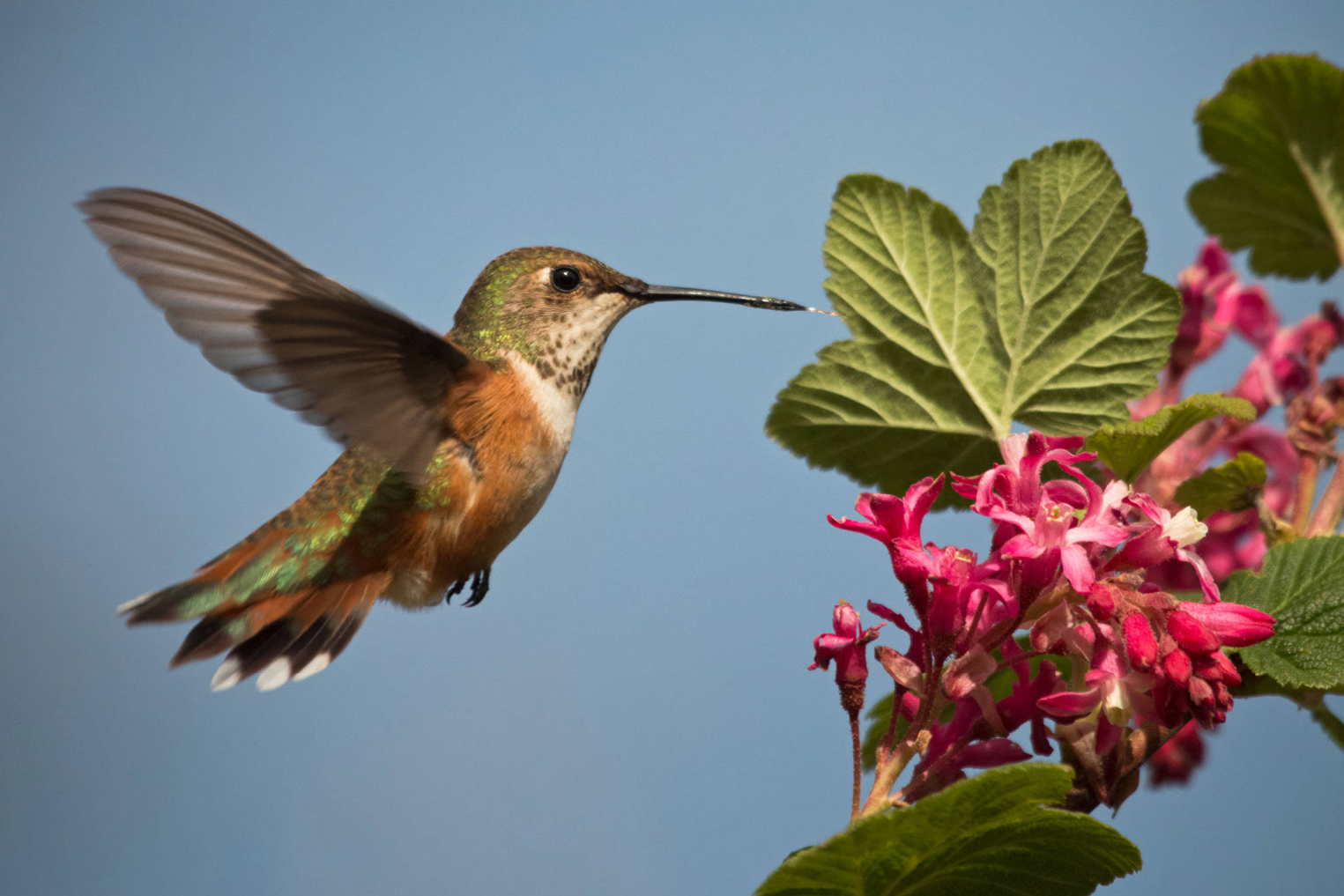
Native Plants for Birds: Female Rufous Hummingbird(Selasphorus rufus) on Red Flowering Current(Ribes sanguineum) Courtesy US FWS, Peter Pearsall, Photographer
Female Rufous Hummingbird(Selasphorus rufus) on Red Flowering Current(Ribes sanguineum)
Courtesy US FWS, Peter Pearsall, Photographer
When we are hungry, we head for the kitchen. When birds are hungry they head for plants. Native plants, in particular provide important sources of food for birds and other wildlife.

Native plants play an important role in an ecosystem, providing the best habitat for wildlife. They are species of plants that have grown naturally in an area and thrive in an environment that matches the soils, moisture, and weather of a particular locality.

Arrowleaf Balsamroot Hyde Park, UT Courtesy & Copyright Linda L'Ai
Arrowleaf Balsamroot
Hyde Park, UT
Courtesy & Copyright Linda L’Ai
There are mutually beneficial connections for plants and birds that have evolved together. Native plants are a veritable market place for birds offering them nuts, seeds, fruits, nectar, and tasty bugs. They have an important influence on a bird’s diet, feeding habits, and even migration patterns. And as birds feed on the local fare they spread pollen and seeds.

This data gathered by Audubon’s Plants for Birds Program supports the planting of native species whenever possible.

  • 96% of land birds feed insects to their chicks.
  • Native oak trees host over 530 species of caterpillars while non-native ginkgo trees host just 4.
  • To raise one nest of chickadee babies, parents must gather between 6,000 and 9,000 caterpillars.
  • Suburban yards planted with native species host 8 times more native birds.

Birds shape their migration patterns around native plants. Plants that produce fleshy fruit duirng the late summer and fall provide birds with the energy needed for long migrations.

Urbanization has resulted in a threat to native plants. According to Audubon, the continental United States has lost over 150 million acres of native habitat due to urban sprawl. Fragmentation of native plant habitat is believed to be due to the construction of cities, roads and river flow reservoirs. All of these, combined with a changing climate’s impact on timing of insect hatching and flowers opening, present many challenges to our birds.

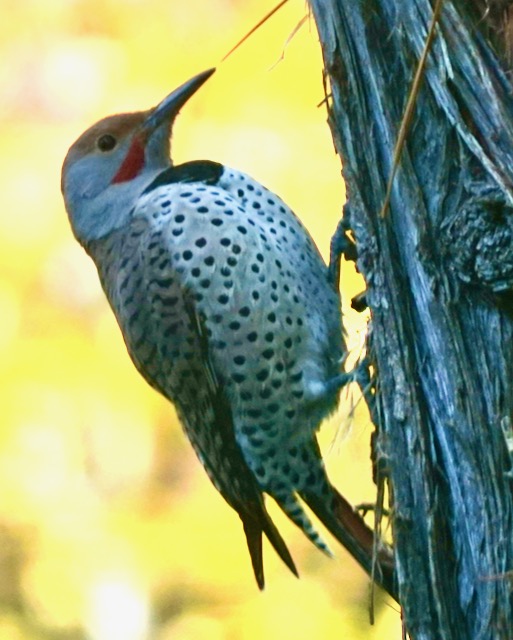
Northern Flicker Courtesy & Copyright Linda L'Ai
Northern Flicker
Courtesy & Copyright Linda L’Ai
You can help improve the connection between native plants and birds by adding native plants to your landscape. The native plants database developed by Audubon provides users with customized lists of native plants specific to your area, as well as the steps needed to evaluate which plants will find success in your soil. You can find the website at Audubon.org/plantsforbirds.  It’s as easy as putting in the area code, then clicking search. There are over 40 native plants listed for the Cache Valley area.

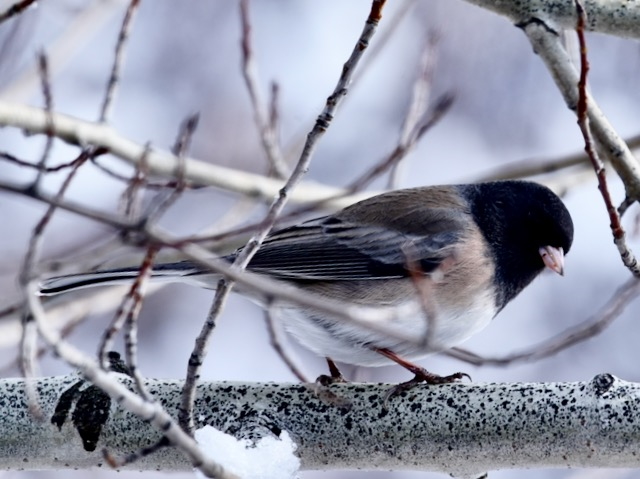
Dark-eyed Junco Courtesy & Copyright Linda L'Ai
Dark-eyed Junco
Courtesy & Copyright Linda L’Ai
Finches, sparrows, and chickadees are common birds to our area and are attracted to the seeds of the common sunflower.

The Wild plum, provides fleshy fruit for sparrows and chickadees and insects for woodpeckers.

Milkweeds attract hummingbirds and insect pollinators and serve as larval hosts for Monarch Butterflies.

Growing native plants is something we all can do in our yards or in the community to help bird populations increase now and in the future. Consider this: native plants that are adapted to the local region require less water, fertilizers and no pesticides.

Check out Audubon.org/plantsforbirds to find out more.
If you really dig birds, try digging native plants into your garden!

I’m Linda L’Ai with the Bridgerland Audubon Society, and I’m Wild About Utah!

Credits:

Photos: Courtesy US FWS, Peter Pearsall, Photographer, https://images.fws.gov/
Audio: Courtesy and Copyright Kevin Colver https://wildstore.wildsanctuary.com/collections/special-collections/kevin-colver
Text: Linda L’Ai, Bridgerland Audubon Society
Additional Reading: Lyle Bingham & Hilary Shughart, Bridgerland Audubon Society

Additional Reading

Grow Native For Birds, Bridgerland Audubon, https://bridgerlandaudubon.org/our-projects/grow-native-for-birds/

Plants For Birds, The Coleman and Susan Burke Center for Native Plants, National Audubon Society, https://www.audubon.org/plantsforbirds
“Plants for Birds,” National Audubon, https://vimeo.com/163864388

Native Plants for the Utah Landscape, Center for Water-Efficient Landscaping, Utah State University Extension, https://cwel.usu.edu/native-other

Native Plants, The Coleman and Susan Burke Center for Native Plants, National Audubon Society, https://www.audubon.org/native-plants/

Native Plant List-Utah and Western Colorado, PlantNative, Portland, OR, https://www.plantnative.org/rpl-ut.htm?fbclid=IwAR1nnlQUQ680x_SpwrKH_Fvtt2J2mtF7cqwZeUW8XAzzvlObs4K-kMPMIg0

Utah Native Plant Society, https://www.unps.org/

Tallamy, Doug, Sustainable Landscaping, Research, University of Delaware, May 2, 2013, 2.26 min, https://youtu.be/NTbPNwNIoLs

Tallamy, Doug, Eierman, Kim, EcoBeneficial Interview: Dr. Doug Tallamy In His Garden on the Importance of Native Plants, EcoBeneficial!, Nov 22, 2013, 29:30 min https://www.youtube.com/watch?v=w39g_f7BMUk


Native Grasses

Native Grasses: Indian Ricegrass Achnatherum hymenoides Courtesy Wikimedia & US NRCS
Indian Ricegrass
Achnatherum hymenoides
Courtesy Wikimedia
& US NRCS
In recent years, there has been an emphasis on ornamental landscape plants that provide bee and butterfly habitat. But did you know that you can also choose landscape plants to support Utah birds and other wildlife? In particular, ornamental grasses can provide both food and cover for birds and other wildlife and also materials for nest building.

A few ornamental grasses that you might consider planting in your landscape are Indian rice grass, blue grama grass, little bluestem, Indiangrass, and Miscanthus.

One of the most attractive native grasses, and the state grass of Utah, is Indian rice grass. This native, cool-season grass grows from 1 to 2 ½ feet tall. Widely adapted in Utah, it is important in foothill and semi-desert areas of the state, providing forage for both livestock and wildlife throughout the year. It has a lovely, airy texture and the seeds are an important food source for many birds and small mammals.

Blue grama grass, also native to Utah, is a warm-season grass with seed stalks standing 6 to 20 inches tall. In the wild areas of Utah, blue grama grass grows on plains, foothills and woodlands and tolerates a variety of soil conditions. In home landscapes, the distinctive seed heads of blue grama are very attractive and are sometimes described as resembling eyebrows.

Little bluestem, a warm-season perennial grass, grows from 1 to 2 feet tall. This drought-tolerant, native grass grows in many Utah plant communities including desert shrub, ponderosa pine, and pinyon-juniper. In ornamental landscapes, little bluestem transitions from blue/green colored grass blades during the growing season to a reddish color after the first frost, providing lots of winter interest in the landscape as well as food and cover for birds.

Indiangrass is a native, warm-season perennial grass with tufted stems reaching up to 5 feet tall. This grass is found in the hanging garden plant communities of southern Utah where annual rainfall is low but flooding from runoff water is common. It may also be associated with other riparian plants such as sedges, rushes, and willows. A tall, upright grass, Indiangrass has showy, golden bronze seed heads in the fall that provide seed for songbirds.

Though not native to Utah, Miscanthus is another ornamental grass that provides food for birds. This large grass, growing up to 6 feet tall, has flower plumes above the foliage in the fall and you may see birds searching the ground underneath throughout the winter looking for leftover seeds.

Hopefully you have one or more of these grasses in your landscape already, but if not, fall is still a good time to plant them. And don’t cut these grasses back as we head into the colder months of the year. They provide a great deal of color and interest to the winter landscape and will continue to provide food and cover for birds and wildlife throughout the season.

As our weather warms into spring, birds will be particularly focused on the dried-out grass blades that remain, using coarse blades for the main wall of nests and finer blades as part of the softer, inner lining.

So, go ahead and try some ornamental grasses in your home landscape or maybe plant more. You’ll be well on your way to attracting and supporting birds and other wildlife.

I’m Kelly Kopp with USU Extension’s Center for Water Efficient Landscaping and I’m Wild About Utah.

Credits:

Images: Courtesy & Copyright , Photographer
Audio: Courtesy & © Kevin Colver https://wildstore.wildsanctuary.com/
Text:     Kelly Kopp, PhD, Plants, Soils & Climate, Utah State University https://psc.usu.edu/directory/faculty/kopp-kelly
Additional Reading Links: Lyle Bingham

Additional Reading:

Lady Bird Johnson Wildflower Center:
Indian ricegrass, Plant Database, Lady Bird Johnson Wildflower Center, https://www.wildflower.org/plants/result.php?id_plant=achy

Blue Gamma, Plant Database, Lady Bird Johnson Wildflower Center, https://www.wildflower.org/plants/result.php?id_plant=bogr2

Little bluestem, Plant Database, Lady Bird Johnson Wildflower Center, https://www.wildflower.org/plants/result.php?id_plant=SCSC

Indiangrass, Plant Database, Lady Bird Johnson Wildflower Center, https://www.wildflower.org/plants/result.php?id_plant=sonu2

Missouri Botanical Garden
Miscanthus, Missouri Botanical Garden, https://www.missouribotanicalgarden.org/PlantFinder/PlantFinderDetails.aspx?taxonid=250962&isprofile=1&basic=miscanthus

Miscanthus, Plant Finder, Missouri Botanical Garden, https://www.missouribotanicalgarden.org/PlantFinder/PlantFinderProfileResults.aspx?basic=miscanthus

Morton Arboretum
https://www.mortonarb.org/trees-plants/tree-plant-descriptions/chinese-silver-grass

Miscanthus sinensis, The Morton Arboretum, https://www.mortonarb.org/trees-plants/tree-plant-descriptions/chinese-silver-grass

USU Extension Range Plants of Utah
Indiangrass, Range Plants of Utah, Utah State University Extension, 2017, Indiangrass

Little bluestem, Range Plants of Utah, Utah State University Extension, 2017, https://extension.usu.edu/rangeplants/grasses-and-grasslikes/little-bluestem

Indian ricegrass, Range Plants of Utah, Utah State University Extension, 2017, https://extension.usu.edu/rangeplants/grasses-and-grasslikes/indian-ricegrass

Blue grama, Range Plants of Utah, Utah State University Extension, 2017, https://extension.usu.edu/rangeplants/grasses-and-grasslikes/blue-grama

Sagers, Larry, Ornamental Grasses, Utah Cooperative Extension Service, https://digitalcommons.usu.edu/cgi/viewcontent.cgi?article=2342&context=extension_histall

Roger Banner, Roger, Pratt, Mindy, Browns, James, Grasses and Grasslike Plants of Utah, A Field Guide,, Extension, Utah State University and Utah Partners for
Conservation and Development, 2011 (2nd ed), https://digitalcommons.usu.edu/cgi/viewcontent.cgi?article=2188&context=extension_curall

Wheaton, Adrea, Rupp, Larry & Caron, Michael, 10 Low-Water Ornamental Grasses, Ideal for Water-Efficient Landscapes in Eagle Mountain, Utah, Extension, Utah State University, , https://digitalcommons.usu.edu/cgi/viewcontent.cgi?article=2875&context=extension_curall

Gunnell, JayDee, Goodspeed, Jerry L., Anderson, Richard M., Ornamental Grasses in the Landscape, Extension, Utah State University, June 2015, https://digitalcommons.usu.edu/cgi/viewcontent.cgi?article=1739&context=extension_curall