Dyer’s Woad

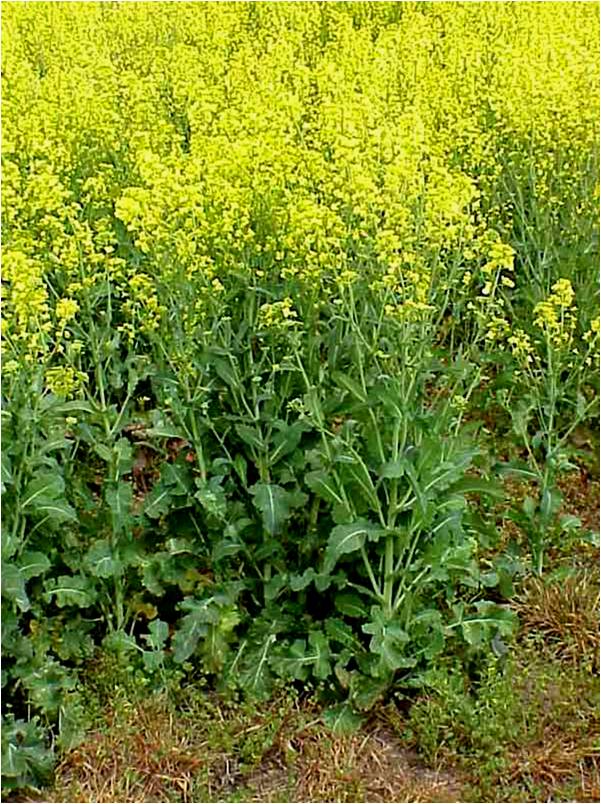
Click to view a larger picture; Dyer's Woad in blossom courtesy and copyright 2009 Brad Kropp - as found on bugwood.org
Dyer’s Woad in blossom
Courtesy of and
Copyright © 2009 Brad Kropp
As found on bugwood.org

In early May, pale yellow carpets some hillsides of Northern Utah. The plants are a non-native known as Dyer’s Woad. This Asian member of the cabbage family has been cultivated as a dye and medicinal plant in Europe and Asia for 2000 years. Dyer’s Woad produces a glorious blue dye, but the process is tricky. No synthetic dye equals the color and characteristics of woad dyes.

Woad had arrived in Utah by 1932 as a seed contaminant. Now it is a noxious weed. Woad has a number of unique abilities that contribute to its vigor. Being a biennial plant, it spends the first year of life as a rosette of leaves, building reserves. In its second year, those reserves allow a woad plant to send forth a tall, lanky stem covered with pale yellow flowers that ultimately yield up to 10,000 seeds per plant.

Although Dyer’s Woad is not toxic, few animals relish it either. The seeds have chemicals that inhibit germination and root elongation in other plants, giving woad a competitive edge. Woad causes millions of dollars in losses each year, so control is a major issue. Herbicides and mechanical removal are best used against the rosettes, but nature has provided a native fungus that views woad as dinner. This rust fungus is very effective at eliminating or severely reducing seed production. Plants infected with the rust fungus are misshapen, wrinkly, and covered in dark spots. Those spots brim with rust spores. Therefore, when removing woad, leave the sickly plants to infect yet more woads.

Click to view a larger picture; Dyer's Woad with rust courtesy and copyright 2009 Brad Kropp - as found on bugwood.org
Dyer’s Woad with rust
Courtesy of and
Copyright © 2009 Brad Kropp
As found on bugwood.org

This is Linda Kervin for Bridgerland Audubon Society.
Credits:
Photos: Brad Krupp, Utah State University, Bugwood.org
Text: Michael Piep, Utah Native Plant Society

Additional Reading:

Resources:
Intermountain Herbarium: https://herbarium.usu.edu/

Washington Weed Board: https://www.nwcb.wa.gov/weed_info/Written_findings

/Isatis_tinctoria.html

References:
Edmonds, J. 2006. The History of Woad and the Medieval Woad Vat. https://www.lulu.com/product/paperback/the-history-of-woad-and-the-medieval-woad-vat/4928037

Shaw, R.J. 1989. Vascular Plants of Northern Utah. Utah State University Press, Logan, Utah. https://www.usu.edu/usupress/books/index.cfm?isbn=1417

Welsh, S.L., N D. Atwood, S Goodrich & L.C. Higgins. 2008. A Utah Flora, 4th Ed. Brigham Young University, Provo, Utah. https://www.amazon.com/Utah-Flora-Stanley-L-Welsh/dp/0842525564

Cryptobiotic Soil Crusts

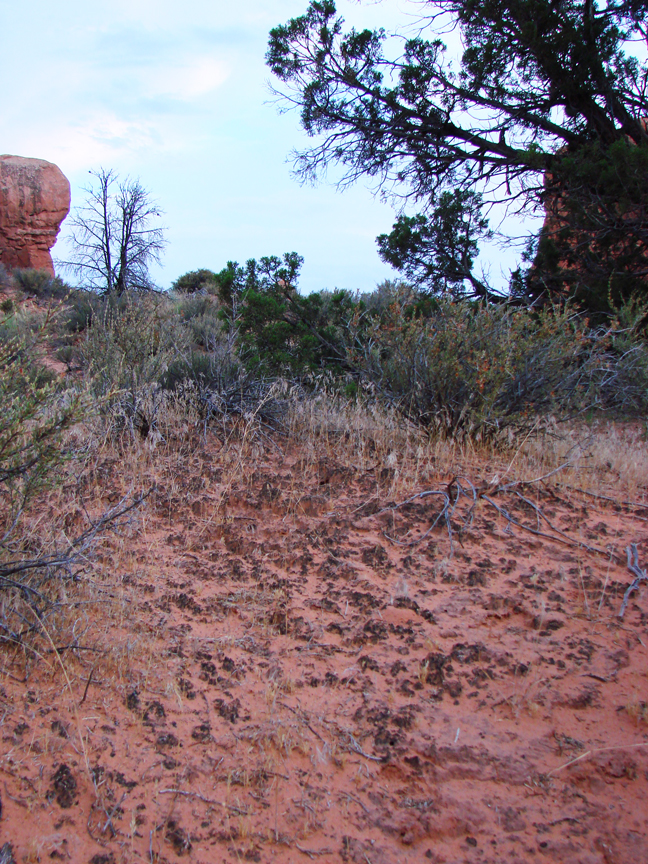
Click to view larger image of Cryptobiotic Soil Crust, Photo Courtesy and Copyright Mark Larese-Casanova
Cryptobiotic Soil Crust
Photo Courtesy & Copyright 2009
Mark Larese-Casanova

Hi, this is Mark Larese-Casanova from the Utah Master Naturalist Program at Utah State University Extension.

Looking out over a Utah desert, we might see relatively few plants- perhaps some sagebrush, maybe a few junipers or Joshua trees, or even some small wildflowers or cacti. What is less noticeable, though, is the living soil crust that holds this entire landscape together. It’s not just sand, but rather an important and vast partnership between bacteria, lichens, algae, and fungi. These soil crusts are often referred to as ‘cryptobiotic’, which means ‘living in suspended animation’. This is a fitting description, considering that water can be so rare in Utah’s deserts.

Cyanobacteria, which is often called blue-green algae, is the backbone of cryptobiotic soil crust. Vast networks of long, microscopic filaments of cyanobacteria and fungi grow in length when they are wet, and leave behind a casing that literally binds the soil together. So, what might otherwise be loose sand not only is less likely to be washed away by water or blown away by wind, but also is able to hold much more water for plants.

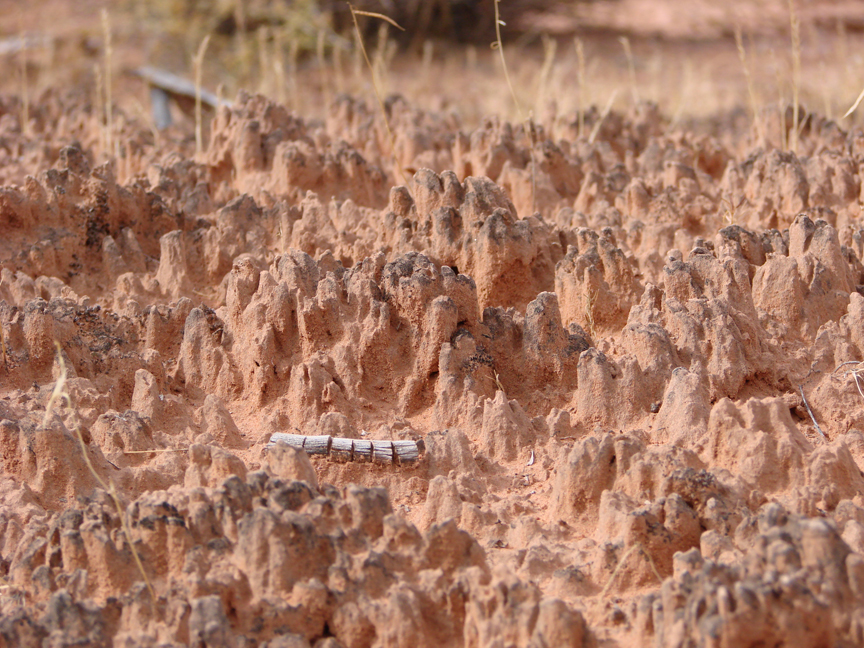
Click to view larger image of Cryptobiotic Soil Crust, Photo Courtesy and Copyright Mark Larese-Casanova
Cryptobiotic Soil Crust
Photo Courtesy & Copyright 2009
Mark Larese-Casanova

Cyanobacteria is also extremely useful to desert landscapes for its ability to take Nitrogen out of the air and make it available to plant roots in the soil. Desert soils typically have relatively low nutrients, so this is especially important to desert plants.

In many Utah deserts, cryptobiotic soil crusts can cover up to 70% of the ground surface. Old soil crust can often look like small mountain ranges with black or white peaks inhabited by lichens or mosses. The little valleys in between the tiny mountains of crust are perfect spots for the seeds of desert plants to grow. Over time, the above ground crust can grow up to ten centimeters, or four inches, thick!

However, cryptobiotic soil crust grows at an alarmingly slow rate of about one millimeter per year. So, any soil crust that is disturbed can take a very long time to recover. Depending on the amount of moisture a desert receives, it can take anywhere between 20 and 250 years for soil crust to grow back.

Next time you’re out in the desert, kneel down and have a close look at the telltale peaks and valleys of cryptobiotic soil crust. If you bring a magnifying glass, you just might be able to see some of the lichens and mosses. Be sure to stay on trail, though, and whatever you do, don’t bust that crust!

For Wild About Utah, I’m Mark Larese-Casanova.

Credits:

Images: Courtesy and copyright Mark Larese-Casanova
Text:     Mark Larese-Casanova, Utah Master Naturalist Program at Utah State University Extension.
Additional Reading:

US Department of Interior. 2001. Biological Soil Crusts: Ecology and Management. Bureau of Land Management Technical Reference 1730-2., https://www.blm.gov/nstc/library/pdf/CrustManual.pdf
Rosentreter, R., M. Bowker, and J. Belnap. 2007. A Field Guide to Biological Soil Crusts of Western U.S. Drylands. U.S. Government Printing Office, Denver, Colorado., https://www.soilcrust.org/

2013 Desert Wildflower Forecast

Click for a larger view of a Dark-eyed 'Oregon' Junco Male, Junco hyemalis montanus, Courtesy and copyright 2008 Ryan P. O'Donnell
Claret cup cactus in bloom
Arches National Park
Echinocereus triglochidiatus
var. melancanthus
Courtesy NPS, Neal Herbert, Photographer

Hi, I’m Holly Strand.

It’s showtime for desert wildflowers in CA, AZ and NM. But in Utah’s deserts think April or May. Within those months the exact timing, type and quantity of blooms are highly variable. Flowering depends upon the pattern of precipitation from fall onward and on spring temperatures, sunlight and elevation. And of course, on the specific ecological requirements of each particular plant.

Annuals are plentiful in the desert. Annual plants germinate, grow, flower, set seed and die all within one season—often in the spring. To avoid water stress—some annuals will start their life cycle only when there is significant moisture. If it’s dry, they may stay in seed form waiting for better conditions. Likewise, many perennials—plants that live more than 2 years—can remain below ground as dormant bulbs, corms or roots. But when conditions are right, these water stress avoiders –both annuals and perennials–will flourish. When this happens we call it a “good year” for wildflowers.

I couldn’t find a wildflower hotline for Utah—so I called different parks representing Utah’s 3 different desert regions to get a flower forecast for 2013.

Nothing much is happening yet on the Colorado Plateau in and around Arches and Canyonlands National Parks. It’s been pretty cold according to staff ranger Sharon Brussell. So the appearance of spring flowers is somewhat delayed. But in April we can expect to see evening primrose, twinpods and milk vetches. And in late April-early May, Princes’ plume, globemallow and yucca. The scarlet blooms of claret cup cactus will follow. If you miss what you are looking for in Arches or the Needles district, just go higher to Islands in the Sky, adds Nathaniel Clark of the Canyonlands National Park. Here–because of the elevation–flowering of similar species occurs 2-4 weeks later.

Snow Canyon is in the Mojave Desert region. Park Manager Kristen Comella told me that this is likely to be a typical year for wildflowers. Spectacled pod and lotus vetch are already out. Soon we’ll see bright yellow flowers of the Mojave’s signature creosote bush, and the deep purple flowers of indigo bush. Prickly pear and Utah yucca will soon follow. If you want to see early spring blooms on Joshua trees, go south on old highway 91 from Gunlock to see Utah’s one and only Joshua Tree forest.

To find out what’s happening in the Great Basin I spoke with Ben Roberts at Nevada’s Great Basin National Park. He says there has been a bit less precipitation than normal but it should still be an OK year for flowers. So far he’s only spotted one — Nevada lomatium. This brave little plant blooms even when there is snow still lying around. From a distance you might even think the low-lying white flowers are a patch of snow. In April desert paintbrush will appear, as will arrow-leaf balsamroot and purple sage. Wild iris, blue flax and prickly pear will follow in May.

For sources and pictures and suggestions for good desert wildflower hikes go to www.wildaboututah.org

For Wild About Utah, I’m Holly Strand.

Credits:
Image: Courtesy NPS, Arches National Park, Neal Herbert, Photographer
Text: Holly Strand

Recommended hikes for viewing wildflowers

Great Basin National Park (Great Basin)
Baker Creek Trail
Lehman Creek Trail
Pole Canyon Trail

Arches National Park (Colorado Plateau)
Primitive Loop

Canyonlands National Park (Colorado Plateau)
Neck Spring Trail—Islands in the Sky

Snow Canyon State Park (Mojave Desert)
Hidden Canyon
Whiptail Trails

Sources & Additional Reading

Arches Flower Guide (by color, month, name and keys)https://www.nps.gov/arch/naturescience/flowerguide.htm 

Comstock, J. and J. Ehrlinger 1992. Plant adaptations in the Great Basin and Colorado Plateau. Great Basin Naturalist. Vol. 52. No. 3

Fertig, Walter. 2010. Utah’s Mojave Desert Flora. Sego Lily, newsletter of the Utah Native Plant Society. Vol. 33, No. 2. https://www.unps.org/segolily/Sego2010MarApr.pdf

McMahon, James. 1985. Deserts (National Audubon Society Nature Guides) NY: Alfred A. Knopf https://www.amazon.com/Deserts-National-Audubon-Society-Nature/dp/0394731395

Williams, David. 2000. A Naturalist’s Guide to Canyon Country. A Falcon Guide. Helena MT. Published in cooperation with Canyonlands Natural History Association.https://www.amazon.com/Naturalists-Guide-Canyon-Country-Williams/dp/1560447834 

Kissing Under the Dung Twig

Juniper Mistletoe
Phoradendron juniperinum
in Red Rock Canyon, Nevada
Courtesy Stan Shebs, Photographer
This file is licensed under the
Creative Commons
Attribution-Share Alike 2.5 Generic license.

Close-up of Juniper Mistletoe
Phoradendron juniperinum
in Red Rock Canyon, Nevada
Courtesy Stan Shebs, Photographer
This file is licensed under the
Creative Commons
Attribution-Share Alike 2.5 Generic license.

Holly: Hi, I’m Holly Strand.

Together with poinsettia and holly, mistletoe is an iconic Christmas plant. The term mistletoe doesn’t refer to a single species or even a single lineage of plants. Instead there are over 1300 species belonging to 5 different plant families. All mistletoes are partially or mostly parasitic –they obtain water and minerals from a host tree, shrub or cactus via specialized stems. Sometimes mistletoe stems may branch into tangled masses called witches brooms. These gnarled structures offer nesting habitat for songbirds, raptors, and squirrels and can provide forage for deer and elk.

In Utah, Juniper mistletoe is the most common species. You’ll find it across the Colorado Plateau and along the Wasatch Front. Acacia mistletoe is much rarer and found only in the Beaver Dam Mountains west of St. George. Both of these species are leafless and spiky looking but many types of mistletoe have green leaves to support photosynthesis.

Most mistletoes reproduce with the help of birds that eat their fruit. Mistletoe seeds pass through the bird’s digestive system and are deposited on new branches where they stick and germinate. This explains the mistletoe’s strange name which is Anglo Saxon for “dung twig”.

Considering its humble origins in bird poop, mistletoe has made quite a name for itself. Like a botanical Forest Gump, it keeps cropping up throughout history in myths, cultural traditions and even medicines.

  • In Norse mythology, the overprotective Goddess Frigg went to all the living creatures on earth, making them pledge not to harm her beloved son Baldur. But she overlooked the mistletoe. When mischievous Loki discovered this, he arranged that Balder’s brother would throw an arrow made of mistletoe to strike Balder—killing him, of course.
  • In Virgil’s epic poem the Aeneid, mistletoe was the “Golden Bough” which allowed Aeneas to pass into the Underworld.
  • The ancient Druids revered both oak trees and the mistletoe that grew in them. They believed that a potion prepared from mistletoe would make barren animals reproduce. And they used mistletoe as an antidote to all kinds of poisons.

  • Throughout the ages, mistletoe was used to treat many medicinal conditions such as epilepsy, infertility, hypertension and arthritis. Today, many claim that mistletoe stimulates the immune system, helping the body fight more efficiently against cancer and other diseases.

    While it was originally hung in doorways to attract good health and good fortune, by the 18th century mistletoe morphed into a Christmas decoration. We don’t know exactly how the custom of kissing under the mistletoe –or dung twig—evolved, but I’m certainly glad it did!

    For pictures and sources for this program and archives of past programs, go to www.wildaboututah.org For Wild About Utah, I’m Holly Strand.

    For Wild About Utah, I’m Holly Strand.

    Credits:

    Image: Courtesy Wikipedia, Stan Shebs, Photographer
    Text: Holly Strand

    Sources & Additional Reading:

    Drury, Susan. 1987. “Customs and Beliefs Associated with Christmas Evergreens: A Preliminary Survey” Folklore 98.2 pp. 194-199., Abstract

    Fertig, Walter. 2006 “Utah Plant Families: The Mistletoes (Viscaceae)” Volume 29 No. 6 Sego Lily (Newsletter of the Utah Native Plant Society) Utah Native Plant Society

    Horneber MA, Bueschel G, Huber R, Linde K, Rostock M. 2008. “Mistletoe therapy in oncology.” https://www.ncbi.nlm.nih.gov/pubmed/18425885 Cochrane Database Syst Rev. 2008 Apr 16;(2):CD003297. doi: 10.1002/14651858.CD003297.pub2. PMID: 18425885 [PubMed – indexed for MEDLINE]

    Milius, Susan. 2002. Science News. “Mistletoe, of all things, helps juniper trees.” Web edition: January 2, 2002. Print edition: January 5, 2002; Vol.161 #1 (p. 6) https://www.sciencenews.org/view/generic/id/2334/description/Mistletoe,_of_all_things,_helps_juniper_trees

    Watson, David. M. “Mistletoe—A Keystone Resource in Forests and Woodlands Worldwide.” 2001. Annu. Rev. Ecol. Syst. 2001. 32:219–491, https://rspb.royalsocietypublishing.org/content/early/2012/07/03/rspb.2012.0856.full