State Symbols

Most people could probably name the state bird or the state tree, but what about the state gem? The state grass? State fruit? Do you know why they are important to Utah? Here are just a few of Utah’s State Symbols that you might not have known.

State Symbols: Sherry-colored topaz from Maynard's Claim (Pismire Knolls), Thomas Range, Juab County, Utah, USA, By Rob Lavinsky, iRocks.com – CC-BY-SA-3.0, CC BY-SA 3.0, https://commons.wikimedia.org/w/index.php?curid=10450654
Sherry-colored topaz from Maynard’s Claim (Pismire Knolls), Thomas Range, Juab County, Utah, USA, By Rob Lavinsky, iRocks.com – CC-BY-SA-3.0, CC BY-SA 3.0, https://commons.wikimedia.org/w/index.php?curid=10450654
Topaz was named Utah’s state gem in 1969 because of its abundance on Topaz or Thomas Mountain in Juab County. In this area, perfect topaz crystals can be found and collected. This semiprecious gem can also be found in Beaver and Toole counties. Topaz can be found in a variety of colors, but in the Thomas Range it is known for its sherry hue. When exposed to sunlight, amber colored topaz will often become clear. Topaz collecting is free and open to the public in most areas and could be a great way to get to know Utah a little bit better.

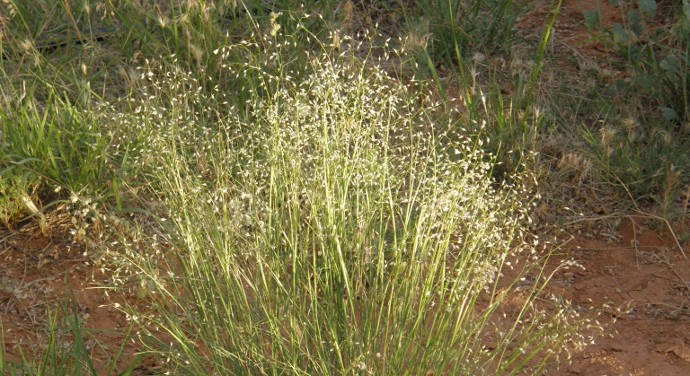
Utah’s state grass was selected in 1990 to be Indian Ricegrass. As you might suspect, indian ricegrass was given its name because of the significance in Native American life. This tough bunchgrass was a common food source and was absolutely crucial to survival when the corn crop failed.

Indian Ricegrass Courtesy US National Park Service
Indian Ricegrass
Courtesy US National Park Service
It can be found in wet and dry areas throughout the West. Long ago this grass was important for Native Americans; now it is important in fighting wind erosion and grazing cattle.

The cherry did not become the state fruit until 1997 when a group of second graders did their research and petitioned for the fruit to be recognized. Cherry was discovered to be the most economically beneficial fruit for Utah when compared to other fruits like peaches and apples. Both sweet and tart cherries are grown commercially in Utah. Utah is the only state ranked in the top five cherry producing states for both types of cherries.

US Cherries for sale in Korea Courtesy USDA
US Cherries for sale in Korea
Courtesy USDA
The cherry is native to Asia, but flourishes in Utah’s environment.

The state insect might be a little easier to guess than the state grass and state fruit. Utah is known as the beehive state, so naturally our state insect is the honeybee. When settlers first arrived in Utah they called it Deseret which means honeybee. Some native bees are listed as endangered species, but many Utahns have become “backyard beekeepers” to help these bees survive.

Honeybee Extracts Nectar Courtesy NASA ClimateKids
Honeybee Extracts Nectar
Courtesy NASA ClimateKids
Bees might seem insignificant, but are actually the unsung heroes of the world’s food supply. Growing bee friendly plants or becoming a beekeeper yourself are great ways to help Utah’s honeybee thrive.

No matter where in the state of Utah you are, you can learn more about these plants, animals, and rocks and see them in action. As a Chinese proverb says, “Learning is a treasure that will follow its owner everywhere.”

This is Aspen Flake and I am Wild About Utah.

Credits:
Photos: Courtesy US NPS and US FWS
Audio: Courtesy and Copyright Kevin Colver
Text & Voice: Aspen Flake
Additional Reading & Listening

State Symbols, as found on OnlineLibrary.Utah.gov, https://onlinelibrary.utah.gov/research/utah_symbols/

Utah as found in StateSymbolsUSA.org: https://statesymbolsusa.org/states/united-states/utah

Gorman, Steve, U.S. Lists a Bumble Bee Species as Endangered for First Time, Scientific American, A Division of Nature America, Inc., Jan 11, 2017,
https://www.scientificamerican.com/article/u-s-lists-a-bumble-bee-species-as-endangered-for-first-time/

Hrala, Josh, 7 Bee Species Have Been Added to The US Endangered Species List, ScienceAlert.com, 3 OCT 2016, https://www.sciencealert.com/seven-species-of-bees-have-been-added-to-the-endangered-species-list

Insects: Bees in trouble and agriculture decline, Endangered Species International, Inc. https://www.endangeredspeciesinternational.org/insects6.html

Ingraham, Christopher, Believe it or not, the bees are doing just fine, Washington Post, October 10, 2016
https://www.washingtonpost.com/news/wonk/wp/2016/10/10/believe-it-or-not-the-bees-are-doing-just-fine/

Farewell Autumn

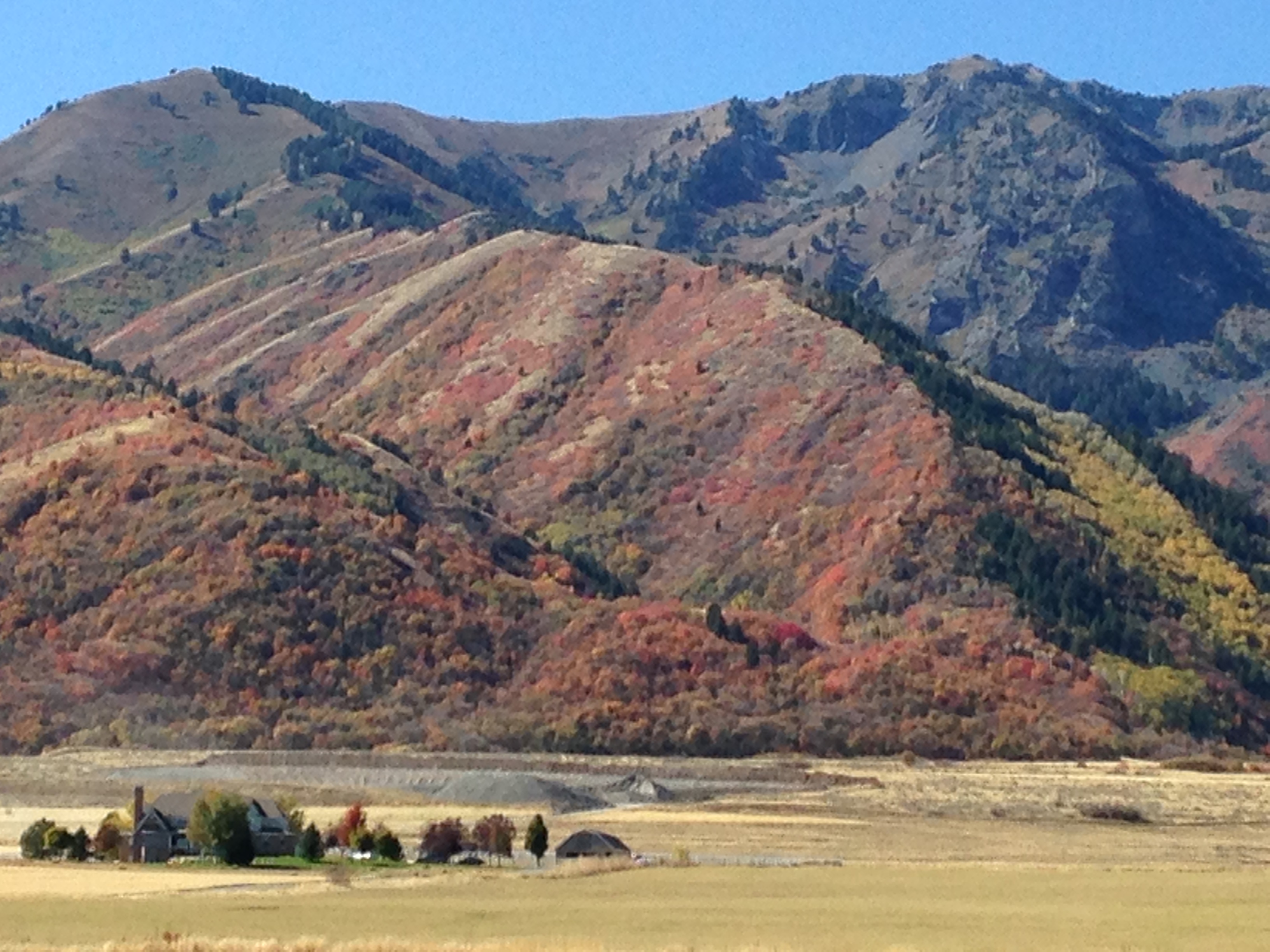
Cache Valley Autumn Colors Courtesy & Copyright Ron Hellstern
Cache Valley Autumn Colors
Courtesy & Copyright Ron Hellstern
Many people enjoy Autumn as their favorite season of the year. Temperatures are comfortable, most pesky insects are absent, animal migrations are evident, and beautiful Fall colors on the trees and shrubs are stunning. But why do these deciduous plants change color? Consider daylight, temperature, and chemistry.

Spring and summer growth and leaf production are due to photosynthesis, a process where plants use light to synthesize the cell’s chlorophyll into transforming carbon dioxide and water to carbohydrates such as sugars and starch. The cells containing chlorophyll also give the plant its green color. But there are other pigments, besides green, within the leaves all year. Xanthophyll produces orange and yellow colors, anthocyanin develops shades of red. When daylight decreases and temperatures drop in the North, the leaves stop their food-making and the green chlorophyll breaks down, leaving the other pigments to dominate the new Autumn colors.

Soon after these vivid colors appear, the tree develops special cells where leaves are attached. Those cells allow the stems to break away from the tree, due to gravity or the wind, and creates a small leaf scar. Although we may not appreciate bare limbs all winter, heavy snows collected by leaves could cause massive breaking of branches due to the additional weight.

In Southern climates, some broad-leaf trees may keep their leaves and only experience changes during wet and dry seasons. Many stay green all year. And, of course, conifers like spruce, pines and firs, retain their needle-like leaves all year.

Now picture yourself in your favorite, quiet, outdoor setting in the Fall as I read a section from the beautiful writings of Aldo Leopold, found in his book “A Sand County Almanac”. It is titled November – If I Were the Wind.

The wind that makes music in November corn is in a hurry. The stalks hum, the loose husks whisk skyward in half-playful swirls, and the wind hurries on.

In the marsh, long windy waves surge across the grassy sloughs, beat against the far willows. A tree tries to argue, bare limbs waving, but there is no detaining the wind.

On the sandbar there is only wind, and the river sliding seaward. Every wisp of grass is drawing circles on the sand. I wander over the bar to a driftwood log, where I sit and listen to the universal roar, and to the tinkle of wavelets on the shore. The river is lifeless: not a duck, heron, marsh-hawk or gull but has sought refuge from the wind.

Out of the clouds I hear a faint bark, as of a far-away dog. It is strange how the world cocks its ears at that sound, wondering. Soon it is louder: the honk of geese, invisible, but coming on.

The flock emerges from the low clouds, a tattered banner of birds, dipping and rising, blown up and blown down, blown together and blown apart, but advancing, the wind wrestling lovingly with each winnowing wing. When the flock is a blur in the far sky I hear the last honk, sounding taps for summer.

It is warm behind the driftwood now, for the wind has gone with the geese.
So would I—if I were the wind.

Credits:

Images: Courtesy & Copyright Ron Hellstern, Photographer
Text:    Ron Hellstern, Cache Valley Wildlife Association

Additional Reading

Autumn Colors, Linda Kervin, Wild About Utah, https://wildaboututah.org/autumn-colors/

Red leaves in autumn: What’s in it for the tree?, Holly Strand, Oct 18, 2012, https://wildaboututah.org/red-leaves-in-autumn-whats-in-it-for-the-tree/

Autumn Leaf Color Change, Linda Kervin, Sept 23, 2010, https://wildaboututah.org/autumn-leaf-color-change/

Build a Certified Wildlife Habitat at Home

Build Community Wildlife Habitats Ron Hellstern See also: https://www.nwf.org/Home/Garden-For-Wildlife.aspx
Build Community Wildlife Habitats
Ron Hellstern
See also:
https://www.nwf.org/Home/Garden-For-Wildlife.aspx
Most people appreciate viewing impressive forms of wildlife, such as Desert Bighorn Sheep in Zion, or Wolves and Grizzlies in Yellowstone, but they may not completely understand the quiet contributions that are being made to earth’s ecosystems every day by the small creatures around our own neighborhoods. These little ones help us in many unseen ways.

It is estimated that one third of the food that humans eat has been provided by small pollinators such as Hummingbirds, Butterflies, and Bees. Having these creatures in our own yards can produce hours of entertainment, and education, as we observe them working feverishly among our flowers, shrubs and trees.

Many citizens, and cities, are diligent in providing beautiful landscaped areas for these pollinators to gain nourishment as they work to increase the production of flowers and fruits.

A couple of quick tips as you decide to help these workaholic animals:
You can make your own hummingbird food by mixing one cup of sugar to four cups of water. Never put food coloring in hummingbird feeders. It can be harmful to them, and the red color of the feeder will automatically attract them. You should also use native, fertile plants in your landscaping design. And, unless you have a severe allergic reaction to bee stings, be assured that they are far more interested in gathering pollen than sacrificing their life to sting someone. Most people can work right alongside bees in their flower gardens. Wasps are another story.

So, as you design, or alter, your property to be more usable by pollinators and songbirds you can be rewarded by the National Wildlife Federation through their Wildlife Habitat Certification program. If you provide food, water, shelter and a place to raise young…you are eligible to have your yard certified. Remember, we’re not talking about Mountain Lions and Elk, just pollinators and songbirds. If you have a birdfeeder, birdbath, and shrubs or trees you qualify.

Nobody inspects your property. Go to their website at (www.nwf.org) and complete the simple application listed under Garden for Wildlife and, for a one-time fee of only $20, they will send you a personal certificate for your home, and a one year subscription to the National Wildlife magazine. They also have metal signs that you can post to show others that you care about wildlife. Once you see the value in this, encourage neighbors to do the same. In fact, you can have portions of your entire community certified as wildlife habitat as did Nibley City in Cache County. They were the first city in Utah to do so by certifying 100 properties, and they are ready to help others around the State to join them in this rewarding effort.

Next time you’re in the grocery store, or harvesting from your own garden, remember that a lot of that food would not exist without our diligent pollinators.

This is Ron Hellstern for Wild About Utah


Credits:

Images: Courtesy & Copyright Ron Hellstern
Text:     Ron Hellstern, Cache Valley Wildlife Association


Additional Reading

Certify Your Wildlife Habitat, National Wildlife Federation, Accessed 20 July 2017, https://www.nwf.org/Home/Garden-For-Wildlife.aspx
Certify: https://www.nwf.org/Garden-For-Wildlife/Certify.aspx

Creating Landscapes for Wildlife… A Guide for Backyards in Utah, Written by Sue Nordstrom and Illustrated by Kathlyn Collins Department of Landscape Architecture and Environmental Planning, Utah State University with Margy Halpin, Utah Division of Wildlife Resources; Second Printing 2001,
Updated for the Utah Division of Wildlife Resources, by Frank Howe, DWR Avian coordinator; Ben Franklin, DWR–Utah Natural Heritage Program botanist; Randy Brudnicki, DWR publications editor; and landscape planning illustrations by Stephanie Duer.,
Published by:
State of Utah Natural Resources, Division of Wildlife Resources,
Utah State University Cooperative Extension Service and
Utah State University Department of Landscape Architecture and Environmental Planning;
1991 updated 2001 https://wildlife.utah.gov/pdf/landscapingforwildlife.pdf


Pando is Dying

Pando the world's largest discovered organism at Fishlake in central Utah Image courtesy USDA Forest Service J Zapell, Photographer
Pando, the worlds largest discovered organism at Fishlake in central Utah
Image courtesy USDA Forest Service
J. Zapell, Photographer

Pando, a sprawling aspen colony and the world’s largest discovered organism, is dying. On the lip of Fish Lake in Central Utah, Pando germinated from a seed the size of a grain of sand thousands of years ago. Now he sprawls over a hundred acres with approximately 47,000 trunks. The combination of the trunks and the extensive root system has Pando weighing in at around 13 million pounds. This giant male, which might be one of the oldest living organisms on the planet, is also prone to disease, wanted by humans to burn in stoves, and targeted by ungulates as a food source. And although Pando consists of literally tons of mature, geriatric trees, there aren’t many young volunteers replacing old trees that die.

Dr. Paul Rogers, a Utah State University scientist who’s trying to save Pando, explained the problem to me while we searched for new growth and deer scat on Pando. He said it would be like depending on a room filled with 90-year-olds to repopulate and save the human race—it’s possible, but not likely.

The age of the current mature trees that make up Pando is about 110-120 years. These ages are gleaned from a tree coring device called a borer. This information combined with others findings show that Pando took a turn for the worse about when Anglo-Americans showed up in central Utah. As they hunted apex predators like bears, wolves and mountain lions, populations of ungulates such as deer and elk increased. White settlers also added other ungulates—sheep, cows, and horses—to the ecosystem. Both domestic and wild ungulates feast on young, nutrient-filled Aspen trees. Which makes it so Pando can’t recolonize himself.

I asked Rogers if the reason he wanted to save Pando was because it was the superlative organism—the oldest and biggest on the globe, and he was quick to correct me. He questions the accuracy of age estimates for Pando based on current available science. And he believes there may even be larger aspen colonies, but we just haven’t found them yet. We know about Pando partially because a paved road goes right over his spine and partially because he almost touches Fish Lake. Rogers says he’s interested in saving Pando because the existence of this huge organism supports many dependent species and it likely holds lessons for sustainable cohabitation of this planet. As an afterthought he added, “If the colony dies on our watch, we’re doing something majorly wrong.”

There is hope for Pando. Aspen do two things really well: die and repopulate. In recent years, efforts have been implemented to preserve Pando. Paradoxically, some sections have been clear cut or burned to stimulate growth. Both techniques have produced positive results, but not enough. It seems the simplest solution to this problem might be the best—protect it from foraging ungulates. Eight-foot deer fences now encircle parts of Pando. Outside the fences, there are no new trees. Inside, however, green shoots can be seen pushing up from the dry ground.

This is Russ Beck for Wild About Utah.

Credits:
Photo: Courtesy USDA Forest Service, J Zapell, Photographer
Text: Russ Beck

Sources & Additional Reading

Pando-(I Spread), Fishlake National Forest, USDA Forest Service, https://www.fs.usda.gov/detail/fishlake/home/?cid=STELPRDB5393641

Pando-The World’s Largest Organism, Holly Strand, Wild About Utah, Sept 3, 2010, https://wildaboututah.org/pando-the-worlds-largest-organism/

Utah State Tree – Quaking Aspen, Utah’s Online Library, https://onlinelibrary.utah.gov/research/utah_symbols/tree.html [Accessed May 15, 2017] See also https://onlinelibrary.utah.gov/utah/symbols/

WESTERN ASPEN ALLIANCE is a joint venture between Utah State University’s College of Natural Resources and the USDA Forest Service Rocky Mountain Research Station, whose purpose is to facilitate and coordinate research issues related to quaking aspen (Populus tremuloides) communities of the west. https://www.western-aspen-alliance.org/

DeWoody J, Rowe C, Hipkins VD, Mock KE (2008) Pando lives: molecular genetic evidence of a giant aspen clone in central Utah. Western North American Naturalist 68(4), pp. 493–497. https://digitalcommons.usu.edu/aspen_bib/3164

Grant, M., J.B. Mitton, AND Y.B. Linhart. 1992. Even larger organisms. Nature 360:216. https://www.nature.com/nature/journal/v360/n6401/abs/360216a0.html

Grant, M. 1993. The trembling giant. Discover 14:83–88. Abstract:https://www.bioone.org/doi/abs/10.3398/1527-0904-68.4.493

Habeck, R. J. 1992. Sequoiadendron giganteum. In: Fire Effects Information System, [Online]. U.S. Department of Agriculture, Forest Service, Rocky Mountain Research Station, Fire Sciences Laboratory (Producer). Available: https://www.fs.fed.us/database/feis/ [Accessed September 2, 2010].

Mock, K.E., C . A. Rowe, M. B. Hooten, J. DeWoody and V. D. Hipkins. Clonal dynamics in western North American aspen (Populus tremuloides) Molecular Ecology (2008) 17, 4827–4844 https://digitalcommons.usu.edu/wild_facpub/163/

Maffly, Brian, A year after southern Utah’s Brian Head Fire, the aspens are bouncing back in a surprising way that could strengthen the forest, The Salt Lake Tribune, Oct 22, 2018, https://www.sltrib.com/news/environment/2018/10/22/year-after-southern/

The Associated Press, Study finds huge aspen grove continues to decline, The Salt Lake Tribune, Oct 22, 2018,
https://www.sltrib.com/news/2018/10/22/study-finds-huge-aspen/

Davis, Nicola, Sound artist eavesdrops on what is thought to be world’s heaviest organism, The Guardian, May 10, 2023, https://www.theguardian.com/environment/2023/may/10/sound-artist-eavesdrops-on-what-is-thought-to-be-worlds-heaviest-organism-pando-utah

The Sweet Song Of The Largest Tree On Earth, Science Friday, National Public Radio, May 12, 2023, https://www.sciencefriday.com/segments/listen-to-the-pando-largest-tree/