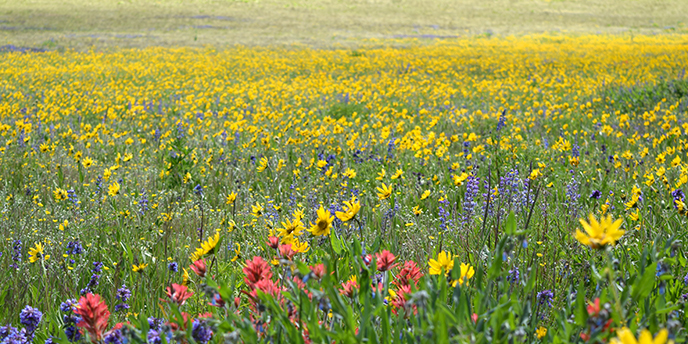
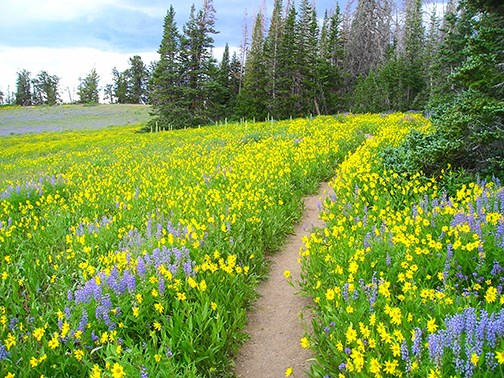
Annual Wildflower Festival Cedar Breaks National Monument Courtesy National Park Service, Cedar Breaks National Monument“Hey, stop the truck!” my wife called from the passenger seat, her nose pressed against the window. I already knew what this was about; she was out the door before the dust had cleared the hood, kneeling in the grass. While she hovered over something newly found with purple petals, I stared out across the high, open meadow of blooming wildflowers, the urge to run surging into my feet. I turned at her exclamation several seconds later, half a football field of colored space between us now. Arms spread wide; grins from ear to ear. In a field of wildflowers, we were kids again.
Scientists call it neoteny, the retention of juvenile features in the adult of a species—basically, the harboring of a playful nature into adulthood. The research into the benefits of play, especially outdoor play, is becoming more replete by the day. In humans, play puts the right hemisphere of the brain into gear, that portion responsible for artistic and creative notions, imagination and insight, and holistic thought. The cerebellum and frontal lobes light up as well, increasing attunement to coordination, executive functioning, and contextual memory development. Neoteny, scientists say, is the key to a species’ adaptability and, therefore, its survival.
Alpine Pond Upper Flowers Cedar Breaks National Monument Courtesy National Park Service, Cedar Breaks National MonumentWild neoteny could be the term used to describe the human affinity to explore one’s natural surroundings, to wander off into the hills in search of something new and interesting, to learn the nuance of a place and to gain some intimacy with it—to call it home. We do that, I think, when we go on hikes into the wild hinterlands, catapult ourselves down the turbulent waters of our rivers, or climb the rock faces we stumble upon. It’s an adrenaline rush to be sure, a high on life as they say; but it’s also an act of survival—and of remaining human.
Robin Moore, a professor at North Carolina State University, says “the natural environment is the principle source of sensory stimulation….” “Sensory experiences,” he says, “link [our] exterior world with [our] interior, hidden, affective world.” The outdoor environment is a medium of human connection where, as Moore puts it, the “freedom to explore and play…through the senses…is essential for healthy development….” Dr. Stuart Brown, clinical researcher and founder of The National Institute for Play, behooves us in his Ted Talk on the subject to explore our individual histories of play. If you close your eyes and imagine yourself at play, where are you? The open water, a deep forest, a mountain peak, or maybe a field of wildflowers?
In his national bestseller, Last Child in the Woods, Richard Louv calls nature a “reset button.” It is the place where we are reminded of ourselves and our purpose. Australian musician Xavier Rudd sings, “Take a stroll to the nearest water’s edge/Remember your place.” It’s often proffered that in a time of industrial expectation and hyper-communication, we need the wild spaces more than ever. There’s some truth to that; but I think I’d go play there anyway, even if it wasn’t to escape the, quote-unquote, “workaday life.” I’m most human when I’m running through a field of blooming wildflowers.
I’m Josh Boling, and I’m Wild About Utah.
Credits:
Photos: Courtesy US National Park Service, Cedar Breaks National Monument
Text: Josh Boling, 2018
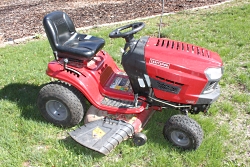
Riding Lawnmower Courtesy & Copyright Ron Hellstern, PhotographerTraditional American landscaping focuses on maintaining a manicured green lawn. However, the National Wildlife Federation has some better environmental choices for people and wildlife by including native trees, shrubs, ground cover, prairie or meadow patches, flower beds and attractively mulched areas.
Did you know
Approximately 20 million U.S. acres are now planted as residential lawn.
30-60% of urban freshwater is used for watering lawns.
67 million pounds of synthetic pesticides are used on U.S. lawns annually.
Areas of lawn that include only one type of plant, such as grass, offer very little habitat value for wildlife.
Yard waste, mostly grass clippings, makes up 20% of municipal solid waste collected, and most of it ends up in landfills.
Reasons to reduce your lawn
Save time and money that you would normally spend on mowing and fertilizing grass.
Provide habitat and food for wildlife.
Conserve water.
Reduce lawn mower pollution and decrease run-off from fertilizers and pesticides.
Here are some ways to reduce your lawn and help wildlife
Use native plant species as ground cover instead of grass.
Install native trees and shrubs
Create a rock garden
Use mulched pathways
Provide meadow or prairie patches
Install a hedgerow
Plant an organic vegetable garden
Create a butterfly or hummingbird garden
Taking Action
Make a plan of how you want your yard to look. Check with your local municipality, neighborhood, or homeowners’ association for regulations. Once you have decided on an area of your yard to convert, follow these simple suggestions:
Cover your turf grass with 6-10 layers of black & white newspaper or brown cardboard. There is no need to remove the grass first.
Make sure the sections overlap one another so that grass and weeds will not come up between the cracks.
Wet down the newspaper or cardboard.
Cover the newspaper or cardboard with a 4”- 6” layer of mulch or soil.
Allow turf grass and weeds to die back for 4-6 weeks.
Plant directly through the mulch and newspaper/cardboard. If you know you’re going to be planting trees or shrubs, dig the holes before putting down layers of paper.
Some other things to consider
Determine what native plants are already thriving in your site. Encourage the native plants already present and replace exotic invasive species with native ones. The Lady Bird Johnson Wildflower Center has lists of recommended native plants by region and state at www.wildflower.org/collections. There are 158 listed for Utah.
Organic mulch can reduce weeds, prevent erosion, improve soil nutrients and increase water holding capacity.
Borders of rock or weed can bring a sense of order to a “wild garden” in an urban or suburban neighborhood. This may make your natural landscape more acceptable to neighbors.
And don’t forget to make a place for people as well. A bench or path will accommodate this nicely and add to your enjoyment.
Great Salt Lake Phragmites Courtesy & Copyright Karin KettenringThose unfamiliar with the history of the Utah’s wetlands may see Phragmites and say, “What a beautiful, elegant plant! It looks so graceful blowing along the shore.” Our Invasive Phragmites
However, the plant’s attractiveness and ability to absorb pollutants may not compensate for its negative impacts.
Phragmites is an invasive perennial grass that now thrives in much of the wetlands around the Great Salt Lake and other marshes in northern Utah. It grows in dense clusters and normally reaches 5 to 10 feet in height. If the conditions are right it can reach 15 feet.
The patches of grass are so dense that wetland managers are called out each year to rescue duck hunters – who are lost in the Phragmites.
Karin Kettenring, associate professor of wetland ecology in the Department of Watershed Sciences at USU and her research team have been studying Utah Phragmites for the past decade.
Kettenring explains why Phragmites is a concern, “We fear it is fundamentally changing the habitat of Great Salt Lake wetlands which are renowned for being a home for migratory birds including waterfowl and shore birds.”
The exotic grass most likely started in the Great Salt Lake wetlands after the flooding of 1983. The flood washed out the marshes. When the water levels receded, the salty water had destroyed all the native vegetation in the wetlands. Phragmites then moved in. By 2011, the exotic grass had spread over 24,000 acres.
Mowing Phragmites Courtesy & Copyright Karin KettenringScientists believe humans inadvertently brought Phragmites to Utah, since birds don’t migrate East and West, and the birds usually don’t eat the seeds. Someone’s boat may have transported the seeds into Utah. They sat dormant in the soil until the conditions were perfect, then the spread of Phragmites began.
Today an average small patch of Phragmites, about 20 feet square, can spread a couple yards a year just from the stems it sends out above and below the ground. However, research has shown it’s not the stems that cause the most reproduction – but the seeds.
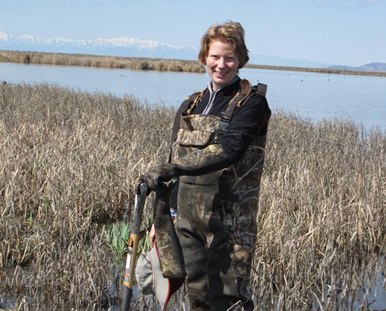
Karin_Kettenring-in-the-Great-Salt-Lake-Wetlands Courtesy & Copyright Karin KettenringKaren Mock, associate professor in the Department of Wildland Resources and a long-term collaborator on this project helped Kettenring with the genetic work.
They tested the genetics of a lot of Phragmites pulled from the same patches and found many different genotypes – proving the plants came from different seeds, not the stems of neighboring plants.
With these results, Kettenring’s lab discovered the best way to control the invasive grass is to first control the seed production by mowing the grass mid-summer to keep it from spreading. Then in the fall spraying the area with herbicide three years in a row. An herbicide approved for use in wetlands can be used – such as Rodeo.
If the Phragmites has been there only a few years then the seeds of the native vegetation will still be in the soil, and they’ll come back on their own.
However, if the Phragmites has been there for a long time then re-seeding of native plants will be necessary.
To determine the best way to re-seed wetlands, Kettenring partnered with Utah Division of Wildlife Resources, Utah Division of Forestry, Fire & State Lands and David England – one of Kettenring’s past graduate students. England has spent extensive time in the lab determining how to help seeds germinate.
Emily Martin, Kettenring’s current graduate student will also help with the UDWR reseeding as she searches for techniques to make seeding more effective.
Ultimately their goal is to restore native plant communities to keep Phragmites from coming back and restore habitat for important migratory birds.
This is Shauna Leavitt and I’m Wild About Utah.
Our Invasive Phragmites-Credits:
Photos: Courtesy & Copyright Karin Kettenring
Audio: Courtesy and Copyright Kevin Colver
Text: Shauna Leavitt, Utah Cooperative Fish and Wildlife Research Unit, Quinney College of Natural Resources, Utah State University
Our Invasive Phragmites-Additional Reading
How to control Phragmites
Kettenring, Karin, Rupp, Larry, Whitesides, Ralph, Hazelton, Eric, Phragmites Control at the Urban/Rural Interface, 2014, https://works.bepress.com/karin_kettenring/92/
Video: USU researchers mowing Phragmites in the Great Salt Lake wetlands. The passenger is Chad Cranney a past graduate student of Karin Kettenring’s: https://bft.usu.edu/rqcq9
Male House Finch Courtesy US FWS Gary Kramer, PhotographerLove is in the air! While shoveling snow, it seems a bit ludicrous to say “spring has arrived”, but here it is! I first noticed it 3 weeks ago when a burst of house finch tumbling notes filled the vapors. That was followed by a robin dusting of some rusty phrases which will soon be heard across the mid-latitudes of N. America.
What is one to think of such outrageous behavior as the snow continues to fall and the thermometer dips well below freezing? In one word-testosterone! This magical chemical is surging once again entirely dependent on the ratio of daylight to dark which has changed to such a degree that life helplessly submits to the urge for love.
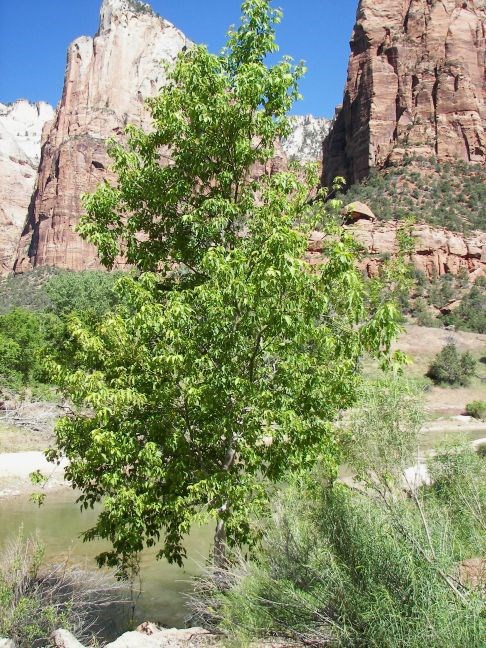
Boxelder at Court of the Patriarchs, Zions National Park Courtesy NPS Amy Gaiennie, Photographer
Even plants are getting in the mood due to hormonal change in response to increasing length of daylight. If I were still teaching science at Logan High we would be tapping a spile into a box elder tree to catch the dripping sap and boil down on the Bunsen burner to delicious maple syrup. When we began this activity 32 years ago March was the month. It gradually changed to mid-February as the winter season shortened.
Death Camas Bryce National Park Courtesy US NPSI’m guessing the tiny pink flower of stork’s bill geranium and yellow of biscuit root is already blooming beneath the snow on south facing slopes. Death camas leaves are beginning to poke through moist soil.
Snow geese and tundra swans are beginning to populate our open waters with sandhill cranes and many other species of waterfowl soon to follow.
Mountain Bluebird Pair Courtesy & Copyright Milt Moody, Photographer Utahbirds.orgIn the heavens you may see golden eagles performing their talon locked tumbling courtship death plunge, and paired ravens cavorting in mid-air. Outrageously beautiful Mountain bluebirds begin decorating fence posts in the countryside. Clark’s nutcrackers are beginning their migration to ridgetops for nesting activities.
Great horned owls present a special case. Their hoots reached a fevered pitch during their January courtship period. Nesting begins in February but no nest building needed. They take the easy out by occupying other raptor nests, especially red tail hawks, crows, or a handy ledge. They are fierce defenders of their young and have caused injure to clueless humans who approach to near. The family unit will remain together into the fall season.
Coyotes and fox are in full courtship mode showing overt affection. Parents of both of these wily canids help with den preparation and rearing pups born a few months later. Both are common in native legends for the cunning and trickery.
“If the day should ever come when one may camp and hear not a note of the coyotes joyous stirring song, I hope that I shall long before have passed away, gone over the Great Divide.” Earnest T. Seton, American naturalist, author, activist and father of the Rocky Mountain N.P.
This is Jack Greene and I’m Wild about Wild Utah!
Credits:
Images:
Male House Finch, Courtesy US FWS, Gary Kramer, Photographer
Boxelder at Court of the Patriarchs, Zions National Park, Courtesy NPS, Amy Gaiennie, Photographer
Death Camas, Bryce National Park, Courtesy US NPS
Mountain Bluebird Pair, Courtesy & Copyright Milt Moody, UtahBirds.org
Audio: Contains Audio Courtesy and Copyright Kevin Colver
Text: Jack Greene