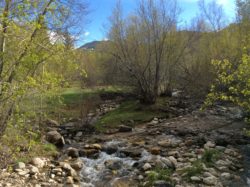
Clear Creek in the Spring Courtesy & Copyright Holly Strand, PhotographerSummer’s heat has turned on. It was evident in a dramatic fashion as I ran a ridge in N. Utah where the early am temps were near 70 degrees, flowers had faded, and the absence of bird song. As I descended to the canyon bottom the temperature dropped a solid 20 degrees and bird voices returned where yellow warblers were competing with lazuli buntings for top songster. I had entered the riparian, or river side biotic community- from the burnt brown of cheat grass above to the lush “green zone” below supporting abundant life in our desert state. I won’t be running ridge tops any time soon!
Throughout the Intermountain West and Great Basin, these givers of life are critical areas for water, wildlife, agriculture, and recreation. About 80 % of all animal life is dependent on stream side habit sometime during its life cycle. As a birder and botanist, this is where I spend much of my time documenting and enjoying the abundance.
On a recent, brief bird survey along the Logan River golf course trail, I recorded 33 species with another ten or so known to nest in this river corridor. I’m planning to prepare a bird checklist for golfers to add more “birdies” to their score card.
Many of these special places have been seriously degraded through invasion of exotic species, agricultural practices, various forms of development, and channelization. But help is on the way.
The Logan River Task Force is one excellent example. Launched in 2016, the task force is well on its way to restoring a much healthier, biologically rich river system. Replacing crack willow, a Eurasian non-native tree, with native cottonwood and willow accompanied by a rich understory of shrubs, will significantly enhance the biodiversity along the floodplain. Another major change is underway as they replace the straight, channelized portion of the river to its meandering original channel. This will create more pools for fish, wetlands for flood control and filtering, while improving aesthetics and recreation opportunity.
In an earlier WAU reading, I mentioned the good work being done by western boxelder ranchers reintroducing beaver whose dams will assist with maintaining stream flow and water quality along with improved fish and wildlife habitat. I’m aware of the same occurring on a Mink Creek ranch in SE Idaho.
The world appears to be awakening to the many values of these critical wildlife and water quality riparian zones, as I awoke to the same on my early morning run.
This is Jack Greene and I’m Wild about Utah!!
Credits:
Images: Holly Strand
Audio: Courtesy and Copyright Kevin Colver
Text: Jack Greene
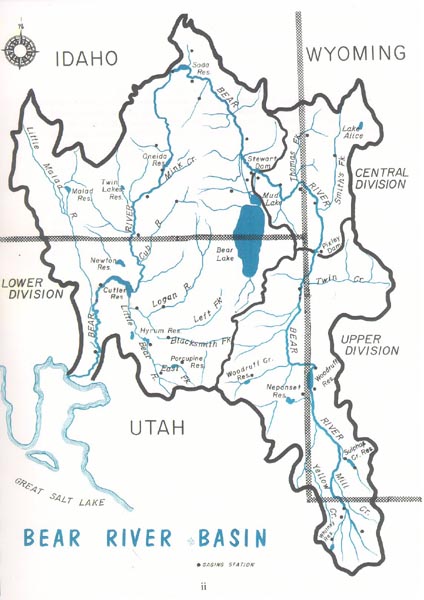
Bear River Basin Courtesy Utah Division of Water Rights bear.river_.basis_.waterrights.utah_.gov_.250×354.jpgFollowing the same route which I had taken when coming up, we arrived at Bear River on the evening of the eleventh and encamped. Examination of Cache valley occupied several days. Crossing over the range of low rounded hills through, which Bear River has cut a passage, we entered this beautiful and picturesque valley. Which was then covered with a profusion of rich green grass and adorned and diversified by numerous clumps of willows. The valley is full of swampy springs affording an abundance of good sweet water and excellent grass. Speckled trout, large size, abound in the streams. I believe this passage to be from “Journal of a Trapper” written by mountain man Osborn Russell around 1816.
The Bear is a unique and beautiful rivering system. Superlatives abound. A river of profound beauty, who provides over 60% of the life blood for the Great Salt Lake eco system. The largest river, to begin and end in the Great Basin. A river which witnessed the largest massacre of Native Americans in our country’s history. A river of abundant life, who supports three national wildlife refuges, in its 500 mile course.
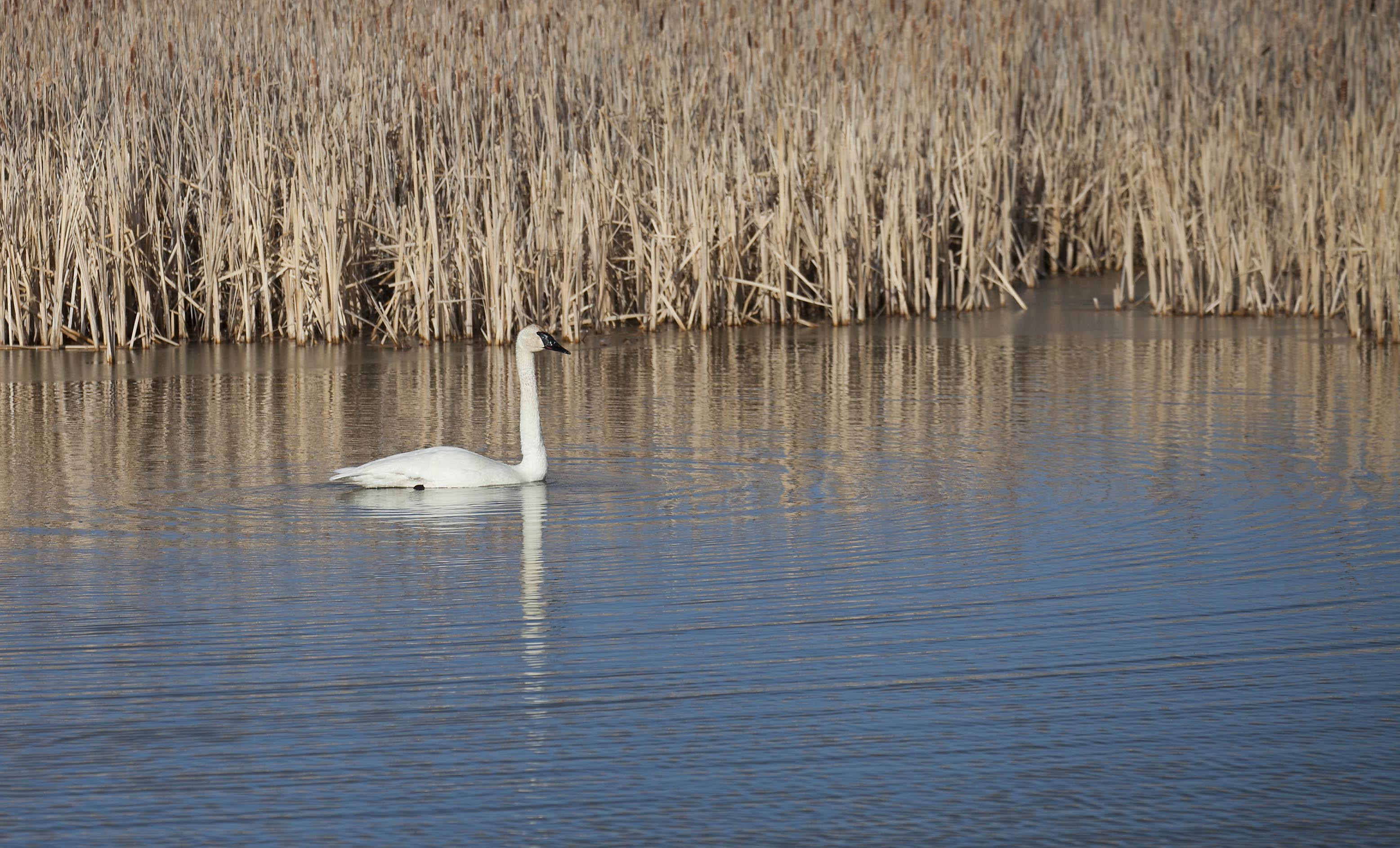
There were a few thoughts running through my brain as I canoed down a stretch of the Bear River though Gentile valley, in southeast Idaho this morning, counting bird species for Utah Power and Light. I was stunned by the beauty as we left the bank, into early morning sunrise, in a river mist with rain clouds forming over surrounding mountains. Our spirits were further buoyed by rampant bird songs, Canada Geese, Sandhill Cranes, Meadow Larks, Red Winged Blackbirds countless swallows and songbirds. Occasionally sun would find a hole in the clouds and awaken the hills to vibrant Spring green offset by dark clouds gathering. Trumpeter Swan Courtesy US FWS/Mountain Prairie-flickr Katie Theule, PhotographerA large white bird appears on the water ahead of us. Perhaps another pelican. Drifting closer we startled this elegant graceful being, which emits a loud trumpeting call to echo through the shrouds of fog. Trumpeter Swan. We are held in awe of this magnificence. Still on the endangered species list, due to overharvesting and habitat loss.
Winding our way through many river miles we finally arrived at the backwaters of Oneida Reservoir, as the river disappears in a rugged defile called the Narrows. Most of this once magnificent stretch of wildriver now lies beneath the reservoir
This is Jack Greene and I am Wild About Utah!
Credits:
Map: The Bear River Basin Courtesy Utah Division of Water Rights
Images:Courtesy US FWS/Mountain Prairie-flickr Katie Theule, Photographer
Text: Jack Greene
Audio: Courtesy and Copyright Kevin Colver
Transcribed from the audio supplied by UPR
Additional Reading:
Russell, Osborne, York, Lem A, Journal Of A Trapper Or Nine Years in the Rocky Mountains 1834-1843, Syms York, 1921, Digitized by Google, https://archive.org/details/journalatrapper00yorkgoog https://play.google.com/books/reader?id=49HTAAAAMAAJ&pg=GBS.PA7
Crews from multiple agencies gather in the encroaching pinyon-juniper forest to begin building the in-stream structures in Birch Creek, UT. Courtesy & Copyright Shauna Leavitt, PhotographerThe job of building 60 in-stream habitat structures in one week seems like a daunting task. But an energetic group of 16 natural resource managers, researchers and volunteers, finish all 60 in four days.
The crew members come from numerous agencies including the Bureau of Land Management, Utah Division of Wildlife Resources, the National Forest Service, interagency firefighting hotshots, and Utah State University.
The purpose of the project is to demonstrate how effective various in-stream structures are at improving habitat for Bonneville cutthroat trout and restoring riparian habitat on a two-mile stretch of Utah’s Birch Creek, located southeast of Beaver, Utah.
Crews from multiple agencies building in-stream structures to restore Birch Creek. Courtesy & Copyright Shauna Leavitt, PhotographerAt one time Birch Creek was rich with beaver, riparian vegetation and diverse in-stream habitat making it an ideal home for Bonneville Cutthroat trout and sage grouse.
The beaver are now gone, and the once woody riparian vegetation has been largely replaced by an encroaching pinyon-juniper forest. The creek is one narrow ditch-like channel.
According to Joseph Wheaton, Associate Professor in the Department of Watershed Sciences and Principal Investigator, “Without the help [of man-made structures or beaver dams] recovery from this type of degradation could take centuries.”
The crews built a variety of simple structures, some designed to mimic beaver dams and others to imitate natural accumulations of wood and debris jams.
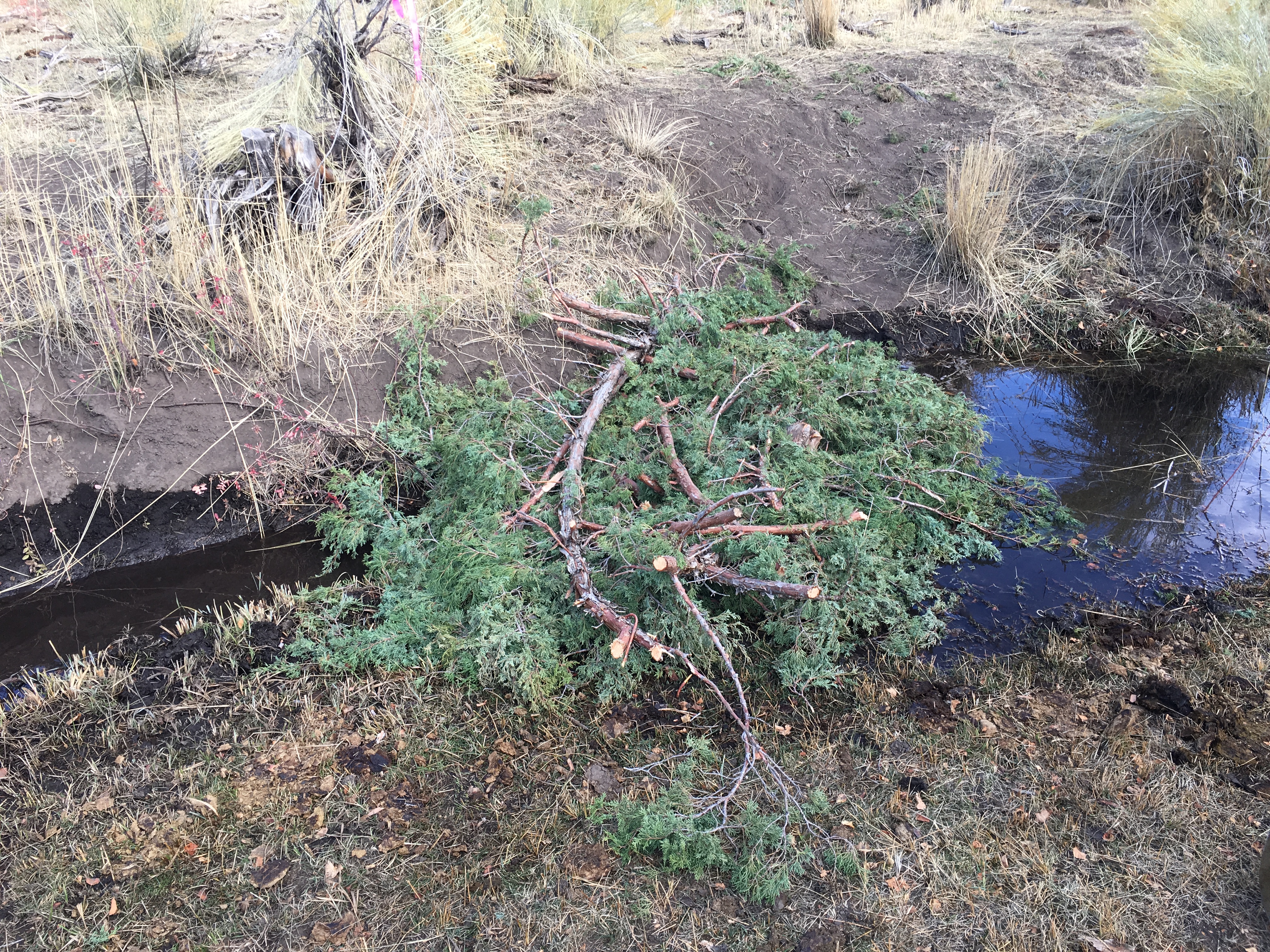
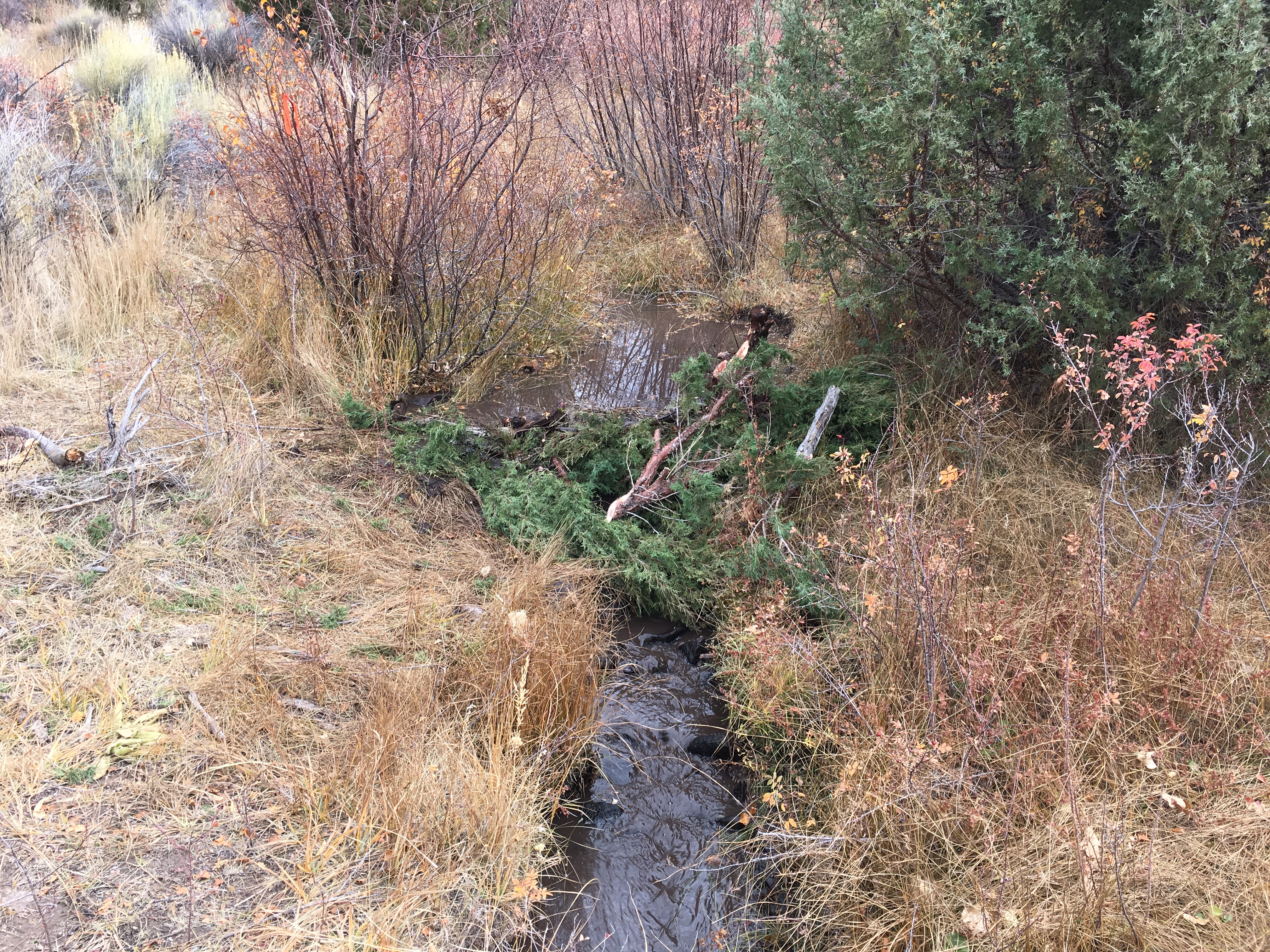
An in-stream structure build from juniper branches, cobble, gravel and mud. Courtesy & Copyright Shauna Leavitt, PhotographerThe largest structures are built with an excavator. The machine pulls up large junipers and drops them in the stream so the water can run over, around and through the juniper and its root wads.
Wheaton explains, ”By putting the [Juniper} in the channel we’re making habitat for fish and at the same time raising water tables, which support a whole range of riparian vegetation and wetland vegetation.”
Another structure is the Beaver Dam Analogues (BDAs), which is a simple, cost-effective method of using posts and juniper branches then adding rocks and mud to partially plug up the deliberately leaky dams, designed to be passable to fish.
A pool forming behind a newly build in-stream habitat structure. Courtesy & Copyright Shauna Leavitt, PhotographerCrews see immediate improvements after each structure is built. New pools form, old-channels that haven’t seen water for decades begin to flow parallel to the main channel, and formerly dry floodplains become wet sponges and wetlands.
These wet sponges will release their water later in the season providing additional moisture in dryer times.
Justin Jimenez, Fisheries Riparian Program Manager with Bureau of Land Management explains why these pools are essential, “We’re working to improve the habitat for native fish by increasing the pool frequency and depth. The depth provides thermal cover.” Which is cooler for summer rearing habitat, and warmer for winter survival.
Before this project began, downstream water-rights holders were concerned about how these structures would impact water for irrigation.
In response to their concerns, Gary O’Brien, a Geomorphologist in the Fluvial Habitat Center at USU installed a common measuring device called a V-notch weir at the top and bottom the of the two-mile stretch to measure the discharge of the stream.
According to O’Brien, “once all the structures fill their pools and the system adjusts for infiltration, we expect the top and the bottom weirs to measure a relatively consistent discharge.”
By the addition of a pressure transducer in the pool behind the weirs, O’Brien will have continuous flow of data at every stage.
With these readings the ranchers can be kept up-to-date on the impact the structures are having on the water resources. The agencies have agreed to remove the structures if gaging shows the structures are negatively impacting downstream water users.
Throughout the project, UDWR, BLM and the USFS will be monitoring cutthroat trout response, and USU will be monitoring how the habitat responds and changes through time.
By monitoring the responses, managers and researchers will be able to make more informed decisions about which types and mix of structures can be most effectively used to restore similar streams cheaply across the state.
This is Shauna Leavitt for Wild About Utah.
Credits:
Photos: Courtesy and Copyright Shauna Leavitt
Text: Shauna Leavitt
Zion Narrows Courtesy & Copyright Rhett HellsternSeventeen miles, and three potential swims. If those two descriptors aren’t deterrents, great scenery awaits those who hike the Zion Narrows from the top down into the main canyon. If you run marathons, bike the LOTOJA race, or simply marvel at nature’s masterpieces, there is nothing intimidating about this adventure. However, if you are a professional armchair quarterback, you had better get some miles under your feet before attempting this adventure, especially if you want to complete it in one day.
I’ve been to Zion many times, but after seeing the inspirational film, “The Bucket List”,
I decided it was time to do this classic hike. Along with good luck, and good sense, the key to success lies in the preparation.
There is no marked trail because at least 60 percent of the hike is in the Virgin River and, although the air temperature was in the 90’s, the water was chilly when we had to do the three short swims. Groups are limited to 12, and permits are required, but Rangers won’t issue them is the flow rate goes above 120 cubic feet per second. We were fortunate and hit a day when it was flowing at 100 CFS.
Unless you reserve one of the dozen Narrow’s campsites for an overnight stay, plan on about 12 hours walking. Unfortunately, if you are too slow and miss the last shuttle bus at the Temple of Sinawava, you will add another 8 mile hike to return to your car at the Visitor Center.
River hiking can be like walking on greasy bowling balls. You can ruin your own shoes, or the Zion Adventure Company will rent sticky-soled boots, tight neoprene socks, and a walking stick. Unless you have two cars, they will also provide the 90-minute shuttle to the Chamberlain Ranch. They are helpful and show a training film about hiking the Narrows. Here you will learn to watch for the signs of deadly flash-floods. If it happens, immediately go to higher ground, available throughout the canyon…except in the “Wall Street” area. Check weather conditions with the Zion Backcountry Desk before you take your first step.
Wear layered clothing, use a river-bag for food and dry clothes, bring at least two liters of water or a good filter, and waterproof bags for your camera. Forget phones, they will not function there. Finally, borrowing a line from “The Bucket List”, (never pass up a bathroom) each hiker is provided with a human waste disposal bag.
To avoid packing extra food and sleeping bags, we were determined to do this as a day-hike. We had picked up our permit the night before, and saw the weather forecast at ten percent chance of light rain. Wanting to hit the trail early, we camped out on the east side of the park. After six hours of slumber-sweet, we let adrenaline pilot us toward the canyon. The first five miles were covered effortlessly, but the trail and shallow river finally transitioned into the copper-colored serpentine canyon we sought.
The Narrows is by far an acme of hikes in Zion. The sandstone walls ascend 2,000 feet, yet at times are only 20 feet apart at their base. For 12 miles we enjoyed incomparable scenery, waterfalls, small tributaries, sandbars where canyon maples provided alluring rest-stops, and the pleasantry was recorded with calendar-quality photos. But then we entered the “Danger Zone”.
True to its namesake, the Wall Street section was full of surprises. The sky darkened as though someone had pulled a black quilt over the canyon. Birds stopped singing. The wind picked up. Our ten percent chance of rain suddenly became one hundred percent! We were already wet, so we laughed…until the lightning flashed. Then thunder rumbled behind us so loudly we turned as if expecting freight trains to pummel us. Since there was no high ground, we picked up our pace and stuck close to the canyon walls. Seven people sloshing, wading, swimming, and helping each other to get to high boulders as soon as possible.
We reached safety the same time the storm stopped. The forecast was accurate. No flash-flood during our adventurous 12-hour journey and, yes, we caught the bus with time to spare. Would we do this hike again? Absolutely!
This is Ron Hellstern for Wild About Utah
Credits:
Images: Courtesy & Copyright Rhett Hellstern
Text: Ron Hellstern, Cache Valley Wildlife Association