
Wind and Sagebrush

Wind and Sagebrush

Wind and Sagebrush: Mountain big sagebrush (Artemisia tridentata subsp. Vaseyana) in flower - Photo Courtesy and Copyright Dr. Leila Shultz
Mountain big sagebrush (Artemisia tridentata subsp. Vaseyana) in flower – Photo Courtesy and Copyright Dr. Leila Shultz

Wind and Sagebrush:Three-tip sage (Artemisia tripartite) with visible yellow flowers. - Photo Courtesy and Copyright Dr. Leila ShultzThree-tip sage (Artemisia tripartite) with visible yellow flowers. – Photo Courtesy and Copyright Dr. Leila Shultz

Hi, I’m Holly Strand of the Quinney College of Natural Resources at Utah State University.

By late summer, most of Utah’s flowering plants have fizzled out for the year—those that remain are looking pretty spent. But not true for the sagebrush. It’s show time for over 20 types of sagebrush of the Intermountain West.

Like grasses and conifers, sagebrush plants are pollinated by the wind. They have no need for the specialized traits designed to attract live pollinators. Instead, they have evolved other strategies to survive and multiply.

For instance, wind-pollinated plants don’t need showy, colorful petals to attract insects or birds. The wind is going to do its job anyway regardless of visual cues. Thus sagebrush flowers are very small and nondescript. In fact, when passing by flowering sagebrush you might not even notice that it’s in bloom. Look for long spikes with clusters of tiny flower heads. The pale yellow flowers are concealed by petal-like bracts, which are the very same color as the rest of the plant.

While the flowers of sagebrush lack in beauty, they make up in quantity. A single flowering stem of the most common sagebrush—known simply as big sagebrush–can hold hundreds of flower heads that produce a massive amount of pollen. Most wind-blown pollen grains won’t end up anywhere near the female part of another plant. So to make up for this risky method of fertilization, individual plants must produce greater volumes of pollen. In contrast, plants with live pollinators get door to door service during fertilization. Far less pollen is needed to get the same job done.

Scent is another way for plants to attract live pollinators. Species pollinated by bees and flies have sweet scents, whereas those pollinated by beetles have strong musty, spicy, or fruity odors. However, the iconic western scent of the sagebrush has absolutely nothing to do with pollination. Instead, the pungent aroma of the sagebrush is a by-product of certain chemicals produced in the leaves. These chemicals evolved to repel animals and to reduce the odds of being eaten or grazed.

The chemicals—bitter terpenes, camphors and other secondary compounds–—peak in early spring. But as the late-summer flowering period approaches, the chemicals start to break down. By winter, browsers like deer and elk can nibble on the protein-rich seed heads without getting a nasty aftertaste.

Thanks to botanist Leila Shultz for sharing her knowledge of sagebrush. For a link to the online version of Leila’s book Pocket Guide to Sagebrush, go to www.wildaboututah.org
If you’d like a hard copy of this Pocket Guide, send an email to wildaboututah@gmail.com We have 5 copies to give away to listeners from across the state.

For Wild About Utah and the Quinney College of Natural Resources, I’m Holly Strand.

NOTE: The copies are gone. You can view the book as a .pdf here or check here for the next printing from https://www.sagestep.org/pubs/brushguide.html.

Credits:

Photo Courtesy & Copyright 2007 Dr. Leila Shultz
Text: Holly Strand, Quinney College of Natural Resources at Utah State University

Additional Reading:

Dudareva, Natalia. 2005. Why do flowers have scents? Scientific American April 18. https://www.scientificamerican.com/article/why-do-flowers-have-scent/

Shultz, Leila. 2012. Pocket Guide to Sagebrush. PRBO Conservation Science. https://digitalcommons.usu.edu/sagestep_reports/20/
As pdf: https://rdjzr2agvvkijm6n3b66365n-wpengine.netdna-ssl.com/wp-content/uploads/2018/06/sagebrush_pock_guide_reduced.pdf

Shultz, L. M. 2006. The Genus Artemisia (Asteraceae: Anthemideae). In The Flora of North America north of Mexico, vol. 19: Asterales, pp. 503–534. Flora of North America Editorial Committee, eds. Oxford University Press. New York and Oxford.

USDA, NRCS. 2012. The PLANTS Database, National Plant Data Team, United States Department of Agriculture (USDA), Natural Resource Conservation Service (NRCS): https://www.plants.usda.gov

VanBuren, R., J. C. Cooper, L. M. Shultz and K. T. Harper. 2011. Woody Plants of Utah. Utah State University Press & Univ. Colorado. 513 pp. https://upcolorado.com/utah-state-university-press/woody-plants-of-utah
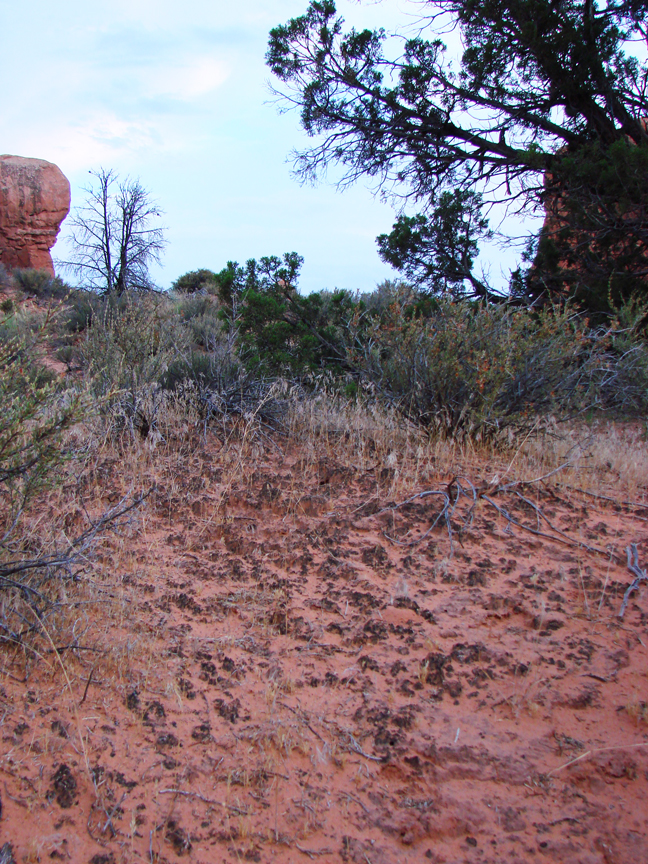
Cryptobiotic Soil Crusts

Click to view larger image of Cryptobiotic Soil Crust, Photo Courtesy and Copyright Mark Larese-Casanova
Cryptobiotic Soil Crust
Photo Courtesy & Copyright 2009
Mark Larese-Casanova

Hi, this is Mark Larese-Casanova from the Utah Master Naturalist Program at Utah State University Extension.

Looking out over a Utah desert, we might see relatively few plants- perhaps some sagebrush, maybe a few junipers or Joshua trees, or even some small wildflowers or cacti. What is less noticeable, though, is the living soil crust that holds this entire landscape together. It’s not just sand, but rather an important and vast partnership between bacteria, lichens, algae, and fungi. These soil crusts are often referred to as ‘cryptobiotic’, which means ‘living in suspended animation’. This is a fitting description, considering that water can be so rare in Utah’s deserts.

Cyanobacteria, which is often called blue-green algae, is the backbone of cryptobiotic soil crust. Vast networks of long, microscopic filaments of cyanobacteria and fungi grow in length when they are wet, and leave behind a casing that literally binds the soil together. So, what might otherwise be loose sand not only is less likely to be washed away by water or blown away by wind, but also is able to hold much more water for plants.

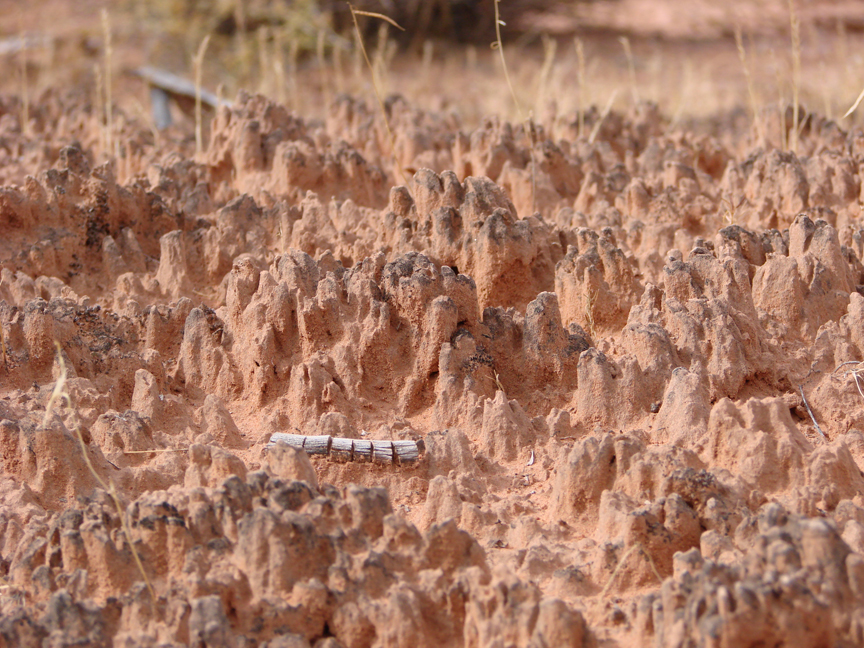
Click to view larger image of Cryptobiotic Soil Crust, Photo Courtesy and Copyright Mark Larese-Casanova
Cryptobiotic Soil Crust
Photo Courtesy & Copyright 2009
Mark Larese-Casanova

Cyanobacteria is also extremely useful to desert landscapes for its ability to take Nitrogen out of the air and make it available to plant roots in the soil. Desert soils typically have relatively low nutrients, so this is especially important to desert plants.

In many Utah deserts, cryptobiotic soil crusts can cover up to 70% of the ground surface. Old soil crust can often look like small mountain ranges with black or white peaks inhabited by lichens or mosses. The little valleys in between the tiny mountains of crust are perfect spots for the seeds of desert plants to grow. Over time, the above ground crust can grow up to ten centimeters, or four inches, thick!

However, cryptobiotic soil crust grows at an alarmingly slow rate of about one millimeter per year. So, any soil crust that is disturbed can take a very long time to recover. Depending on the amount of moisture a desert receives, it can take anywhere between 20 and 250 years for soil crust to grow back.

Next time you’re out in the desert, kneel down and have a close look at the telltale peaks and valleys of cryptobiotic soil crust. If you bring a magnifying glass, you just might be able to see some of the lichens and mosses. Be sure to stay on trail, though, and whatever you do, don’t bust that crust!

For Wild About Utah, I’m Mark Larese-Casanova.

Credits:

Images: Courtesy and copyright Mark Larese-Casanova
Text:     Mark Larese-Casanova, Utah Master Naturalist Program at Utah State University Extension.
Additional Reading:

US Department of Interior. 2001. Biological Soil Crusts: Ecology and Management. Bureau of Land Management Technical Reference 1730-2., https://www.blm.gov/nstc/library/pdf/CrustManual.pdf
Rosentreter, R., M. Bowker, and J. Belnap. 2007. A Field Guide to Biological Soil Crusts of Western U.S. Drylands. U.S. Government Printing Office, Denver, Colorado., https://www.soilcrust.org/

Dust in the Wind

Dust Storm Milford Flats
4 March 2009
US Geological Survey photo by Mark Miller


Hi, I’m Holly Strand of the Quinney College of Natural Resources at Utah State University.

American paleontologist Roy Chapman Andrews was a frequent visitor to the Gobi Desert. This is how he described being caught in a Gobi desert dust storm: “Seemingly a raging devil stood beside my head with buckets of sand, ready to dash them into my face…” “…after each raging attack it would draw off for a few moments’ rest. Then suddenly the storm devil was on us again, clawing, striking, ripping, seeming to roar in fury that any of the tents still stood.”

Andrews didn’t have to go so far to feel the rage of a dust storm. He could have come to western Utah. While we don’t have the monstrous storms of the Sahara and the Gobi/Manchurian deserts, the eastern Great Basin–which is essentially western Utah–sits secure on any global list of dust storm hotspots.

Let’s consider why this is so…

First and foremost, western Utah has the dust. In scientific terms, dust is any particle—organic or inorganic—that is less than .63 microns or smaller in diameter. .63 microns is about half the width of a single human hair. In geological terms think silt or clay particles. A grain of sand is much larger. If you are the size of a dust particle, then a relatively small puff of wind will release you into the air. And you’ll stay there until it’s completely calm or rain forces you down.

A great place to find geologic dust is in desert playas. For runoff sediments collect in these dry lake depressions. Western Utah has several of these desert dust bins. And satellite data have confirmed that playas such as Sevier Dry Lake, Tule Dry Lake, and Great Salt Lake Desert are major sources of dust plumes. The alluvial fans of the Great Basin mountains provide an additional source of dust.

To get this dust airborne you need wind which is also plentiful in western Utah. This region typically experiences strong south and southerwesterly winds called “hatu winds.” That’s Utah spelled backwards. The name was coined by colorful Utah meteorologist Mark Eubank. These hatu winds blow south to north or to the northwest. They pick up speed and dust as they race along the north-south trending Great Basin ridges. They can reach speeds of over 90 miles per hour.

Utah’s hatu winds peak in the spring months with a secondary peak in August-September. In spring these windy freight trains full of dust can hit the populated Wasatch Front wreaking havoc with air quality and human health.

Sometimes raindrops capture dust in the airstream and splat them onto our windshields and windows. These mud rains are most common in spring when the hatus are at their peak. And this is why saavy Utahns never bother washing their home windows until June.

While dust storms can be considered natural events, the fact that they are increasing in number and severity is definitely unnatural. The increase is caused by human-related activities that remove vegetation or break the biological soil crusts that help stabilize dust and soil. Overgrazing, water withdrawals, military operations, farming on marginal lands, off-road vehicle riding, fires, even restoration activities all release dust to be carried off by the next significant wind.

Thanks to Atmospheric Scientist Maura Hahnenberger for her help with this Wild About Utah story.

For Wild About Utah, and the Quinney College of Natural Resources, I’m Holly Strand.

Credits:

Images: Courtesy USGS.gov and NRCS.gov
Theme: Courtesy & Copyright Don Anderson as performed by Leaping Lulu
Sound: Wind sound effect from Sound Bible.com Recorded by Mark DiAngelo https://soundbible.com/1810-Wind.html
Text: Holly Strand

Sources & Additional Reading

Hahnenberger, M. and K. Nicoll. Geomorphic and land use characteristics of dust sources in the eastern Great Basin of Utah, U.S.A. Accepted Geomorphology. https://georesearch.ir/article-1-381-en.html

Hahnenberger, M. and K. Nicoll, 2012. Meteorological characteristics of dust storm events in the eastern Great Basin of Utah, U.S.A. Atmospheric Environment, 60, 601-612. https://doi.org/10.1016/j.atmosenv.2012.06.029, https://www.sciencedirect.com/science/article/abs/pii/S1352231012005808?via%3Dihub
https://sci-hub.se/https://doi.org/10.1016/j.atmosenv.2012.06.029

Jason P Field, Jayne Belnap, David D Breshears, Jason C Neff, Gregory S Okin, Jeffrey J Whicker, Thomas H Painter, Sujith Ravi, Marith C Reheis, and Richard L Reynolds The ecology of dust Front Ecol Environ 2010; 8(8): 423–430, doi:10.1890/090050 (published online 12 Oct 2009)https://www.esajournals.org/doi/pdf/10.1890/090050
https://sci-hub.se/https://www.esajournals.org/doi/pdf/10.1890/090050

Neff, J. C., A. P. Ballantyne, G. L. Farmer, N. M. Mahowald, J. L. Conroy, C. C. Landry, J. T. Overpeck, T. H. Painter, C. R. Lawrence, and R. L. Reynolds, 2008: Increasing eolian dust deposition in the western United States linked to human activity. Nature, 1, 189-195
https://www.nature.com/articles/ngeo133
https://sci-hub.se/https://doi.org/10.1038/ngeo133

Warner, Thomas T. 2004. Desert Meteorology. NY: Cambridge University Press
https://www.cambridge.org/core/books/desert-meteorology/830636E147078337D24957845F6A6855
https://doi.org/10.1256/wea.201.04

Washington, R., M. Todd, N. J. Middleton and A. S. Goudie, 2003. Dust-storm source areas determined by the Total Ozone Mapping Spectrometer and Surface Observations, Annals of the Association of American Geographers, 93(2), 297-313.
https://onlinelibrary.wiley.com/doi/abs/10.1111/1467-8306.9302003
https://sci-hub.se/https://doi.org/10.1111/1467-8306.9302003

Miller, M. E., et al. (2012). “Post-fire land treatments and wind erosion – Lessons from the Milford Flat Fire, UT, USA.” Aeolian Research 7: 29-44.
https://www.sciencedirect.com/science/article/abs/pii/S1875963712000171
https://sci-hub.se/https://doi.org/10.1016/j.aeolia.2012.04.001

Steenburgh, W. J., et al. (2012). “Episodic Dust Events of Utah’s Wasatch Front and Adjoining Region.” Journal of Applied Meteorology and Climatology 51(9): 1654-1669.
https://journals.ametsoc.org/view/journals/apme/51/9/jamc-d-12-07.1.xml

National Park or National Monument?

National Park or National Monument: Sipapu Natural Bridge, Natural Bridges National Monument, Courtesy and Copyright Anna Bengston
Sipapu Natural Bridge
Natural Bridges National Monument
Courtesy & Copyright Anna Bengston

National Park or National Monument: Delicate Arch, Arches National Park, Courtesy and Copyright Anna BengstonDelicate Arch
Arches National Park
Courtesy & Copyright Anna Bengston

Established in 1916 the National Park Service manages all properties included in the National Park System. This system includes over 400 areas that encompass more than 84 million acres of land. These areas can go by one of 31 different titles. Within this system, Utah boasts 1 national historic site, 2 national recreation areas, 7 national monuments, and 5 national parks. While the reason for some of these titles is self-explanatory, the reason for others is less clear. National Park or National Monument?

For example, what makes one area a “national park” and another a “national monument?” Most people – including myself – would probably guess that the difference is in size. And while this is sometimes true, the primary difference is the reason for which each is established, because these two designations grew from historically separate concepts. The notion of the national park, which was simply the idea of large-scale natural preservation for public enjoyment, grew in popularity throughout the 1800s. As a result you can typically think of a national park as a spectacular scenic feature or natural phenomena preserved for inspirational, educational, and recreational value.

On the other hand, the idea of the national monument arose as a result of the need and desire to also protect prehistoric cliff dwellings, pueblo remains, and other historic ruins found by explorers of the American West and Southwest. Efforts to protect these sites resulted in the passing of the Antiquities Act of 1906. Therefore a national monument is usually designated to preserve objects of prehistoric, historic, cultural, and/or scientific interest. However, the Antiquities Act has been used more widely to preserve natural features as well, meaning the content of national monuments can be quite varied from wilderness areas to military sites to buildings and ruins.

There are also a couple of legal differences between these two designations. National parks are established through acts of Congress, whereas national monuments are established by Presidential proclamation. Administratively, the National Park Service manages all national parks. While national monuments, depending on their location and content, can fall under not only under the jurisdiction of the National Park Service, but also that of the U.S. Forest Service, the U.S. Fish and Wildlife Service, the National Oceanic and Atmospheric Administration, the Department of Defense, or the Bureau of Land Management.

So, it’s not just size that makes the difference, its intent, content, process of establishment, and administration. The next time you visit one of Utah’s national parks or monuments, will you be able to tell the difference?

For Wild About Utah, I’m Anna Bengtson of Park City.

Arches National Park
Bryce Canyon National Park
Capitol Reef National Park
Canyonlands National Park
Zion National Park

Golden Spike National Historic Site
Cedar Breaks National Monument
Dinosaur National Monument
Grand Staircase National Monument
Hovenweep National Monument
Natural Bridges National Monument
Pipe Spring National Monument(Border Utah/Arizona)
Rainbow Bridge National Monument
Timpanogos Cave National Monument

Flaming Gorge National Recreation Area
Glen Canyon National Recreation Area

Credits:
Image: Courtesy and Copyright Anna Bengston
Text: Anna Bengston

Additional Reading:

Biggers, Ashley. “National Parks Versus National Monuments.” Outside Online. 22 Apr. 2014. Web. 8 June 2014. https://www.outsideonline.com/adventure-travel/escapes/travel-agent/The-Difference-between-National-Parks-and-National-Monuments.html.

McDonnell, Janet. The national parks: shaping the system. 3rd ed. Washington, D.C.: U.S. Dept. of the Interior, 2005. Web, 8 June 2014. https://www.nps.gov/parkhistory/online_books/shaping/index.htm.

O’Connor, Mary. “Killing A Bill that Could Save National Parks.” Outside Online. N.p., 14 Apr. 2014. Web. 8 June 2014. https://www.outsideonline.com/outdoor-adventure/the-current/footprint/Five-Treasures-We-Owe-to-the-Imperiled-Antiquities-Act.html.

“Parks and Monuments.” Utah. N.p., n.d. Web. 8 June 2014. https://www.visitutah.com/parks-monuments/.

Righter, Robert. “National Monuments to National Parks:
The Use of the Antiquities Act of 1906”, National Park Service History: National Monuments to National Parks. N.p., Aug. 1989. Web. 8 June 2014. https://www.nps.gov/parkhistory/hisnps/npshistory/righter.htm.

United States. National Park Service. “National Park Service History: National Park System Nomenclature.” National Parks Service. U.S. Department of the Interior, n.d. Web. 8 June 2014. https://www.nps.gov/history/history/hisnps/NPSHistory/nomenclature.html.

United States. National Park Service. “Frequently Asked Questions.” National Parks Service. U.S. Department of the Interior, 28 May 2014. Web. 8 June 2014. https://www.nps.gov/faqs.htm.

Yard, Robert Sterling, and Isabelle F. Story. “Parks vs. Monuments.” The national parks portfolio. 6th ed. Washington: U.S. Government Printing Office, 1931. Web, 8 June 2014. https://www.nps.gov/history/history/online_books/portfolio/portfolio0b.htm.