Tiny Brain, Big Memory

Mountain Chickadee, Poecile gambeli, Courtesy US FWS, Anna Weyers Blades, Photographer
Mountain Chickadee, Poecile gambeli
Courtesy US FWS, Anna Weyers Blades, Photographer
Winter is a season when most of us spend more of our time indoors. But wild animals don’t have that option. Not only must they find ways to keep warm all winter, but they have to work harder to find food. That’s why so many songbirds take advantage of the seeds and suet supplied by us humans at our bird feeders. We do the work for them.

Pine Siskin, Spinus pinus, Courtesy US FWS, Courtney Celley, Photographer
Pine Siskin
Spinus pinus
Courtesy US FWS
Courtney Celley, Photographer

Red Breasted Nuthatch Courtesy US FWS Dave Menke, Photographer Red Breasted Nuthatch
Courtesy US FWS
Dave Menke, Photographer

Clark's Nutcracker Courtesy US Fish & Wildlife Service Dave Menke, Photographer Clark’s Nutcracker
Courtesy US Fish & Wildlife Service
Dave Menke, Photographer

Mountain Chickadee, Poecile gambeli, Courtesy Pixabay, BlenderTimer, Contributor Mountain Chickadee, Poecile gambeli
Courtesy Pixabay
BlenderTimer a.k.a.Daniel Roberts, Contributor

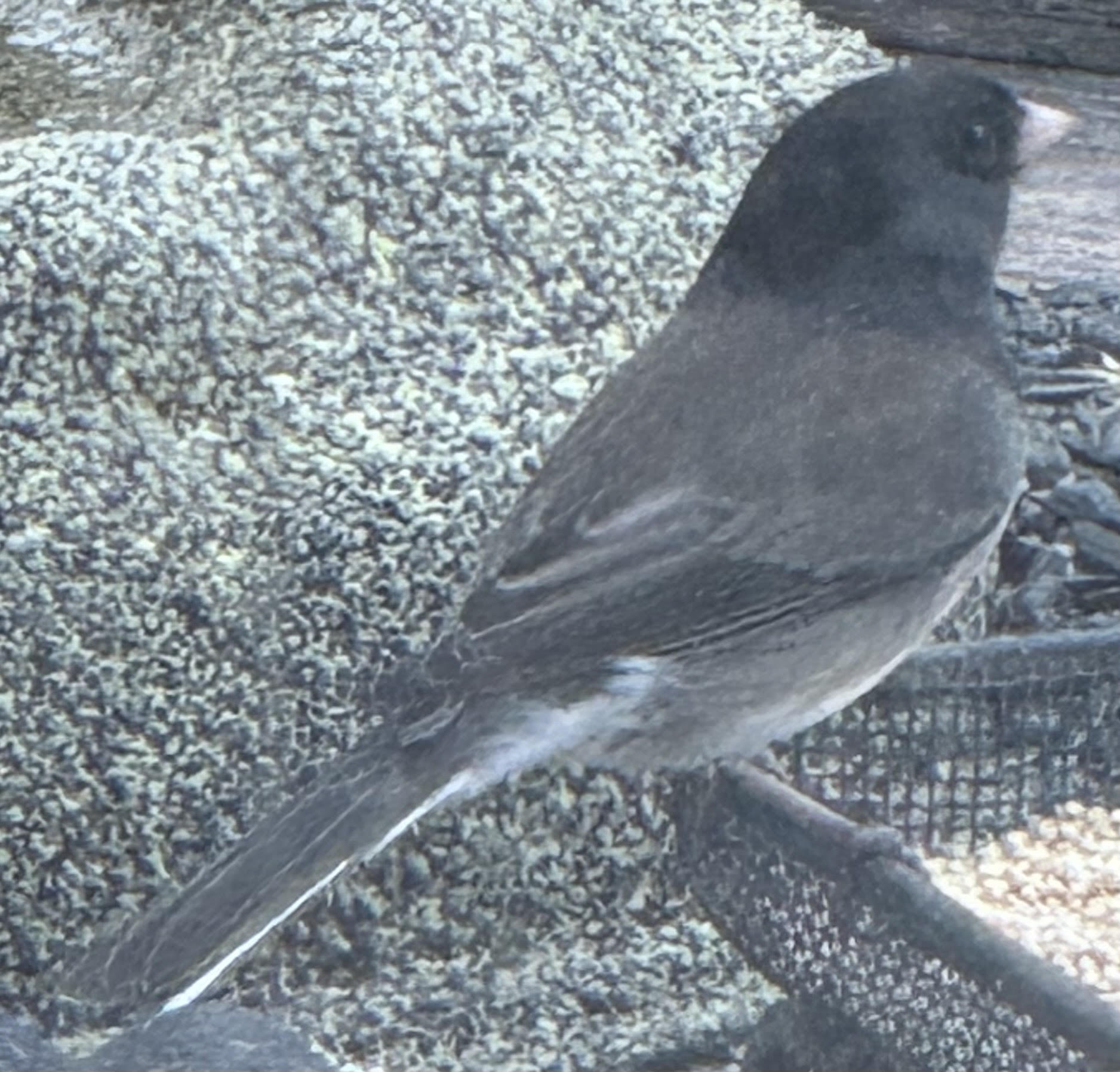
Over many years, I’ve learned which birds to expect at the feeders in our backyard. We host finches, sparrows, magpies, and doves year-round. In winter, we also see a lot of Black-capped Chickadees, American Goldfinches, Dark-eyed Juncos, and Pine Siskins. Those are species that spend the warmer months in the forested mountains near our home, then come down for the winter into town, where they know it’s easier to find food.

But other songbirds we only see a few times a year – ones that seem to survive just fine in the winter woods. That got me to wondering: How are they able to do that while others can’t or won’t? One survival strategy is to nibble all winter on food that they stored in the fall. It’s called seed-caching – that’s c-a-c-h-e, like the valley around Logan.

You may have heard of seed-caching by the Clark’s Nutcracker, well-known for its habit of burying the large seeds of limber pine and pinyon pine for later use. But that approach only works if you can remember where you stashed food a few months ago. Clark’s Nutcrackers are in the same family as crows, ravens, and jays – birds renowned for their cleverness, with a larger front part of their brains than other perching birds. What about smaller songbirds with tinier brains? Do they have good memories, too?

For some northern Utah songbirds that don’t rely as much on feeders, the answer seems to be “Yes.” They gather seeds, dried berries, and dead insects in the fall, and stash them under bark or in crevices in tree trunks for later use. These seed-caching birds include the Red-breasted Nuthatch, Juniper Titmouse, and Mountain Chickadee.

You might be wondering: “Wait, there’s two different kinds of chickadee? How are they different?” Well they’re pretty similar. The Mountain Chickadee’s song and call are a bit higher-pitched, and they sport a cute little white “eyebrow” that black-caps don’t have. And despite having a brain slightly larger than a pea, they have great memories.

Recently, some biologists conducted an ingenious experiment. They put radio tags on Mountain Chickadees, then hung out seed feeders equipped with radio frequency readers that would only open to certain individuals. That meant each bird would have to learn for itself which feeders were food sources for them. Then the scientists tracked how often the little critters would find the right feeders, and how long it took them to remember which ones to visit. For most individuals, it didn’t take long at all.

Then the researchers switched things up, changing the radio frequencies so the birds had to re-learn where they could find seeds. It turned out that the birds who learned fastest the first time had the most difficulty adjusting to the change. The scientists think this shows that it’s memory, and not exploratory foraging, that guides their feeding behavior.

Mountain Chickadees can live up to nine years, a long time for such a tiny bird. Having a good long-term memory helps them do that. I think that’s pretty awesome – even if it does keep them from visiting my feeders every winter.

I’m Mark Brunson, and I’m wild about Utah’s endlessly fascinating bird life.

Credits:

Images Mountain Chickadee, Courtesy US FWS, Anna Weyers Blades, Photographer
Red-breasted Nuthatch, & Clark’s Nutcracker, Courtesy US FWS, Dave Menke, Photographer
Pine Siskin, Courtesy US FWS, Courtney Celley, Photographer
Image Mountain Chickadee, Courtesy Pixabay, BlenderTimer a.k.a.Daniel Roberts, Contributor, https://pixabay.com/photos/mountain-chickadee-bird-animal-9971732/
Featured Audio: Courtesy & © Kevin Colver, https://wildstore.wildsanctuary.com/collections/special-collections
Text: Mark Brunson, https://www.usu.edu/experts/profile/mark-brunson/
Additional Reading: Mark Brunson, https://www.usu.edu/experts/profile/mark-brunson/ & Lyle Bingham, Bridgerland Audubon Society

Additional Reading

Mark Brunson’s archive: https://wildaboututah.org/?s=brunson

Mountain Chickadee. All About Birds, Cornell Lab of Ornithology. https://www.allaboutbirds.org/guide/Mountain_Chickadee/overview

Mountain chickadees have remarkable memories. A new study explains why. Nevada Today, April 24, 2024. https://www.unr.edu/nevada-today/news/2024/chickadee-memory-genetic-tradeoffs

Greene, Jack, Bird Brains,, Wild About Utah, September 6, 2017, https://wildaboututah.org/bird-brains/

Greene, Jack, Clark’s Nutcracker, Wild About Utah, January 7, 2019, https://wildaboututah.org/clarks-nutcracker/

Hutson, Matthew. 2024. The Elephantine Memories of Food-Caching Birds. The New Yorker, Dec. 29, 2024. https://www.newyorker.com/science/elements/the-elephantine-memories-of-food-caching-birds

Where is that bird going with that seed? It’s caching food for later. All About Birds, Cornell Lab of Ornithology, April 13, 2016. https://www.allaboutbirds.org/news/where-is-that-bird-going-with-that-seed-its-caching-food-for-later/

Ye, Yvaine, Goda, Nicholas, Mountain chickadees have remarkable memories. A new study explains why, CU Boulder Today, University of Colorado Boulder, April 17, 2024, https://www.colorado.edu/today/2024/04/17/mountain-chickadees-have-remarkable-memories-new-study-explains-why

Cox, Sophie, The brain science of tiny birds with amazing memories, Duke Research Blog, Duke University, via Phys.org/Science X Network, March 27, 2023, https://phys.org/news/2023-03-brain-science-tiny-birds-amazing.html

Cache Valley Winter Backyard Birds, Bridgerland Audubon Society, https://bridgerlandaudubon.org/wp-content/uploads/2021/12/BAS-ChristmasBirdCount-TallySheetV1.1.pdf

Reindeer Visit

Yuki the Reindeer from the Mountain West Animal Hospital. Courtesy & Copyright Mary Heers, Photographer
Yuki the Reindeer from the Mountain West Animal Hospital
Courtesy & Copyright Mary Heers, Photographer

Mary with Bluebell the Reindeer from the Rockin Reindeer Ranch at the Ogden City Christmas Square. Copyright Mary Heers Mary with Bluebell the Reindeer
from the
Rockin Reindeer Ranch
Ogden City Christmas Square
Copyright Mary Heers

I first time I came face to face with a living, breathing reindeer was a few weeks ago at the Reindeer Express hosted by Utah State University vet students. Two vets from the Mt. West Animal Hospital near Provo had brought two of their reindeer with them to Cache Valley and were standing by to answer our questions.

The first thing I learned was that both male and female reindeer grow a new set of antlers every year. The antlers are solid bone and can weigh up to 15 pounds. The males usually drop their antlers in Nov after the mating season, while the females keep theirs a few months longer – until after they drop their calves in the Spring. A vet student chimed in. He said reindeer losing their antlers looks a lot like us losing a baby tooth. The antlers get a little wobbly and simply fall off. The reindeer just keeps grazing.

Now I was hot on the trail of reindeer in Utah. I went to the Ogden City Christmas Square to meet Bluebell from the Rockin Reindeer farm near Ogden. As admirers were taking pictures, Bluebell’s owner told me that watching the antlers regrow could be pretty exciting. Every morning you could get up and easily see how the antlers had grown another inch overnight.

I also learned if you listened closely, you could hear a clicking when the reindeer walked. The first time they heard it, they thought something was terribly wrong. But all reindeer click when the tendon in their leg slides over a bone. Clicking seems to be a way for the herd to find each other in white-out winter weather.

Another adaptation to intense cold is the hair that covers every reindeer’s nose This helps keep it warm in the reindeers natural habitat in the far north.

I can trace my own fascination with reindeer to my childhood days when my father arranged for a friend of his to dress up as Santa and personally deliver a big white sack full of presents to our house. The fact that Santa rang our doorbell didn’t strike me as odd since we didn’t have a chimney. One Christmas Eve I was talking all day about how I would soon get to meet Santa’s reindeer. When the doorbell rang, I rushed to open the door. There was Santa with his big white sack. No reindeer.

“Where are the reindeer?” I asked.

“I left them down the street,” Santa said. “Let’s go see them after we open the presents. “

That did the trick. I forgot all about the reindeer.

But now that I’m older and wiser, I know that most male reindeer drop their antlers in Nov, while the females keep theirs a few more months. So the odds are very, very good that the Santa that rang my doorbell was driving an all-female dream team.

This is Mary Heers and I’m Wild About Utah

Credits:
Photos: Courtesy Mary Heers,
Featured Audio: Courtesy & Copyright © Friend Weller, Utah Public Radio upr.org
Text: Mary Heers, https://cca.usu.edu/files/awards/art-and-mary-heers-citation.pdf
Additional Reading: Lyle Bingham, https://bridgerlandaudubon.org/

Additional Reading

Wild About Utah, Mary Heers’ Wild About Utah Postings

Heaps, Spenser, (The Daily Herald), Springville veterinarian and his reindeer find success, Salt Lake Tribune, June 6, 2015 https://archive.sltrib.com/article.php?id=2596124&itype=CMSID

Bott, Isaac, DocBott – Musings of a mixed animal veterinarian, https://docbott.org/

Rockin Reindeer Ranch, https://www.rockinreindeerranch.com/

Rough-legged Visitors

Rough-legged Visitors: Rough-legged Hawks, Buteo lagopus Courtesy US FWS Louis Agassiz Fuertes, Illustrator
Rough-legged Hawks
Courtesy US FWS
Louis Agassiz Fuertes, Illustrator
I’m so ready for snow to cover our lower canyons which allows me to ski near our canyon home! I’m not alone on this wish. Thinking of those little furry critters that use snow to protect them from hungry predators- hawks, owls, coyotes, fox, cats, etc. With the grasses lying low to the ground, the small mammals- primarily mice and meadow voles, their cover has been blown and until enough snow falls giving them shelter, they are at the mercy of those with claws, beaks, and fangs.

Rough-Legged Hawk, Buteo lagopus, Courtesy US FWS
Rough-Legged Hawk
Buteo lagopus
Courtesy US FWS

Young Rough-legged Hawk with black belly and lighter head Courtesy US FWS, Tom Koerner, Photographer Young Rough-legged Hawk with black belly and lighter head
Courtesy US FWS, Tom Koerner, Photographer

Rough-legged Hawk on Power Pole Courtesy US FWS John and Karen Hollingsworth, Photographers Rough-legged Hawk on Power Pole
Courtesy US FWS
John and Karen Hollingsworth, Photographers

Additionally, enough snow- 6 inches or more, offers excellent insulation from extreme low temperatures. This subnivean (below the snow) world is alive with activity from those who don’t have the luxury of hibernating in a burrow beneath the ground. The aerial predators, and members of the canid and feline families, would agree with those who wish for a snow-free valley – easy pickings!

A most a spectacular avian winter visitor, the rough legged hawk, spend their breeding season in the far north- Canada and Alaska. With the loss of our Swainson hawks that spend their winters in Argentina, it does the heart good to see their replacement rough legs move in.

The Rough-legged Hawk spends the summer capturing lemmings on the arctic tundra, tending a cliffside nest under a sun that never sets. Found globally across northern latitudes, it occurs in both light and dark forms.

The name "Rough-legged" refers to the feathered legs. Joining them are the Ferruginous Hawk and the Golden Eagle, the only American raptors to have legs feathered all the way to the toes.

“These hawks may take an occasional small bird or two when the opportunity presents itself. But small mammals and birds aren’t the only source of food for these beautiful arctic raptors. Rough-legged hawks will scavenge and feed on leftover duck carcasses if and when the need arises, especially when rodents are scarce.

Rough-legged hawks aren’t really adept at capturing live ducks, especially on the wing, but they will scavenge waterfowl carcasses during the sometimes very cold and brutal winters here in Utah.” From the “Bear River Blogger”, which I highly recommend.

Rough-legged Hawks have been shown to hunt more in areas experimentally treated with vole urine than in control areas. They may be able to see this waste (as American Kestrels can), which is visible in ultraviolet light, in order to find patches of abundant Prey.

Despite a strong affinity for rodents, Rough-legged Hawks were perceived as a threat to poultry up until the early 20th century. Being approachable birds that spend their time in open spaces, they were vulnerable to hunting by farmers. It’s now illegal to shoot raptors and most other wild birds under the Migratory Bird Treaty Act.

Thus, I’m expecting to encounter some of these glorious raptors who will be taking advantage of our snow-barren fields laced with rodent urine, as I saunter through them during our Christmas Bird Count this Saturday.

This is Jack Greene for Bridgerland Audubon Society, and Wild About Utah and it’s Wild Roughlegs!!

Credits:

Images: Courtesy US Fish & Wildlife Service, All noted with links below:
Louis Agassiz Fuertes, Illustrator: https://www.fws.gov/media/rough-legged-hawk-1
https://www.fws.gov/media/rough-legged-hawk-0
Tom Koerner, Photographer, https://www.fws.gov/media/rough-legged-hawk-soaring
John and Karen Hollingsworth, Photographers, https://www.fws.gov/media/rough-legged-hawk-power-lines

Featured Audio: Courtesy & Copyright Shalayne Smith-Needham, https://upr.org/,
Kevin Colver, https://wildstore.wildsanctuary.com/collections/special-collections and
J. Chase and K.W. Baldwin.
Text & Voice: Jack Greene, Bridgerland Audubon, https://bridgerlandaudubon.org/
Additional Reading Links: Lyle Bingham, https://bridgerlandaudubon.org/

Additional Reading:

Wild About Utah Pieces by Jack Greene, https://wildaboututah.org/author/jack/

Rough-legged Hawks Are Scavengers, Too., BearRIverBlogger, October 13, 2023, https://bearriverblogger.com/rough-legged-hawks-are-scavengers-too/

Rough-legged Hawk, All About Birds, Cornell Lab of Ornithology, https://www.allaboutbirds.org/guide/Rough-legged_Hawk/id

Migratory Bird Treaty Act of 1918, US Fish & Wildlife Service, US Department of the Interior, https://www.fws.gov/law/migratory-bird-treaty-act-1918

Mourning Cloaks and Witchy Skies

Nora's embellished May Swenson poem: "Unconscious Came a Beauty," as a butterfly-A means to emphasize the butterfly poem subject. Poem copyright acknowledged-Photo Courtesy Shannon Rhodes
Nora’s embellished May Swenson poem: “Unconscious Came a Beauty,” as a butterfly
A means to emphasize the butterfly poem subject.
Poem copyright acknowledged
Photo Courtesy Shannon Rhodes
I’m sitting here today with first grader Nora Baggaley and USU student teacher Ashlyn Prince. Just steps away from where we spend our days at Edith Bowen Laboratory School on the campus of Utah State University, we find Swenson Park, built on the lot where May’s childhood home once stood. She spent her elementary school days here, she was a student at Utah State Agricultural College, and she moved east to become a writer. During her lifetime May Swenson wrote her way into fame by recording memories riding her willow horse, enjoying strawberry juice dripping down her chin, and describing the relationships that develop when a baseball bat, ball, and mitt meet. Eventually she became Chancellor of the Academy of American Poets. I love that she wrote shape poems about simple things like insects.

Insects? Did you say bugs? Coming into student teaching, I wasn’t too thrilled when I heard about the focus we have on bugs. From the beginning of the school year, we were already in the Logan River, digging out stonefly larva. By the second week, I was already writing a book for my students about why I do not like bugs. Here’s some of my book “Definitely NOT the Bug Girl.” I loved butterflies; they had beautiful wings. That was until I saw them closer. They looked an awful lot like grasshoppers with wings, and if you were paying attention, I hate grasshoppers! Why did I never think they were big, sticky, scary insects too? They did come from caterpillars…I should’ve known!”

Throughout the semester, from katydids flying at my head to being chased at recess with grasshoppers, I’ve grown to love the stories and discoveries the children have with bugs. Now today, I see a bug and instantly start to wonder: How did it get here? Where is it going? What would my students think about this? I could almost say I love bugs…

Mourning cloak butterfly (pinned), Courtesy & Copyright Don Rolfs 2010
Mourning cloak butterfly (pinned)
Courtesy & Copyright Don Rolfs 2010 https://wildaboututah.org/springs-earliest-butterflies/
Well, I love bugs.

Swenson’s “Unconscious Came a Beauty” captures an encounter with a butterfly. She isn’t certain about which kind of butterfly, so she offers two choices based on her descriptors. She must have been outside writing when one landed on her hand long enough for her to notice it, know it well enough to describe it.

I like how her words are in the shape of a butterfly and the wiggly way she typed the title.

When I wrote “Definitely NOT the Bug Girl,” Nora and her classmates encouraged me to include even more chapters about different kinds of insects. They wanted chapters of how I felt about roly polys, katydids, and ladybugs. I never really had an opinion about ladybugs. They were cute but a little frightening when they would fly. Finding them at recess became not so scary to me. Did you know they start their life as black and orange larvae?

How’s this for a poem inspired by May’s shape poem?
Hungry crawls a lady bug larva
To our recess rock riddled with yellow aphids dots
And stopped our games
Orange-striped black
Alligator-wiggling on its six legs
We sat wondering, and Asher brought one to class
Where it crept out overnight as a familiar friend.

Aurora Borealis from Logan Utah
Courtesy & Copyright Shannon Rhodes, Photographer
Aurora Borealis from Logan Utah
Courtesy & Copyright Shannon Rhodes, Photographer
Besides bugs, did you know May also wrote about space topics we know, like astronaut landings, gibbous moons, shadows, and her ghost moon? She called it, “the albino bowl on cloth of jet.”

In November, every student, and teacher, was given a nature journal paper to observe the full moon that night. Sadly, the sky was full of clouds and only a faint glow was visible. Amazingly enough though, we could see the northern lights a few days later! It was a beautiful sight, and made up for missing the November Beaver Moon.


Night Sky Nature Journal Entries by Ashlyn and Nora
Courtesy & Copyright Shannon Rhodes, Photographer
Night Sky Nature Journal Entries by Ashlyn and Nora
Courtesy & Copyright Shannon Rhodes, Photographer

This is a two-voice poem we call “Witchy Sky.”
The beaver moon reminds me of cotton candy in the dark.
         It reminds me of a flashlight shining through my finger.
The northern lights are Glinda and Elphaba.
         I notice a lot of thick clouds.
I can’t really see the shape of the moon in the clouds but still it glows through them.
I wonder what does the moon feel like?
         How bright would the sky have been if there were no clouds tonight?

May Swenson remembered classmates folding paper airplanes and releasing them in the classroom when their teachers’ backs were turned. In a clip from a 1969 recording “Poetry Is Alive and Well and Living in America,” she says, “My poems sail away like that, I don’t know who picks them up, who may be reading them. It’s lovely to think that people are reading my things, especially that they are being stimulated to write their own poems.”

Don’t worry, May. We are inspired by your Mourning Cloak, Ashlyn’s aphid-eaters, Nora’s night sky auroras, and students, young adult and age 6, immersed in words every day.

This is Nora Baggaley, Ashlyn Prince, and Shannon Rhodes, and we are Wild About Utah, May Swenson, night sky poetry, and of course, bugs.
Well, maybe bugs.

Nora, Shannon & Ashlyn in the Studio
Courtesy & Copyright Stu Baggaley, Photographer
Nora, Shannon & Ashlyn in the Studio
Courtesy & Copyright Stu Baggaley, Photographer

Credits:

Images: Classroom art Courtesy & Copyright Shannon Rhodes, Photographer
         Mourning cloak butterfly (pinned), Courtesy & Copyright Don Rolfs
         Nora, Shannon and Ashley in the UPR Studio, Courtesy & Copyright Stu Baggaley
Audio: Courtesy & © Friend Weller, https://upr.org/
Text & Voice:     Shannon Rhodes, Nora Baggaley, and Ashlyn Prince, Edith Bowen Laboratory School, Utah State University https://edithbowen.usu.edu/
Additional Reading Links: Shannon Rhodes

Additional Reading:

BEETLES Project, The Regents of the University of California, https://beetlesproject.org/resources/for-field-instructors/notice-wonder-reminds/

Hellstern, Ron. June Fireflies, Wild About Utah, June 19, 2017, https://wildaboututah.org/june-fireflies/

Ross, Fran, 1969. Poetry is Alive and Well and Living in America. https://www.youtube.com/watch?v=TaKRjiqGizQ&t=1s

Spencer, Sophia with Margaret McNamara. Bug Girl: A True Story. https://www.amazon.com/Bug-Girl-True-Story/dp/0525645934

Strand, Holly. May Swenson, Wild About Utah, April 14, 2009, https://wildaboututah.org/may-swenson-a-utah-poet-and-observer-of-nature/

Swenson, May. Unconscious Came a Beauty. Poets Speak, https://www.youtube.com/watch?v=VO6LSVzBTKs&t=6s

Tevela, Irina. May Swenson in Space, Washington University in St. Louis, July 19, 2019, https://library.washu.edu/news/may-swenson-in-space/