Desert Desserts

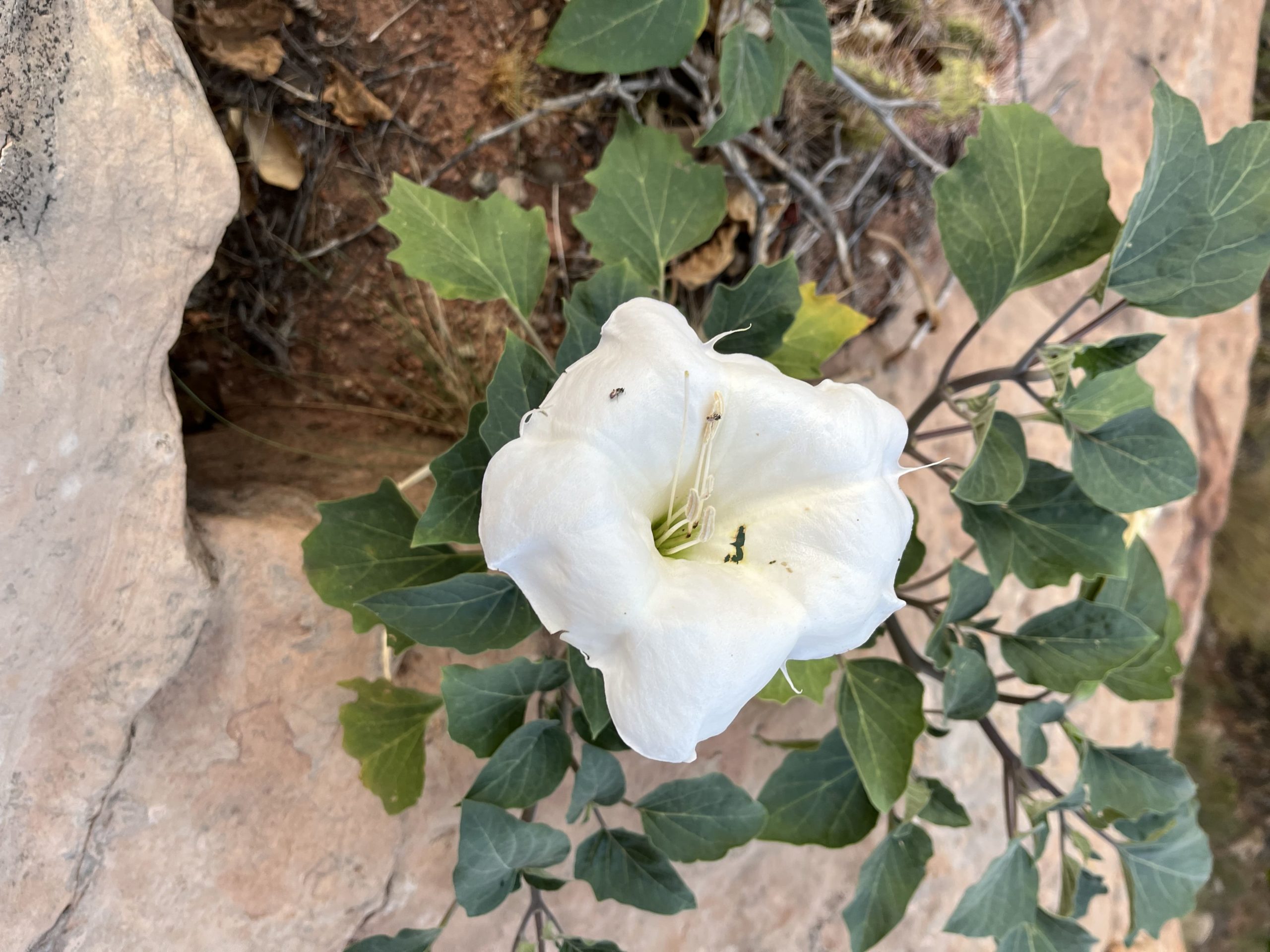
Desert Desserts: Sacred Datura Moon Flower Courtesy & © Shannon Rhodes, Photographer
Sacred Datura Moon Flower
Courtesy & © Shannon Rhodes, Photographer

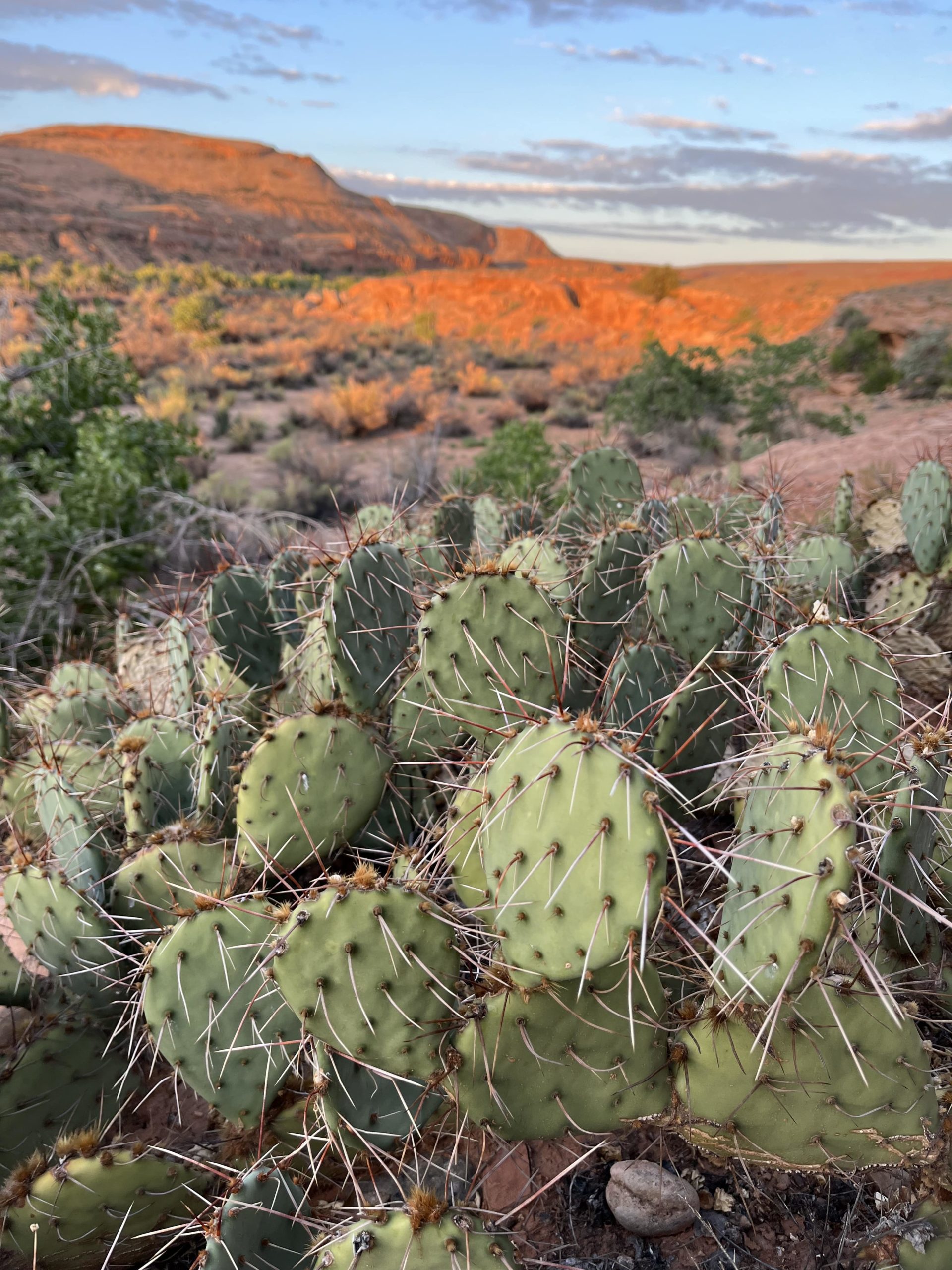
Prickly Pear Cactus Courtesy & © Shannon Rhodes, Photographer Prickly Pear Cactus
Courtesy & © Shannon Rhodes, Photographer

Mormon Tea (Ephedra) From Comb Ridge Courtesy & © Shannon Rhodes, Photographer Mormon Tea (Ephedra) From Comb Ridge
Courtesy & © Shannon Rhodes, Photographer

Limestone Crinoids Courtesy & © Shannon Rhodes, Photographer Limestone Crinoids
Courtesy & © Shannon Rhodes, Photographer

My proofreader’s eye has often spotted “dessert” misspelled as “desert,” and to some, those two concepts couldn’t be more dissimilar. During my three days in and along a short 27-river-mile stretch of Utah’s San Juan River this month though, I marveled at the menu.

Terry Tempest Williams captures what she calls “small devotions of the desert alphabet” in her book “The Illuminated Desert.” She lists lizards languishing in desert heat, ravens and rattlesnakes amid the red rocks. A fascinating one, the Sacred Datura, blooms only at night and attracts pollinators like the hawkmoth with its showy white blossoms in the moonlight. If it is food you are after, however, avoid this poisonous temptation. Instead, try a juicy prickly pear cactus pad once you have removed the long, sharp spines. Some say it tastes like watermelon, but it tastes like a banana to me.

Along the path to San Juan Hill atop Comb Ridge, I also find ephedra, a shrub that carries out photosynthesis in its green branches, that has traditionally been said to have been used medicinally and brewed, hence the common name Mormon tea. Some, like Brock Cheney who has researched the claim that Brigham Young advocated drinking tea made from boiling the stems, argue that Young’s “composition tea” was not made from the Mormon tea plant, and once you try it, the bitterness will tell you why. Having not ever had a sip myself, I can say that the Mormon tea shrub does sprinkle brilliant green to the landscape like a garnish.

“Lie down on your backs and try to feel what is special about this place.” That’s the challenge in Joseph Cornell’s book “Sharing Nature with Children,” but it is equally rewarding to do as an adult. Lounging in the raft as another rows, I look from the sediment-laden river that reminds me of watery chocolate pudding thanks to recent rainstorms, to the great blue heron standing as a guide, flying ahead and waiting for us to catch up, just to fly ahead again. I watch with wonder as the western tanager males, songbirds with yellow bodies and black wings, heads aflame with red-orange, flutter among the salt cedars.

This oasis offers a promise of quiet away from the commotion of my city life as the desert bighorn sheep nod from the coyote willow. Even after studying the scorpions in the sand illuminated by flashlight, I stretch out and nibble at the buffet of constellations above me in the sky.

The crinoids encased in the limestone boulders along the riverbank the next morning remind me that this place was once for millions of years, actually, an ancient inland sea. I find deliciousness here in the dry heat, the muddy grit, as a guest who will return, hungry for more.

For Wild About Utah, I’m Shannon Rhodes.

Credits:
Images: Courtesy & Copyright Shannon Rhodes, Photographer
Audio: Courtesy & © Kevin Colver https://wildstore.wildsanctuary.com/
Text:     Shannon Rhodes, Edith Bowen Laboratory School, Utah State University https://edithbowen.usu.edu/
Additional Reading Links: Shannon Rhodes

Additional Reading:

Cheney, Brock. 2009. Mormon Tea! Plain but Wholesome: Adventures in Mormon Pioneer Food. https://pioneerfoodie.blogspot.com/2009/02/in-news-mormon-tea.html

Cornell, Joseph. 1998. Sharing Nature With Children. DAWN Publications. https://www.sharingnature.com/sharing-nature.html

Eldredge, Sandra. 1992. Geologic Resources of San Juan County. Department of Natural Resources Utah Geologic Survey. https://ugspub.nr.utah.gov/publications/public_information/PI-14.pdf

Larese-Casanova, Mark. 2011. Amazing Adaptations of Utah’s Desert Plants. https://wildaboututah.org/amazing-adaptations-of-utahs-desert-plants/

U.S. Forest Service. Sacred Datura. https://www.fs.usda.gov/wildflowers/beauty/Sky_Islands/plants/Datura_wrightii/index.shtml

https://www.fs.usda.gov/wildflowers/ethnobotany/Mind_and_Spirit/datura.shtml

Utah State University Extension. Salt cedar and coyote willow. https://extension.usu.edu/rangeplants/shrubs-and-trees/Saltcedar

https://extension.usu.edu/rangeplants/shrubs-and-trees/CoyoteWillow

Williams, Terry Tempest. 2008. The Illuminated Desert. Canyonlands Natural History Association. https://www.amazon.com/Illuminated-Desert-Terry-Tempest-Williams/dp/0937407119

Up a Fork in the National Forest

Up a Fork in the Cache National Forest: Cache National Forest Courtesy & © Patrick Kelly, Stokes Nature Center https://logannature.org
Cache National Forest
Courtesy & © Patrick Kelly, Stokes Nature Center
https://logannature.org
There’s a place I like to walk, when I don’t know where else to go, up a Fork in the Cache National Forest.
It’s got all that I want, and all my dog needs: good views and plenty of fast clear water.Up a Fork in the Cache National Forest

It starts off hot and dry, breaks you in quick, but soon the sun’s not so bad.
Walking along the way, helps my mind stray, and soak up right where I am.

The office, the traffic, the honey-dos and the chores all slip freely from my mind,
As I watch my dog sprint, over gentian and mint, and love being as free as the wild.

Being out there and free, helps me think and see, that I’m a part of instead of apart from,
This beautiful world, full of imperfect others, that with time are revealed as imperfect Thous.

This world, this here, this beautiful now, I choose and choose nowhen else,
Because today I see beavers, and grasshoppers, and eagles, and get to wonder when the ducks will again fly south.

My dog and I continue, to hike along the trail, until we come to the Cottonwood Graveyard,
There we stop, maybe stay, for a while and a bit, and she swims after sticks thrown in ponds.

After she’s had a cooldown, we keep hiking uptrail, into the thick of evergreen scents,
My calves start mooing, and my dog she keeps zooming, a bobsledder hot in the chute.

When the trees do break, and the land opens again, we cross the river one last time,
It brings us into a place, folks once knew back in the day, as the sawmill with the best oxen in town.

Me and my dog, we’ll linger there for a minute, and I’ll think how happy we are,
That this place was here, but isn’t any longer, or else the boon would not be worth the trial.

On our way back to the car, it’s hard work to keep your mind far, from the valley to-dos in the not far ahead,
But I remember why, I take the time to get out under the sky, in the wild to clear my over-civilized head:

You can bring a horse to water, but you can’t make him drink, but he also can’t drink unless he’s at that trough.
So even if today’s got you feeling astray, remember there’s good liquid if you’d like it not too far off.

So go out today, or tomorrow or Thursday, make it a formal appointment if it’ll keep you true,
Doesn’t matter the place, as long as there’s space, to keep an eye out for the moments which pull the awe to you.

And when you find them, because if you look hard you will, take a minute and breathe in the crackling air’s hum.
And remember that smell, and keep it deep in your heart, because that’s the wild wind that makes all it and us one.

I’m Patrick Kelly and I’m Wild About Utah
 
Credits:

Images: Image Courtesy & Copyright © Patrick Kelly, Photographer
Audio: Contains audio Courtesy & Copyright Friend Weller, J. Chase and K.W. Baldwin
Text:    Patrick Kelly, Director of Education, Stokes Nature Center, https://logannature.org
Included Links: Lyle Bingham, Webmaster, WildAboutUtah.org

Additional Reading

Ohms, Sarah, Bridgerland Audubon Society, Logan Canyon Hiking, https://LoganCanyonHiking.com/

The Allen & Alice Stokes Nature Center, https://logannature.org
Included Links: Lyle Bingham, Webmaster, WildAboutUtah.org

Kelly, Patrick, In the Eyes of a Bear, Wild About Utah, July 27, 2020 https://wildaboututah.org/in-the-eyes-of-a-bear/

Spider Mountain

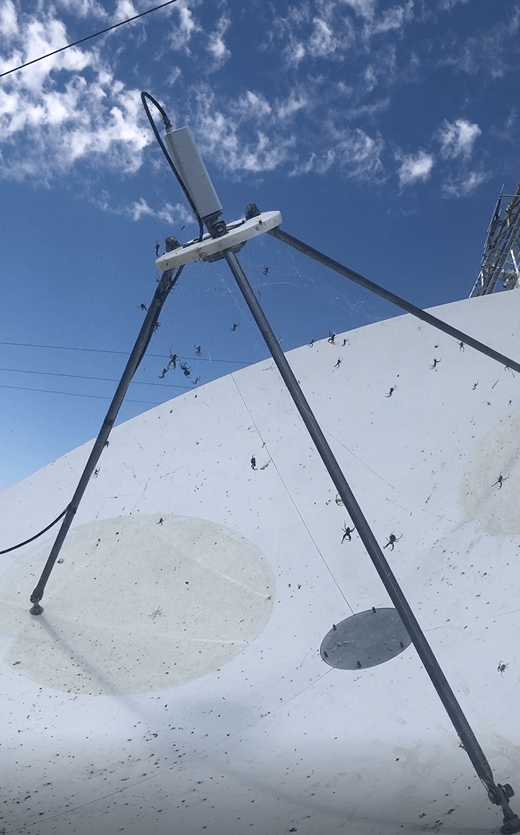
Spider Mountain: Spiders on Dish Western Spotted Orbweaver Neoscona oaxacensis Courtesy & © Lyle Bingham, Photographer
Spiders on Dish
Western Spotted Orbweaver
Neoscona oaxacensis
Courtesy & © Lyle Bingham, Photographer

Spiders on Mast for UPR Transponder Antenna West (Spider) Mountain, Utah Courtesy & © Lyle Bingham, PhotographerSpiders on Mast for UPR Transponder Antenna
Courtesy & © Lyle Bingham, Photographer

Spiders on Mast for UPR Transponder Antenna With Microwave Dish for Other Building Occupants West (Spider) Mountain, Utah Courtesy & © Lyle Bingham, PhotographerSpiders on Mast for UPR Transponder Antenna With Microwave Dish for Other Building Occupants
Courtesy & © Lyle Bingham, Photographer

Spiders on Dish for Other Building Occupants. Note Red Former AT&T (Now 'American Tower') Structure Above. West (Spider) Mountain, Utah Courtesy & © Lyle Bingham, PhotographerSpiders on Dish for Other Building Occupants
Note Red Former AT&T (Now ‘American Tower’) Structure Above.
Courtesy & © Lyle Bingham, Photographer


Recently, I accompanied Friend Weller, chief radio engineer for Utah Public Radio, on a visit to what local radio engineers affectionately call Spider Mountain. We sought to determine why the Utah County translator would intermittently go off air for minutes to hours. Friend speculated that wasps or spiders were to blame. He explained that this translator receives the signal from Logan via satellite and rebroadcasts it for lower Utah County on 88.7 MHz. It is one of more than 30 translators that re-transmit UPR where mountains block the original signal.

We drove up a gravel road to the top of the dry, desert mountain known locally as West Mountain. This cheatgrass-covered mountain rises nineteen hundred feet from the waters on the south end of Utah Lake. At the base, there are fruit orchards, but climbing higher, we saw few plants rising above the cheatgrass. Near the top, more than 12 structures support antennas that transmit and relay signals across portions of Utah and Juab counties.

As we slowly climbed the gravel road in the UPR pickup, large bodies began to appear, moving on silk threads attached, like guy wires, to anything with height. Mobile spiders guarded each thread. When we passed, they took what appeared to be offensive positions. These spiders’ delicate legs easily span two inches. A unique black and white pattern of diamonds and dots on their back identifies them as western spotted orb weavers. The larger-bodied, grey spiders are females with legs attached to a three-quarter-inch body. The narrower-bodied males measure half an inch. When they move, flashes of red show on the undersides of their legs. These same spiders live along the shores of Utah Lake and the Great Salt Lake.

The exterior of the equipment building was covered with spiders, as were the transmitting antennas above and the large receiving satellite dish nearby. We could see the problem. Spiders were blocking the signal to the satellite dish feed horn. Using a broom, we gently relocated them. Many took quick exits, dropping on threads of silk from the horn to the dish below, then running to the edge and rappelling to the ground. Others took more defensive or combative positions, only to be invited off with the broom or a gloved hand. After the eviction, we sprayed around the horn and the dish supports.

On previous trips, we had often wondered what these spiders eat. This time we found small flying insects, akin to those found along the shores of Utah Lake. They are likely carried up the mountain on wind currents. Up-hill winds develop every day as the sun warms the surface of the mountain. This time of year, the spiders don’t lack nourishment.

And how did the spiders get up there? Their progenitors were also likely carried uphill on silk parachutes. Once there, the spiders found the tallest location, strung their lines, and thrived on other unfortunates delivered by the same winds. You see, spiders, like predatory birds, are helpful pest control. For a spider, hanging high above the ground on a mountain top is a great place to be. There, the spiders can catch anything that blows or flies by. No wonder they grow so large and multiply so profusely on top of Spider Mountain.

Visit Wildaboututah.org for images of the spiders hanging from the trees, guy wires, antenna masts and satellite dish. We also have links to common spiders found in Utah.

This is Lyle Bingham, and I’m Wild About Utah, Utah Public Radio and Utah’s spiders.

Credits:
Photos: Courtesy & Copyright Lyle Bingham, Photographer
Featured Audio: Courtesy & Copyright © Friend Weller, Utah Public Radio upr.org
Text: Lyle Bingham, https://bridgerlandaudubon.org/
Additional Reading: Lyle Bingham, https://bridgerlandaudubon.org/

Additional Reading

Lyle Bingham’s Wild About Utah Postings

Mitton, Jeff, Spiders disperse on strands of silk | Colorado Arts & Sciences Magazine Archive | University of Colorado Boulder
https://www.colorado.edu/asmagazine-archive/node/585

Narimanov, Nijat; Bonte, Dries; Mason, Paul; Mestre, Laia; Entling, Martin H.; Disentangling the roles of electric fields and wind in spider dispersal experiments
https://bioone.org/journals/the-journal-of-arachnology/volume-49/issue-3/JoA-S-20-063/Disentangling-the-roles-of-electric-fields-and-wind-in-spider/10.1636/JoA-S-20-063.full

Simonneaua, Manon; Courtiala, Cyril; Pétillon, Julien; Phenological and meteorological determinants of spider ballooning in an agricultural landscape – ScienceDirect
https://www.sciencedirect.com/science/article/pii/S1631069116300919

Davis, Nicky, Neoscona Tree, Lincoln Beach, Utah Lake, Utah, WildUtah.us, August 23, 2018, https://www.wildutah.us/html/insects_other/h_s_neoscona_tree.html

Davis, Nicky, Western Spotted Orbweaver a.k.a. Zig-Zag Spider-Neoscona oaxacensis Female, WildUtah.us, August 20, 2018, https://www.wildutah.us/html/insects_other/h_s_neoscona_oaxacensis_fe_west_utah_lake_20aug2018.html

Davis, Nicky, Western Spotted Orbweaver a.k.a. Zig-Zag Spider-Neoscona oaxacensis Male, WildUtah.us, August 20, 2018, https://www.wildutah.us/html/insects_other/h_s_neoscona_oaxacensis_m_west_utah_lake_20aug2018.html

Davis, Nicky, Spider at Inlet Park, Jordan River Trail, Saratoga, Utah County – Neoscona oaxacensis, Bugguide, Iowa State University, September 17, 2017, https://bugguide.net/node/view/1446087

Eaton, Eric R, Spider Sunday: Western Spotted Orbweaver, Bug Eric, February 12, 2012, https://bugeric.blogspot.com/2012/02/spider-sunday-western-spotted-orbweaver.html


These spiders were blocking the UPR satellite signal received by the Utah County transponder broadcasting at 88.7 MHz. The spiders were identified as Western Orb Weavers, Neoscona oaxacensis, that are also found along the shores of Utah Lake and the Great Salt Lake.
Courtesy and Copyright Lyle Bingham, Photographer


More than one type of spider lives on Spider Mountain. The last time we visited Spider Mountain, we hadn’t traveled far before Friend Weller stopped the truck. A Utah tarantula was walking across the road. Yes, did I tell you the spiders on Spider Mountain are big? This guy easily covered a small dinner plate without extending its legs.
We found out that tarantulas are nocturnal and rarely seen except in August and September, when the males are searching for mates. In Utah, we found most tarantulas are identified as Aphonopelma iodius, because they have a triangular dark patch near their eye turrets. We understand our tarantulas are not to be confused with a similar brown-bodied, black-legged species, Aphonopelma chalcodes, the western desert tarantula that are found in Mexico, Arizona, and southern Utah.
Courtesy and Copyright Lyle Bingham, Photographer
Visit ‘Spider Mountain’ on https://wildaboututah.org/

Spiders in Utah, SpiderID.com, https://spiderid.com/locations/united-states/utah/

Harris, Martha, What spiders show us about mercury and the Great Salt Lake ecosystem, KUER, July 23, 2024, https://www.kuer.org/science-environment/2024-07-23/what-spiders-show-us-about-mercury-and-the-great-salt-lake-ecosystem


Gallop Thru Time

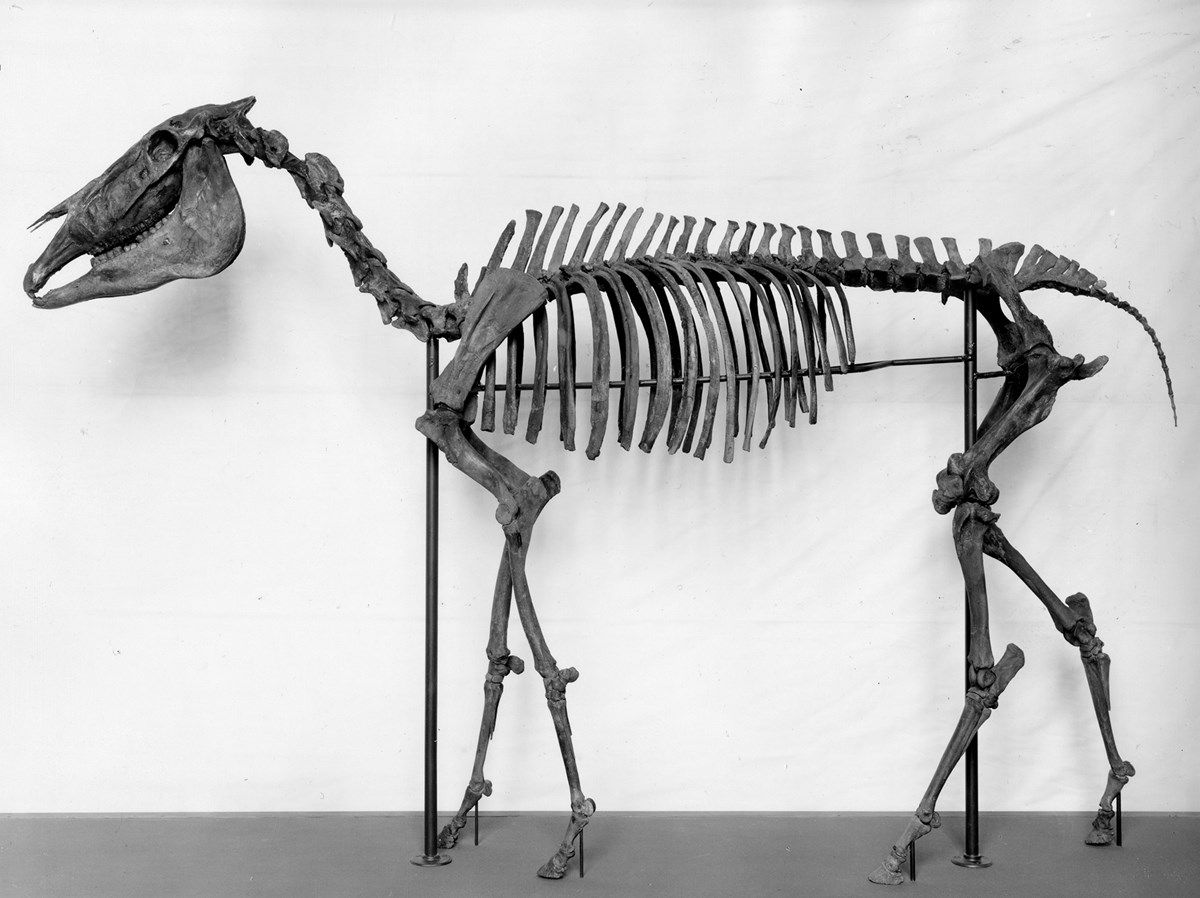
Gallop Thru Time: The Hagerman Horse (Equus simplicidens), Hagerman Fossil Beds National Monument, Courtesy US NPS
The Hagerman Horse (Equus simplicidens), Hagerman Fossil Beds National Monument, Courtesy US NPS

Elmer Cook Recognition Plaque Hagerman Fossil Bed National Monument Courtesy & © Mary Heers, Photographer Elmer Cook Recognition Plaque
Hagerman Fossil Bed National Monument
Courtesy & © Mary Heers, Photographer

Mary Heers' Selfie with the Hagerman Horse Hagerman Fossil Bed National Monument Courtesy & © Mary Heers, Photographer Mary Heers’ Selfie with the Hagerman Horse
Hagerman Fossil Bed National Monument
Courtesy & © Mary Heers, Photographer

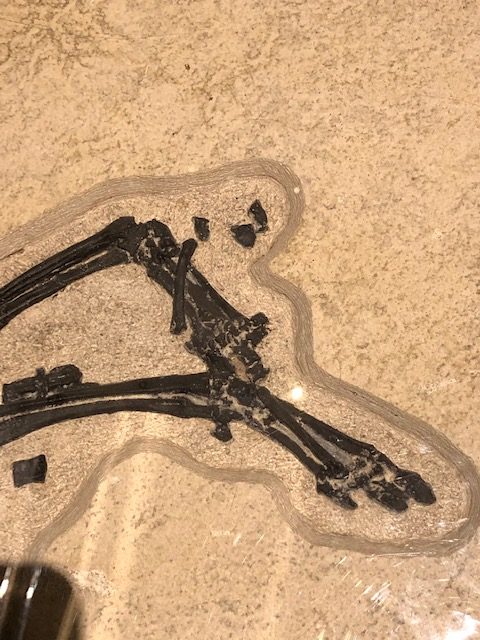
Three Toes on the Kemmerer Horse Utah Museum of Natural History Courtesy & © Mary Heers, Photographer Three Toes on the Kemmerer Horse
Utah Museum of Natural History
Courtesy & © Mary Heers, Photographer

Metacarpal Toe, Hoof Hagerman Horse Equus simplicidens Hagerman Fossil Bed National Monument Courtesy & © Mary Heers, Photographer Metacarpal Toe, Hoof Hagerman Horse
Equus simplicidens
Hagerman Fossil Bed National Monument
Courtesy & © Mary Heers, Photographer

Metacarpal Toe, Hoof Domestic Horse Equus ferus caballus Hagerman Fossil Bed National Monument Courtesy & © Mary Heers, Photographer Metacarpal Toe, Hoof Domestic Horse
Equus ferus caballus
Hagerman Fossil Bed National Monument
Courtesy & © Mary Heers, Photographer

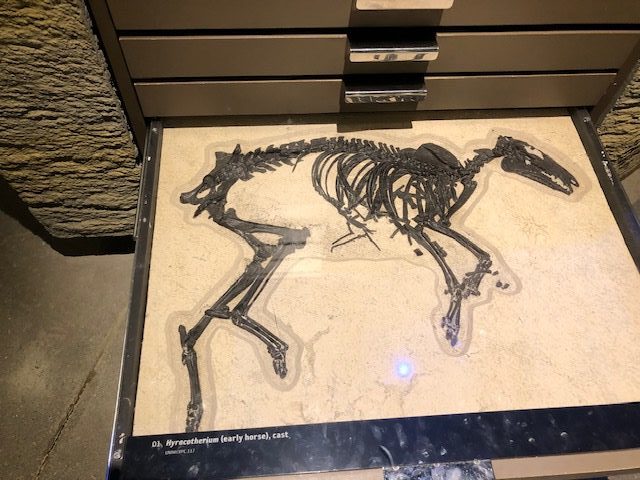
Cast of Kemmerer Early Horse Utah Museum of Natural History Courtesy & © Mary Heers, Photographer Cast of Kemmerer Early Horse
Utah Museum of Natural History
Courtesy & © Mary Heers, Photographer

In 1928 Elmer Cook, a rancher in Hagerman, Idaho, noticed an interesting bone sticking our of the hillside on his land overlooking the Snake River. Intrigued, he started to dig around and discovered it was a fossilized bone and there were plenty more like it. Elmer alerted the National Smithsonian Museum, who sent out a team. This team determined the bones were ancestors of the modern horse. They were 3½ million years old. In the end, after digging into the hillside for 2 years, they took over 200 fossils, including 12 complete horse skeletons, back to Washington D.C.

My own fascination with horse fossils actually began a few years ago when I was giving tours at the Utah Museum of Natural History in Salt Lake City. A fossil hunter near Kemmerer, Wyoming, had been quite surprised to find a small mammal while digging through layers of fossilized fish in an ancient seabed. This skeleton is now also in the Smithsonian Museum in D.C., but the Utah museum owns a copy.

When giving tours, I always paused my group as we entered the dinosaur floor. “I’m going to pull a whole horse out of here,” I’d say as I pulled a sliding drawer out of a chest with a flourish.

It was a fully grown horse about the size of a small dog – 24 inches long and 20 inches high.

It was over 50 million years old. In that time, the Intermountain West was a lush, swampy place. Fierce predators like the Utah Raptor roamed the land, and the mammals that survived were small and stayed hidden in the dense forested undergrowth.

Over the next 50 million years, the dinosaurs went extinct and the terrain dried out The Hagerman Horse (dating back 3 ½ million years ) stood about 4 ½ feet high. Most notably, it now stood on four hooves. The 3 toes on the Kemmerer Horse had evolved into a single dominant toe, perfectly adapted to running away from predators over dry terrain.

Unfortunately, this remarkable adaptation was not enough to save the horse. The horse went extinct in the Americas (along with other large mammals like the mammoth and giant sloth) about 10,000 years ago. It was the Spanish Conquistadors that reintroduced the horse to North America. When Hernan Cortez and his 200 soldiers landed in Mexico in 1519, they brought 16 horses with them. Over time, some of these horses got away to form wild bands, and others fell into the hands of the Native Americans.

This summer I made a small archeological pilgrimage into Idaho, to see the Hagerman Fossil Beds, now a National Monument. In the newly opened visitor center I found a life size replica of the Hagerman Horse. As I stood next to it, admiring its shapely hoof, I remembered one more remarkable fact about the horse. The bows now used to play violins are made from horse hair It takes 5 horse tails to make a violin bow. To this day, absolutely nothing has been found that makes the strings of a violin sing as sweetly.

This is Mary Heers and I am Wild About Utah.

Credits:
Photos: Courtesy & Copyright © Mary Heers
Photos: Courtesy
Featured Audio: Courtesy & Copyright © Kevin Colver, https://wildstore.wildsanctuary.com/collections/special-collections/kevin-colver
Text: Mary Heers, https://cca.usu.edu/files/awards/art-and-mary-heers-citation.pdf
Additional Reading: Lyle Bingham, https://bridgerlandaudubon.org/

Additional Reading

Wild About Utah, Mary Heers’ Wild About Utah Postings

Hagerman Fossil Beds National Monument, History, National Parks Service, US Department of the Interior, https://npshistory.com/publications/hafo/index.htm

The Hagerman Horse (Equus simplicidens), Hagerman Fossil Beds National Monument, National Parks Service, US Department of the Interior, https://www.nps.gov/articles/000/equus_simplicidens.htm

Hagerman Fossil Beds, National Parks Service, US Department of the Interior, https://www.nps.gov/hafo/index.htm

The Horse (Exhibit), Natural History Museum of Utah, July 21, 2014 – January 4, 2015, https://nhmu.utah.edu/horse#:~:text=The%20Natural%20History%20Museum%20of,and%20spiritual%20connections%20with%20them.
Natural History Museum of Utah,https://nhmu.utah.edu/

Fossil Horse Quarry Near Hagerman, Idaho, Worked by National Museum, Smithsonian Libraries and Archives, The Smithsonian Institution, https://www.si.edu/object/fossil-horse-quarry-near-hagerman-idaho-worked-national-museum:siris_arc_367758

Plesippus shoshonensis Gidley, 1930, National Museum of Natural History, The Smithsonian Institution, https://www.si.edu/object/plesippus-shoshonensis-gidley-1930:nmnhpaleobiology_3590445