June Fireflies

Click for a larger view of a firefly, Courtesy Wikimedia, Bruce Marlin, Photographer, licensed under Creative Commons Attribution-Share Alike 2.5 Generic license
Firefly
Courtesy Wikimedia,
Bruce Marlin, Photographer
Licensed under
Creative Commons Attribution-
Share Alike 2.5 Generic license


Most people are fascinated by unusual displays of light. Meteor showers, solar eclipses, and the stunning Aurora Borealis, or Northern Lights, are grandiose in scale and mesmerize onlookers. But people are also enchanted with the small life-forms that create their own light.

Bioluminescence, the production of light by living creatures, is an incredible phenomenon produced by certain mushrooms, scorpions, millipedes, bacteria, snails, worms, beetles, and nearly half of marine life including single-celled plankton, jellyfish, octopi, and fish. Some are also fluorescent by absorbing light rays and then emitting them as a different color.

But today we will focus on fireflies, also known as lightning bugs, which are actually beetles.

How, and why, do these creatures produce their own light? Scientists are still learning how the process works, but basically it is a chemical reaction involving luciferin, a light-emitting compound, being catalyzed by an enzyme and reacting with oxygen to release cool, light photons.

The “why” part is primarily for locating mates. But other species could also use it to lure prey, as a method of escape, and to warn predators.

The nighttime hours of late Spring and early Summer months are prime time for firefly activity. They live around wetland areas where the soil is moist and will start flashing when the sky is dark. Females remain fairly stationary atop tall grass and watch for males who fly around flashing various light signals. When a female approves of a suitor’s signal, she will respond with her own glow pattern which allows the male to find her. After mating, the female will lay eggs in the moist soil or leaf litter where they won’t dry out. The eggs usually hatch in 3-4 weeks.

The larvae live in the soil hunting worms, snails or slugs. At this stage they may actually begin glowing. They live in the soil for one or two winters before pupating and undergoing metamorphosis into the adult stage. And the purpose of the adult stage is primarily breeding.

While we enjoy seeing these insect “shooting stars” it is critical to avoid trying to capture them since the Utah populations are small and fragile. (Photos are available online on many websites if one needs to see them closeup.) Walking on the soil can kill the eggs or larvae, and light from automobiles, street lights and flashlights can disrupt their ability to see the flashing of their prospective mates. While the “Firefly Citizen-Science Project” from the Natural History Museum of Utah indicates sightings at more than 50 locations, careless actions, as well as loss of critical habitat, are actually causing a decrease in populations across the country.

Let’s do our best to be good stewards of the earth and only “observe” the amazing firefly.

This is Ron Helstern with Wild About Utah.

Credits:

Image: Courtesy Wikimedia, Bruce Marlin, Photographer, Licensed under Creative Commons Attribution-Share Alike 2.5 Generic license
Theme music: Composed by Don Anderson and performed by Leaping Lulu, https://leapinglulu.com/
Text: Ron Hellstern, Cache Valley Wildlife Association

Reported Sightings:

24 June 2017
Today while waiting for local city fire works we saw a lighting bug or two. We are in West Haven.


Report your sighting


Additional Reading

Holly Strand, Firefly Light, Wild About Utah, 20 June 2013, https://wildaboututah.org/firefly-light/

Clayton Gefre, Sparks Fly: Researchers track firefly populations across Utah, The Herald Journal, https://news.hjnews.com/allaccess/sparks-fly-researchers-track-firefly-populations-across-utah/article_270ac8b9-3d3f-5a01-9b5b-ac22e89a54bb.html

Natalie Crofts, New Website Tracks Utah Firefly Sightings, KSL, https://www.ksl.com/article/34439516

Utah Museum of Natural History, Firefly Citizen Science Project, https://nhmu.utah.edu/fireflies

Greater Sage-Grouse in Utah

Female Sage-Grouse Flying in Winter, Courtesy & Copyright Todd Black, Photographer
Utah’s dry, sagebrush covered landscapes are home to one of North American’s largest grouse species, commonly known as the greater sage-grouse.

The females are attractive chicken-size birds with gently curved bodies. Their feathers show streaks of black, brown and gray. This pattern acts as a natural camouflage in their sagebrush habitat to help protect them from predators.

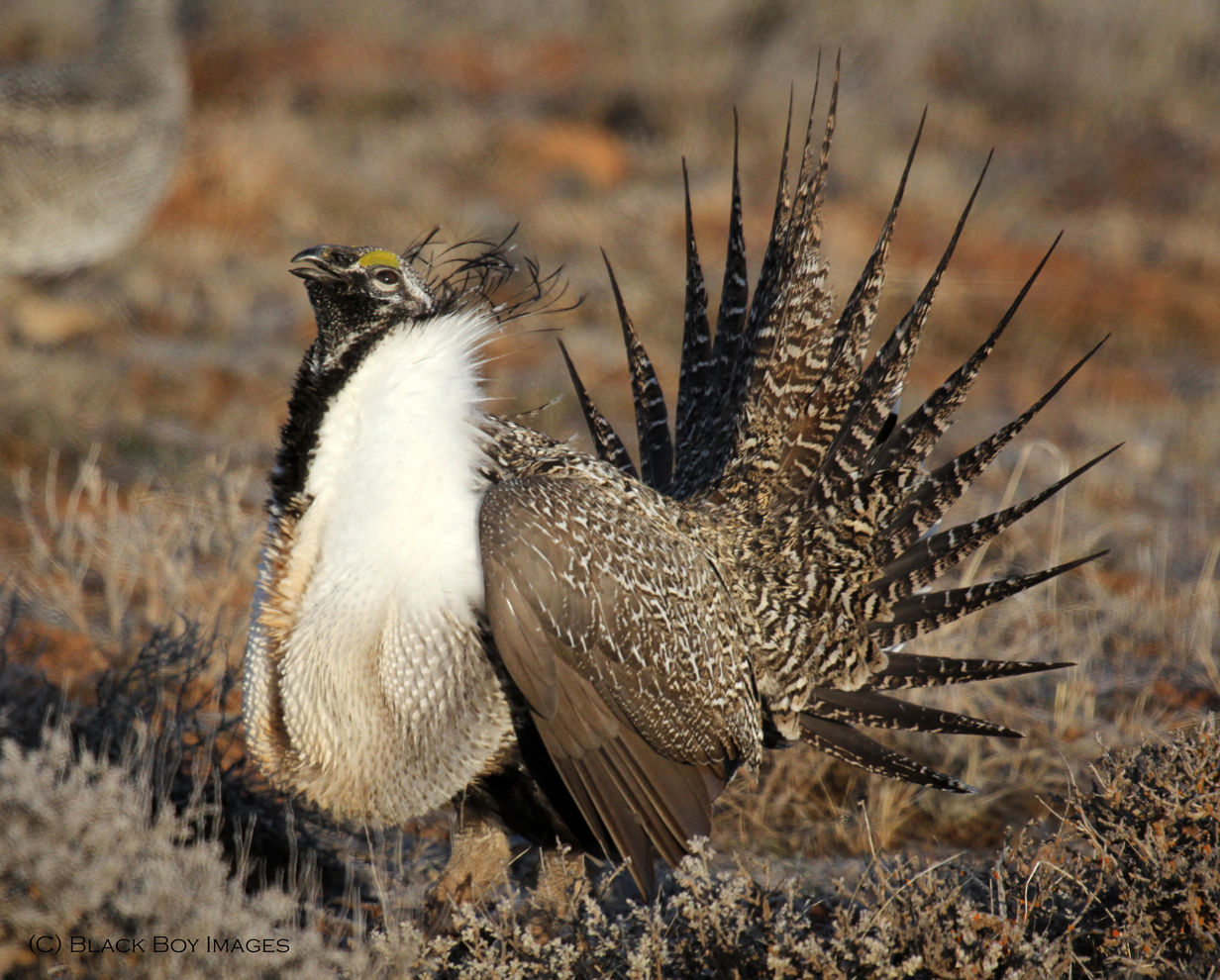
Male Sage-Grouse on Lek, Courtesy & Copyright Todd Black, Photographer
Males are distinguished from females by their majestic form and decorative feather patterns. They are often twice the size of females and can weigh over seven pounds. A thick layer of white plumage covers the males’ breast and wraps up around both sides of their thick necks. Their tails are a long spray of pointy feathers, which rise into a beautiful fan during courting season and provide the basis for their scientific name Centrocercus urophasianus derived from the Greek word “kentron” meaning spiny, “kerkos” meaning tail, and urophasianus meaning tail of a pheasant.

To help protect against predators their wing and back feathers have streaks of black, grey, and brown – similar to the females.

Buried under the male’s white breast feathers are two air sacs that remain concealed until mating season begins.
The greater sage-grouse are probably best known, by most, for their extravagant courtship rituals.

Around the beginning of March, the male grouse return to their communal mating grounds called a lek where they compete with other males to attract and breed with the females. The ritual is called lekking. The lek is in an open area where visibility is good – such as a dry lakebed.

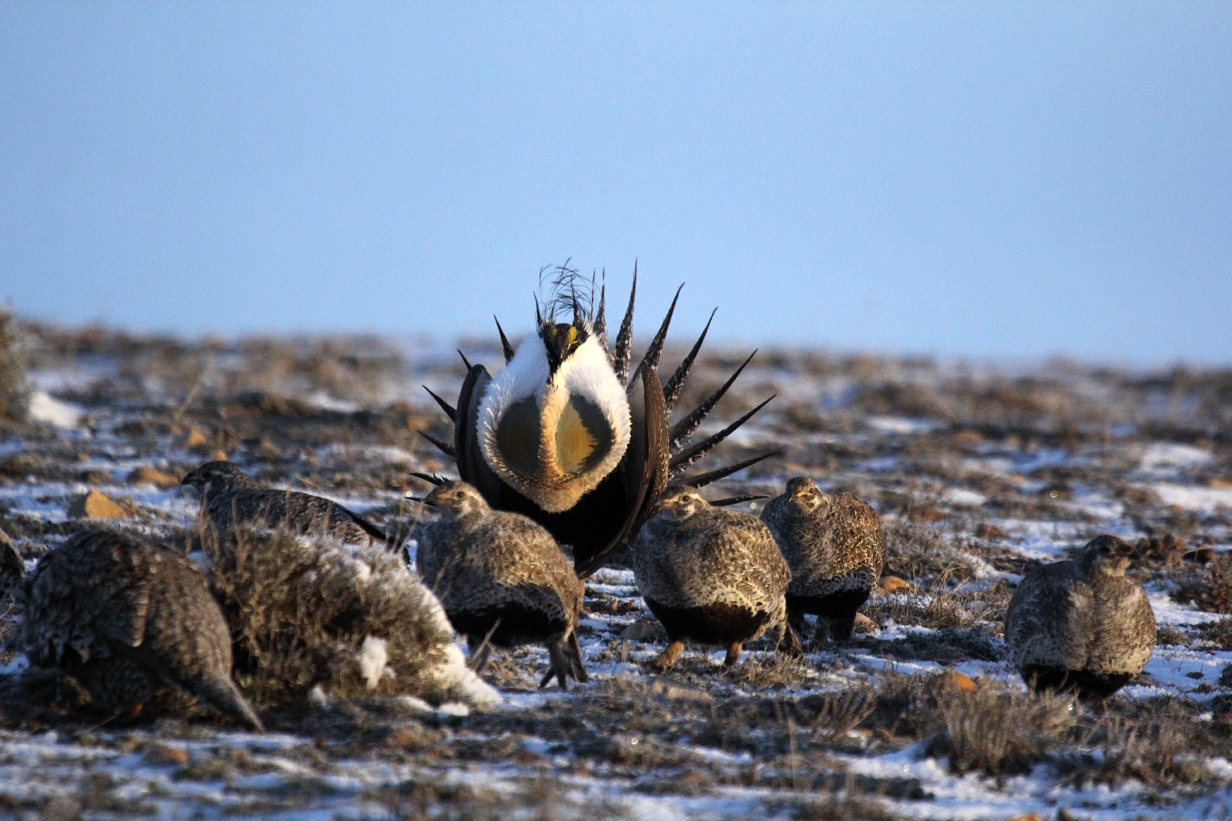
Dominate Male Sage-Grouse with Females, Courtesy & Copyright Todd Black, Photographer
To show their dominance, the males raise their tail feathers in a magnificent fan, fill their breast sacs with air then thrust the air out of the sacs making a popping/bubbling sound as they strut around the lek in a regal fashion.

The females are attracted to the leks by the calls of the males, which can carry for over 1.5 miles. When they arrive, they roost among the males to watch their strutting performances. The hens may visit the lek several times during the breeding season before nesting.

During the courtship rituals, the females will begin searching for a nesting site. Most will choose to build their nests under the protective cover of a sagebrush bush. The female lines the bowl-shaped nest with dead grass and a few feathers. When she sits on her nest of 6-8 eggs, her camouflage colors go to work and make her nearly invisible from her surroundings. A potential predator may often pass by her as she sits motionless and in silence on her nest for a 30-day incubation period.

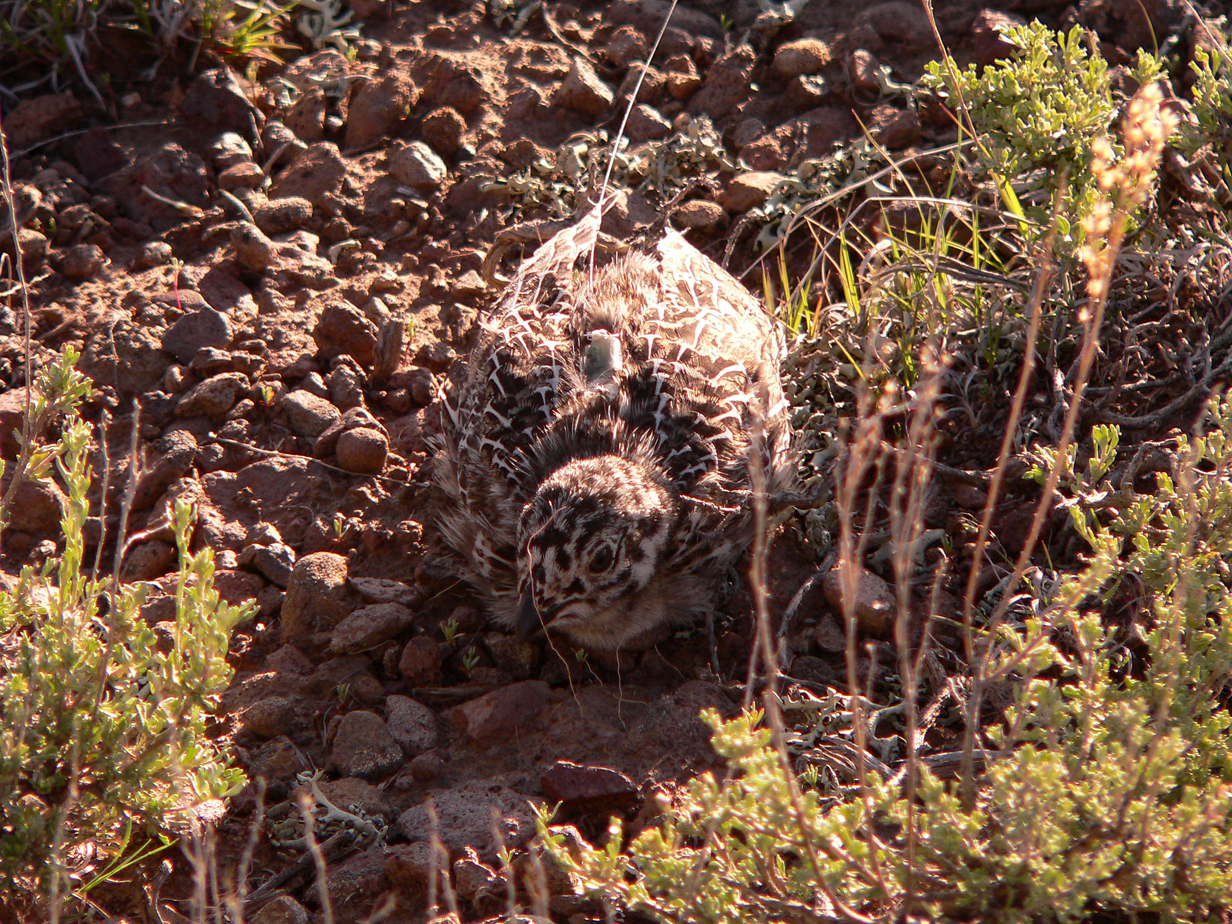
Week-old Sage-Grouse Chick with Transmitter, Courtesy & Copyright Todd Black, Photographer
Dr. Terry Messmer, Utah State University Extension wildlife specialist and director of the Berryman Institute explains, “Greater sage-grouse do not have a muscular crop and are not able to digest hard seeds like other upland game species such as the ring-necked pheasant… they depend on sagebrush for their survival. In fact, during the winter sage-grouse survive by only eating sagebrush. They are the only species that can gain weight during the winter by [consuming] sagebrush.”

Biologists estimate that since the European settlement of North America there has been a 50% decline of the sage-grouse sagebrush habitat and population.

In the late 1990’s, in an effort to reverse this trend, Messmer through Utah State University entered into a collaboration with the State of Utah and numerous other stakeholders to develop a community-based conservation plan. Its purpose was to bring local communities, agencies, and researchers together to determine the best methods to preserve sage-grouse, their sagebrush habitats, and benefit the local community – without having to list it for protection under the federal Endangered Species Act.

After two decades of hard work, the partners have witnessed a resurgence of the greater sage-grouse as their habitats have been protected, enhanced and expanded.

If you’d like to see greater sage-grouse, the largest populations are found in western Box Elder County, on Blue and Diamond Mountains in Uintah County in northeastern Utah, in Rich County, and on Parker Mountain in south central Utah. Just remember to bring your binoculars.

This is Shauna Leavitt for Wild About Utah.

Credits:
Photos: All photos courtesy of and used with permission of Todd A. Black.
Text: Shauna Leavitt, Utah Cooperative Fish and Wildlife Research Unit, Quinney College of Natural Resources, Utah State University

Additional Reading

To learn more about Utah sage-grouse conservation, please go to www.utahcbcp.org.

Conserving Water

A Flowing Stream, Conserving Water Starts at Home, Courtesy and Copyright Ron Hellstern, Photographer
Liquid water is essential to life as we know it on planet Earth. With rising temperatures ahead, our water resources are critical to us all. Whether nations contain hot-desert areas or not, the appropriate management of water is essential. In fact, life-sustaining water is literally far more important and valuable than oil. While most Americans generally take clean water for granted, the current generation may see unprecedented changes in water policy, development of desalinization plants, and the distant transport of water through major pipelines. While the “amount” of Earth’s water remains stable, its accessibility and distribution may change dramatically. A current example is truckloads of water being hauled from California to the Crater Lake National Park system in Oregon.

As good Earth Stewards, what can/should we do to use water responsibly? Here are 25 ideas:

  • Run kitchen-tap water into pitchers until it is hot before you start your dishwasher. Use that water later for your houseplants or garden.
  • If washing dishes by hand, use a container of rinse water rather than letting it run over dishes.
  • Try a Navy Shower: Get wet, turn water off, lather up, rinse. Two minutes of water use is all you’ll need.
  • Install a water-saver showerhead.
  • Keep a pitcher of cold drinking water in the fridge instead of letting the water run down the drain while waiting for it to cool.
  • Wash your car on the lawn.
  • Use a pistol-nozzle on your garden hose rather than letting it run open ended.
  • Use a bucket in your bathtub to catch water until it warms, then use it on plants later.
  • Water plants with runoff caught from rinsing fruit and vegetables under your faucet.
  • See if your community allows plumbing your gray water directly to your outdoor plants.
  • Use a broom, not water, to clean sidewalks and driveways.
  • Turn running water off while shaving, washing hands, or brushing teeth.
  • Water lawns only in the early morning or late evening, and preferably on windless days.
  • Compost fruit & vegetable waste rather than using the garbage disposal.
  • Consider replacing your lawn with water-wise plants. If you live in a desert, grow desert plants.
  • Run dishwashers and clothes-washers only with full loads.
  • Upgrade old toilets with the newer water-saving models
  • Make sure that lawn sprinklers never hit driveways, sidewalks, buildings, fences, etc.
  • Put your lawn mower on the “highest setting” to conserve water and strengthen grasses.
  • Check the policy in your area about using barrels to catch rainwater from your roof to use later on flower beds and gardens.
  • Never use running water to thaw frozen foods. Plan ahead, and defrost it in the fridge.
  • Fix plumbing leaks immediately.
  • Don’t use toilets as garbage cans.
  • Save money and resources by avoiding plastic water-bottles. Use your own refillable container for meetings, hiking, etc.
  • If you have a pool, cover it when it’s not in use to reduce evaporation loss.
  • For dozens of other water-saving ideas go to www.wateruseitwisely.com

A Flowing Stream, Home for Wildlife, Courtesy and Copyright Ron Hellstern, Photographer
This is Ron Helstern with Wild About Utah.

Credits:

Images:
Courtesy & Copyright Ron Hellstern, Photographer
Text:     Ron Hellstern, Cache Valley Wildlife Association

Additional Reading

Conservation Program, Utah Division of Water Resources,
https://conservewater.utah.gov/

Waterwise Utah, Utah Education Network & Partners, https://waterwiseutah.org/

Water Quality-Conservation, USU Extension, https://extension.usu.edu/waterquality/conservation/

Slow the Flow, Jordan Valley Water Conservancy District & Partneres, https://www.slowtheflow.org/

Water-Liquid Life

Water-Liquid Life: Spring Runnoff in Cottonwood Creek near Sandbagged Home From "Spring Run-off Dangers Ahead," Unified Fire Department Chief Mike Watson Courtesy Cottonwood Heights City
Spring Runnoff in Cottonwood Creek near Sandbagged Home
From “Spring Run-off Dangers Ahead,” by Unified Fire Department Chief Mike Watson
Courtesy Cottonwood Heights City
It’s springtime in the Rockies, and Utah’s northern rivers are engorged with liquid life- and have been for what seems like months now. After a winter of record snowfall, the spring heat and a miniature monsoon season have raised our local waters to levels not seen in decades. During this exceptional seasonal runoff, it’s easy to forget that we still live in the second-most arid state in the Union. Nonetheless, this seasonal plethora of the wet stuff is an ardent reminder that, even here, it is water we Utahns have to thank for our most prestigious landscapes and the diversity of flora and fauna that call these places home. Water-Liquid Life

It has, in most cases, taken quite a lot of time, though. Consider the Great Salt Lake: Utah’s most iconic landmark. It’s a remnant of prehistoric Lake Bonneville-itself the pluvial product of slow glaciation and rainwater collection. Thousands upon thousands of years of evaporative sun exposure, though, shrank Lake Bonneville and changed the local climate and ecosystem into what we have today, a salty inland sea implanted within an arid, Mediterranean climate. Though deprived of its acreage- and being immensely saltier than its predecessor- The Great Salt Lake supports an incredibly diverse and highly complex ecosystem. Concocted by the mixture of ancient salts and fresh water provided by the Jordan, Weber, and Bear Rivers, the wetland ecosystems on the fringes of the Great Salt Lake play host to millions of migratory birds each year that are travelling along the Pacific Flyway. Without these oases, the diversity of Utah’s waterfowl-and wildlife at large- would dwindle drastically.

One cannot speak of water’s effect upon Utah’s landscapes without singing the praises of the wondrous redrock canyons that dissect our state’s southern reaches. The force of water upon the high desert of Utah’s allocation of Colorado Plateau is intermillenial, hydrological poetry. Ancient Jurassic and Cretaceous seas deposited layer upon colorful layer of various sediments before heat, pressure, and the recession of shorelines turned them to stone. Water then went back to work within a new climate upon an old geography with rare but violent torrents of flashing floods that sliced ever deeper and more intricate cleavages into the sandstone. I remember visiting one particularly beautiful slot canyon with my wife. The fossilized wave action we spotted above the rim was preserved below as well with streaks of sediment mismatched and displaced into a beautiful kaleidoscope of reds, oranges, and purples. Water’s work was not finished here, though. Dispersed along the distant trail into the best parts of this remote canyon, there were desert riparian jungles of small cottonwoods, mosses, and ferns that harbored ephemeral pools dotted with water striders and even the occasional canyon tree frog.

Street Flooding Box Elder County 2017 Courtesy https://dem.utah.gov/2017/03/31/news-release-gov-herbert-declares-state-of-emergency-for-february-flooding/
Street Flooding Box Elder County 2017
Courtesy https://dem.utah.gov/2017/03/31/news-release-gov-herbert-declares-state-of-emergency-for-february-flooding/
Water is a fickle beast, though- crucial to maintaining life but behaving without regard for its endeavors. The same forces of hydrology that created the Great Salt Lake, our richly diverse wetland ecosystems, and the stunning desert landscapes we love to explore can likewise wreak havoc upon our daily lives. Consider the recent deluge in Cache Valley. Several weeks ago, our northern valley was inundated with precipitation, leaving some families stranded in their low-lying homes with no access to the nearest road. A friend of mine who runs a canoe rental business told tale of making deliveries to homes so that people could commute from the end of their driveway to their front door. Perhaps no other force of nature can be so frustrating yet so gratifying; so plentiful yet so fleeting. It’s a wild thing, water. It is a miraculous ubiquity that, even in the driest places, leaves an indelible mark upon the landscape and the lives that inhabit it.

For Wild About Utah this is Josh Boling

Credits:
Photo: Courtesy & Copyright Cottonwood Heights City
Text: Josh Boling

Additional Reading

Water Week, Eli Robinson, USU Water Quality Extension program, May 8, 2017, https://wildaboututah.org/utah-water-week/

Water Properties, Andrea Liberatore, Stokes Nature Center, Nov 17,2014, https://wildaboututah.org/water-properties/