Build a Certified Wildlife Habitat at Home

Build Community Wildlife Habitats Ron Hellstern See also: https://www.nwf.org/Home/Garden-For-Wildlife.aspx
Build Community Wildlife Habitats
Ron Hellstern
See also:
https://www.nwf.org/Home/Garden-For-Wildlife.aspx
Most people appreciate viewing impressive forms of wildlife, such as Desert Bighorn Sheep in Zion, or Wolves and Grizzlies in Yellowstone, but they may not completely understand the quiet contributions that are being made to earth’s ecosystems every day by the small creatures around our own neighborhoods. These little ones help us in many unseen ways.

It is estimated that one third of the food that humans eat has been provided by small pollinators such as Hummingbirds, Butterflies, and Bees. Having these creatures in our own yards can produce hours of entertainment, and education, as we observe them working feverishly among our flowers, shrubs and trees.

Many citizens, and cities, are diligent in providing beautiful landscaped areas for these pollinators to gain nourishment as they work to increase the production of flowers and fruits.

A couple of quick tips as you decide to help these workaholic animals:
You can make your own hummingbird food by mixing one cup of sugar to four cups of water. Never put food coloring in hummingbird feeders. It can be harmful to them, and the red color of the feeder will automatically attract them. You should also use native, fertile plants in your landscaping design. And, unless you have a severe allergic reaction to bee stings, be assured that they are far more interested in gathering pollen than sacrificing their life to sting someone. Most people can work right alongside bees in their flower gardens. Wasps are another story.

So, as you design, or alter, your property to be more usable by pollinators and songbirds you can be rewarded by the National Wildlife Federation through their Wildlife Habitat Certification program. If you provide food, water, shelter and a place to raise young…you are eligible to have your yard certified. Remember, we’re not talking about Mountain Lions and Elk, just pollinators and songbirds. If you have a birdfeeder, birdbath, and shrubs or trees you qualify.

Nobody inspects your property. Go to their website at (www.nwf.org) and complete the simple application listed under Garden for Wildlife and, for a one-time fee of only $20, they will send you a personal certificate for your home, and a one year subscription to the National Wildlife magazine. They also have metal signs that you can post to show others that you care about wildlife. Once you see the value in this, encourage neighbors to do the same. In fact, you can have portions of your entire community certified as wildlife habitat as did Nibley City in Cache County. They were the first city in Utah to do so by certifying 100 properties, and they are ready to help others around the State to join them in this rewarding effort.

Next time you’re in the grocery store, or harvesting from your own garden, remember that a lot of that food would not exist without our diligent pollinators.

This is Ron Hellstern for Wild About Utah


Credits:

Images: Courtesy & Copyright Ron Hellstern
Text:     Ron Hellstern, Cache Valley Wildlife Association


Additional Reading

Certify Your Wildlife Habitat, National Wildlife Federation, Accessed 20 July 2017, https://www.nwf.org/Home/Garden-For-Wildlife.aspx
Certify: https://www.nwf.org/Garden-For-Wildlife/Certify.aspx

Creating Landscapes for Wildlife… A Guide for Backyards in Utah, Written by Sue Nordstrom and Illustrated by Kathlyn Collins Department of Landscape Architecture and Environmental Planning, Utah State University with Margy Halpin, Utah Division of Wildlife Resources; Second Printing 2001,
Updated for the Utah Division of Wildlife Resources, by Frank Howe, DWR Avian coordinator; Ben Franklin, DWR–Utah Natural Heritage Program botanist; Randy Brudnicki, DWR publications editor; and landscape planning illustrations by Stephanie Duer.,
Published by:
State of Utah Natural Resources, Division of Wildlife Resources,
Utah State University Cooperative Extension Service and
Utah State University Department of Landscape Architecture and Environmental Planning;
1991 updated 2001 https://wildlife.utah.gov/pdf/landscapingforwildlife.pdf
Securing Utah’s Moose Population

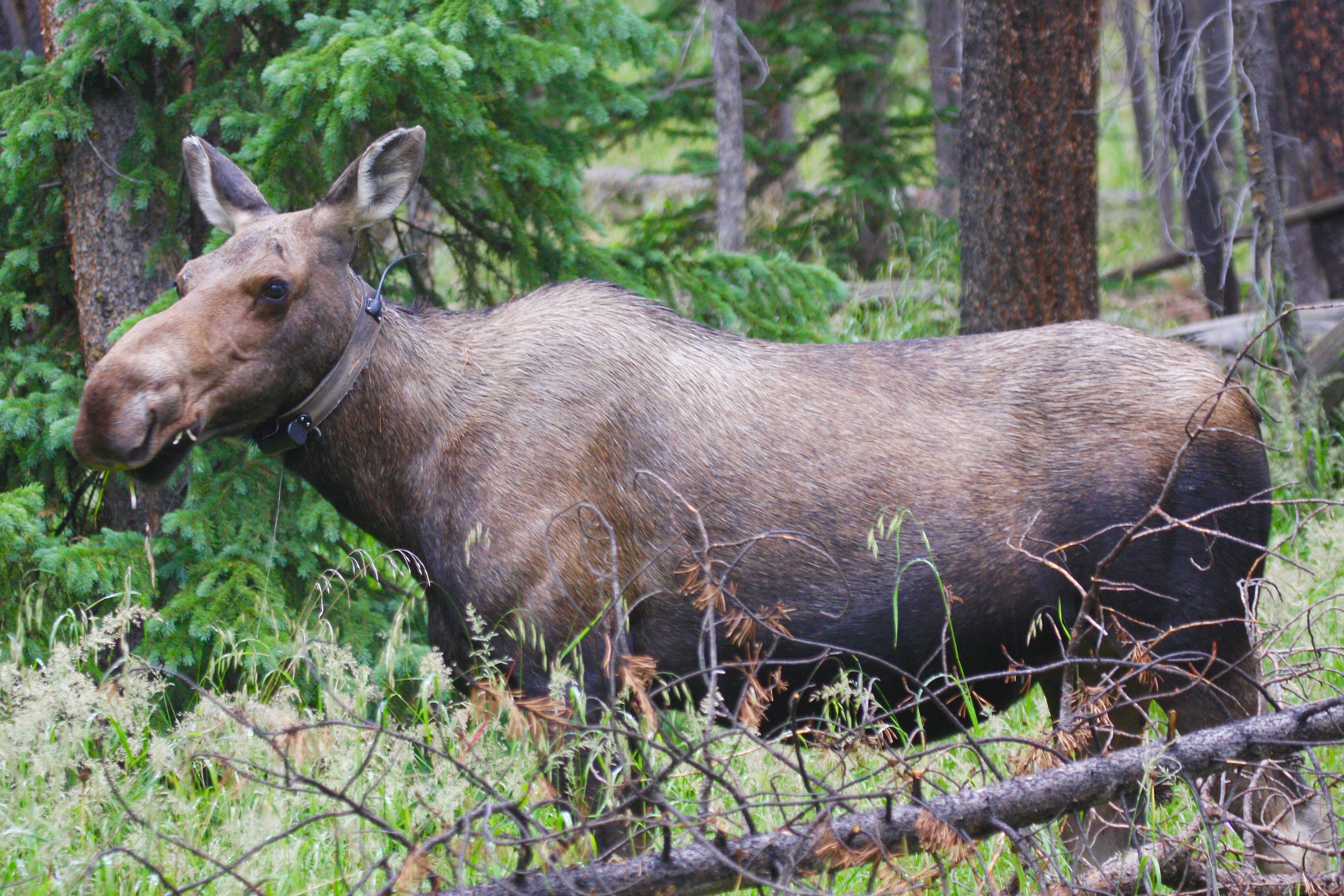
Moose with radio collar Courtesy & Copyright Sam Robertson, Photographer
Moose with radio collar
Alces alces
Courtesy & Copyright Sam Robertson, Photographer
Historically, the settlers and hunters of Utah didn’t find moose when they were exploring the state.
It wasn’t’ until 1906-07 when the first recorded moose sighting occurred in Utah.

Ironically, at this same time the population of Shiras moose also known as Wyoming moose (the subspecies found in Utah today) was dangerously close to extinction due to overhunting.

Settlers in nearby states had preferred hunting moose because the large animal was easy to catch, and was an efficient way to obtain a few hundred pounds of sweet venison.

To prevent their extinction, western states discontinued moose hunting for a time. Until 1950, hunters agreed to hunt other deer species to provide time for the moose population to replenish.
Searching for moose became a challenging spectators sport.

Moose are active during the day and loners most of the year (except mothers with their young) and since they prefer habitat where they can easily hide – finding one was a rare occasion.

By 1957, Utah’s moose had a resident herd in the Uinta mountains and the population continued to grow.
Dan MacNulty, associate professor in the Department of Wildland Resources in the Quinney College of Natural Resource at USU has been studying the state’s moose. He explains, “Utah’s moose population reached an estimated high of over 3,500 in 2005. The population subsequently declined to a current estimate of 2,600 moose. The reasons for this drop were unclear.”

To determine the factors causing the fluctuation in the moose population, Utah Division of Wildlife Resources (DWR) joined with MacNulty’s research lab to investigate the drivers of moose population growth. MacNulty says, “The first priority of the research was to determine the current status of the moose population. Is it increasing, decreasing or stable?”

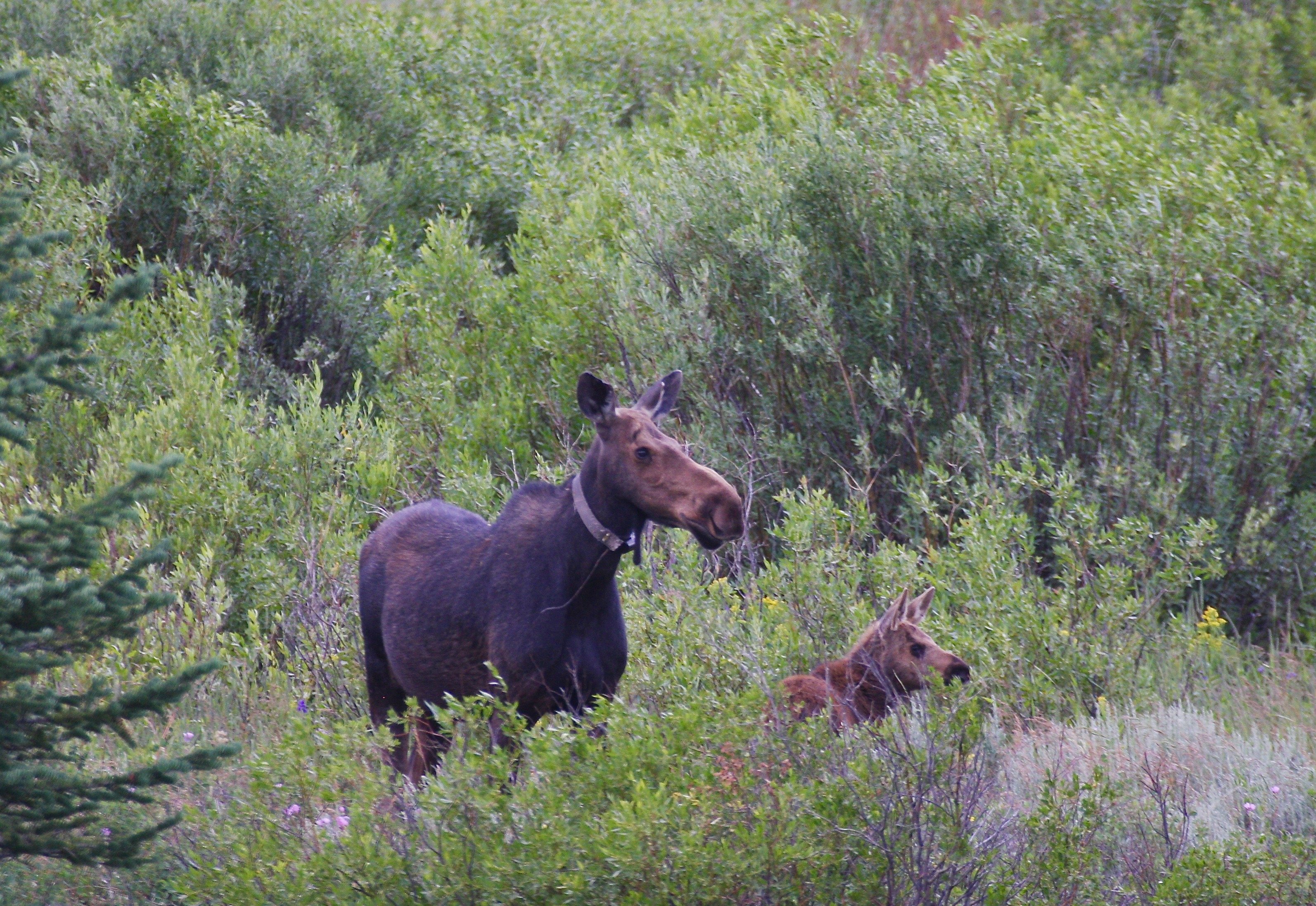
Moose Cow & Calf with radio collars Courtesy & Copyright Sam Robertson, Photographer
Moose Cow & Calf with radio collars
Courtesy & Copyright Sam Robertson, Photographer
To do this, the researchers collared 120 female adult moose in two established herds – 60 in the Wasatch Mountains and another 60 in the North Slope of the Uinta Range.

Female moose are the best indicators of the health of the herd. The females provide the data to determine the health of both the adults and calves. By tracking them, the research team can see the number of females that calve, the number of calves who survive their first winter to join the population, and the survival rate of the adults during the four-year project.

When the first year of data was gathered they found in both herds, 80-90 percent of the collared females survived. Kent Hersey, Big Game Project Leader for DWR adds, “Compared to other moose herds, Utah moose tend to have average or below average survival rates.”

Joel S. Ruprecht, USU graduate student in MacNulty’s lab discovered one reason this may be occurring. He found the maternal fat stores of the female directly impact the reproductive and survival success in Shiras moose.
When midwinter fat stores of the expecting moose were measured Ruprecht found it predicted whether the female moose would successfully give birth to her young and also whether her young would live long enough to become a healthy long-term member of the herd.

If a solution for the population drop could be to increase nutrition levels of the mothers, then DWR may be able to improve habitat conditions for adult moose and increase their health, which would in turn increase calving rates.
DWR plans to use these research findings to help stabilize Utah’s moose population.
The results may have come at an ideal time since the state’s 7-year Statewide Moose Management Plan expires later this year.

This is Shauna Leavitt for Wild About Utah

Credits:
Photos: All photos copyright and courtesy of Sam Robinson.
Text: Shauna Leavitt, Utah Cooperative Fish and Wildlife Research Unit, Quinney College of Natural Resources, Utah State University

Additional Reading

Moose, Alces apces, compiled by Anthony Bell, Vertebrate Zoology Collections Assistant, Utah Museum of Natural History, https://nhmu.utah.edu/sites/default/files/attachments/Alces%20alces.pdf

Moose entering water, Jeff Rice, Western Soundscape Archive; University of Utah, https://collections.lib.utah.edu/details?id=1117822

Moose in Utah, Jason Pietrzak, Wild About Utah, Bridgerland Audubon Society/Utah Public Radio, 30 Sept 2008, https://wildaboututah.org/moose-in-utah/

Moose, Wild Aware Utah, Hogle Zoo & Utah Division of Wildlife Resources, https://www.wildawareutah.org/utah-wildlife-information/moose/

Utah Moose Statewide Management Program, Utah Division of Wildlife Resources, https://wildlife.utah.gov/hunting/biggame/pdf/moose_plan.pdf

Mayfly Life Cycle

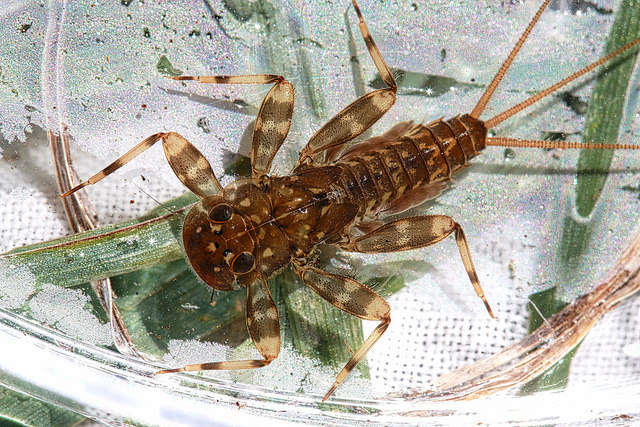
Mayfly Nymph Courtesy Robert Henricks, Photographer Found on VisualHunt.com Licensed through CC BY-SA https://creativecommons.org/licenses/by-sa/2.0/legalcode
Mayfly Nymph
Courtesy Robert Henricks, Photographer
Found on VisualHunt.com
Licensed through CC BY-SA https://creativecommons.org/licenses/by-sa/2.0/legalcode
It’s commonly believed that mayflies live for only one day. If you visit a cold, clear river in the spring or early summer, you might see what is known as a “mayfly hatch,” when millions of delicate, glassy insects suddenly appear on the surface of the water, take to the air, and then fall into the river later that day and apparently drown.

The truth is mayflies live for much longer than one day, but like many other aquatic insects, their life cycle consists of a long period during which almost nothing happens, followed by a sudden and dramatic burst of activity.

The mayfly begins life as an egg so tiny it’s nearly invisible to the naked eye. The egg sinks to the bottom of the river, and a couple weeks later a mayfly nymph hatches. Speckled and primitive-looking, the nymph simultaneously resembles a crab, shrimp, and troglodyte. For one entire year (and in the case of some species, two years), they grub around the streambed eating algae and hiding from trout. Lift a rock from a mountain stream and turn it over–if the stream is unimpaired by pollution or water quality problems, you’ll likely see a mayfly nymph doing what it does best: waiting in the mud for its birthday.

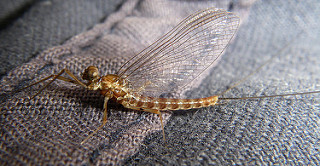
Mayfly Imago Courtesy J Schoen, Photographer Found on VisualHunt.com Licensed through CC BY-SA https://creativecommons.org/licenses/by-sa/2.0/legalcode
Mayfly Imago
Courtesy J Schoen, Photographer
Found on VisualHunt.com
Licensed through CC BY-SA https://creativecommons.org/licenses/by-sa/2.0/legalcode
In the spring, when its big day arrives, the nymph leaves the blackness of the streambed and heads for air and sunlight. But the nymph is so small and weak, the water’s surface is like a rubbery membrane that it must pierce and wriggle through. Then the nymph sheds its skin and emerges as a dull-colored and clumsy flying insect called a “sub-imago,” or what fly anglers call a “dun.” Practically weightless, they stand on the water, drifting downstream likes fleets of tiny sailboats as they wait for the UV light of the sun to harden their wings so they can fly away.

Mayfly Imago Courtesy Audrey Zharkikh,, Photographer Found on VisualHunt.com Licensed through CC BY-SA https://creativecommons.org/licenses/by-sa/2.0/legalcode
Mayfly Imago
Courtesy Audrey Zharkikh,, Photographer
Found on VisualHunt.com
Licensed through CC BY-SA https://creativecommons.org/licenses/by-sa/2.0/legalcode
It’s difficult to overstate how fragile and helpless a mayfly dun is. As the mayflies float up through the current, fight their way out of the water, and then surf along the waves, fish gorge themselves on them. When the mayflies get airborne, there are swallows and other birds to worry about. Even strong breezes and rough water can be catastrophic to duns. Luck is the only thing they can rely on.

But if the mayfly can escape the river and hole up in the bankside vegetation for just a couple hours, its skin will split open again, and a bolder, stronger creature will emerge. Now called the “imago” (fly anglers call them “spinners”), this stage can fly faster and more skillfully than before, and they use this agility to accomplish their final acts–find a partner, mate in mid-air over the stream, and deposit the seeds of a new generation in the water. Then, exhausted, the spinners die and fall back into the river, where the fish feed on them once again.

And so it’s easy to understand why some people mistakenly believe that mayflies live for only one day–by the time we see them emerging, they have only one day left to live. It’s almost as if, after a lifetime of staying home, the mayfly suddenly decides it’s time to get out and see the world, find love, and have a family, but they have to do it all that same day. Is there a lesson for us in the life cycle of a mayfly? Something about not waiting too long to do the things you want, or living every day as if it’s your last? The answer to this question, and possibly others, can be found by visiting cool, clear mountain streams in the springtime or early summer.

For Wild About Utah this is Chadd VanZanten.

Credits:
Photo credit #1: henricksrobert via Visualhunt.com / CC BY-SA
Photo credit #2: jschoen2000 via Visualhunt.com / CC BY-SA
hoto credit #3: andrey_zharkikh via Visualhunt.com / CC BY-SA
Text: Chadd VanZanten

Additional Reading:

Craig Macadam, The mayfly’s lifecycle: a fascinating, fleeting story, The Freshwater Blog, May 16, 2011, https://freshwaterblog.net/2011/05/16/the-mayflys-lifecycle-a-fascinating-fleeting-story/

Biology 5445, Entomology (Feener), https://courses.biology.utah.edu/feener/5445/Lecture/Bio5445%20Lecture%2005.pdf

Distribution of mayfly species in North America, List compiled from Randolph, Robert Patrick. 2002. Atlas and biogeographic review of the North American mayflies (Ephemeroptera). PhD Dissertation, Department of Entomology, Purdue University. 514 pages and information presented at Xerces Mayfly Festival, Moscow, Idaho June, 9-12 2005, https://www.usu.edu/buglab/Content/Mayflylist.pdf

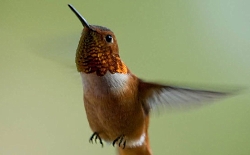
Rufous Hummingbirds

Rufus Hummingbird Courtesy US FWS, Roy W, Lowe, Photographer
Rufus Hummingbird
Courtesy US FWS,
Roy W. Lowe, Photographer

Who doesn’t love hummingbirds! I’m always amazed how a tiny life form with a brain smaller than a pea is capable of such amazing intelligence and behaviors. In fact, a hummingbird’s brain is proportionally larger in size to their body than that of any other bird. And like the corvid family (jays, magpies, and crows), research has found that hummers have an amazing memory.

Now is the seasonal peak for hummingbird activity with young birds fresh off the nest. One of my favorites, the migrating rufous hummingbird, may join the milieu on their long distance marathon as they make their way from as far north as Alaska to winter in Mexico.

The feistiest hummingbird in North America, the brilliant orange male and the green-and-orange female are relentless attackers at flowers and feeders. These fearless competitors will challenge even the largest hummingbirds of the Southwest, which can be double their weight, and often win the contest! Rufous Hummingbirds are wide-ranging, and breed farther north than any other hummingbird. Look for them in spring in California, summer in the Pacific Northwest and Alaska, and now in the Rocky Mountains as they make their annual circuit of the West.

Rufous Hummers have the hummingbird gift for fast, darting flight and pinpoint maneuverability. Like other hummers, they eat insects as well as nectar, taking them from spider webs or catching them in midair.

Rufous Hummingbirds breed in open areas, yards, parks, and forests up to timberline. On migration they pass through mountain meadows as high as 12,600 feet where nectar-rich, tubular flowers are blooming. Winter habitat in Mexico includes shrubby openings and oak-pine forests at middle to high elevation.

They may take up residence (at least temporarily) in your garden if you grow hummingbird flowers or put out feeders. But beware! They may make life difficult for any other species that visit your yard. If you live on their migration route, the visiting Rufous is likely to move on after just a week or two.

Regarding feeders, make sugar water mixtures with about one cup of sugar per quart of water. Food coloring is unnecessary; table sugar is the best choice. Change the water before it grows cloudy or discolored and remember that during hot weather, sugar water ferments rapidly to produce toxic alcohol. If you are among those who have these dazzling sprites of amazing life stop by, consider yourself fortunate indeed!

This is Jack Greene reading for “Wild About Utah”

Credits:

Pictures: Courtesy US FWS, Roy W Lowe, Photographer
Text: Jack Greene, Bridgerland Audubon Society

Additional Reading:

Strand, Holly, Hummingbirds in Utah, Wild About Utah, UPR/Bridgerland Audubon Society, Sept 3, 2009, https://wildaboututah.org/hummingbirds-in-utah/

Kervin, Linda, Gardening for Hummingbirds, Wild About Utah, UPR/Bridgerland Audubon Society, June 5, 2014, https://wildaboututah.org/hummingbirds-in-utah/

Liberatore, Andrea, Hummingbird Nests, Wild About Utah, UPR/Bridgerland Audubon Society, June 14, 2012, https://wildaboututah.org/hummingbird-nests/

Hummingbird Society, https://www.hummingbirdsociety.org/index.php

Coro Arizmendi Arriaga, Maria del, Hummingbirds of
Mexico and North America, In Spanish and English, CONABIO, 2014, https://www.biodiversidad.gob.mx/Difusion/pdf/colibries_mexico_y_norteamerica.pdf