Attracting Birds and Butterflies to Your Yard

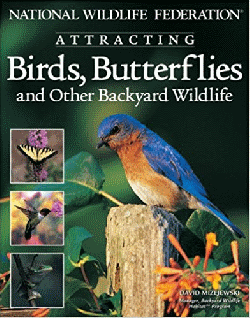
Attracting Birds, Butterflies and Other Backyard Wildlife National Wildlife Federation 2004 Cover Courtesy and Copyright Creative Homeowner a.k.a Fox Chapel Publishing
Attracting Birds, Butterflies and Other Backyard Wildlife
National Wildlife Federation 2004
Cover Courtesy and Copyright Creative Homeowner a.k.a Fox Chapel Publishing
As human populations increase, and construction developments overtake agricultural land and wildlife habitat, some people may feel as if there is little hope for local connections to nature. Don’t raise the white flag of surrender. There is much you can do in your own yards to help attract wild songbirds and butterflies.
The simple answer is to keep things in line with restoring their natural habitat by providing food, water, shelter and places to raise their young.

The best way to restore, or maintain, a successful and healthy ecosystem is to utilize “native” plants. Natives are basically the plants that would grow in the area naturally. Although some exotic transplants from other locations can be stunning to look at, and may even grow successfully in a new environment, wildlife may not be able to adapt to its use as food or shelter. In fact, those foreign plants may actually spread and push out native plants and prevent songbirds and pollinators from entering your yard. Some of them also carry diseases for which our native plants have no immunity.

Scientific studies have proven that having a diversity of plant species in an area improves the health of all those plants…..if they are natives to that locale. And healthy plants provide healthy benefits for wildlife and people. Westerners should reconsider the idea of having a monoculture lawn of Kentucky Bluegrass that is so common in the Eastern parts of the U.S.

What are some factors that determine which native plants will succeed in your area?
Learn about the elements and nutrients in your soil by using simple soil-test kits which can be purchased at Garden Centers.

Can you obtain plants that will succeed in natural soils, or will you have to supplement it with chemical fertilizers? Are you willing to deal with the potential effects of additional chemical use?
Some plants require mostly sunny areas, some shady, and some a combination of both.
What is the climate like in your locale? Don’t confuse this with weather. Climate is the average condition of a place for twenty years or more.

What is the normal precipitation pattern? Will you have to supplement that with irrigation? Can you afford that if your area is suffering from drought conditions?
Make certain that you check the cold-hardiness zone of plants you purchase. Some commercial retail stores will sell whatever they are shipped, often knowing that those plants will never survive in your area.

For a list of Utah native trees, shrubs, and flowers, research:
* Utah Native Plant Society at unps.org

*Utah State University Extension Center for Water-Efficient Landscaping at cwel.usu.edu

And you can always “Google” Native Plants + Utah.

* Plantnative.org/rpl-ut.htm

This is Ron Hellstern, and I am Wild About Utah.
 
Credits:

Images: Courtesy & Copyright 2004 NWF.org
Audio: Courtesy and Copyright Kevin Colver
Text: Ron Hellstern, Cache Valley Wildlife Association

Additional Reading

D. Mizejewski, Attracting Birds, Butterflies and Other Backyard Wildlife (Reston, VA: National Wildlife Federation/Fox Chapel Publishing, 2004). https://www.amazon.com/National-Wildlife-Federation-Attracting-Butterflies/dp/1580111505/
Publisher Website: https://foxchapelpublishing.com/national-wildlife-federation-r-attracting-birds-butterflies-backyard-wildlife.html

Certify Your Wildlife Habitat, National Wildlife Federation, Accessed 20 July 2017, https://www.nwf.org/Home/Garden-For-Wildlife.aspx
Certify: https://www.nwf.org/Garden-For-Wildlife/Certify.aspx

Creating Landscapes for Wildlife… A Guide for Backyards in Utah, Written by Sue Nordstrom and Illustrated by Kathlyn Collins Department of Landscape Architecture and Environmental Planning, Utah State University with Margy Halpin, Utah Division of Wildlife Resources; Second Printing 2001,
Updated for the Utah Division of Wildlife Resources, by Frank Howe, DWR Avian coordinator; Ben Franklin, DWR–Utah Natural Heritage Program botanist; Randy Brudnicki, DWR publications editor; and landscape planning illustrations by Stephanie Duer.,
Published by:
State of Utah Natural Resources, Division of Wildlife Resources,
Utah State University Cooperative Extension Service and
Utah State University Department of Landscape Architecture and Environmental Planning;
1991 updated 8/2025 https://wildlife.utah.gov/pdf/landscapingforwildlife.pdf
The Bear River

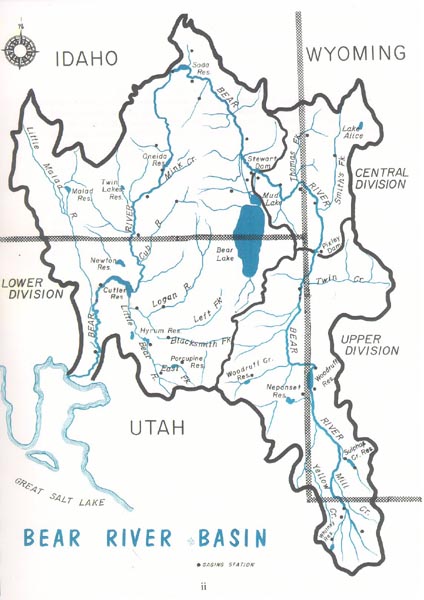
The Bear River Basin Courtesy Utah Division of Water Rights bear.river_.basis_.waterrights.utah_.gov_.250x354.jpg
Bear River Basin
Courtesy Utah Division of Water Rights
bear.river_.basis_.waterrights.utah_.gov_.250×354.jpg
Following the same route which I had taken when coming up, we arrived at Bear River on the evening of the eleventh and encamped. Examination of Cache valley occupied several days. Crossing over the range of low rounded hills through, which Bear River has cut a passage, we entered this beautiful and picturesque valley. Which was then covered with a profusion of rich green grass and adorned and diversified by numerous clumps of willows. The valley is full of swampy springs affording an abundance of good sweet water and excellent grass. Speckled trout, large size, abound in the streams. I believe this passage to be from “Journal of a Trapper” written by mountain man Osborn Russell around 1816.

The Bear is a unique and beautiful rivering system. Superlatives abound. A river of profound beauty, who provides over 60% of the life blood for the Great Salt Lake eco system. The largest river, to begin and end in the Great Basin. A river which witnessed the largest massacre of Native Americans in our country’s history. A river of abundant life, who supports three national wildlife refuges, in its 500 mile course.

There were a few thoughts running through my brain as I canoed down a stretch of the Bear River though Gentile valley, in southeast Idaho this morning, counting bird species for Utah Power and Light. I was stunned by the beauty as we left the bank, into early morning sunrise, in a river mist with rain clouds forming over surrounding mountains. Our spirits were further buoyed by rampant bird songs, Canada Geese, Sandhill Cranes, Meadow Larks, Red Winged Blackbirds countless swallows and songbirds. Occasionally sun would find a hole in the clouds and awaken the hills to vibrant Spring green offset by dark clouds gathering.

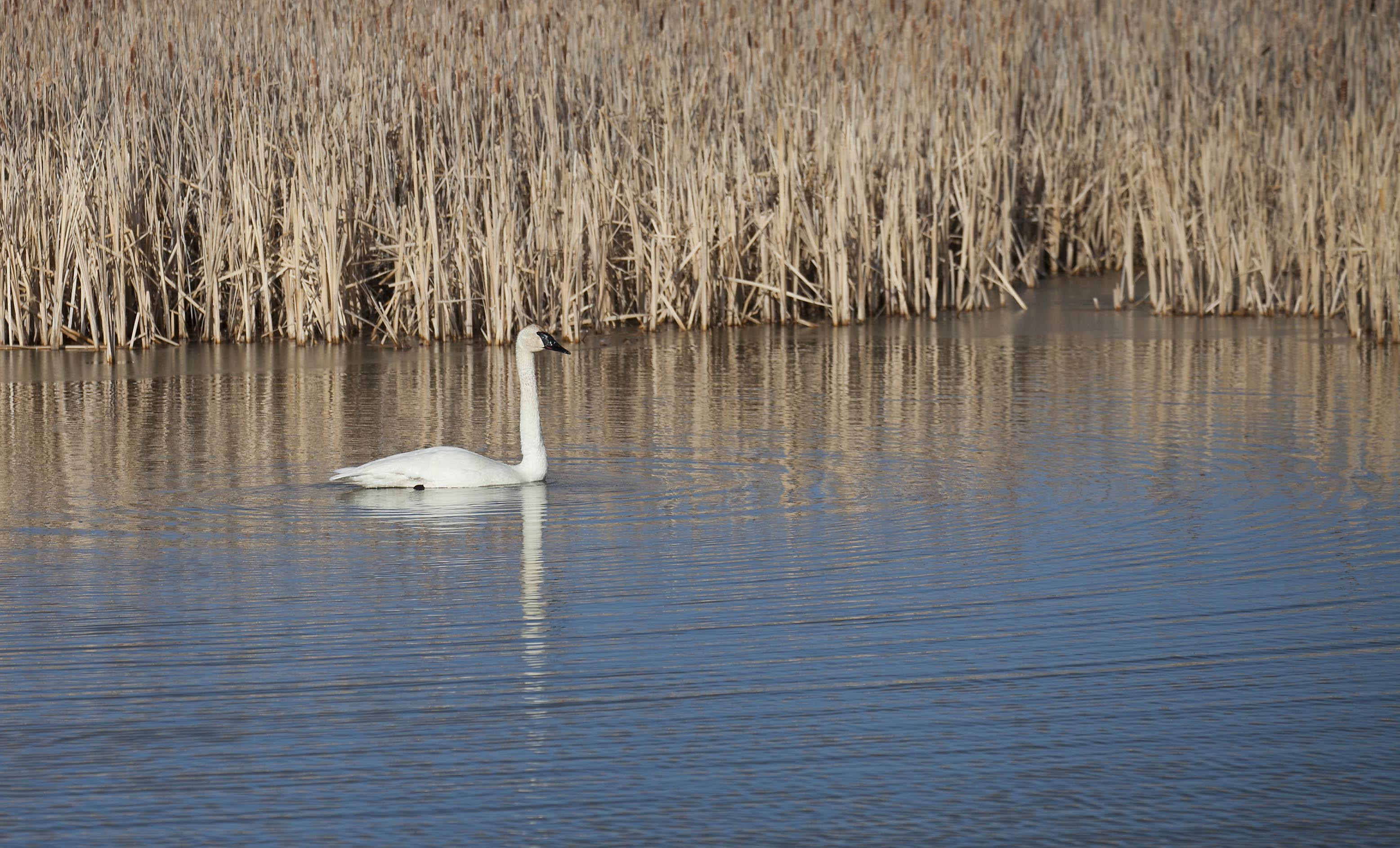
Trumpeter Swan Courtesy US FWS/Mountain Prairie-flickr Katie Theule, Photographer
Trumpeter Swan
Courtesy US FWS/Mountain Prairie-flickr
Katie Theule, Photographer
A large white bird appears on the water ahead of us. Perhaps another pelican. Drifting closer we startled this elegant graceful being, which emits a loud trumpeting call to echo through the shrouds of fog. Trumpeter Swan. We are held in awe of this magnificence. Still on the endangered species list, due to overharvesting and habitat loss.

Winding our way through many river miles we finally arrived at the backwaters of Oneida Reservoir, as the river disappears in a rugged defile called the Narrows. Most of this once magnificent stretch of wildriver now lies beneath the reservoir

This is Jack Greene and I am Wild About Utah!

Credits:

Map: The Bear River Basin Courtesy Utah Division of Water Rights
Images:Courtesy US FWS/Mountain Prairie-flickr Katie Theule, Photographer
Text: Jack Greene
Audio: Courtesy and Copyright Kevin Colver
Transcribed from the audio supplied by UPR

Additional Reading:

Russell, Osborne, York, Lem A, Journal Of A Trapper Or Nine Years in the Rocky Mountains 1834-1843, Syms York, 1921, Digitized by Google, https://archive.org/details/journalatrapper00yorkgoog
https://play.google.com/books/reader?id=49HTAAAAMAAJ&pg=GBS.PA7

Russell, Osborne, Journal Of A Trapper: Nine Years in the Rocky Mountains 1834-1843, University of Nebraska Press, 1955, https://www.amazon.com/manuscript-Robertson-Collection-University-Mountains/dp/B000OFZEES/
Other versions
https://www.amazon.com/Journal-Trapper-Years-Mountains-1834-1843/dp/1541104935
https://www.amazon.com/Journal-Trapper-Years-Mountains-1834-1843-ebook/dp/B01MYMW9AQ

Morgan, Dale, Jedediah Smith and the Opening of the West, Bison Books, 1964, https://www.amazon.com/Jedediah-Smith-Opening-West-Bison/dp/0803251386

Oneida Narrows Reservoir, Southwest Region, Idaho Birding Trail, Idaho Fish & Game, https://idfg.idaho.gov/ifwis/ibt/site.aspx?id=127

Trumpeter Swans, US FWS/Mountain Prairie-flickr account, Several Photographers https://www.flickr.com/photos/usfwsmtnprairie/sets/72157659882083253

Hidden in Plain Sight

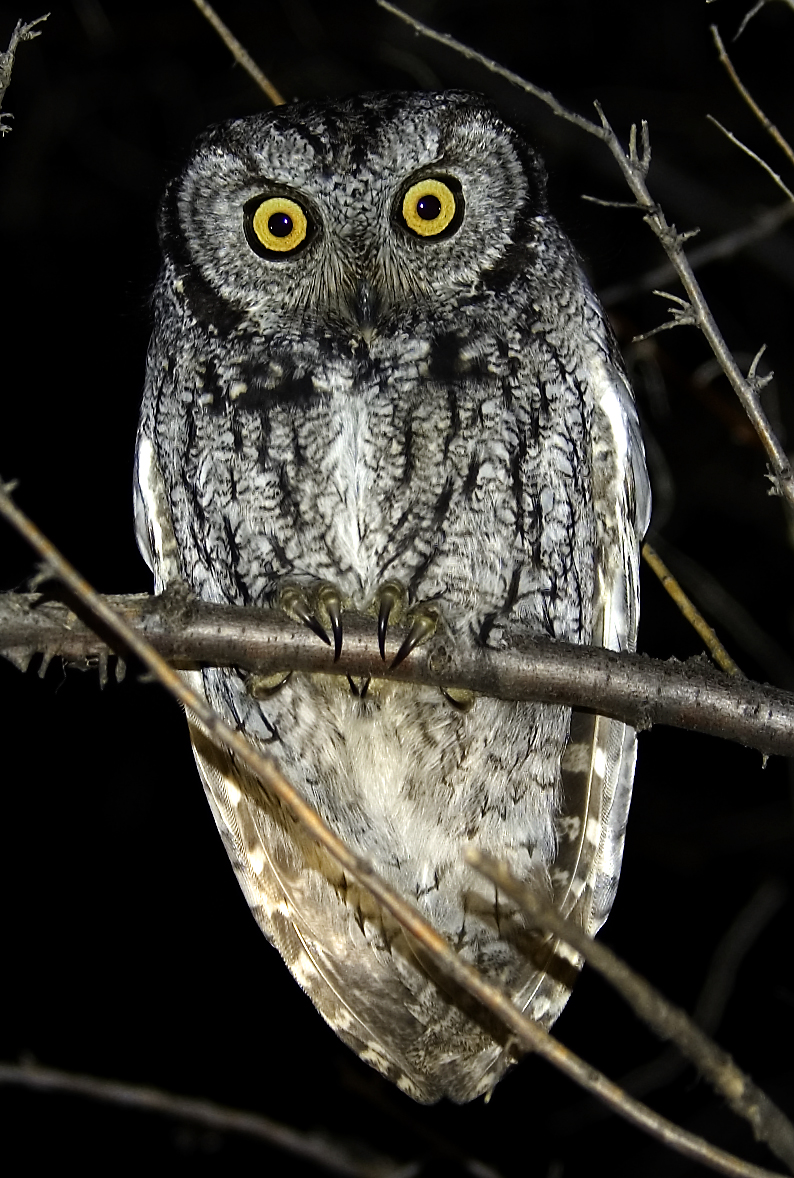
Hidden in Plain Sight: Western Screech Owl Courtesy & Copyright Lou Giddings
Western Screech Owl
Courtesy & Copyright Lou Giddings

My wife and I paddled our kayak gingerly into the eaves of a limestone cliff, our eyes scanning its face for some sort of concavity or movement where there was none. “I don’t see where she could possibly be,” my wife confessed. She was right. We knew we had found the right rock, soiled as it was with bird refuse, but there was nowhere for the nest to lie it seemed. Just then, on cue, a stirring of movement. Dark triangles rose out of the rock, followed by the lemony-yellow eyes of a mother Western Screech Owl. She climbed slowly from her grotto before exploding out of the rock toward us. A flurry of feathers rocketed toward us. I’m pretty sure I screamed, ducked as the bird soared away over our heads. We backed off a little. Concerned about the integrity of the nest site and our own well-being, we didn’t want to venture too close. When we were finally far enough away for mother’s comfort, she leap-frogged her way back to the cliff-side and disappeared again into the rock.

It’s a wonder she was there at all! Inconspicuous as it is, her placement is nevertheless adjacent to a highly frequented recreational reservoir. As we watched her descend back into her incubation chamber, country music blared from the opposite shore and the joyous yelps of our fellow boaters rang out through the air. To be sure, this wasn’t the first time she had been stirred from her nest; but she must have somehow grown accustomed to human sights and sounds. Otherwise, she wouldn’t choose this same nesting site year after year, as I’d heard she does. My wife and I marveled at her bravery in defying what seemed a too-close proximity to our louder, more aggressively curious species; but the more I thought about it, the peculiarity of her choice faded. This was not the first intimate space we had discovered this spring.

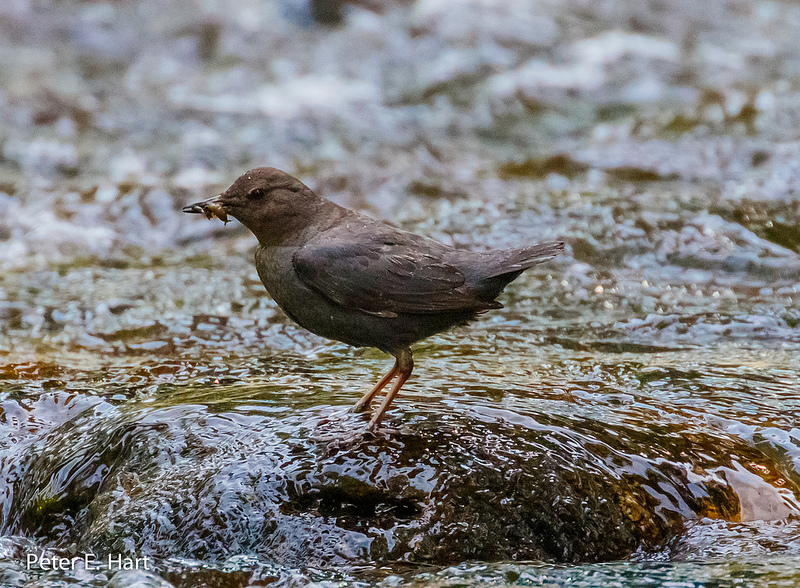
Hidden in Plain Sight: American Dipper Peter Hart, Photographer Photo credit: PEHart via Visual hunt / CC BY-SA
American Dipper
Peter Hart, Photographer
Photo credit: PEHart via Visual hunt / CC BY-SA
A couple weeks earlier, as we sat at swift water’s edge, a small charcoal feather-bundle fell out of the sky toward the water near the opposite bank. A Water Ouzel—otherwise known as the American Dipper—had just lit upon a boulder where it commenced its famous bouncing. At once, it lunged at the riffles of water at its feet, torpedoing itself toward whatever invertebrate morsel was to be found in early spring. Having fetched what it was after, the dipper surfaced into full flight. I thought it would have returned to the rock; but instead, it swept itself into the girders of the small bridge spanning the river.

American Dipper Courtesy & Copyright Josh Boling
American Dipper
Courtesy & Copyright Josh Boling
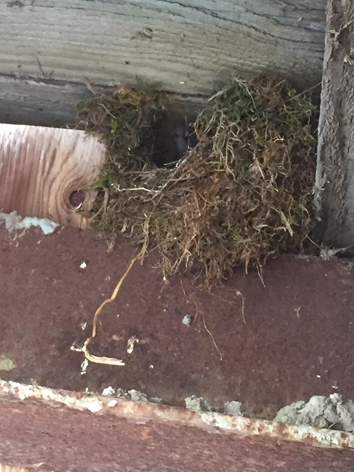
I waited for what I thought was a polite enough amount of time before investigating the scene. As I peered into the dim shadows beneath the bridge, my eyes adjusted to two others blinking back at me from the rounded doorway of a mossy, gourd-like dipper nest. “Why here?” I wondered aloud. The bird had taken offense to the question and took its immediate leave of my presence. This was the second dipper nest I’d found within a few miles’ stretch of river—the mark of a healthy and robust riparian zone, and perhaps also indicative of a healthy human/nature relationship. The other, too, neighbored a well-travelled recreational space.

It seems heroic at first glance, the wild ones enduring our somewhat rude domesticity; but perhaps it’s a complement. They’re comfortable enough to hide in plain sight.

I’m Josh Boling, and I’m Wild About Utah.

Credits:
Photos: Courtesy US FWS
Text: Josh Boling, 2018

Sources & Additional Reading

Western Screech Owl (images & sounds), AllAboutBirds.org, The Cornell Lab of Ornithology, https://www.allaboutbirds.org/guide/Western_Screech-Owl/

American Dipper (images & sounds), AllAboutBirds.org, The Cornell Lab of Ornithology, https://www.allaboutbirds.org/guide/American_Dipper/sounds

Consider Soundscapes

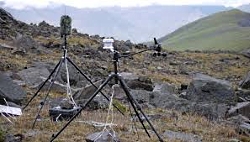
Scoundscape Recording Equipment Courtesy US NPS
Scoundscape Recording Equipment
Courtesy US NPS
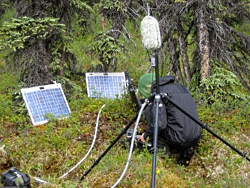
Imagine yourself in your favorite place outside. What sounds do you expect to hear? The sound of water rushing over rocks? Crickets chirping? The wind softly blowing through the trees? These are some of the natural sounds you might expect to hear, but it might not always work out that way. Recreation areas are often filled with anthropogenic noises like vehicles, people talking, music playing, machinery, and more.

Checking sound equipment set up near the McKinley Bar Trail, Denali National Park Courtesy US NPS
Checking sound equipment set up near the McKinley Bar Trail, Denali National Park
Courtesy US NPS
Soundscapes, or the acoustic environment, are not often thought of as a natural resource, but are actually an important part of the environment. A common reason people go to nature is for peace and quiet. Quiet is considered a valuable resource. Humans have grown accustomed to a constant background of noise, but it is not always good. Escaping to nature can potentially provide relief from noise pollution, but natural soundscapes are becoming less and less common.

Noise pollution significantly impacts human health. Physical and mental impacts can include hearing disorders, sleep disruption, and even interruptions in the cardiovascular and endocrine systems. Sound is more important than you might realize.

Soundscapes may be important to humans, but they are arguably even more important for wildlife. Many animals depend on hearing for warning them of danger, communicating with other animals, and locating prey. Birds and other animals can hear noises from very far away, and noise interference can disrupt them easily. Behavioral responses may include leaving an area for a brief time or leaving an area for good.

Through evolution, some animals have lost sight, because it was not a necessary trait in some situations. Up to this point, there has been no animal discovered that has lost its hearing through evolution. This illustrates how vital the acoustic environment is to wildlife and ecosystem health.

Barn Owl Courtesy US FWS
Think of a Barn Owl. Hunting in the dark, they rely on the tiniest rustle to lead them to their prey. Their sense of hearing is fine-tuned and adapted specially for this purpose. One ear hole is slightly higher than the other, which allows them to perceive depth through hearing. Also, one ear hole can hear sounds below them on the ground, and the other can hear the sounds in the air. Just by listening, an owl can locate a mouse far below it on the ground. Noise pollution would make it nearly impossible for owls to hunt.

Owls are just one example of noise pollution negatively effecting wildlife. As soundscapes are disturbed, wildlife will be displaced or even die. Public land managers now have the challenge of managing soundscapes. This is a difficult, but soundscapes are important for humans recreating, wildlife, and whole ecosystems.

As William Shakespeare said, “The earth has music for those who listen.”

This is Aspen Flake and I am Wild About Utah.

Credits:
Photos: Courtesy US NPS ans US FWS
Audio: Courtesy and Copyright Kevin Colver
Text: Aspen Flake

Additional Reading & Listening

https://naturalheroes.org/videos/natures-orchestra/

Bernie Krause, Recording Artist:
https://www.wildsanctuary.com/

Bryan C. Pijanowski, Luis J. Villanueva-Rivera, Sarah L. Dumyahn, Almo Farina, Bernie L. Krause,
Brian M. Napoletano, Stuart H. Gage, and Nadia Pieretti, Soundscape Ecology: The Science
of Sound in the Landscape, BioScience, Volume 61, Issue 3, 1 March 2011, Pages 203–216, https://www.wildsanctuary.com/BioScience2011-SoundscapeEcology.pdf or https://academic.oup.com/bioscience/article/61/3/203/238162

Wild Soundscapes: Discovering the Voice of the Natural World, Revised Edition Paperback – May 24, 2016
by Bernie Krause (Author),‎ Roger Payne (Foreword) https://www.amazon.com/Wild-Soundscapes-Discovering-Natural-Revised/dp/0300218192

Voices of the Wild: Animal Songs, Human Din, and the Call to Save Natural Soundscapes (The Future Series) Hardcover – August 25, 2015
by Bernie Krause (Author) https://www.amazon.com/Voices-Wild-Animal-Natural-Soundscapes/dp/0300206313

The Great Animal Orchestra: Finding the Origins of Music in the World’s Wild Places Paperback – March 12, 2013
by Bernie Krause (Author) https://www.amazon.com/Great-Animal-Orchestra-Finding-Origins/dp/031608686X/

Kevin Colver, Recording Artist:

Know Your Bird Sounds: Common Western Species (with audio CD) (The Lang Elliott Audio Library) Paperback – January 10, 2008
by Lang Elliott (Author),‎ Kevin Colver (Contributor) https://www.amazon.com/Know-Your-Bird-Sounds-Western/dp/0811734463/

Songbirds of Yellowstone and the High Rockies Audio CD – January 1, 1996
by Kevin J. Colver (Author) https://www.amazon.com/Songbirds-Yellowstone-Rockies-Kevin-Colver/dp/1929797079/ or https://wildstore.wildsanctuary.com/collections/all-albums/products/songbirds-of-yellowstone-and-the-high-rockies

Songbirds of the Southwest Canyon Country Audio CD – January 1, 1994
by Kevin J. Colver (Author) https://www.amazon.com/Songbirds-Southwest-Canyon-Country-Colver/dp/1929797036/ or https://wildstore.wildsanctuary.com/products/songbirds-of-the-southwest-canyon-country

Songbirds of the Rocky Mountain Foothills Audio CD – January 1, 1994
by Kevin J. Colver (Author) https://www.amazon.com/Songbirds-Rocky-Mountain-Foothills-Colver/dp/192979701X/ or https://wildstore.wildsanctuary.com/products/songbirds-of-the-rocky-mountain-foothills

Songbirds of Yosemite and the Sierra Nevadas by Kevin J. Colver (Author) https://www.amazon.com/Songbirds-Yosemite-Sierra-Nevadas-Colver/dp/B00004T1L2/, or
https://wildstore.wildsanctuary.com/products/songbirds-of-yosemite-and-the-sierra-nevadas

Frogs and Toads, Kevin J Colver, August 16, 2011 https://www.amazon.com/Frogs-Toads-Kevin-J-Colver/dp/B005I0C4ZQ/

https://wildstore.wildsanctuary.com/products/katmai-wilderness
https://wildstore.wildsanctuary.com/products/saguaro-sunrise
https://wildstore.wildsanctuary.com/products/voice-of-the-arctic-refuge
https://wildstore.wildsanctuary.com/products/starvation-creek-utah

Jeff Rice, Recording Artist:
Dobner, Jennifer, LISTENING TO THE NATURAL WEST
The U’s Western Soundscape Archive captures the animal and ambient music of the wild., CONTINUUM
THE MAGAZINE OF THE UNIVERSITY OF UTAH, Summer 2014, https://continuum.utah.edu/web-exclusives/listening-to-the-natural-west/

Vanderbilt, Tom, You Need to Hear This, Recording engineer Jeff Rice is on a mission to preserve the sounds of nature. Why? Listening to them might actually make us healthier., OutsideOnline.com, 20 Oct 2011, https://www.outsideonline.com/1887466/you-need-hear

https://www.nps.gov/subjects/sound/index.htm

A Symphony of Sounds, US National Park Service (US NPS), https://www.nps.gov/articles/denali-understanding-managing-soundscapes.htm