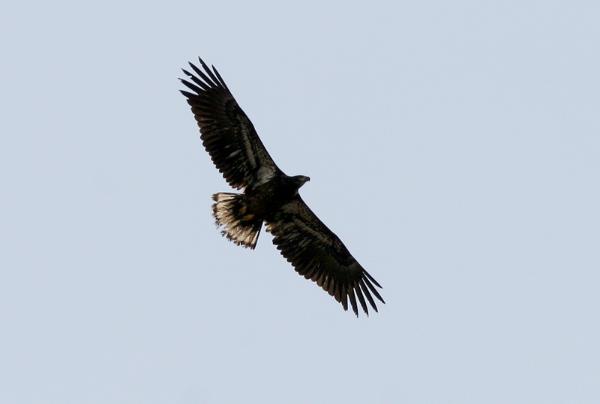
Turkey Vultures

Swainsons Thrush
Turkey Vulture in flight
Cathartes aura
Courtesy Utah Division of Wildlife Resources
Scott Root, Photographer
Licensed under CCL

Turkey Vulture Kettle above LoganTurkey Vulture Kettle above Logan
Cathartes aura
Courtesy and Copyright
Andrea Liberatore, Photographer

Turkey Vulture Kettle above LoganTurkey Vulture Kettle above Logan
Cathartes aura
Courtesy and Copyright
Andrea Liberatore, Photographer

On certain days in the spring and fall, the sky above my neighborhood looks like a scene from Alfred Hitchcock’s ‘The Birds’. As many as 60 large black birds swarm the sky, circling above the rooftops. On the busiest of days, people will stop their cars in the middle of the road to gawk at the sight. Some give a visible shiver when told that the birds are turkey vultures. But we have nothing to fear from these birds – in fact they should be embraced for the absolutely vital role they play in our environment.

There are lots of myths surrounding vultures, which in turn creates a misunderstanding about them. So let’s set the record straight on a few things. Vultures circle for two main reasons, neither of which involves waiting for a sick or wounded animal to die. The first reason is to take advantage of rising columns of air, called thermals, which generally occur in the mornings as the sun warms the air closest to the earth. Vultures are soaring birds and flapping their 6-foot wingspans takes a lot of effort, so they rarely do it. In fact these birds can fly for hours without a single flap. Circling within a thermal helps them travel higher and farther on much less energy.
The second reason vultures circle is to hone in on a food source. Turkey vultures are one of the few birds that have a highly developed sense of smell. Working together with their excellent eyesight, the birds soar and circle to pin down the location of their next meal.

Continue reading “Turkey Vultures”

William Swainson and His Namesake Hawk and Thrush

William Swainson and His Namesake Hawk and Thrush: Swainsons Thrush, Photo Copyright 2004 Jim Bailey
Swainson’s Thrush
Catharus ustulatus
Copyright © 2004 Jim Bailey

Swainsons Hawk, Buteo swainsoni, Photo Copyright 2010 Eric Peterson Swainsons Hawk
Buteo swainsoni
Copyright © 2010 Eric Peterson


What links this melodious thrush of northern Utah forests
(Kevin Colver: Song Birds of Yellowstone)
with a hawk that soars over farms, range lands and prairies in western North America?

Both Swainson’s Thrush and Swainson’s Hawk are named after the 17th century self-taught British naturalist, William Swainson. He was a contemporary of John James Audubon. Like Audubon, Swainson was a passionate solo collector, taxidermist and skilled illustrator of birds. Unlike Audubon, Swainson’s single intensive field expedition took him far to the south, sailing to eastern Brazil. During his two year stay, he amassed a collection of 20,000 animal specimens, including 760 bird skins. Swainson ultimately named 20 species new to science. Although he never visited North America, he nonetheless co-authored an encyclopedic four volume treatise about North America’s fauna.

Swainson’s Hawk and Swainson’s Thrush share another similarity, this one biological. Both birds migrate long distances to escape winter’s cold and hunger. Swainson’s Thrush winters in balmy tropical forests of South America. Swainson’s Hawk soars farther, all the way to the arid Argentine pampas. There this large slender hawk dines mostly on big flying insects, particularly grasshoppers and even dragonflies. Swainson’s Hawks migrate in groups, often along regular corridors. Every September, Hawkwatch volunteers and hardy birders have reported hundreds of Swainson’s Hawks rocketing past the Wellsville Mountains of northern Utah, flying amid several thousand migrating raptors of all kinds.

Birds migrate to avoid the snow, cold and lean times of northern winters. Migration poses natural risks, of course. Hawkwatch ornithologists also suspect that widespread use of two deadly organophosphate insecticides on Argentine crops kills many insect-eating Swainson’s Hawks. The plow, pavement and subdivisions have also reduced this hawk’s historic northern range, especially in California. In addition, foolish people still shoot this relatively tame hawk, not caring that its diet of rodents and grasshoppers benefits our farmers and ranchers.

Professional disappointments drove the quarrelsome William Swainson south as well, to New Zealand, where he died in anonymity. His namesakes, Swainson’s Hawk and Swainson’s Thrush, live on to cross and recross the equator in pursuit of perpetual summer and the feast it provides.

This is Linda Kervin for Bridgerland Audubon Society.

Credits:
Pictures: Swainson’s Hawk, Courtesy and Copyright © 2010 Eric Peterson, as found on utahbirds.org
Swainson’s Thrush, Courtesy and Copyright © 2004 Jim Bailey, as found on utahbirds.org
Bird Recordings: Kevin Colver https://wildstore.wildsanctuary.com/collections/special-collections
Text: Jim Cane, https://bridgerlandaudubon.org/
Voice: Linda Kervin https://bridgerlandaudubon.org/

Additional Reading:

Swainson’s Hawk, Fieldguide, Utah Division of Wildlife Resources, Utah Department of Natural Resources, State of Utah, https://fieldguide.wildlife.utah.gov/?species=buteo%20swainsoni

Swainson’s Hawk, All About Birds, The Cornell Lab of Ornithology, https://www.allaboutbirds.org/guide/Swainsons_Hawk/overview

Swainson’s Thrush, Fieldguide, Utah Division of Wildlife Resources, Utah Department of Natural Resources, State of Utah, https://fieldguide.wildlife.utah.gov/?species=catharus%20ustulatus

Swainson’s Thrush, All About Birds, The Cornell Lab of Ornithology, https://www.allaboutbirds.org/guide/Swainsons_Thrush/

Owls: Silent Hunters

Barn owl sleeping in a tree, Photo Copyright 2010 Mike Fish
Barn Owl Sleeping in a Tree
Copyright © 2010 Mike Fish

Great Horned Owl  Photographer: Ronald Laubenstein US FWS Digital Library Great Horned Owl
Photographer: Ronald Laubenstein
US FWS Digital Library

Click for a larger image - Western Screech Owl courtesy and copyright 2007 Lu Giddings Western Screech Owl
Copyright © 2007 Lu Giddings

Click for a larger view of the tethered Snowy Owl, Bubo scandiacus, Image courtesy US FWS.  Ronald Laubenstein, Photographer Tethered Snowy Owl in Alaska
Bubo scandiacus

Courtesy US FWS
Ronald Laubenstein, Photographer

Click for a larger view of Snowy Owl in Alaska, Bubo scandiacus, Photo taken in Alaska by Floyd Davidson, Photographer, Courtesy Wikimedia and licensed through GNU Free Documentation License 1.2Snowy Owl in Alaska
Bubo scandiacus

Courtesy Wikimedia
Floyd Davidson, Photographer
Licensed under the
Creative Commons: GNU Free Documentation License

Click for a larger view of Snowy Owl with chick, Bubo scandiacus, Photo taken by Tony Hisgett, Photographer, Courtesy Wikimedia and licensed through the Creative Commons: Attribution 2.0 Generic LicenseSnowy Owl with Chick
Bubo scandiacus

Courtesy Wikimedia
Tony Hisgett, Photographer
Licensed under the
Creative Commons: Attribution 2.0 Generic License

Click for a larger view of Snowy Owl in Alaska, Bubo scandiacus, Photo taken by Bert de Tilly, Photographer, Courtesy Wikimedia and licensed through the Creative Commons: Attribution-Share Alike 3.0 Unported LicenseSnowy Owl in Flight
Bubo scandiacus

Courtesy Wikimedia
Bert de Tilly, Photographer
Licensed under the
Creative Commons: Attribution-Share Alike 3.0 Unported License

Hi, this is Mark Larese-Casanova from the Utah Master Naturalist Program at Utah State University Extension.

Walking across the yard late at night, the crescent moon was casting little light. A dark, phantom shape soared past our heads. It was silent, not making a single noise. It could only be one thing out here in the night- an owl, drifting off into the darkness.

Even though they hunt at night, owls use their vision to find prey. Owl eyes are proportionately large compared to those of other birds, and also have large corneas and pupils to allow more light into the eye. The retina, where an image is formed at the back of the eye, is so large that an owl’s eye is shaped more like a rounded cone or tube rather than a ball. Because the back of an owl’s eye is wider than the front, owls cannot move their eyes within the socket like other animals. To make up for this, owls are able to turn their heads three-quarters of a full rotation!

To supplement its acute vision, owl’s ears are particularly well adapted for hearing prey. In fact, some owls hear so well that they can catch prey in complete darkness. The feathers of the facial disk- the round, flat areas around the eyes- help direct sound toward their large ear openings. In addition, an owl’s ear openings are set relatively far apart on its skull, and at different orientations on each side. One is high and more forward on the skull, and the other is lower and to the rear. This allows owls to locate noises, such as the rustling of a mouse, by triangulation with remarkable precision.

Excellent sight and hearing are helpful to owls, but very quiet feathers help them sneak up on prey. Relatively large wings covered with feathers that have a velvety soft upper surface and a serrated edge reduce noise during flight. Owls even have feathers on their legs to help keep quiet!

Most birds sleep soundly in their roosts at night. But, it’s not uncommon for us to see an owl gliding through the darkness in search of its prey. Just don’t expect to hear them…

For Wild About Utah, I’m Mark Larese-Casanova.

Credits:
Images: Courtesy US FWS images.fws.gov
Courtesy and Copyright Mike Fish
Courtesy and Copyright Lu Giddings
Courtesy Wikimedia & licensed through CCL
Text:     Mark Larese-Casanova, Utah Master Naturalist Program
            at Utah State University Extension.


Additional Reading:

Berger, C. (2005). Owls. Mechanicsburg, PA: Stackpole Books.

Lynch, W. (2007). Owls of the United States and Canada. Baltimore, MD: Johns Hopkins University Press.

Owl Feathers and Flight. (2012). In The Owl Pages. Retrieved September 20, 2013, from https://www.owlpages.com/articles.php?section=owl+physiology&title=Feathers

Owl Eyes and Vision. (2012). In The Owl Pages. Retrieved September 20, 2013, from https://www.owlpages.com/articles.php?section=owl+physiology&title=Vision

Kokanee Life Cycle

Kokanee Salmon above Porcupine Reservoir
Copyright 2008 Mary-Ann Muffoletto

Hi, I’m Holly Strand from the Quinney College of Natural Resources at Utah State University.

A highly compelling mating drama is taking place now in select mountain reservoirs. Utah’s colorful kokanee salmon are at the very peak of their upstream migration. Yearning to find the gravel bar in which they were born, these fish follow their noses. For the smell of that gravel birthplace–and the surrounding stream–is imprinted in young kokanee brains. Biologists call this smell the “home stream olfactory bouquet.”

Once a female kokanee is satisfied with the surrounding “olfactory bouquet,” she digs a nest in the gravel with her tail. As she digs one or more of these nests, individual males will try to guard her in order to secure their paternity. Part of the spectacle of kokanee-watching comes from the darting and biting and jostling among males attempting to get access to females. Once the eggs are laid and fertilized the female covers them with gravel.

This is the end of the line for the new parents. Within a few days of egg laying the female will die. And the male will follow soon after. Expired fish provide food for predators and scavengers such as gulls, ravens, and coyotes. Any leftover salmon will decompose and fertilize the stream waters, leading to plankton growth, which—in turn–will nourish the new crop of young salmon.

In Utah, kokanee eggs hatch between November and January. The tiny new salmon will spend their first weeks of life hiding in the gravel feeding off the remains of their egg yolk sack. After a few weeks they will emerge from the gravel to feed on plankton. By spring, these youngsters—called fingerlings– will be an inch and a half long. During spring runoff the fingerlings are swept downstream until they spill into a lake or reservoir. Now they will stay here in the open water for 2-4 years, feeding on zooplankton until they reach maturity.

For these first stages of life kokanee are dark to greenish blue on the head and back, silver on the sides and silvery or white underneath.
But at summer’s end, the spawning salmon will undergo their astonishing transformation. The males’ bodies will turn a bright red-orange. Their shape will change as well. They will acquire humped backs, hooked jaws, and elongated teeth. The females also turn red although the color may not be as striking. By late August both males and females are congregating at the mouth of the spawning stream preparing to embark on the final–and most important–mission of their lives.

For more information and locations for kokanee viewing go to www.wildaboutUtah.org. You’ll also see a video of kokanee spawning in the Little Bear River*, the main tributary of Porcupine Reservoir.

For Wild About Utah, I’m Holly Strand.

* Many people call this Cinnamon Creek. However the Little Bear River feeds Porcupine reservoir. Cinnamon creek joins the Little Bear, as a tributary, a little bit up stream and East of Porcupine reservoir.

Credits:

Photo: Courtesy and Copyright 2008 Mary-Ann Muffoletto, Photographer
Video: Courtesy and Copyright 2013 Charles Hawkins, Photographer
Video: Courtesy and Copyright 2013 Holly Strand, Photographer
Text: Holly Strand, Quinney College of Natural Resources at Utah State University

Where to see kokanee salmon spawning (adapted from Utah Div. of Wildlife Resources website)

The Kokanee spawning runs in Sheep Creek, Indian Creek, Strawberry River and the upper East Fork Little Bear River occur in late August through early October. Flaming Gorge Reservoir has a late-season spawning population which spawns in the Green River and along the shores of the reservoir in late October through November.

Sheep Creek is in northeastern Utah, about six miles south of Manila. The viewing site is at the Scenic Byway turnout where Sheep Creek crosses under state Route 44.

Porcupine Reservoir: Just pass Avon, turn left (there’s a sign) and head east to the reservoir. Pass the dam and follow the shelf road past the end of the reservoir. There will be a wide level area where you can park and walk down to the Little Bear River to see the salmon.

Sept. 22 is Kokanee Salmon Viewing Day.at the U.S. Forest Service visitor center at Strawberry Reservoir. Utah Div. of wildlife Biologists will be on hand to show you the salmon and answer any questions. https://wildlife.utah.gov/dwr/news/42-utah-wildlife-news/906-see-kokanee-at-strawberry.html Even if you can’t make it to this event, salmon should be visible in the Strawberry River, and other tributaries to Strawberry, from now until the first part of October.

Sources & Additional Reading

Sept. 22 is Kokanee Salmon Viewing Day.at the U.S. Forest Service visitor center at Strawberry Reservoir. Utah Div. of wildlife Biologists will be on hand to show you the salmon and answer any questions.
https://wildlife.utah.gov/dwr/news/42-utah-wildlife-news/906-see-kokanee-at-strawberry.html [Accessed September 19, 2013]

Resources:
Fuller, P., G. Jacobs, J. Larson, and A. Fusaro. 2013. Oncorhynchus nerka. USGS Nonindigenous Aquatic Species Database, Gainesville, FL.
https://nas.er.usgs.gov/queries/factsheet.aspx?SpeciesID=915 Revision Date: 3/7/2012 Note: Oct 29, 2024 New link https://nas.er.usgs.gov/queries/factsheet.aspx?SpeciesID=915

Sigler, John W. and William F. Sigler. 1987. Fishes of the Great Basin: A Natural History. Reno, NV: University of NV Press. https://unpress.nevada.edu/9780874176940/fishes-of-the-great-basin/

Sloman, Katherine A., Rod W. Wilson, Sigal Balshine. 2006. Behaviour and Physiology of Fish. San Diego, CA: Elsevier Academic Press. https://shop.elsevier.com/books/fish-physiology-behaviour-and-physiology-of-fish/sloman/978-0-12-350448-7

Steward, Ron. 1994. Kokanee. Utah Division of Wildlife Resources. Wildlife Notebook Series No. 10. https://utah.ptfs.com/awweb/main.jsp?flag=collection&smd=1&cl=all_lib&lb_document_id=12657&itype=advs&menu=on
[accessed September 19, 2013] Downloaded and found at https://wildaboututah.org/wp-content/uploads/kokanee-dwr-booklet1.pdf

Ross, Crystal, Where to see Utah’s spawning kokanee salmon, Wildlife Blog, Utah Division of Wildlife Resources, August 29, 2019, https://wildlife.utah.gov/news/wildlife-blog/755-where-to-see-utah-s-spawning-kokanee-salmon.html [accessed October 29, 2024]