Seasonal Changes, Amazing Adaptations

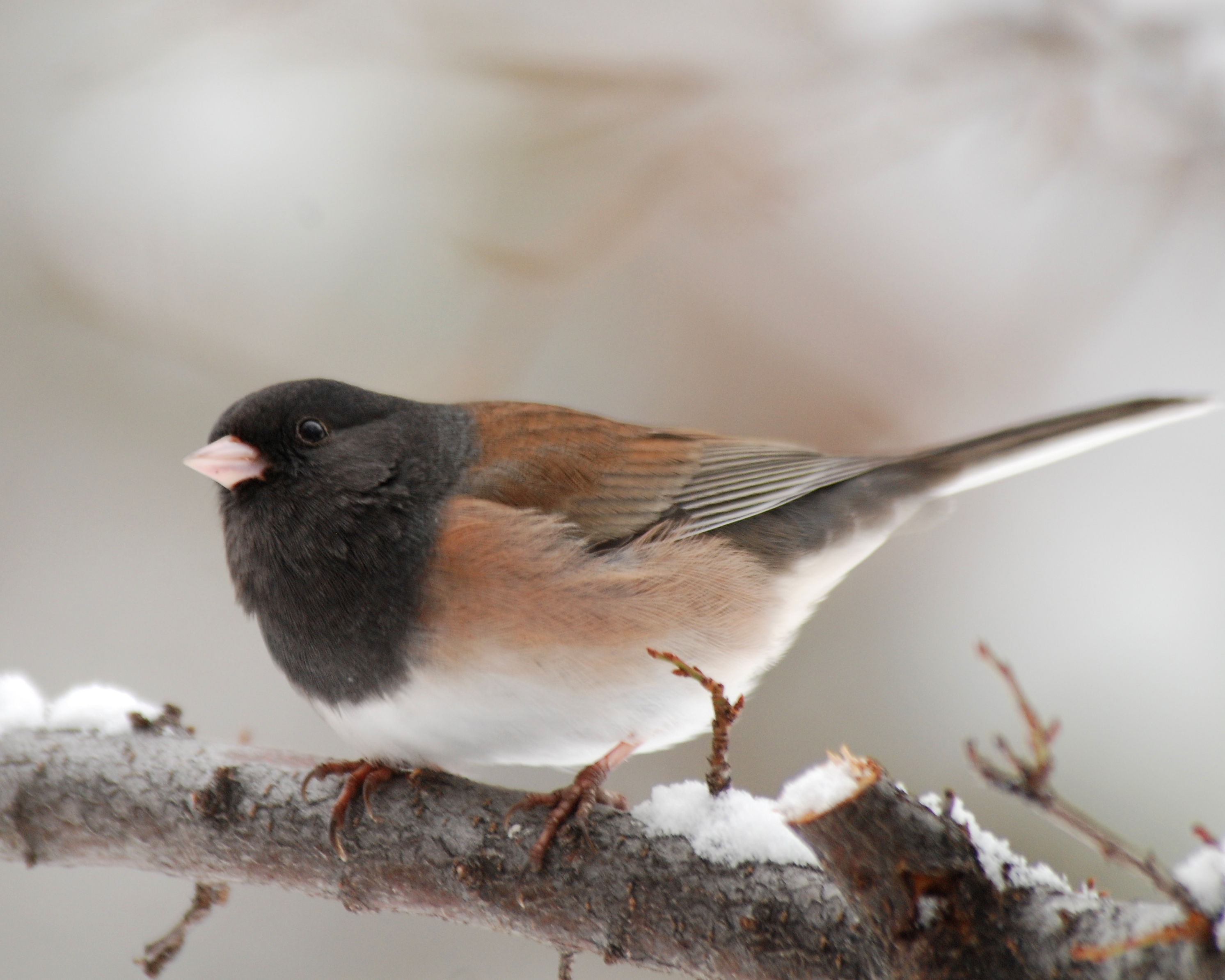
Seasonal Changes, Amazing Adaptations: Click for a larger view of a Dark-eyed 'Oregon' Junco Male, Junco hyemalis montanus, Courtesy and copyright 2008 Ryan P. O'Donnell
Dark-eyed Junco “Oregon” Male
Junco hyemalis montanus
Courtesy & © 2008 Ryan P. O’Donnell 
Biking daily from Smithfield Canyon to USU campus, combined with an early am run, I’m well aware of the drop in temperatures, as are those of us who find themselves outdoors on a more permanent schedule. I’m speaking of our relatives who reside in the wild- birds, trees, raccoons, and such.

While I put on an extra layer or two, plants and animals have far more sophisticated adaptations from behavioral to physiological to structural.

We are all aware of the marvelous migration and hibernation behaviors, so let’s add a few more amazing adaptations to the list.

I’ll begin with a bird that is very common at our winter feeder- the Dark-eyed Junco. which responds to the first shortening days of summer with a series of physical changes: its reproductive organs become inactive and shrink in size, hormones stimulate the rapid growth of a new set of feathers, and fat deposits develop to provide fuel for the long migratory flight ahead.

Thus the preparation for migration starts as soon as the days begin to shorten. And the process must operate in reverse when the bird is in its winter habitat in the United States. As soon as days begin to lengthen, the Dark-eyed Junco must gear up physically for the flight north and breeding season. If it fails to do so, it likely won’t survive a long-distance migration. So the cycle of life and its related migrations and transitions are deeply connected to the heavens.

Plants are no less amazing. Those in temperate zones must also set their calendars accurately in order to flower and, for deciduous species, develop and drop leaves at the optimal time. Plants set their internal calendars using several attributes from the sunlight they receive. In fact, the angle of the sun may be more important to a plant than day length.

That’s because plant cells produce compounds called phytochromes in response to different portions of the light spectrum. Direct sunlight is higher in red light, while indirect sunlight contains more far-red light. During late fall and early winter, when the sun remains low in the southern sky, the indirect light produces an increase in far-red phytochromes.

As spring approaches and the arc of the sun rises in the sky, direct sunlight triggers the production of red phytochromes. The ratio of these two compounds mediates the hormones involved in flowering, leaf drop, and bud development. Even seeds below the soil are affected. The amount of red and far-red light that penetrate the soil is sufficient to govern germination.

Some behavioral alterations worth mention beyond migrating and hibernation are herding and flocking, huddling to share body warmth, dietary change, hair & feather change- both color and structure, and many more but my radio time is ending, so now it’s your turn to explore more! It really does make you appreciated the wonders of nature.

This is Jack Greene for Wild About Utah.

Credits:
Image: Courtesy and copyright 2008 Ryan P. O’Donnell
Text:     Jack Greene, Bridgerland Audubon Society


Additional Reading:

Dark-eyed Junco, Junco hyemalis, Aynsley Carroll, Animal Diversity Web, https://animaldiversity.org/accounts/Junco_hyemalis/

Dark-eyed Junco, Junco hyemalis, Aynsley Carroll, Boreal Songbird Initiative, https://www.borealbirds.org/bird/dark-eyed-junco

https://scholar.google.com/scholar?q=junco+winter+reproductive+cycles

Jigang Lia, Gang Lib, Haiyang Wangb, and Xing Wang Denga, Phytochrome Signaling Mechanisms, The Arabidopsis Book, American Society of Plant Biologists, 2011, https://www.ncbi.nlm.nih.gov/pmc/articles/PMC3268501/ pdf
Kit Foxes: Utah’s Desert Night Sentinels

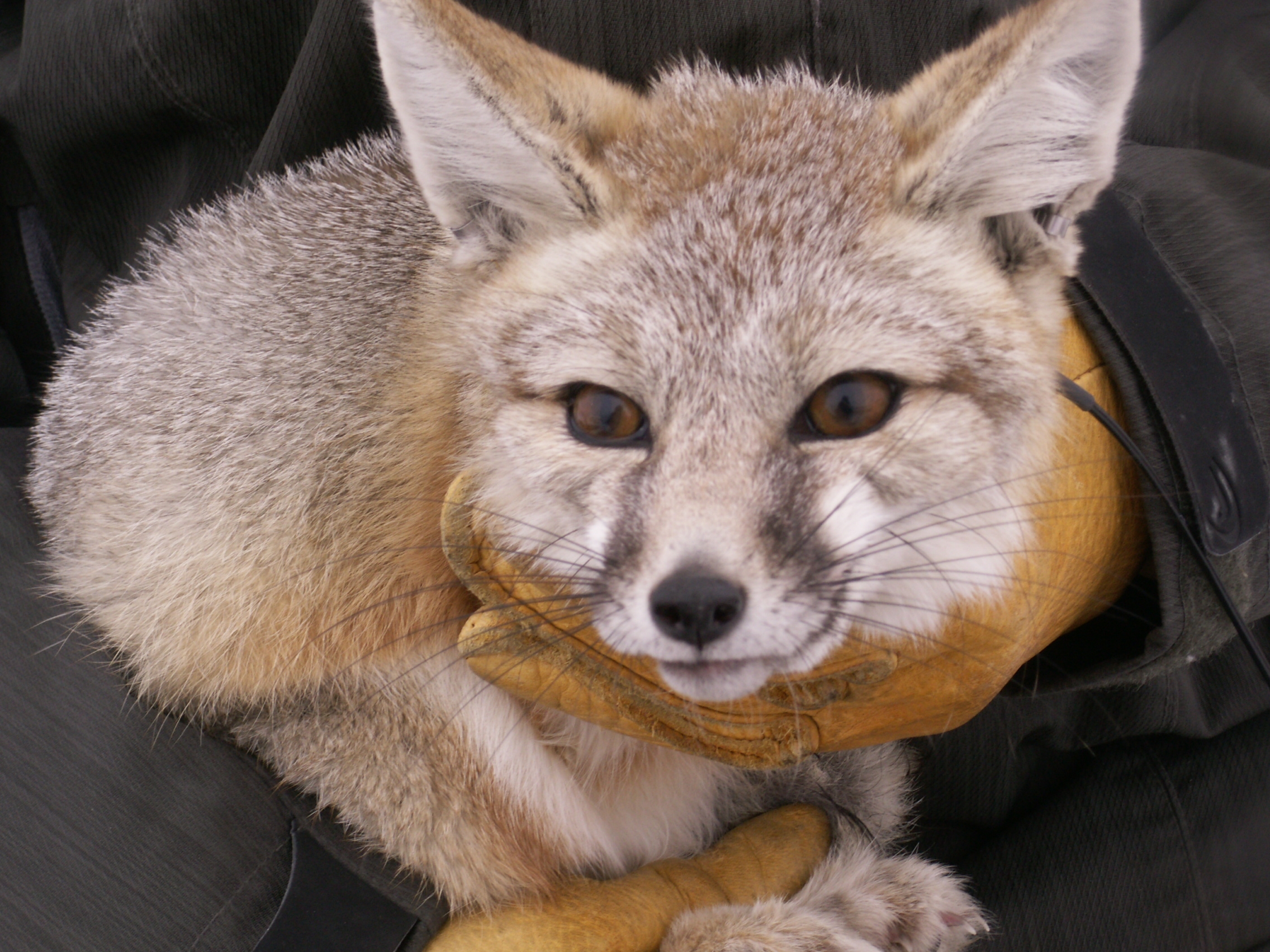
Kit Foxes Utahs Desert Night Sentinels: Kit Fox, click to view larger image, Photo Courtesy and Copyright © 2009 Bryan Kluever
Adult Kit Fox
captured with a box trap.
Kit foxes are weighed,
fitted with a radio collar,
and then released
Courtesy & Copyright © 2010
Bryan Kluever
Graduate Research Assistant
Utah State University
Dept of Wildland Resources
One of the first things observers notice about the kit fox is its tiny size. Weighing in at a mere four pounds or so, Vulpes macrotis is among the smallest canids on the planet.

Kit Foxes: Utah’s Desert Night Sentinels
Often mistaken for swift foxes, kit foxes are a distinct species that sport larger ears and a leaner, more angular appearance. The small mammal has a long, black-tipped bushy tail and a yellowish-gray coat tinged with rusty orange.

Listed as a sensitive species in Utah, the carnivores live primarily in the state’s arid, western regions, where they reside in family dens and hunt for smaller mammals such as field mice and jackrabbits, as well as insects, birds, amphibians and fish.

But the diminutive hunter is susceptible to predation by a host of larger beasts, including coyotes, bobcats and golden eagles, says USU alum and wildlife biologist Bryan Kluever.

“With small size comes disadvantages; however, the advantage is increased agility and mobility,” he says.

Kit foxes have little difficulty leaping over sagebrush and rabbitbrush that towers over them and provides a welcome refuge from hungry predators. Given a choice, the foxes prefer to stay in open areas, where they can put their sense of sight to full use. Their vulnerability to larger members of the food chain partially explains the animal’s nocturnal habits.

Kit Fox, click to view larger image, Photo Courtesy and Copyright © 2009 Bryan Kluever
Adult kit fox prior to being
released. Note the black
collar antenna on the right
side of the fox.
Courtesy & Copyright © 2010
Bryan Kluever

“The life of a kit fox is ruled by the night,” Kluever says. “They are rarely active during the day and, when they are, this activity is limited to near dawn and dusk. This behavior is likely a function of eluding their enemies and avoiding harsh desert temperatures, especially in summer.”

One of the kit foxes’ most distinctive traits is its insatiable curiosity.

“If one word had to be used to describe the kit fox, it would be inquisitive,” says Kluever, who extensively studied the creatures at the Army’s Dugway Proving Ground. “Most canids cannot be captured with cage traps but kit foxes are one of the exceptions. When we released them after capture, they often began to walk toward us, rather than running away.”

Thanks to USU’s Quinney College of Natural Resources for supporting research and development of this Wild About Utah topic.

Credits:
Images: Courtesy & Copyright Bryan Kluever
Text:     Kit Foxes: Utah’s Desert Night Sentinels, Mary-Ann Muffoletto, Utah State University College of Natural Resources
Credits:
Bryan Kluever, wildlife biologist, Fort Carson Military Installation, Colorado.

Additional Reading:

Utah’s Desert Fox, Mary-Ann Muffoletto, Wild About Utah, May 27, 2010, https://wildaboututah.org/utahs-desert-fox/

White, P. J. and K. Ralls. 1993. Reproduction and spacing patterns of kit foxes relative to changing prey availability. Journal of Wildlife Management 57:861–867 The Wildlife Society, https://si-pddr.si.edu/dspace/bitstream/10088/510/1/White1993.pdf

Kit Fox (Vulpes macrotis), Wildlife Notebook Series No. 9, Utah Division of Wildlife Resourceswildlife.utah.gov/publications/pdf/2010_kit_fox.pdf

Kit Fox Vulpes macrotis, Utah Species, Utah Division of Wildlife Resources, Department of Natural Resources, State of Utah, https://fieldguide.wildlife.utah.gov/?species=vulpes%20macrotis

Tiger Salamander, Utah’s only salamander

Tiger Salamander, Utah’s only salamander, Ambystoma tigrinum, Courtesy Andrey Zharkikh, Photographer, licensed under CreativeCommons 2.0
Tiger Salamander
Ambystoma tigrinum
Courtesy Andrey Zharkikh, Photographer
License: Creative Commons 2.0
Tiger Salamanders, named for their bold black-and-orange stripes, are Utah’s only salamander. Secretive inhabitants of our forests, streams, and lakes, these amphibians are rarely seen. Tiger Salamanders spend most of their year underground, in moist burrows beneath logs and among tree roots. They come to the surface just once a year, emerging at night in the early spring to trek across the snow to newly-thawed wetlands.

Many people see Tiger Salamanders only when one accidentally falls into their window well. About 6 inches long, with a 6-inch tail, they are often mistaken for lizards even though they are more closely related to frogs. This is more obvious when you look at a salamander’s aquatic larvae, which hatch from tiny, shell-less eggs that resemble caviar. At first, they sport gills and have only tiny limbs. Usually, they metamorphose after about 2 ½ months, transforming into boldly-barred adults. Occasionally, if wetland conditions are safe, they can mature in their natal pond, becoming juvenile-like adults called paedomorphs, which can breed but resemble gigantic larvae.

Tiger Salamanders select very particular wetlands. They particularly look for bodies of water that don’t have any large, predatory fishes that would eat their eggs. Well-known examples of breeding sites in Utah include Lake Solitude in Big Cottonwood Canyon, Tony Grove Lake in Logan Canyon, and the aptly-named Salamander Lake in Stewart Canyon on the northeast slope of Mt. Timpanogos.

For Wild About Utah, I’m Andrew Durso.

Credits:

Images: Courtesy Andrey Zharkikh, Photographer, licensed under CreativeCommons 2.0.
Text: Andrew Durso, https://www.biology.usu.edu/htm/our-people/graduate-students?memberID=6753

Additional Reading:

Amphibian Decline: Saving the Salamander, Karen Lips AAAS – The American Association for the Advancement of Science, Washington, DC 20005, https://youtu.be/mgVPh8PCCk4, (Accessed: Feb 15, 2016)

Save the salamanders, unsung heroes of the forest, Brian Resnick, Science Reporter Vox, Interviewing Matthew Grey, University of Tennessee Knoxville, https://www.youtube.com/watch?v=cnrSa18-onc, (Accessed: Feb 15, 2016)

AmphibiaWeb: Information on amphibian biology and conservation. Ambystoma tigrinum. 2016. Berkeley, California: AmphibiaWeb. Available: https://amphibiaweb.org/. (Accessed: Feb 15, 2016).

Our Barking Dogs, Coyotes

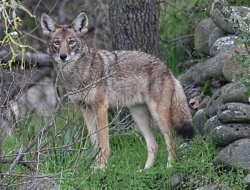
Our Barking Dogs, Coyotes | Coyote, Canis latrans, Courtesy US FWS, Steve Thompson, Photographer
Coyote, Canis latrans, Courtesy US FWS, Steve Thompson, Photographer
With the big game hunting season beginning, I reflect back on my first deer hunt in Utah. Arriving from Michigan in 1971, Utah friends took me into White Pine Lake above Logan. Alone on my stand, a large animal approached. Finely in my sights, a large, gorgeous male coyote in its prime. I fired and the coyote was dead before it slumped to the ground. Like Aldo Leopold after watching the “green fire” fade from the eyes of the she-wolf he shot, I resolved never to kill another coyote.

Since that long ago time, my admiration for this amazing animal has only heightened. It’s fascinating behavior, intelligence, and cultural significance are all worthy of mention.

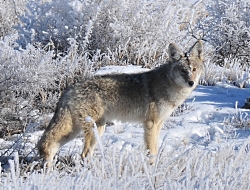
Coyotes now occur throughout most of North America, as well as in parts of Latin America. It has been described as “the most vocal of all North American mammals”. Its penetrating range of vocalizations gave it the name Canis latrans, meaning “barking dog”. Its wild song awakens something deep within my primal being.

Coyote, Canis latrans, Courtesy US FWS, Tom Koerner, Photographer
The coyote features prominently as a trickster figure in the folktales of America’s indigenous peoples. It was given the trickster role in light of its intelligence and adaptability. Some tribes, such as the Paiute, and Ute portray the coyote as the companion of the creator. In the Paiute creation myth, the coyote was created by the wolf as a companion, and the two created land by piling soil on the water-covered world. In Navajo mythology, the coyote was present in the First World with First Man and First Woman.

19th-century writers wrote of coyotes being kept in native villages in the Great Plains. Although shy, pups have been raised for hunting both as retrievers and pointers. In 1945 a tame coyote named “Butch”, had a short-lived career in cinema, appearing in Smoky and Ramrod before being shot while raiding a henhouse.

Coyotes were occasionally eaten by mountain men. It was sometimes featured in feasts of the Plains Indians, and coyote pups were eaten by the indigenous people of California. The taste of coyote meat has been likened to that of the wolf, and is more tender than pork when boiled.

At one location in Southern California, coyotes began relying on a colony of feral cats as a food source. Over time, the coyotes killed most of the cats, and then continued to eat the cat food placed by people who were maintaining the cat colony.

Fortunately, in my view, it is nearly impossible to eradicate coyotes from an area. Despite large-scale and expensive efforts to kill coyotes over the past 150 years, coyotes continue to thrive, as I was reminded on my run up SLC’s City Creek Canyon where two families on either side of the canyon serenaded on me.

Research suggests that when aggressively controlled, coyotes can increase their reproductive rate by breeding at an earlier age and having larger litters, with a higher survival rate among the young. This allows coyote populations to quickly bounce back, even when as much as 75 percent of their numbers are removed. For coexisting peacefully with this remarkable being, check out Projectcoyote.org.
Long live America’s song dog!

This is Jack Greene reading and writing for Wild About Utah.

Credits:
Images: Courtesy US FWS, Tom Koerner and Steve Thompson, Photographers
Text: Jack Greene, Bridgerland Audubon Society

Additional Reading:

Jack Greene’s Postings on Wild About Utah, https://wildaboututah.org/author/jack/

Coyote-Canis latrans, Wikipedia.org, https://en.wikipedia.org/wiki/Coyote

Coyote, Animals, Photo Ark, The National Geographic Society, https://www.nationalgeographic.com/animals/mammals/c/coyote/

Coyote-Canis latrans, DesertUSA.com and Digital West Media, Inc., https://www.desertusa.com/animals/coyote.html

Coyote, Learn, Yellowstone National Park, US National Park Service, US Department of the Interior, https://www.nps.gov/yell/learn/nature/coyote.htm

Coyote – Canis latrans, Utah Species, Utah Division of Wildlife Resources, Department of Natural Resources, State of Utah, https://fieldguide.wildlife.utah.gov/?species=canis%20latrans