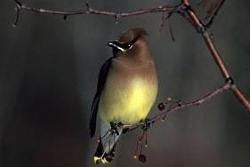
Cedar Waxwing US FWS FWS Digital Library, David Menke, PhotographerEvery winter, many of Utah’s breeding birds migrate south to avoid the cold. After the warblers, tanagers, and orioles leave each fall, we share the snowy winter with hardier residents, such as chickadees, nuthatches, and juncos. But even hardier birds breed in the far north and venture south to Utah only during the most severe winters.
Many people are familiar with the high, thin calls of Cedar Wawings. Less frequently heard in Utah are the slightly lower calls of their close cousins, Bohemian Waxwings.
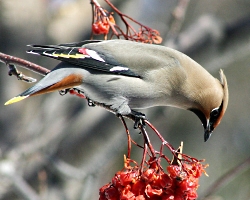
Bohemian Waxwing, licensed under the Creative Commons Attribution-Share Alike 2.0 Generic license. Source Wikimedia.org, Randen Pederson, Photographer.Bohemian Waxwings are slightly larger than Cedar Waxwings, and a little fancier—their wing feathers include red, yellow, black, and white, and the underside of their tails is a rich cinnamon. Both species gather by the hundreds to eat berries, so you won’t miss a flock if there’s one nearby. Although waxwings are songbirds, the calls you hear don’t serve the same functions as true songs, advertising mate quality and defending territories. Instead, waxwings cooperate to find and feed on scattered fruit, their main winter diet. Unlike most birds, waxwings are able to smell, which may help them find their food. If waxwings eat berries that have begun to ferment over the winter months, they may become intoxicated even though their ability to metabolize ethanol is very high. The last time Bohemian Waxwings were abundant in Utah was during the winter of 2012-2013.
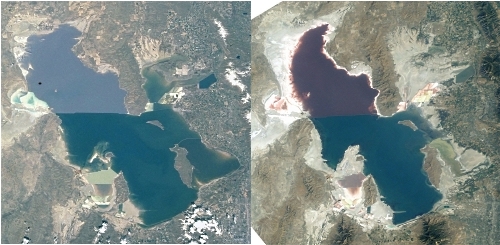
The Great Salt Lake Breach Courtesy U.S. Geological Survey
Department of the Interior/USGS
Mike Freeman, Photographer
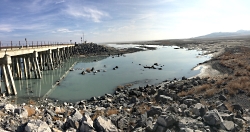
10 Nov 2015 Water flowing through the Great Salt Lake breach in 2011, when lake levels were high due to above average snowfall in the Wasatch and Uinta Mountains. The Great Salt Lake breach is an area that allows water to travel between the southern and northern parts of the lake. There is a giant among us with a profound influence on our past, present, and future. My first encounter with this giant was both buoyant and delightful as I floated in the brine on a lovely summer day. But I was oblivious to the Great Salt Lake’s immense value as an environmental, cultural, and economic resource.
A Giant Among Us–The Great Salt Lake
Much of what follows is taken from a very recently released collaborative study titled “Impacts of Water Development on Great Salt Lake and the Wasatch Front” which was a collaborative effort from four institutions(Utah State University, Utah Division of Water Resources, Salt Lake Community College, and the Utah Division of Wildlife Resources.)
A 2012 analysis by Bioeconomics estimated the economic value of the lake at $1.32 billion per year for mineral extraction, brine shrimp cyst production, and recreation. The abundant food and wetlands of the lake attract 3 million shorebirds, as many as 1.7 million eared grebes, and hundreds of thousands of waterfowl during spring and fall migrations. Because of this, it has been designated as a Western Hemisphere Shorebird Reserve Network Site. Due to its enormous surface area, it produces the “lake affect” which enhances our snow pack by an estimated 8%, a significant amount for both skiers and our available water. But our giant is shrinking.
Since the arrival of 19th Century pioneers water diversions for irrigation have decreased its elevation by 11 feet exposing much of the lake bed. Natural fluctuations in rainfall and river flow cause the lake level to rise and fall, but there has been no significant long‐term change in precipitation and water supply from the main tributaries since their coming in 1847.
The Great Salt Lake Breach Credit: U.S. Geological Survey Department of the Interior/USGS Mike Freeman, Photographer 10 Nov 2015 For the first time since it was opened in 1984, water has stopped flowing through the Great Salt Lake causeway breach, an area that allows water to travel between the southern and northern parts of the lake. To significantly reduce water use, a balanced conservation ethic needs to consider all uses, including agriculture, which consumes 63 percent of the water in the Great Salt Lake Basin. There are no water rights to protect our Great Lake, so water development currently focuses solely on whether there is water upstream to divert. If future water projects reduce the supply of water to the lake, (such as the Bear River Development Project, its level will (most likely) continue to drop.
We must look beyond the next few decades and decide how we value the lake for future generations. Lower lake levels will increase dust pollution and related human health impacts, and reduce industrial and environmental function of Great Salt Lake. We must be willing to make decisions now that preserve Great Salt Lake’s benefits and mitigate its negative impacts into the coming centuries.
John Muir, one of my favorite early American naturalists would most certainly agree with me. From his baptismal plunge into the Great Salt Lake. “I found myself undressed as someone else had taken me in hand and got myself into right lusty relationship with the brave old lake. I was conscious only of a joyous exhilaration….”
And where else could John and I have such a wonderfully buoyant experience?
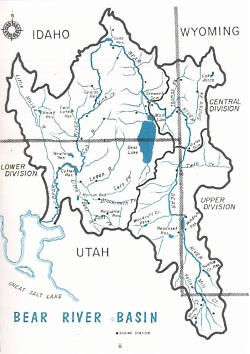
Bear River basin
Courtesy Utah State Division of Water Rights
https://waterrights.utah.gov/techinfo/bearrivc/history.html I grew up in a town that had a story for nearly every run-down property in its borders. Most buildings had at least one ghost floating around its fence line, but the really haunted estate—the one where, supposedly, my great-great uncle plastered babies into the walls, where it’s said he threw his wife into the well, where the land itself swallows livestock and spits out bones, where you can still hear screams coiling up near the hackthorn bushes and willow trees—is just outside of town. Just far enough to escape the reach of the city lights, but not too far that you won’t make it back by morning. The location, more than its history, is probably the reason for the stories. If there is no journey, there is no room for stories to germinate.
My friend, Dr. Lynne S. McNeil, is a folklorist. She told me that it’s common for haunted things to happen in liminal spaces, in the places between places. So the haunted house on the edge of town makes sense. Just like it makes sense that most of the people who went to the haunted house were teenagers—not yet adults, but somehow not kids either. It’s human to seek out nooks to create the things we fear, and the things we feel compelled to lie about. She also told me about the theory of ostentation. People act out something of the legend to connect to the legend more. It’s not enough just to go to the haunted house, but you have to throw stones in the well to see if the motion of something falling will awaken the long murdered wife.
Bear River
Courtesy USDA Forest Service I now live near the geographic center of the Bear River drainage. I can walk to decent water from my house. But I hardly ever fish it. Mostly because the best fishing in Northern Utah is in Southern Idaho. Some of it is right on the border. There’s something in the trip. It’s more of an event even if the trip distance is increased by fifteen minutes. The Bear River travels nearly five-hundred miles, but its mouth and source are only separated by about 100 miles. It starts and ends in Utah, but crosses the borders of five states. It’s the largest river in North America that doesn’t flow to an ocean. It is known for its calm meanderings and its white-water kayak sections. It is America’s caveat river. Almost as an homage to the river that always needs an explanation, I choose to travel to it. I choose to fish those tributaries that feed the river instead of the convenient pull-outs where the Bear threads the road. I like to follow the fish to where they spawn. I’m always looking for the less obvious place to fish because everyone knows the story goes that you have to work for the big fish. Fishing trips need time to steep both before and after fishing. Where, if you fish with others, they’ll tell you how the fishing is going to be or was that day. Where, if you fish alone, you’ll think about how the fishing will actually be or was that day. You’ll compare it to other times at the same place and you’ll remember both real and imaginary fish. If there isn’t a space between fishing and not fishing to think and create, if you don’t drive past water that looks fine in search of great water, the fishing won’t be as good. I’ll never be a guy who spends more time on the road consistently than in the river—but, I’ll always give the fish and the river the respect of a drive.
Mule DeerOdocoileus hemionus Courtesy US FWS Ryan Moehring, Photographer As I look out my front window, 7 mule deer are cavorting, feeding, with some lying down for a mid-day siesta. With the final week of the regular season deer hunt winding down, some have taken sanctuary from the nimrods to join the urban herd.
For our 30 years in Smithfield canyon, deer have been regulars, disappearing for the most part from mid-May to mid-June to give birth, as do the bucks, perhaps somewhat embarrassed with strange bumps forming on their crowns.
Spotted fawns begin adorning our lawn in mid-July. With enough speed to outrun all but the fastest predator’s, mom drops her guard a bit. Bucks begin parading their new, fully formed head gear.
As fall and winter approach, the neighborhood herd grows, with a few dozen hanging out when winter finally sets in. Their snow trails through the yard become conspicuous, further defined with sprinkles of fecal material. Out back the steep hillside across Summit Creek becomes a winter playground as small groups run repeatedly up and down and around. Apparently, their abundant stores of energy allow them to break winter’s lethargy. This is generally not the case for deer in the wilds where every calorie is conserved for winter hardships as snow deepens and temperatures plunge.
We’ve witnessed a few humorous behaviors during our 3 decades of observation. Deer are very curious which occasionally works against their best interests. We had an especially aggressive rooster who became our “feathered” watchdog. A small deer herd passing through the front yard noticed the stocky cock guarding the front door and decided on closer inspection. The lead deer approached stretching his neck and tender nose to get a closer whiff. Old roaster rooster gave her a welcoming sharp jab to the nose which sent the herd bounding off.
On another occasion, our tomcat found itself taking refuge under the trampoline as 4 deer approached from a patch of forest. The cat’s movement piqued the deer’s curiosity. They surrounded the trampoline, bent down on front knees with noses poked underneath for a close-up. Poor tom was terrified- to be munched by a deer- what a horrible end!
Of course, we realize that not everyone is enamored with deer in their space. Deer can be a nuisance causing damage to landscapes and gardens. With proper fencing and plant selection, this can be managed. A greater concern is safety, vehicle-deer collisions. Here again, with proper signage, this can be minimized. I’ve experienced close encounters on my bike, so always go slow when deer appear near or on the roadway.
An excellent resource for landscaping is found at wildlife.utah.gov/habitat/deer-browse.php Blending a variety of native and ornamental plants into a home landscape can create a highly attractive environment for family, friends, mule deer and other wildlife species. Enhancing the home environment and replacing some of the lost wildlife habitat can be enjoyable and beneficial.