SNOTEL Snowpack Recording Stations

Manual Snow Measurement
Cover image from
Snow surveying by James C. Marr
USDA 1940 Publication 380
Public Domain
Courtesy UVA, Google & HathiTrust

For a modern view visit
https://www.meted.ucar.edu/afwa
/avalanche/print.htm
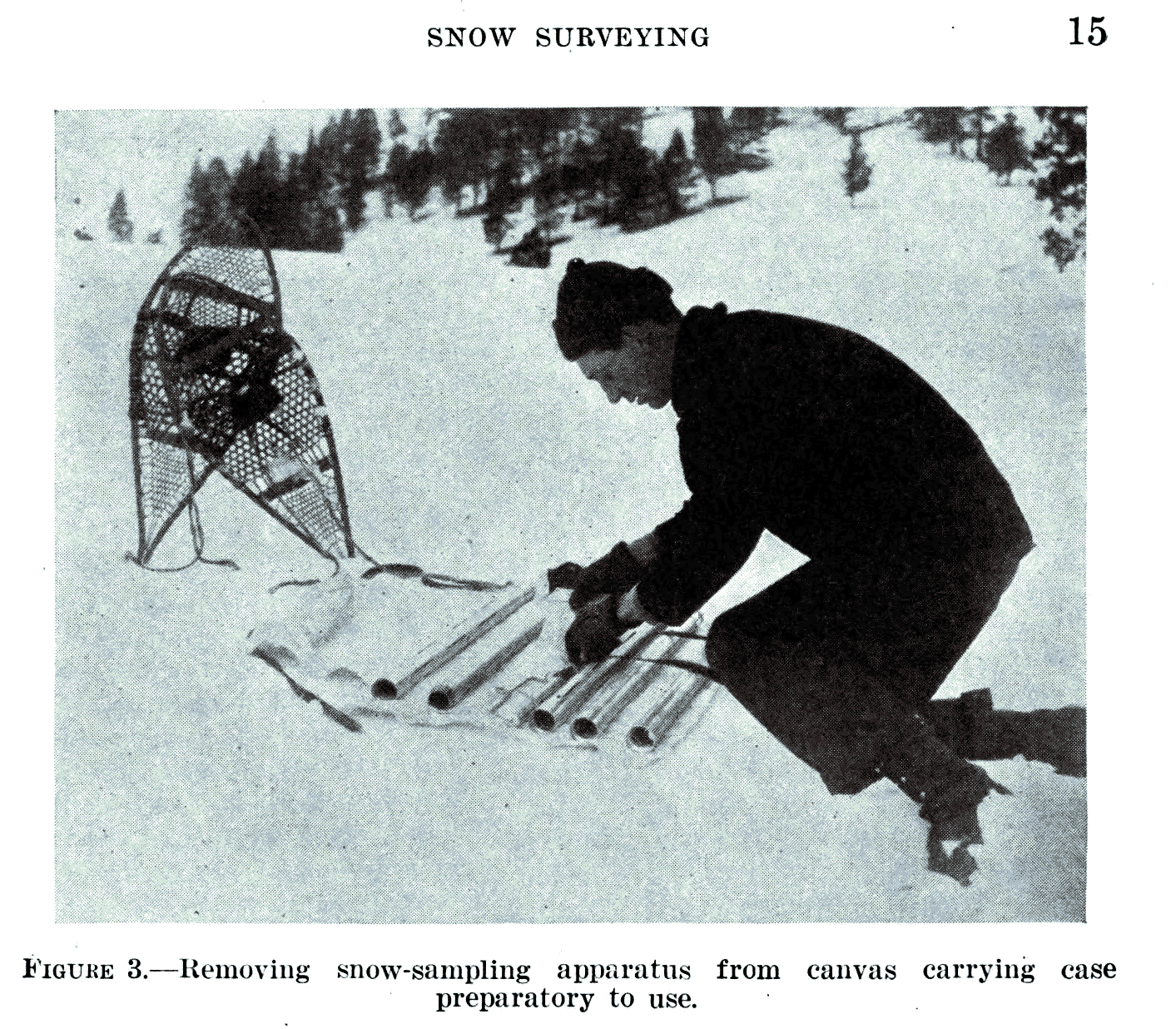
Removing snow surveying apparatus
from canvas carrying case
preparatory to use
From
Snow surveying by James C. Marr
USDA 1940 Publication 380
Public Domain
Courtesy UVA, Google & HathiTrust

Water is a precious resource throughout the world. Most of Utah consists of arid habitats and many users clamor for their share of the scarce moisture. Ever-growing demand challenges water managers to insure that agriculture, cities and nature all get their portion. Predicting and monitoring stream flow is imperative in order to know how much to hold in reservoirs or send downstream, and when to anticipate floods, enact water conservation measures, and in general provide for all users.

Much of Utah’s water originates in the mountain snowpack. Early in the twentieth century, the Department of Agriculture constructed a series of Snow Courses in mountainous areas of the West. Hardy personnel periodically trekked in to measure snow depth with a long ruled stick. Water content was found by taking a core sample, weighing it and subtracting out the weight of the metal tube. Stream gauging stations installed by the US Geological Survey allowed correlation of stream flows with snowpack measures.

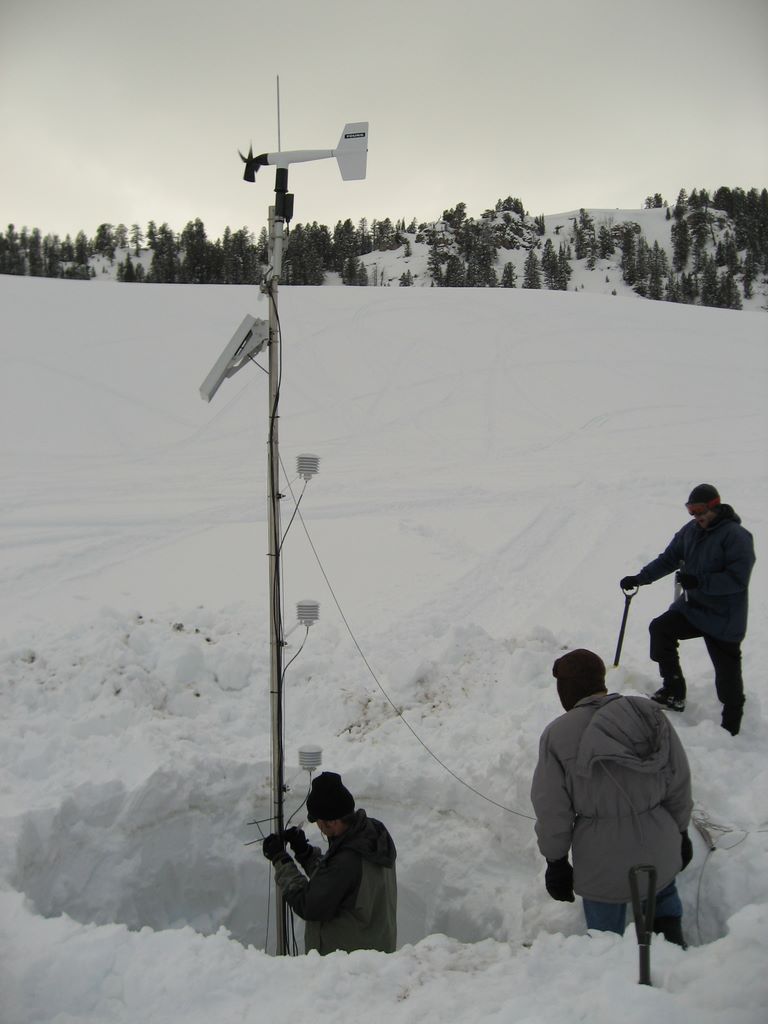
In the 1970’s, monitoring snow courses became more automated. The reporting stations were named “SNOTEL” for snowpack telemetry. Now there are over 600 SNOTEL sites in 13 western states. The measurement functions of SNOTEL stations are elegantly simple and reliable. Air and soil temperatures are monitored with standard thermocouples. Water content of the snowpack is measured by its weight atop a broad thin bladder called a snow pillow that is filled with antifreeze. The snow pillow is carefully spread on the ground. Accumulating snow presses down on the pillow, pushing some antifreeze out a connecting tube to a pressure sensor.

Some SNOTEL sites also measure snow depth, using the autofocus technology of the digital camera. Subject distance is gauged by the time delay of an ultrasonic pulse, like sonar or hearing your voice echo back in a canyon. At a SNOTEL station, a similar sensor is placed high above the expected snow line. As snow accumulates, the downward facing sensor reports the shortening distance between it and the snow surface.

SNOTEL stations have batteries and a solar panel to power their hourly data transmissions. Ogden has one of the two master receiving stations. Want to size up mountain snowfall from the last storm or know how warmly to dress for an outing? Just go to Utah’s SNOTEL information site on the web.

Credits:

Image: Public Domain, Courtesy University of Virginia, Google and HathiTrust, Cover image from Snow surveying by James C. Marr, USDA 1940 Publication 380
Theme Music: Written by Don Anderson and performed by Leaping Lulu from their CD “High Road, Low Road”
Text: Jim Cane & Linda Kervin, Bridgerland Audubon Society https://www.bridgerlandaudubon.org
Voice: Linda Kervin, Bridgerland Audubon Society https://www.bridgerlandaudubon.org
Additional Reading:

Water Conservation Begins with Snow Surveys, USDA NRCS, https://www.wcc.nrcs.usda.gov/factpub/wc_ss.html

Snow Hydrology: SNOTEL, Randall Julander, Civil & Environmental Engineering, University of Utah, (formerly at https://www.civil.utah.edu/~cv5450/snotel/snotel.htm)

Utah Snow Survey Program, USDA NRCS, https://www.ut.nrcs.usda.gov/snow/

NRCS Snow Surveyor Collects Vital Water Data, Lives Dream Job, Spencer Miller, NRCS, Jan 10, 2013, https://www.nrcs.usda.gov/wps/portal/nrcs/detail/national/home/?cid=STELPRDB1076993

Snow Surveys and Water Supply Forecasting, National Atlas of the United States, US Department of the Interior, formerly at https://www.wcc.nrcs.usda.gov/factpub/sect_4a.html

Utah Snow Survey Program, Natural Resources Conservation Service, US Department of the Interior, https://www.nrcs.usda.gov/utah/snow-survey

Map, Utah USGS SNOTEL Stations https://www.wcc.nrcs.usda.gov/snotel/Utah/utah.html
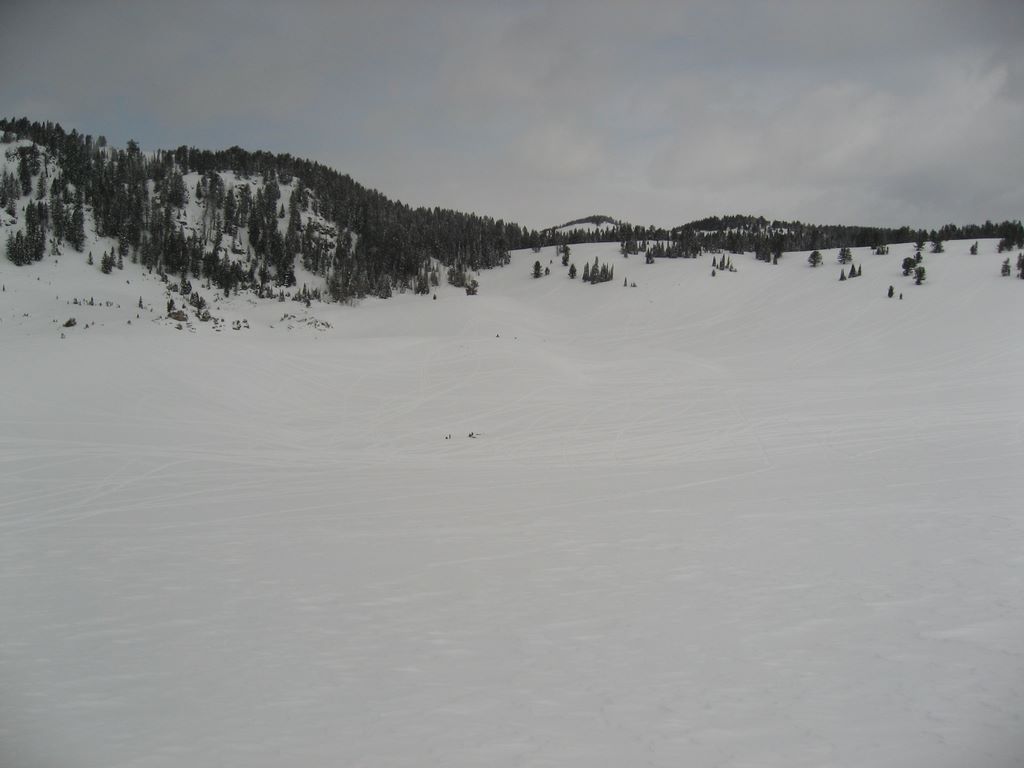
Baby, It’s Cold Outside

Baby, It’s Cold Outside: Peter Sinks.  Courtesy the Utah Climate Center

Peter Sinks
Courtesy Utah Climate Center

Peter Sinks
Campbell Scientific Weather Station

Courtesy Utah Climate Center

Holly: Hi, I’m Holly Strand.

-18 in Logan, -20 in Moab, -26 degrees in Randolph. In other words, it’s January in Utah! Subzero temps are common this time of year across most of the state.

Some sources give – 50 degrees Fahrenheit as the coldest temperature ever recorded in Utah. It was -50 on Feb 6, 1899 in Woodruff and again on Jan 5, 1913 at the East Portal of Strawberry Reservoir. But—as many of you know—the real lowest temperature recorded was -69 degrees occurring at Peter Sinks on Feb 1, 1985. There were two weather stations recording at the time. A Campbell Scientific instrument recorded a temperature of -70.5 from a sensor 20 inches above the snow surface. A few days later, USU student Zane Stephens retrieved a minimum recording alcohol thermometer which registered -68.3. The National Bureau of Standards calibrated Stephens’ thermometer which adjusted the reading to -69.3. This became the ‘official’ temperature minimum since– at that time–the National Weather Service only recognized the type of weather station used by Stephens.

While the -69 observation was verified, the station it came from was not part of any long-term weather monitoring network. That’s why you still see the -50 cited as the low. But -69 is so much better. For this figure gives Utah boasting rights for having the 2nd coldest recorded temperature in the lower 48 (plus Hawaii). -69 beats the coldest temperature recorded in Europe which is only -67. And it comes fairly close to North America’s record which is -81 in the Canadian Yukon. Just so you know, Asia’s record is -90 in Verkhoyansk in Siberia. And of course, Antarctica takes the cake with -129 at Vostok Research Station.

But back to Utah. Peter Sinks—where the -69 reading occurred–is an oval-shaped limestone sinkhole located on the crest of the Bear River Range just west of Old Limber Pine off of Highway 89. It’s about 150 meters deep and 1 km long. Having no tributary valleys, it’s a perfectly closed basin. On clear nights the area surrounding the sink radiates away its heat. And if the wind is calm, the, colder heavier air sinks and pools on the basin floor . If there were an outlet the cold air could flow out and warmer air could lower in to replace the outgoing cold. But there isn’t an outlet.

You probably recognize this situation—it’s an inversion. The Wasatch Front valleys and Cache Valley experience this same phenomenon during winter. Snow cover reflects incoming sunlight which cools the land surface and warm temperatures aloft seal the colder air down below. Meanwhile, a high pressure system called the Great Basin High brings clear, still air which locks the inversion in place. But the large size of these populated valleys prevents the temperature from dropping down to -69. Thank goodness. But in our case, manmade pollutants created during the inversions create a toxic cold air cocktail that we have to endure. At least until a low pressure system comes in and blows the lid off the inversion, pulling the cold air upward and “mixing” it away.

For more information on inversions and to see pictures of the notorious Peter Sinks, visit www.wildaboututah.org

Thanks to Robert Davies of the Utah Climate Center at Utah State University for his help in developing this episode.

For Wild About Utah, I’m Holly Strand.

Credits:

Image: Courtesy Utah Climate Center
Text: Holly Strand

Sources & Additional Reading:

Ahrens, C. Donald, Perry Samson. Extreme weather and climate. Belmont, CA : Brooks/Cole, Cengage Learning.

Clements, Craig B. Whiteman, C. David Horel, John D. 2003. Cold-Air-Pool Structure and Evolution in a Mountain Basin: Peter Sinks, Utah. Journal of Applied Meteorology, Jun 01, 2003; Vol. 42, No. 6, p. 752-768

Moller, Allen; Robert R. Gillies. 2008 Utah Climate. Logan, Utah: Utah Climate Center, Utah State University

NOAA, State Climate Exchange Committee. State Temperature Extremes https://www.ncdc.noaa.gov/extremes/scec/records

Utah Climate Center, Utah State University https://climate.usu.edu/

Utah Climate Center with support from Campbell Scientific, Inc. Peter Sinks Monitoring Project. Site history, data and more pictures. https://twdef.usu.edu/Peter_Sinks/Sinks.html

Utah.Gov Choose Clean Air https://www.cleanair.utah.gov/

From Flood to Fire, Utah’s evolving role in mending rangelands

From Flood to Fire, Utah’s evolving role in mending rangelands: Click for a larger view of , Utah.  Courtesy and Copyright 2012 Jim Cane, Photographer
Blue flowers of wild flax
years after seeding
of Devil’s Playground.
Courtesy & Copyright 2012
Jim Cane, Photographer

From Flood to Fire, Utah’s evolving role in mending rangelands: Click for a larger view of Native grasses established two years after seeding Scooby Fire., Utah.  Courtesy and Copyright 2012 Jim Cane, PhotographerNative grasses established
two years after
seeding Scooby Fire.
Courtesy & Copyright 2012
Jim Cane, Photographer

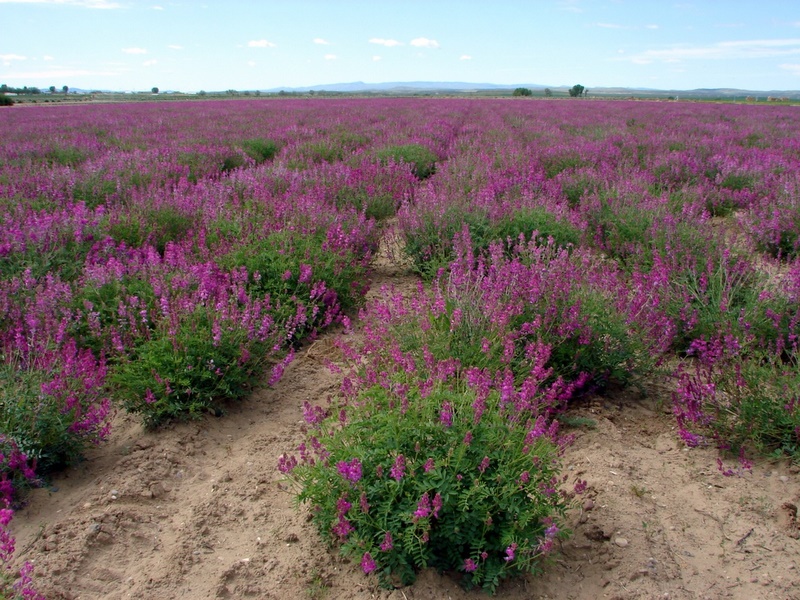
From Flood to Fire, Utah’s evolving role in mending rangelands: Click for a larger view of , Utah.  Courtesy and Copyright 2012 Jim Cane, PhotographerNative sweetvetch farmed
for seed production.
Courtesy & Copyright 2012
Jim Cane, Photographer

Restoring degraded plant communities has a long history on Utah’s public lands. The problem began with the transcontinental railroad, which enabled transport of livestock from Western rangelands to Eastern cities. By the late 1800s, vast flocks of ravenous sheep roved Utah’s unregulated wildlands. Montane summer pastures were stripped bare, so snow melt and summer rainfall washed across the ground unchecked, carving deep gullies. Downstream settlements, such as Logan and Manti, incurred ruinous floods and mud flows. Teddy Roosevelt responded to local pleas for federal control by designating our first national forests in Utah.

Soon thereafter, the fledgling Forest Service created the Great Basin Research Station east of Ephraim Utah. It was charged with discovering the cause of the floods. Within two years, large grazing exclosures were built in nearby mountain meadows by the Agency’s first range ecologist, Arthur Sampson. His research quickly linked overgrazing with denuded meadows, eroding soil and the floods. By 1914, Sampson advocated for rest rotational grazing. To then restore the impacted plant communities, there followed a landmark program at the Station to evaluate plants that could revegetate the degraded watersheds, and later, restore big-game winter range. Led by Perry Plummer, the Station evaluated the performance of 1000 species of shrubs, grasses and wildflowers, some tested in most of Utah’s plant communities. Methods to better collect, store, plant and germinate seeds underpinned the restoration of plant communities that, along with the 1934 Taylor Grazing Act, ended Utah’s frequent canyon floods.

That public research continues with the Great Basin Native Seed Selection and Increase Project. Today’s goal is to restore plant communities after rangeland fire, stalling and eventually reversing the invasion of flammable exotic grasses and weeds in the Intermountain West. Dedicated warehouses in Ephraim, Ely and Boise can store up to 3 million pounds of seed, a testimony to further progress in farming and collecting desirable seed. The seed is spread by aircraft over rocky places, while on gentler slopes, versatile rangeland seeders can place each kind of seed at the right depth, from tiny sagebrush to big grass seeds, all in a single pass over uneven ground. For every planting that takes hold, another weedy legacy of hundred-year-old overgrazing is finally repaired.

This is Linda Kervin for Bridgerland Audubon Society.

Credits:

Images: Courtesy & Copyright Jim Cane
Text: Jim Cane, Bridgerland Audubon Society

Additional Reading:

https://wildfiretoday.com/page/2/

https://www.fs.fed.us/rm/boise/research/shrub/greatbasin.shtml

https://www.fs.fed.us/rm/boise/research/shrub/projects/plant_guides.html

Fall Frost

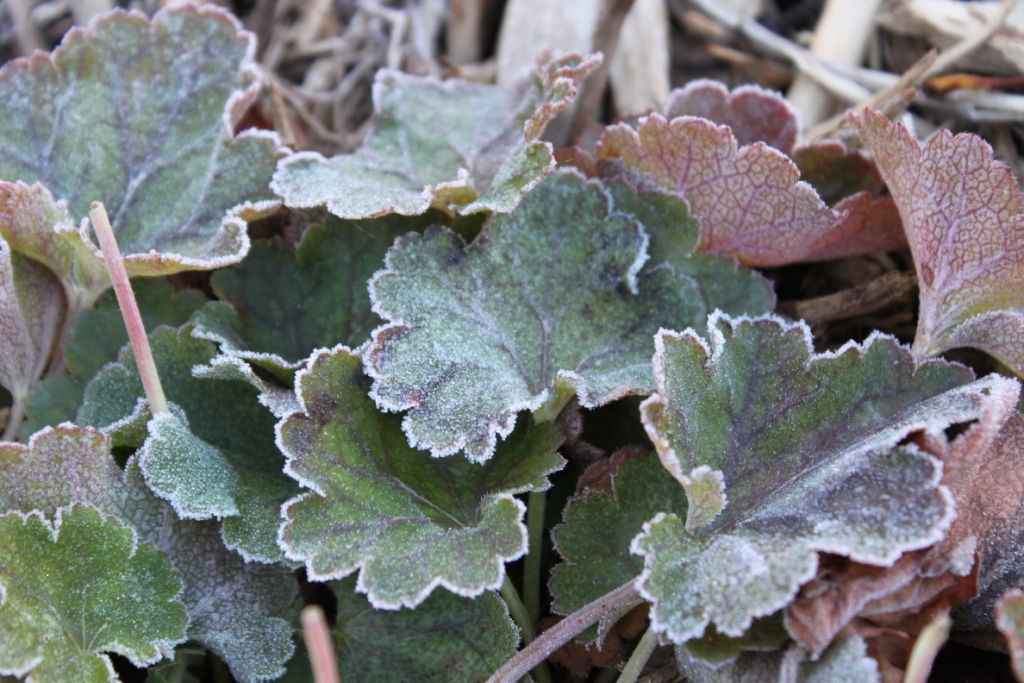
Frost on a Hairy Leaf
Copyright © 2012 Andrea Liberatore

Frost on a Leaf
Copyright © 2012 Andrea Liberatore

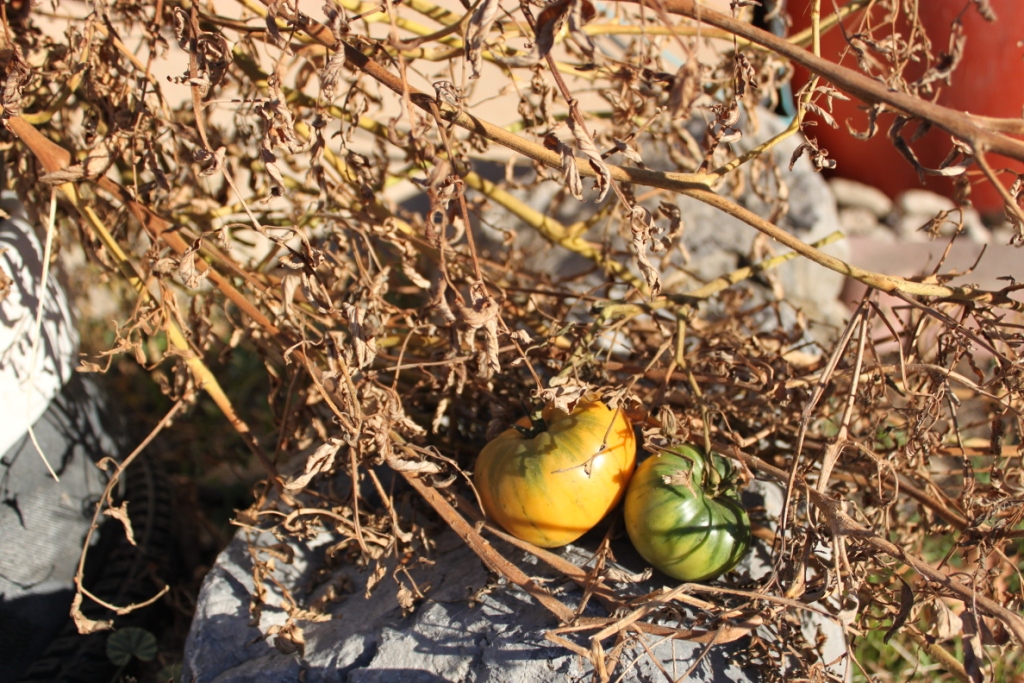
Frost Damage on a Tomato
Copyright © 2012 Andrea Liberatore

Evergreens take hardiness
to the Extreme
Two-needle Pinion Pine
Copyright © 2009 Linda Kervin

Fall has descended in earnest across Utah. Leaves have flashed their colors and dropped to the ground. Juncos have replaced the flycatchers on my backyard’s best perches, and my garden has been cleaned up and tilled under. As I watched the fall weather affect plants in my vegetable garden, I began to wonder about the different reactions they had to the changing temperatures. My tomatoes and squash turned brown and wilted at the merest suggestion of cold temperatures. Other plants, like kale, carrots and onions are still bright and fresh, even after an early snowfall. What is it about some plants that allow them to withstand frost, while others succumb right away?

Frost occurs when the temperature of an object – in this case a plant leaf – falls below the dew point of the air. Moisture from the atmosphere collects on the surface of the leaf and freezes when temperatures drop below 32 degrees. Just seeing frost on a plant doesn’t necessarily mean it will die – it’s the internal tissue temperature that counts. Like humans, plants are made mostly of water – upwards of 80-90% in an herbaceous plant like lettuce. When temperatures drop, the water inside plant cells expands as it freezes, tearing cell walls and causing irreparable damage.

The amount of harm done to a plant depends on many different factors and is generally referred to as a plant’s hardiness. Species or individuals that are more compact will incur damage at a lower temperature than others due to their reduced surface area. Those growing close to the ground are more protected by their proximity to the warm earth. Plants with darker colored leaves such as the deep greens of spinach and chard may be hardier because their leaves absorb and retain heat better than lighter-colored leaves. Fuzzy or hairy leaves also fend off cold temperatures better than their smooth counterparts.

Perhaps the best defense of all is found in plants that protect themselves with natural antifreeze. When frost hits these plants, the relatively pure water in the space between leaf cells freezes first, which in turn draws more water out of the surrounding cells. The remaining cellular fluid contains a high concentration of sugars and other molecules, which reduces the fluid’s freezing point and protects the cell’s contents from ice.

Evergreens, of course, take hardiness to the extreme, utilizing a number of different tactics to remain alive and photosynthesizing throughout the winter. These tactics include compact leaf size, a thick leathery consistency, and a waxy coating that both insulates and prevents water from escaping into the dry winter air.

Frost damage to less hardy plants can be postponed by human interventions such as covering with blankets, but as the cold spells get longer and more frequent, damage is inevitable. Everything has its season, and now is the time to harvest the last of those hardy fall greens and tuck the garden in for the coming winter.

For the Stokes Nature Center and Wild About Utah, this is Andrea Liberatore.

Credits:
Images: Courtesy &
            Copyright 2012 Andrea Liberatore
            Copyright 2009 Jim Cane
Text:     Andrea Liberatore,
            Stokes Nature Center in Logan Canyon.

Additional Reading:


Savonen, Carol (2012) Some plants make natural antifreeze to cope with winter’s wrath. Oregon State University Extension Service. Available online at: https://extension.oregonstate.edu/gardening/node/847


Frost And Your Plants: What You Need To Know, Farmer’s Almanac, November 17, 2021, https://www.farmersalmanac.com/frost-temperature-outdoor-plants-9788

Huber, Kathy (Feb 16, 2002) What Happens When a Plant Freezes. The Houston Chronicle. Available online at: https://www.chron.com/life/gardening/article/What-happens-when-a-plant-freezes-1635570.php