The Christmas Bird Count: Connecting to our ever changing natural world

The Christmas Bird Count: Evening Grosbeak Courtesy US FWS George Gentry, Photographer
Evening Grosbeak
Courtesy US FWS
George Gentry, Photographer
My boots crunch loudly on the snow and we pause frequently to uncover a bundled-up ear from hats and hoods to listen. We are listening for birds like the high-pitched call of a cedar waxwing, clear trilling song of a ruby-crowned kinglet, or the incessant sounds of the red-breasted nut-hatch. The bright light from the rising winter sun sparkles brilliantly on the snow, which marks the start of a full day of birding ahead in the dead of winter. I, along with many others, make these winter birding treks annually to collect data for the Christmas Bird Count, which is the longest running community science project. This count began in 1900 as an effort by an Ornithologist, Frank M. Chapman, to start a new holiday tradition to encourage people to look at birds instead of hunt them. Fast forward to 121 years later and we are still collecting data instead of dinners. The first count in the State of Utah started not long after in Provo in 1903 with many other places following suit across the state as the years went on.

The rules are simple; count all of the birds both seen and heard within a designated 15-mile diameter area over the entire day of the count which must be sometime between 14 December and 5 January. The result of these local and national counts now equates to a treasure trove of data. Every year since 1956 when the count started in Cache Valley, we observe around 90 species, though weather permitting we can see upwards of 100 species.

Data from these counts are valuable in documenting species like the Evening Grosbeak, a large vibrantly yellow-colored finch which migrates in large flocks. In the early days of the Christmas Bird Count, Evening Grosbeaks would migrate south in large numbers every few years from the Boreal Forests of Canada and the Northern U.S., to the point that they were observed in over 50% of the Christmas Bird counts across the U.S. In the late 1980’s however, their population size and ranges suddenly decreased drastically. In our data from the Cache Valley Christmas Bird Count we see this trend echoed with just 3 Evening Grosbeak observed in 1980 jumping to 119 seen the following year. That record was broken again though 2 years later and then shattered in 1987 with 721 Evening Grosbeaks seen on the single count date. The very next year the numbers plummeted with only 5 individuals seen. Numbers have since remained low until 2017 when we saw 282 Evening Grosbeaks. One theory about these dramatic fluctuations in population size and ranges is thought that it mirrors the abundance of their prey, spruce budworms. It is also hypothesized that deforestation and climate change play a role in these fluctuations of their population as well as their prey.

Observing these species and increasing this treasure of data is important for painting a picture of species movement and in addition, how species are responding to a changing climate locally and globally like the Evening Grosbeak. This massive data collection cannot be achieved by only scientists however, the participation of community members, like you and me, is necessary for not only the collection of more accurate data, but also for opening our own eyes to the natural world around us and getting to know the space that we occupy. Birding is a great way to connect to the outdoors and the Christmas Bird Count is the perfect excuse to get outside, especially this winter. Participation can be as simple as watching out your own window, joining a caravan, in separate vehicles this year to maintain social distance, or trekking through the snowy mountains from sunup to sun down. Visit Audubon.org to find a Christmas Bird Count near you to join this historic count.

I am Makenna Johnson with the Bridgerland Audubon Society and I am Wild About Utah!

Credits:
Photos: Courtesy US FWS George Gentry, Photographer
Audio:
Text: Makenna Johnson, Bridgerland Audubon Society and Graduate Student, Quiney College of Natural Resources, Utah State University
Additional Links: Makenna Johnson and Lyle Bingham, Bridgerland Audubon Society

Additional Reading

Info on Evening Grosbeaks received from:
Evening Grosbeaks, Bird Watching Daily, https://www.birdwatchingdaily.com/news/species-profiles/species-profile-evening-grosbeak/
Evening Grosbeaks, All About Birds, https://www.allaboutbirds.org/guide/Evening_Grosbeak/id

Check to see if you live within the count circle, then sign up to count today: Bridgerland Audubon Society, https://bridgerlandaudubon.org/

Greene, Jack, Christmas Bird Count 2019, Wild About Utah, December 9, 2019, https://wildaboututah.org/christmas-bird-count-2019/

Greene, Jack, Cache Valley Christmas Bird Count (CBC) and Climate Change, Wild About Utah, December 11, 2017, https://wildaboututah.org/cache-valley-christmas-bird-count-cbc-climate-change/

Liberatore, Andrea, Ruffed Grouse and the Christmas Bird Count, Wild About Utah, December 8, 2014, https://wildaboututah.org/ruffed-grouse-christmas-bird-count/

Cane, James, Kervin, Linda, The Christmas Bird Count, Wild About Utah, December 9, 2010, https://wildaboututah.org/christmas-bird-count/

Kervin, Linda, The Christmas Bird Count, Wild About Utah, December 16, 2008, https://wildaboututah.org/the-christmas-bird-count/

Greene, Jack, Climate Change and the Christmas Bird Count, Wild About Utah, December 12, 2008, https://wildaboututah.org/climate-change-and-the-christmast-bird-count/

How To Create a Bird Friendly Yard

Male Western Tanager Courtesy Pixabay
Male Western Tanager
Courtesy Pixabay
How To Create a Bird Friendly Yard
Growing up in Smithfield Canyon in northern Utah, I heard birds singing every day. We had the incredible luxury of having variety of native plants and trees in our yard and the yards of our neighbors. The natural landscape of the canyon makes every yard bird friendly!

When my husband Marc and I moved to downtown Logan, we realized we need to be more intentional about creating bird friendly yards. We purchased two feeders to attract birds to the yard. We started with a globe feeder filled with black oil sunflower seeds, a sock feeder filled with nyjer thistle, and a suet cage.

I set up the feeders where I had the best line of sight from where I spent the most time at home. I was really disappointed that the birds weren’t coming to my feeders! After a bit of research, I learned that I need to place the feeders where the birds are most comfortable, near trees, bushes, and flowers where they can take cover and enjoy food from native plants.

Taking note of this, I relocated the feeders near bushes and trees and rearranged the furniture in my home to allow me a better view. Because relocating the feeders took them farther from my home, I put a small pair of binoculars in the console of our couch so I could grab them quickly if a bird landed at the feeder.

Black Oil Sunflower Seeds (Chickadees, Finches, Grosbeaks)
Black oil sunflower seeds feed the widest number of birds year-round, including chickadees, finches, pine siskins, and grosbeaks. If you are new to attracting birds to your yard, start with black oil sunflower seeds.

Learning to recognize different species by sight and sound is made easier by paying attention to your feeders. If you are lucky birds will stay at the feeder for 30 seconds, giving you time to study the markings or grab your binoculars for a closer look. The globe feeder with black oil sunflower seeds helped me learn the difference between a pine siskin and a female finch.

Looking at photos posted in the Facebook Group, Birding in Utah, I noticed a pattern of beautiful Evening and Black-Headed Grosbeaks at platform feeders. I had not realized that different birds utilize different styles of feeders! I ordered a platform feeder, filled it with black oil sunflower seeds, and soon had Grosbeaks at my feeders at home.

Nyjer Thistle
A nyjer thistle sock or feeder will bring goldfinches to your yard. I love trying to determine the difference between American goldfinches and lesser goldfinches. This task becomes even more challenging when you begin to see differences in males, females, and juveniles. This type of identification is meditative for me and has been an especially important form of self-care for me through the COVID-10 pandemic. T

Grape Jelly
This spring, I added a grape jelly feeder to my feeding station. I was working from home and engaging in a Zoom call. I happened to look out of my window at the jelly feeder and nearly screamed with delight when I saw a yellow warbler enjoying the jelly. I took note of the general time it visited and took a photo of it at the feeder on the weekend.

Resources
I use eBird, a website and app, to track bird sightings in my yard. Ebird helps me know the dates I can expect to see migrating birds in my yard. I love to look at the data to see which birds I am recording most often and the months that I see the most density.

Like many of you, I have been spending more time at home due to the coronavirus pandemic. In mid-May, I looked out the window to see a Western Tanager, my favorite bird, perched on the top of a hook holding my feeders. Spending more time at home has become an opportunity to take small steps to make my yard more bird friendly. The birds give me something to look forward to every day and they are a great reminder for staying present and hopeful for the future.

This is Mykel Beorchia from the Bridgerland Audubon Society and I am wild about Utah.

Credits:
Photos:
    Courtesy Pixabay,
Audio: Courtesy and Copyright Kevin Colver
Text: Mykel Beorchia, Bridgerland Audubon Society and University and Exploratory Advising, Utah State University

Additional Reading

About eBird, https://ebird.org/about
Note: eBird is a project of the Cornell Lab of Ornithology and is supported entirely by grants, sponsors, and donations.

Grow a Bird Friendly Yard:

Hummingbird Nectar Recipe, Smithsonian’s National Zoo & Conservation Biology Institute, https://nationalzoo.si.edu/migratory-birds/hummingbird-nectar-recipe

Feeding Birds, Project Feederwatch, Cornell Lab of Ornithology, https://feederwatch.org/learn/feeding-birds/

Ebersole, Rene, How to Create a Bird-Friendly Yard, National Audubon Society, July-August 2013, https://www.audubon.org/magazine/july-august-2013/how-create-bird-friendly-yard

D. Mizejewski, Attracting Birds, Butterflies and Other Backyard Wildlife (Reston, VA: National Wildlife Federation/Fox Chapel Publishing, 2004). https://www.amazon.com/National-Wildlife-Federation-Attracting-Butterflies/dp/1580111505/
Publisher Website: https://foxchapelpublishing.com/national-wildlife-federation-r-attracting-birds-butterflies-backyard-wildlife.html

Certify Your Wildlife Habitat, National Wildlife Federation, Accessed 20 July 2017, https://www.nwf.org/Home/Garden-For-Wildlife.aspx
Certify: https://www.nwf.org/Garden-For-Wildlife/Certify.aspx

Creating Landscapes for Wildlife… A Guide for Backyards in Utah, Written by Sue Nordstrom and Illustrated by Kathlyn Collins Department of Landscape Architecture and Environmental Planning, Utah State University with Margy Halpin, Utah Division of Wildlife Resources; Second Printing 2001,
Updated for the Utah Division of Wildlife Resources, by Frank Howe, DWR Avian coordinator; Ben Franklin, DWR–Utah Natural Heritage Program botanist; Randy Brudnicki, DWR publications editor; and landscape planning illustrations by Stephanie Duer.,
Published by:
State of Utah Natural Resources, Division of Wildlife Resources,
Utah State University Cooperative Extension Service and
Utah State University Department of Landscape Architecture and Environmental Planning;
1991 updated 2001 https://wildlife.utah.gov/pdf/landscapingforwildlife.pdf

United States Department of Agriculture, Plants Profile: Littleleaf Mock Orange. Found online at: https://plants.sc.egov.usda.gov/plant-profile/PHMI4

United States Department of Agriculture, Plants Profile: Garrett’s Fire Chalice. Found online at: https://plants.sc.egov.usda.gov/plant-profile/EPCAG

Plant Lists & Collections, Recommended Species by State, Lady Bird Johnson Wildflower Center, www.wildflower.org/collections

Attracting Hummingbirds to your Yard, Human Wildlife Interactions, Utah State University Extension, April 2015, https://extension.usu.edu/wildlife-interactions/featured-animals/other-animal-topics/hummingbirds.php


Beaver Tail Slap

Beaver Tail Slap: Beaver swimming Courtesy NPS,  J Schmidt, Photographer
Beaver swimming
Courtesy NPS,
J Schmidt, Photographer
When I first saw a beaver in Cache Valley I thought I’d seen an alligator. I was sitting in the front of a canoe when a large head shot past the bow followed by a black tail that flew into the air and came down on the water with a resounding slap

“What was that?” I asked
“I don’t know,” my friend answered
“I think it was an alligator,” I said
By then then creature had disappeared and we paddled on.

I found out later that tail slapping is a common beaver behavior. Its a warning shot before the beaver dives for cover.

Intrigued, I set out to learn more. It came as a surprise to me to find out that when a beaver builds a dam, it is actually building a home. Inside a sturdy wall of sticks, rocks and mud, the beavers build a living space above the water line. It’s dry – and its safe because it can only be entered by swimming through underwater tunnels. Not a problem for a beaver who can swim underwater for as long as 15 minutes.

When the surface of the pond freezes over, the females will give birth. Its an extended family life – an adult pair, the yearlings, and the new kits. When winter is long, and with so many mouths to feed, the beavers have perfected their food storage. Hauling their favorite food, aspen , back to the lodge, they jam it into the muddy bottom of the pond. There is stays, fresh and crisp like any refrigerated food, until its needed.

When fur trappers arrived in Northern Utah in the 1800’s, European hat makers had discovered that felted beaver wool made the very best hats. Bear Lake became a hot spot. The historical marker just north of Garden City tells us,

“Donald MacKenzie, Jim Bridger, and a host of famous beaver hunters operated here. Two major summer frolics and trade fairs brought plenty of excitement to Bear Lake in 1827 and 1828.”

Trappers were harvesting up to 500 lbs a year. But by 1840, the beavers had become almost extinct. European fashion in hats moved on to silk – a good thing for the hat makers as well because the mercury used in the felting of beaver wool caused all kinds of neurological disorders. Its no joke the Hatter in Alice in Wonderland is mad.

Back in northern Utah, the beaver population slowly rebuilt, but the human population also grew and conflicts arose. Recently a farmer in Benson became irate when beavers began to redirect the flow of water through his irrigation canals

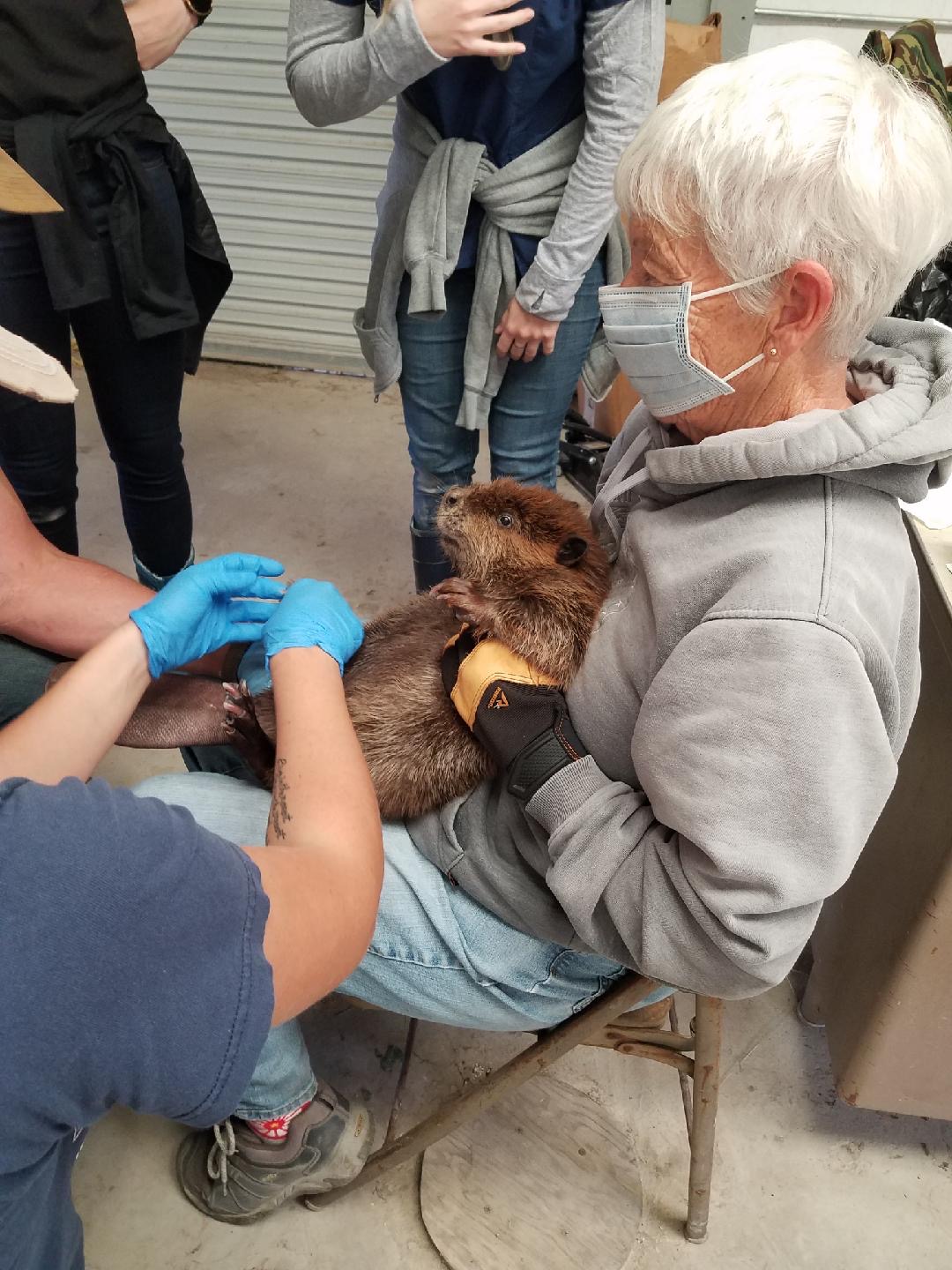
Beaver Health Exam Courtesy & © Mary Heers, Becky Yeager, Photographer
Beaver Health Exam
Courtesy & © Mary Heers, Becky Yeager, Photographer
It’s the job of the Utah Division of Wildlife Resources to live trap and relocate these beavers. I was lucky to be allowed into the loop at this point.

When I picked up one of the smaller beavers, I could feel its heart going a mile a minute under my fingers. But it settled down as I sat in a chair holding it against my chest while it got a quick physical checkup.

Holding the beaver close, I had a good look at the nibble fingers on its front feet, the webbing on its back feet that can paddle along at 6mph, and the marvelous flat tail, a good rudder for swimming, a prop for standing on land, and perfect for slapping the water’s surface.

Take my word for it, once you’ve seen this slap up close, you won’t forget it.

I’m Mary Heers and I’m Wild About Utah.

Credits:
Photos: Courtesy US NPS, Yellowstone Collection, J. Schmidt, Photographer
Photos: Courtesy & Copyright © Mary Heers
Featured Audio: Courtesy Friend Weller, Utah Public Radio
Text & Voice: Mary Heers
Additional Reading: Lyle Bingham, Webmaster

Additional Reading

Leavitt, Shauna, Beaver in Utah’s Desert Rivers, Wild About Utah, July 6, 2020, https://wildaboututah.org/beaver-in-utahs-desert-rivers/

Leavitt, Shauna, Proposed Beaver Holding Facility in Millville, Utah, Wild About Utah, September 3, 2018, https://wildaboututah.org/proposed-beaver-holding-facility-in-millville-utah/

Goodwin, Jim, Riparian Zones and a Critter Quiz, Wild About Utah, January 22, 2015, June 15, 2015, https://wildaboututah.org/riparian-zones-and-a-critter-quiz/

Strand, Holly, Beavers: The Original Army Corps of Engineers, Wild About Utah, April 29, 20-10, August 16, 2012, https://wildaboututah.org/beavers-the-original-army-corps-of-engineers/

Kervin, Linda, Huddling for Warmth, Wild About Utah, February 3, 2011, https://wildaboututah.org/huddling-for-warmth/

Beaver Monitoring App, Utah Water Watch, Extension, Utah State University, https://extension.usu.edu/utahwaterwatch/citizenscience/beavermonitoringapp/

Pollock, M.M., G.M. Lewallen, K. Woodruff, C.E. Jordan and J.M. Castro (Editors) 2018. The Beaver Restoration Guidebook: Working with Beaver to Restore Streams, Wetlands, and Floodplains. Version 2.01. United States Fish and Wildlife Service, Portland, Oregon. 189 pp. Online at: https://www.fws.gov/oregonfwo/ToolsForLandowners/RiverScience/Beaver.asp
also https://restoration.usu.edu/pdf/2018BRGv.2.01.pdf

Macfarlane W.W., Wheaton J.M., and M.L. Jensen. 2014. The Utah Beaver Restoration Assessment Tool: A Decision Support and Planning Tool. Ecogeomorphology and Topographic Analysis Lab, Utah State University, Prepared for Utah Division of Wildlife Resources, Logan, Utah, 135 pp. Available at: https://etalweb.joewheaton.org.s3-us-west-2.amazonaws.com/Downloads/BRAT/UTAH_BRAT_FinalReport.pdf

Wheaton JM. 2013. Scoping Study and Recommendations for an Adaptive Beaver Management Plan. Prepared for Park City
Municipal Corporation. Logan, Utah, 30 pp. https://etalweb.joewheaton.org.s3-us-west-2.amazonaws.com/Reports/Beaver_Management_Plan_Recc_Park_City_%20Report_FINAL.pdf

Beaver Reintroduction Looks Positive for Stream Restoration
in Northern Utah, Utah Forest News, USU Forestry Extension, Utah State University, Volume 18, Number 3, 2014, https://forestry.usu.edu/files/utah-forest-newsletter/utah-forest-newsletter-2014-3.pdf

Muffoletto, Mary-Ann, Dam Good! Beavers May Restore Imperiled Streams, Fish Populations, Today, Utah State University, July 07, 2016, https://www.usu.edu/today/story/dam-good-beavers-may-restore-imperiled-streams-fish-populations

Restoring Degraded Waters, One Pest at a Time, Utah State Magazine, Utah State University, December 7, 2021, https://utahstatemagazine.usu.edu/environment/restoring-degraded-waters-one-nuisance-at-a-time/

“Greetings puny earthlings”

Download Pre-broadcast audio

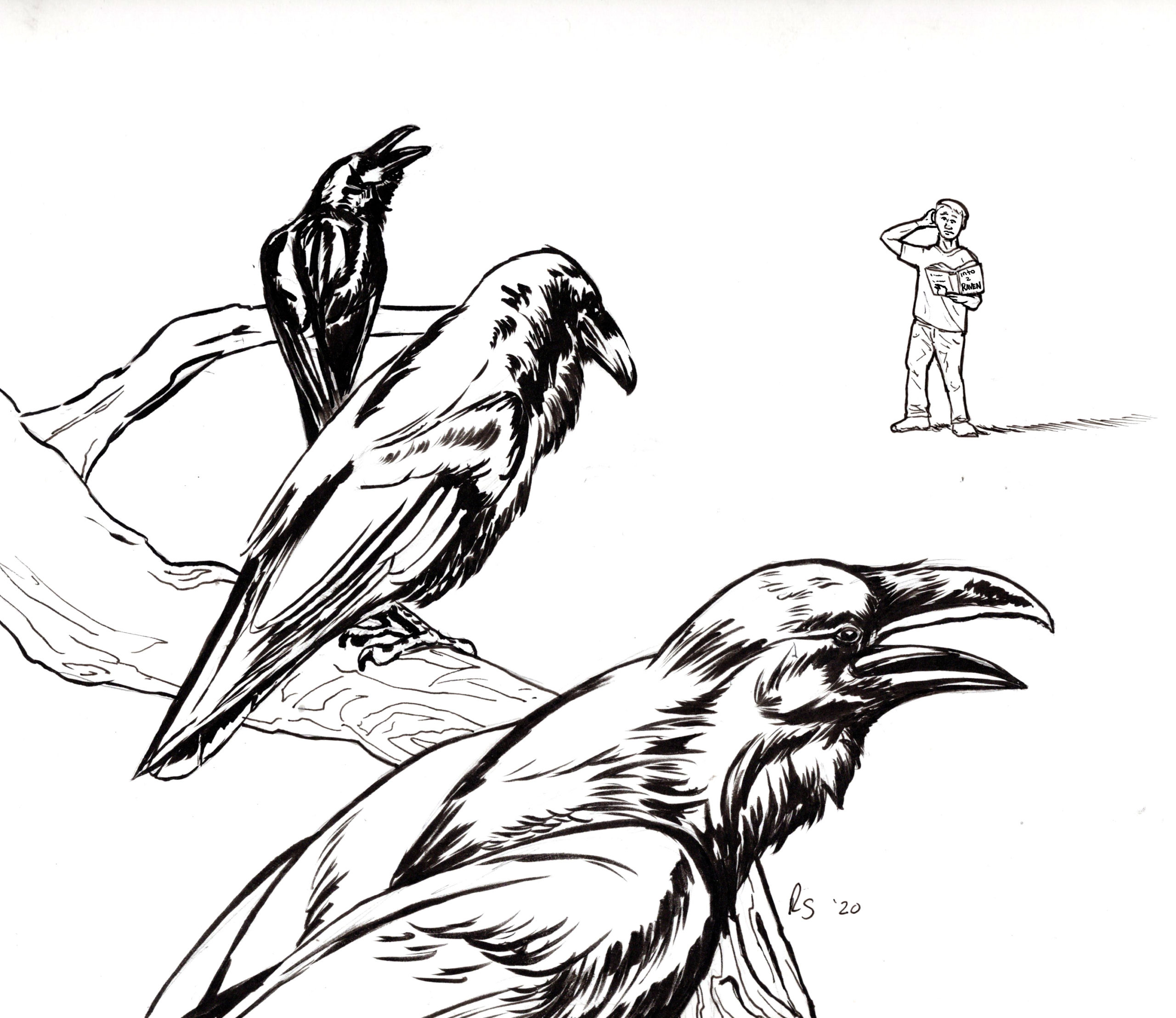
Greetings puny earthlings: Raven, Courtesy & © Rob Soto Used with permission
Raven
Courtesy & © Rob Soto Used with permission
What does it mean to speak and not simply talk? Does it mean you croak back with ravens? Or does it mean that ravens croak back with you?

I have spent many hours on many days for many years speaking with ravens. It’s not easy though to learn a new language, and their patience with my workshopping is not high on their honey-do list. Nevertheless, I work on it every chance I get, and they humor me with free lessons and bountiful harvests of humility.

Before you can speak though, you must first listen. Hear what dialect they speak because they do differ. Do their calls sound like mercury dropping into a still pail of clear cool water, or a porcupine purring as a trusted one scratches an old itch with gentle trepidation? Perhaps this raven growls in fours, fives, and sevens. Perhaps it mimics the locking door beeps it learned from the untrusting cars at a dusty desert gas station. Any way they call though, don’t forget that they do so without lips. When you call back, remember to curl yours back to show your own black beak. It also helps if you look friendly, so maybe give them a smile, too.

What I’ve learned from years speaking with ravens, is that they enjoy engaging with us wilderness tourists just like how I imagine the French mock Americans who ask simple questions through their noses while in berets at the Eiffel Tower. The ravens, still like how I imagine the French, will chirp or croak or clop back at you, but always faster than you thought you had tacitly agreed to. Can’t you hear that I’m not a native speaker, and can’t you respect that I’m at least trying? Oh, they can and they don’t. That’s the humor.

Sometimes they’ll throw new words your way, too, and always with a gleam in their eye. Just as you’re learning how to hock “hello,” they’ll pop quiz you and bleet back, “howdy,” “hey there,” and “greetings puny earthings,” just to smile to themselves at your dense bones and plucked, useless wings. To you, they may all sound like new noises. To them, they’re new jokes. Even when they start to cackle at my attempts, in time I’ve learned to cackle at myself, too. The lessons go on.

So next time you’re high in the mountains or deep in the desert and find yourself startled by a raven asking what life is like from way down there on the target range, listen first. Hear for the intonation, the subtleties in rhythm and iridescent syncopation, and their sandstone timbre. Then simply repeat after them. Curl your lips back, clench your larynx, and croak. Taste a new language. Harness the moment as a shared moment. Allow yourself to be the wild echo of a wild raven. Soon, you’ll find that when you speak the right language, ravens will give your own wild echo back. So now the question arises: will allow yourself to continue learning to speak with ravens, or will you simply settle to talk amongst your fellow puny earthlings?

I’m Patrick Kelly, and I’m Wild About Utah
 
Credits:

Images: Images Courtesy & Copyright Rob Soto, Artist, all rights reserved
Audio: Contains audio courtesy Davyd Betchkal, NPS Audio
Text:    Patrick Kelly, Director of Education, Stokes Nature Center, https://logannature.org
Included Links: Lyle Bingham, Webmaster, WildAboutUtah.org

Additional Reading

Boling, Josh, Josh’s Raven Encounter, Wild About Utah, June 11, 2018, https://wildaboututah.org/joshs-raven-encounter/

Boling, Josh, The Language of Ravens, Wild About Utah, February 19, 2018, https://wildaboututah.org/language-of-ravens/

Strand, Holly, Crow vs. Raven, September 15, 2011, Wild About Utah, https://wildaboututah.org/crow-vs-raven/

Strand, Holly, Cache and Retrieve, Wild About Utah, January 19, 2012, https://wildaboututah.org/cache-and-retrieve/

Kelly, Patrick, As a Child I Loved Nature, Wild About Utah, April 29, 2019, https://wildaboututah.org/as-a-child-i-loved-nature/

Raven Sounds:

Max Ushakov, A huge raven making weird sounds in front of a crowd at the Tower of London., YouTube.com, July 14 2016, https://www.youtube.com/watch?v=l7jgjovK5lY

ESL and Popular Culture, Raven ~ bird call, YouTube.com, Dec 12, 2012, https://www.youtube.com/watch?v=DDv_PlrBg14

Common Raven, Animals, National Geographic, https://www.nationalgeographic.com/animals/birds/c/common-raven/

Bird Note, How to Tell a Raven From a Crow, Oct 22, 2012, Audubon, https://www.audubon.org/news/how-tell-raven-crow

https://video.nationalgeographic.com/video/raven_intelligence

Ravens, Arches National Park, National Park Service – NPS.gov, Last updated: February 8, 2017, https://www.nps.gov/arch/learn/nature/ravens.htm

Common Raven, Zion National Park, National Park Service – NPS.gov, Last updated: January 31, 2016 https://www.nps.gov/zion/learn/nature/raven.htm