Grandaddy

Granddaddy: Oft Have We by Alfred Ralph Robbins Courtesy & © Shannon Rhodes, Photographer
Oft Have We
by Alfred Ralph Robbins
Courtesy & © Shannon Rhodes, Photographer

Oft have we, my friends and I,
Left cares of home, and work day woes
To find a haven, there cast a fly;
And where we’ll camp–God only knows.

Oft have we hiked the trail uphill
To see it pass, and again return–
Walked mile on mile, to get the thrill
Of a meadow lake and a creel filled.

Oft round the lake we’ve cast and fussed
And wished it something we might shun;
But something deep inside of us
Just holds us fast till day is done.

Breathtaking Beauty by Alfred Ralph Robbins Courtesy & © Shannon Rhodes, Photographer
Breathtaking Beauty by Alfred Ralph Robbins
Courtesy & © Shannon Rhodes, Photographer
Utahn Alfred Ralph Robbins loved exploring the Grandaddy Basin in northeastern Utah’s High Uintas with a group he called The High Country Boys. He compiled his labeled-and-dated sketches of camp and lake adventures among a sprinkling of black-and-white photographs in a scrapbook spanning the 1920s through the 1960s. They were casting at Governor Lake in 1927 and resting at Pine Island Lake in 1952 with 125 trout strung between the trees. I know they fished Pinto Lake, Trial Lake, Betsy Lake, and just about every lake in the area for 40 years. I know they, outfitted by Defa’s Dude Ranch, even stopped “on top of the world” on their way to Hatchery Lake with Alvis Newton Simpson, Robbins’s son-in-law and my grandfather, because he captured and preserved it.

Alfred Ralph Robbins and Grandson Jerry Newton Simpson 1947 Utah Courtesy & © Shannon Rhodes, Photographer
Alfred Ralph Robbins and Grandson Jerry Newton Simpson 1947 Utah
Courtesy & © Shannon Rhodes, Photographer
As my father handed down copies of this family fishing scrapbook to his grandchildren, my sons and daughters, after what they called a Fishing-with-Grandpa Simpson Saturday, he included a cover photograph of his Grandaddy Robbins, in his fishing waders, holding five-year-old grandson’s hand. My father added, “I only made one horse pack trip to Grandaddy Basin with Grandpa Robbins, but it was a very eventful week. It stormed one day and we could hear the rocks tumbling down the mountain when the lightning would strike and dislodge them. Another day there was a mayfly hatch as we were fishing one of the lakes. When that happened, the fish would bite on anything that hit the water. The mosquitoes just about ate us alive, and repellant didn’t help much. We saw some fish about three feet long near the rocks on shore, but we couldn’t get them to bite. We caught plenty of other fish and ate fish for supper most days that week.”

Do you have similar memories in the wild with your grandparents recorded somehow? Turning to one of my favorite books, “Refuge: An Unnatural History of Family and Place,” I read again how Terry Tempest Williams described the memories with her grandmother among avocets, ibises, and western grebes during their outings in Utah’s Great Salt Lake wetlands. Grandmother Mimi shared her birding fascination with her granddaughter Terry along the burrowing owl mounds of the Bear River Migratory Bird Refuge. Williams wrote, “It was in 1960, the same year she gave me my Peterson’s Field Guide to Western Birds. I know this because I dated their picture. We have come back every year since to pay our respects.”

I’m not a grandmother yet, but I will one day make a trek over Hades Pass again, gaze at the Grandaddy Basin below, and capture nature’s poetry with pen, camera lens, and little hiker hands in mine. Bloggers have technologies today to share instantly with me and the rest of the world their adventures in this Grandaddy Wilderness region. Documenting autobiographical history has evolved from dusty diaries and scrapbooks with black-and-white photographs to today’s digital image- and video-filled blogs in exciting ways that can include the places in Utah you love with the generations you love. Consider it your contribution to history.

Grandaddy Ohs and Ahs by Alfred Ralph Robbins Courtesy & © Shannon Rhodes, Photographer
Grandaddy Ohs and Ahs
by Alfred Ralph Robbins
Courtesy & © Shannon Rhodes, Photographer

I would not miss the Oh’s! and Ah’s!
I’ve seen in Doug’s and Noel’s eyes,
When first they saw Grandaddy Lake
From the summit, in the skies.

They are thrilled I know, and so am I.
They show it in their face;
While I just swallow hard and try
To thank God for this place.

I am Grandaddy Basin poet Alfred Ralph Robbins’s great granddaughter Shannon Rhodes, and I’m wild about Utah.

Credits:

Images: Courtesy & Copyright Shannon Rhodes, Photographer
Audio: Courtesy & © Kevin Colver https://wildstore.wildsanctuary.com/
Text:     Shannon Rhodes, Edith Bowen Laboratory School, Utah State University https://edithbowen.usu.edu/
Additional Reading Links: Shannon Rhodes

Additional Reading:

Williams, Terry Tempest. 1992. Refuge: an unnatural history of family and place. New York: Vintage Books. https://www.amazon.com/Refuge-Unnatural-History-Family-Place/dp/0679740244

Andersen, Cordell M. The Grandaddies. 2015. https://cordellmandersen.blogspot.com/2015/06/photoessay-backpack-1-2015-grandaddy.html

Wasatch Will. Fern Lake: Chasing Friends in Grandaddy Basin. 2018. https://www.wasatchwill.com/2018/06/fern-lake.html

Delay, Megan and Ali Spackman. Hanging with Sean’s Elk Party in the Uinta’s Grandaddy Basin. 2015. https://whereintheworldaremeganandali.wordpress.com/2015/09/05/hanging-with-seans-elk-party-in-the-uintas-grandaddy-basin/

Rhodes, Shannon, Wild About Nature Journaling, Wild About Utah June 22, 2020, https://wildaboututah.org/wild-about-nature-journaling/

Common Starlings

Common Starlings or European Starling, Sturnus vulgaris, Courtesy US FWS, Dave Menke, Photographer
Common or European Starling, Sturnus vulgaris, Courtesy US FWS, Dave Menke, Photographer
It all began so innocently. Let’s bring over a few European starlings to add authenticity for a Shakespearean theatrical. That was 1890. Today, North America has about half of the world population of starlings, approaching a few hundred million.

Following many years of demonizing this bird, I have become convinced they do have value beyond compost. In fact, they are utterly fascinating. My first glimmer came when a friend suggested I read “Arnie, the Darling Starling”. I have yet to read it, but he convinced me this bird was worth taking a second look.

European Starling, Sturnus vulgaris, Courtesy & © Hilary Shughart, Photographer
European Starling, Sturnus vulgaris,
Courtesy & © Hilary Shughart, Photographer”
Since that time in the mid 70’s, I’ve witnessed many of the starling’s remarkable behaviors. It possesses a maddening ability to imitate other birds- killdeer, red tail hawk, evening grosbeak, etc., with such accuracy I always stop to look for a killdeer perched in a tree- gotcha Jack! The starling’s gift for mimicry has long been recognised. Mozart had a pet starling which could sing part of his Piano Concerto in G Major. He became very attached to the bird and arranged an elaborate funeral for it when it died three years later.

Starlings are commonly kept as pets in Europe and widely used as laboratory animals, second only to pigeons. Austrian ethologist Konrad Lorenz wrote of them in his book King Solomon’s Ring as “the poor man’s dog” and “something to love”. Their inquisitiveness makes them easy to train or study.

Starling Murmuration Courtesy Wikimedia and Copyright Walter Baxter Licensed under Creative Commons Attribution-ShareAlike 2.0 license
Starling Murmuration
Courtesy Wikimedia and Copyright Walter Baxter
Licensed under Creative Commons Attribution-ShareAlike 2.0 license
I’ve always been amazed by their immense winter flocks called murmurations- thousands of birds reminiscent of what the now extinct passenger pigeons must have resembled, and for these massive bird clouds to change form and direction in milliseconds, which I observed when a merlin falcon plummeted into an enormous flock that split in half. I stood in disbelief as the cloud morphed, then saw the merlin emerge just below the bifurcated cloud.

The starling has 12 subspecies breeding in open habitats across its native range in temperate Europe to western Mongolia, and it has been introduced to seven other countries from Australia to Fiji.

Major declines in populations have occurred from 1980 onward in much of Europe and Eurasia. The decline appears to be caused by intensive farming methods used in northern Europe, and the reduced supply of grassland invertebrates needed for the nestlings. This in contrast to 1949, when so many starlings landed on the clock hands of London’s Big Ben that it stopped the clock!
Our love hate starling relationships are evident in how various countries view them. In Spain, starlings are hunted commercially as a food item. In France, it is classified as a pest, and can be killed throughout most of the year. In Great Britain, Starlings are protected under the Wildlife and Countryside Act. In 2008, the United States government killed 1.7 million starlings, the largest number of any nuisance species to be culled.

A closing note- starlings are trapped for food in some Arab countries. The meat is tough and of low quality, so it is casseroled or made into pâté. Even when correctly prepared, it may still be seen as an acquired taste. You may wish to remove them from your grocery list.

Jack Greene for Bridgerland Audubon Society, and I’m wild about Utah’s not so wild starlings!

Credits:

Pictures: Courtesy US FWS, Dave Menke, Photographer
Pictures: Courtesy US FWS, Lee Karney, Photographer
Pictures: Courtesy Wikimedia and Copyright Walter Baxter, Photographer (Licensed Under Creative Commons Attribution-ShareAlike 2.0 license) https://commons.wikimedia.org/wiki/File:Starling_murmuration.jpg
Audio: Courtesy & © Kevin Colver https://wildstore.wildsanctuary.com/collections/special-collections
Text: Jack Greene, Jack Greene, Bridgerland Audubon Society & Utah State University Sustainability
Additional Links: Lyle Bingham, Webmaster, Bridgerland Audubon Society, Wild About Utah,

Additional Reading:

Grant, Val, Short-tailed Bird of Perdition-Starlings, Wild About Utah, June 5, 2009, https://wildaboututah.org/short-tailed-bird-of-perdition-starlings/

European Starling, Sturnus vulgaris, Julia Butler Hansen Refuge, US Fish and Wildlife Service, US Department of the Interior, https://www.fws.gov/refuge/julia_butler_hansen/wildlife_and_habitat/habitats/birds/european_starling.html

King, Barbara J., Video: Swooping Starlings In Murmuration, National Public Radio (NPR), January 4, 2017 2:29 PM ET, https://www.npr.org/sections/13.7/2017/01/04/506400719/video-swooping-starlings-in-murmuration

European Starling, BirdWeb, https://www.birdweb.org/birdweb/bird/european_starling

Sigl Corbo, Margarete(Author), Barras, Diane Marie(Author), Morrill, Leslie(Illustrator), Arnie, the Darling Starling, Houghton Mifflin Harcourt, November 1, 1983, https://www.amazon.com/Arnie-Darling-Starling-Margarete-Corbo/dp/0395343909

Embarking on an Ecological Transition through Permaculture Design

Ecological Transition through Permaculture Design: Before and After Permaculture Rain Garden USU Moab Photo Courtesy & © Roslynn Brain McCann, Photographer
Before and After
Permaculture Rain Garden
USU Moab
Photo Courtesy & © Roslynn Brain McCann, Photographer
Before installing our permaculture gardens at Utah State University, Moab, the only birds I observed from my office window were Eurasian Collared Doves and crows. The space is small. It used to consist of concrete and a mono-planted row of juniper bushes. Seven years ago, over 40 members of the Moab community helped us dream up a new vision for the space. We took out a few parking spaces that allowed my building’s roof rainwater runoff to run-in to our garden and into a rock-lined swale and a series of basins. In an area that receives an average of under 10 inches of rainfall per year, our USU Moab permaculture gardens now harvest an estimated 125,000 gallons of rainwater either directly into the garden soil, or into a series of rain tanks for later use.

Alongside planting the rain through water harvesting earthworks, we installed an ecological design with a fruit and shade producing overstory, and an understory of shrubs, plants, and grasses. The understory performs one or more of four functions: pollinator attractors, nitrogen fixers, nutrient accumulators (which pull nutrients deeper in soil layers towards the surface, becoming available through a chop and drop technique), and soil stabilizers. Now, broad-tailed hummingbirds, spotted towhees, rock wrens and more can be seen and heard as the garden bounty ripens each year. These birds bring color, song, and delight as they contribute to pest control, devouring aphids, grasshoppers and pesky plant eating beetle grubs.

What we have learned through our small urban campus is that with permaculture design, any landscape can undergo a complete ecological transition – even a landscape that is only a few feet wide and was previously partially covered in concrete.

If you are interested in applying permaculture design to your landscape, start by observing your site as it currently is. See how water flows in a rain event. Walk around during the hottest days of the year and feel where the hot and cool zones are. How does the sun move across the site during summer solstice. During winter solstice. What views do you want to take in and block? What species engage in your landscape and what ones are missing? These are the types of questions you can ask yourself. Then, as you begin to think about design ideas, here are some general tips:

    • Ask elders in your community about extreme weather events and other helpful historical information
    • Think about what your landscape is currently doing for you, and what you would like it to do. Then, develop your goals for the site. This will help you determine what is and is not currently working
    • In the desert, as a general rule, place your paths high and dry, plants low and wet (or at least wetter)
    • Discover what plants might work well together in what is called a guild. For example, if you have a nitrogen dependent shrub, plant nitrogen-fixing plants around it.
    • Harvest as much rainwater as possible through active systems like rain tanks, and passive systems like earthworks that slow, spread, and sink rainwater
    • Plant your high-maintenance plants in your most-frequented areas – alongside the pathway between your house and chicken coop, for example.
    • Birds and humans appreciate diversity in heights, species, and food-producing plants
    • Start small
    • See failures as opportunities for learning

    For Utah State University Extension Sustainability and the Department of Environment and Society, this is Roslynn Brain McCann and I’m wild about Utah!

    Credits:
    Images: Courtesy and copyright Roslynn G.H. Brain McCann, Photographer
    Audio: Courtesy and copyright Kevin Colver
    Text:     Roslynn G.H. Brain McCann, Utah State University Extension Sustainability
    Additional Reading: Lyle Bingham, Webmaster
    Additional Reading:

    Brain McCann, Roslynn G.H., Rainwater Harvesting, Wild About Utah, October 19, 2015, https://wildaboututah.org/rainwater-harvesting/

    Brain McCann, Roslynn G.H., Permaculture, Wild About Utah, May 23, 2016, https://wildaboututah.org/permaculture/

    Brain McCann, Roslynn G.H., Three-Leaf Sumac (Rhus trilobata), Wild About Utah, November 23, 2015, https://wildaboututah.org/three-leaf-sumac-rhus-trilobata/

    Brain McCann, Roslynn G.H., Dandelion, Friend or Foe?, Wild About Utah, April 4, 2016, https://wildaboututah.org/dandelion-friend-foe/

    Brain McCann, Roslynn G.H., Edible Weeds: Lambs Quarters and Purslane, Wild About Utah, March 27, 2017, https://wildaboututah.org/edible-weeds-lambs-quarters-and-purslane/

    Brain McCann, Roslynn G.H., Yellow-bellied Marmot, Wild About Utah, September 21, 2015, https://wildaboututah.org/yellow-bellied-marmot/

    YCC Team, Lush Utah garden makes the most of a small amount of rain, Yale Climate Connections, July 25, 2022, https://yaleclimateconnections.org/2022/07/lush-utah-garden-makes-the-most-of-a-small-amount-of-rain/

    Juncos

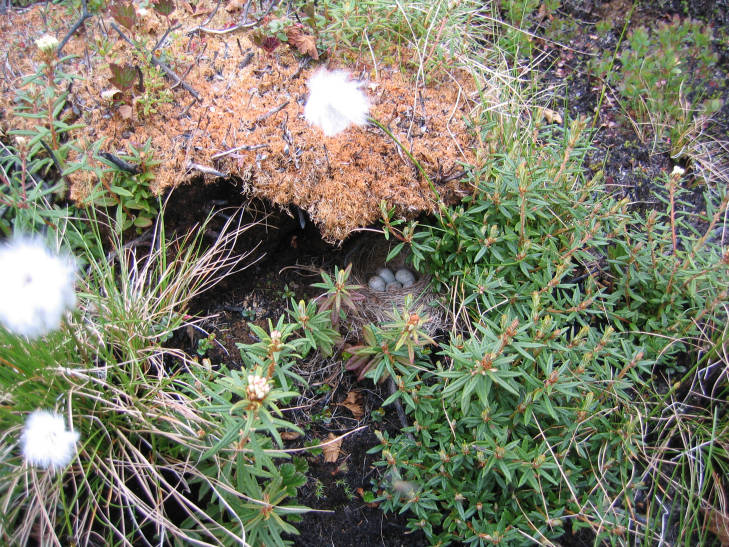
    Juncos: Junco Nest Courtesy US FWS Carla Stanley, Photographer
    Junco Nest
    Courtesy US FWS
    Carla Stanley, Photographer
    I first became aware of dark eyed juncos while doing fieldwork for the USFS in Montana. My young children discovered an active nest on the ground near a mountain stream. This was before my birding days. It occurred to me this was a strange place for a small, sparrow sized bird to build a nest, giving predators the advantage. Yet they flourish, and are among the most common and prolific songbirds in north America.

    Juncos: Dark-eyed 'Oregon' Junco Male, Junco hyemalis montanus, Courtesy and copyright 2008 Ryan P. O'Donnell, Photographer
    Dark-eyed ‘Oregon’ Junco Male, Junco hyemalis montanus, Courtesy and copyright 2008 Ryan P. O’Donnell, Photographer
    Now, many years later, I enjoy them at my feeder as they migrate down from the high country to winter in my backyard. I’ve found them to be very chatty with constant vocalizations being exchanged. A friend spent her PhD work on their chatter and discovered 23 sound variations representing different messages. I’m guessing there are many more if one includes nonverbal means of communicating and possible notes beyond our range of hearing.

    Another fascinating discovery was how different individual juncos were as I handled those captured in a mist net for banding purposes. Some were quite belligerent biting and struggling throughout the experience. Others were very docile. I imagined them to be smiling throughout the ordeal.

    The Dark-eyed Junco can be found across the continent, from Alaska to Mexico, from California to New York. A recent estimate set the junco’s total population at approximately 630 million individuals, about double the U.S. human population.

    Belonging to the sparrow family Passerellidae, Junco systematics are still confusing after decades of research, with various authors accepting between three and 12 species. There is a huge range of geographic variation in the Dark-eyed Junco. Among the 15 described races, six forms are easily recognizable in the field and five used to be considered separate species until the 1980s.

    Primarily ground feeders, in winter they become highly social often foraging in flocks, evident as masses attack my feeder, and each other! Their breeding habitat is coniferous or mixed forest areas, ranging from subarctic taiga to high-altitude mountain forests in Mexico and Central America south to Panama. The Oregon Dark-eyed Junco, along with the Slate-colored, are the two most widely known subspecies.

    The oldest recorded Dark-eyed Junco was at least 11 years, 4 months old when it was recaptured and rereleased during banding operations in West Virginia in 2001.

    Juncos are described as “happy, bubbly, little birds that are a joy to watch”. All races and species share a pink bill as well as pink legs, a reminder that no matter how different two things look, they are not all that different on the inside. Please enjoy your juncos and happy holidays!

    Jack Greene for Bridgerland Audubon Society, and I’m always wild about wild things in Utah!

    Credits:

    Nest Picture: Courtesy US FWS, Carla Stanley, Photographer
    Junco Picture: Courtesy & © Ryan P O’Donnell, Photographer
    Audio: Courtesy and Copyright Kevin Colver
    Text: Jack Greene, Bridgerland Audubon Society
    Additional Reading: Lyle W Bingham, Webmaster

    Additional Reading:

    Liberatore, Andrea, Dark-Eyed Juncos, Wild About Utah, January 12, 2012, https://wildaboututah.org/dark-eyed-juncos/

    Greene, Jack, Seasonal Changes and Amazing Adaptations, Wild About Utah, Nov 9, 2015, https://wildaboututah.org/seasonal-changes-amazing-adaptations/

    Atwell, J.W., O’Neal, D.M, and Ketterson, E.D. (2011) Animal Migration as a Moving Target for Conservation: Intra-species Variation and Responses to Environmental Change, as Illustrated in a Sometimes Migratory Songbird. Environmental Law. Vol. 41:289 p. 289-319, https://www.amazon.com/Animal-migration-moving-target-conservation/dp/B005C29H7I

    Alderfer, Jonathan (editor) (2005) National Geographic Complete Book of Birds. National Geographic Press. Dark-eyed junco information available online at: https://animals.nationalgeographic.com/animals/birding/dark-eyed-junco/

    Cornell Lab of Ornithology, All About Birds: Dark-eyed Junco. https://www.allaboutbirds.org/guide/Dark-eyed_Junco/id/ac

    History of Name Changes for Juncos. Cornell Lab of Ornithology. https://www.birds.cornell.edu/pfw/News/junco_taxonomy.pdf