“Greetings puny earthlings”

Download Pre-broadcast audio
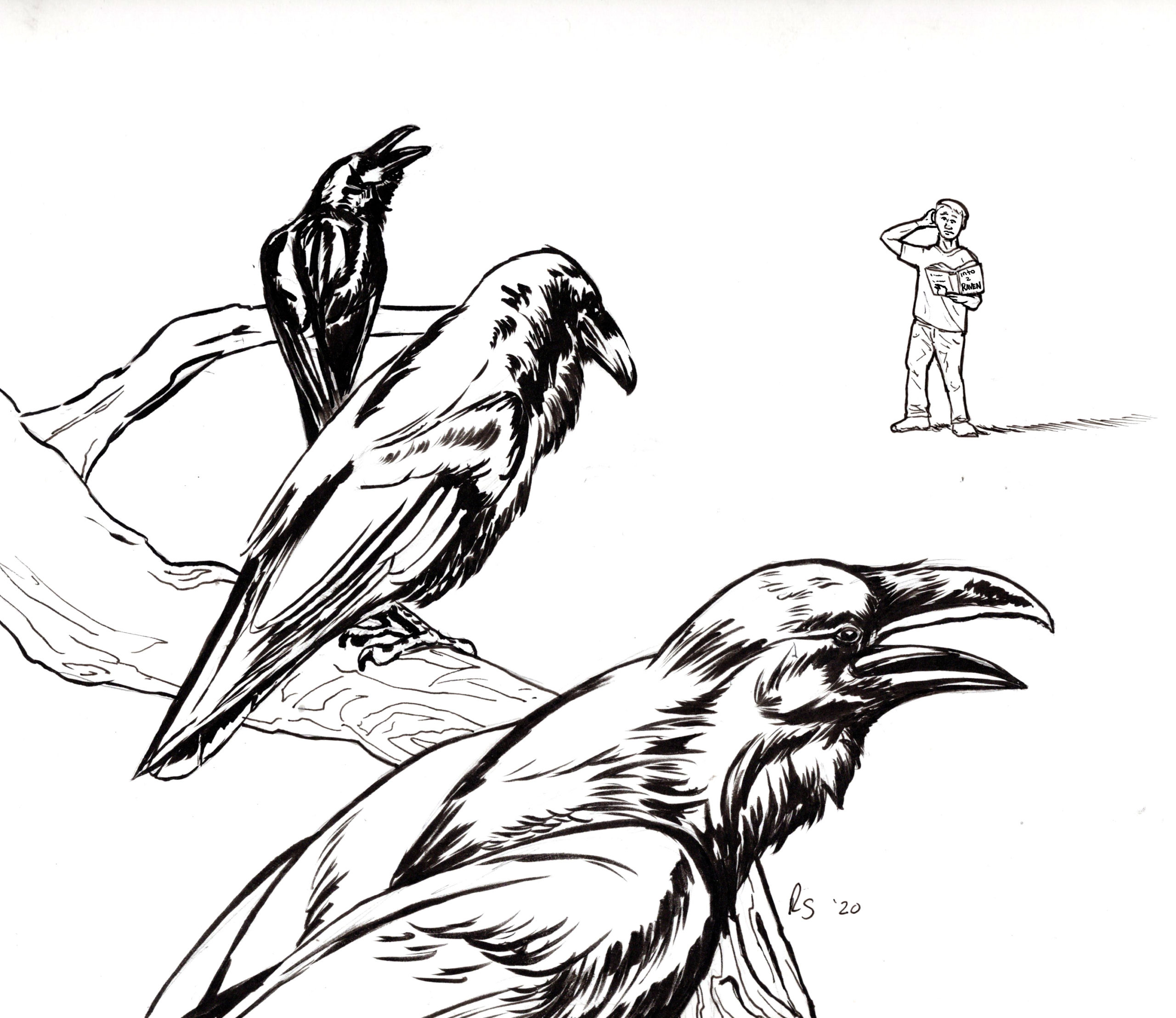
Greetings puny earthlings: Raven, Courtesy & © Rob Soto Used with permission
Raven
Courtesy & © Rob Soto Used with permission
What does it mean to speak and not simply talk? Does it mean you croak back with ravens? Or does it mean that ravens croak back with you?

I have spent many hours on many days for many years speaking with ravens. It’s not easy though to learn a new language, and their patience with my workshopping is not high on their honey-do list. Nevertheless, I work on it every chance I get, and they humor me with free lessons and bountiful harvests of humility.

Before you can speak though, you must first listen. Hear what dialect they speak because they do differ. Do their calls sound like mercury dropping into a still pail of clear cool water, or a porcupine purring as a trusted one scratches an old itch with gentle trepidation? Perhaps this raven growls in fours, fives, and sevens. Perhaps it mimics the locking door beeps it learned from the untrusting cars at a dusty desert gas station. Any way they call though, don’t forget that they do so without lips. When you call back, remember to curl yours back to show your own black beak. It also helps if you look friendly, so maybe give them a smile, too.

What I’ve learned from years speaking with ravens, is that they enjoy engaging with us wilderness tourists just like how I imagine the French mock Americans who ask simple questions through their noses while in berets at the Eiffel Tower. The ravens, still like how I imagine the French, will chirp or croak or clop back at you, but always faster than you thought you had tacitly agreed to. Can’t you hear that I’m not a native speaker, and can’t you respect that I’m at least trying? Oh, they can and they don’t. That’s the humor.

Sometimes they’ll throw new words your way, too, and always with a gleam in their eye. Just as you’re learning how to hock “hello,” they’ll pop quiz you and bleet back, “howdy,” “hey there,” and “greetings puny earthings,” just to smile to themselves at your dense bones and plucked, useless wings. To you, they may all sound like new noises. To them, they’re new jokes. Even when they start to cackle at my attempts, in time I’ve learned to cackle at myself, too. The lessons go on.

So next time you’re high in the mountains or deep in the desert and find yourself startled by a raven asking what life is like from way down there on the target range, listen first. Hear for the intonation, the subtleties in rhythm and iridescent syncopation, and their sandstone timbre. Then simply repeat after them. Curl your lips back, clench your larynx, and croak. Taste a new language. Harness the moment as a shared moment. Allow yourself to be the wild echo of a wild raven. Soon, you’ll find that when you speak the right language, ravens will give your own wild echo back. So now the question arises: will allow yourself to continue learning to speak with ravens, or will you simply settle to talk amongst your fellow puny earthlings?

I’m Patrick Kelly, and I’m Wild About Utah
 
Credits:

Images: Images Courtesy & Copyright Rob Soto, Artist, all rights reserved
Audio: Contains audio courtesy Davyd Betchkal, NPS Audio
Text:    Patrick Kelly, Director of Education, Stokes Nature Center, https://logannature.org
Included Links: Lyle Bingham, Webmaster, WildAboutUtah.org

Additional Reading

Boling, Josh, Josh’s Raven Encounter, Wild About Utah, June 11, 2018, https://wildaboututah.org/joshs-raven-encounter/

Boling, Josh, The Language of Ravens, Wild About Utah, February 19, 2018, https://wildaboututah.org/language-of-ravens/

Strand, Holly, Crow vs. Raven, September 15, 2011, Wild About Utah, https://wildaboututah.org/crow-vs-raven/

Strand, Holly, Cache and Retrieve, Wild About Utah, January 19, 2012, https://wildaboututah.org/cache-and-retrieve/

Kelly, Patrick, As a Child I Loved Nature, Wild About Utah, April 29, 2019, https://wildaboututah.org/as-a-child-i-loved-nature/

Raven Sounds:

Max Ushakov, A huge raven making weird sounds in front of a crowd at the Tower of London., YouTube.com, July 14 2016, https://www.youtube.com/watch?v=l7jgjovK5lY

ESL and Popular Culture, Raven ~ bird call, YouTube.com, Dec 12, 2012, https://www.youtube.com/watch?v=DDv_PlrBg14

Common Raven, Animals, National Geographic, https://www.nationalgeographic.com/animals/birds/c/common-raven/

Bird Note, How to Tell a Raven From a Crow, Oct 22, 2012, Audubon, https://www.audubon.org/news/how-tell-raven-crow

https://video.nationalgeographic.com/video/raven_intelligence

Ravens, Arches National Park, National Park Service – NPS.gov, Last updated: February 8, 2017, https://www.nps.gov/arch/learn/nature/ravens.htm

Common Raven, Zion National Park, National Park Service – NPS.gov, Last updated: January 31, 2016 https://www.nps.gov/zion/learn/nature/raven.htm

I Notice, I Wonder

I Notice, I Wonder: Purple Cones Courtesy & © Shannon Rhodes, Photographer
Purple Cones
Courtesy & © Shannon Rhodes, Photographer
Allow me to share an excerpt from my nature journal. “July 5, 2020. 6:10 p.m. We are perched on the east side of Buck Ridge, racing the sun’s western descent as we conclude a day on Utah’s Skyline Drive. He is drawn to the bull elk in the meadow below the ivory cliff’s edge. I can’t pull myself away from the purple cones. Not brown, not gray, but vibrant violet cones stretching straight upward. How have I missed noticing these before? I wonder what purpose such a hue serves.”

Utah has inspired writers to notice and wonder for centuries. Father Escalante described Utah’s geography, ecology, and native people he encountered in his 1776 travel diary, and a decade before, Juan Maria Antonio de Rivera was writing in his own nature journal as he searched for silver ore and a way to cross what we now call the Colorado River. We can gaze at the many petroglyph and pictograph panels detailing deer, bison, bighorn sheep, and interesting beings sprinkled throughout this state, including my favorite Head of Sinbad in the San Rafael Swell, that have survived the environmental and human efforts to alter or erase.

John Wesley Powell captured his nature experience this way: “We are three-quarters of a mile in the depths of the earth, and the great river shrinks into insignificance, as it dashes its angry waves against the walls and cliffs, that rise to the world above; they are but puny ripples, and we but pygmies, running up and down the sands, or lost
among the boulders….How beautiful the sky; how bright the sunshine; what “floods of delirious music” pour from the throats of birds; how sweet the fragrance of earth, and tree, and blossom!”

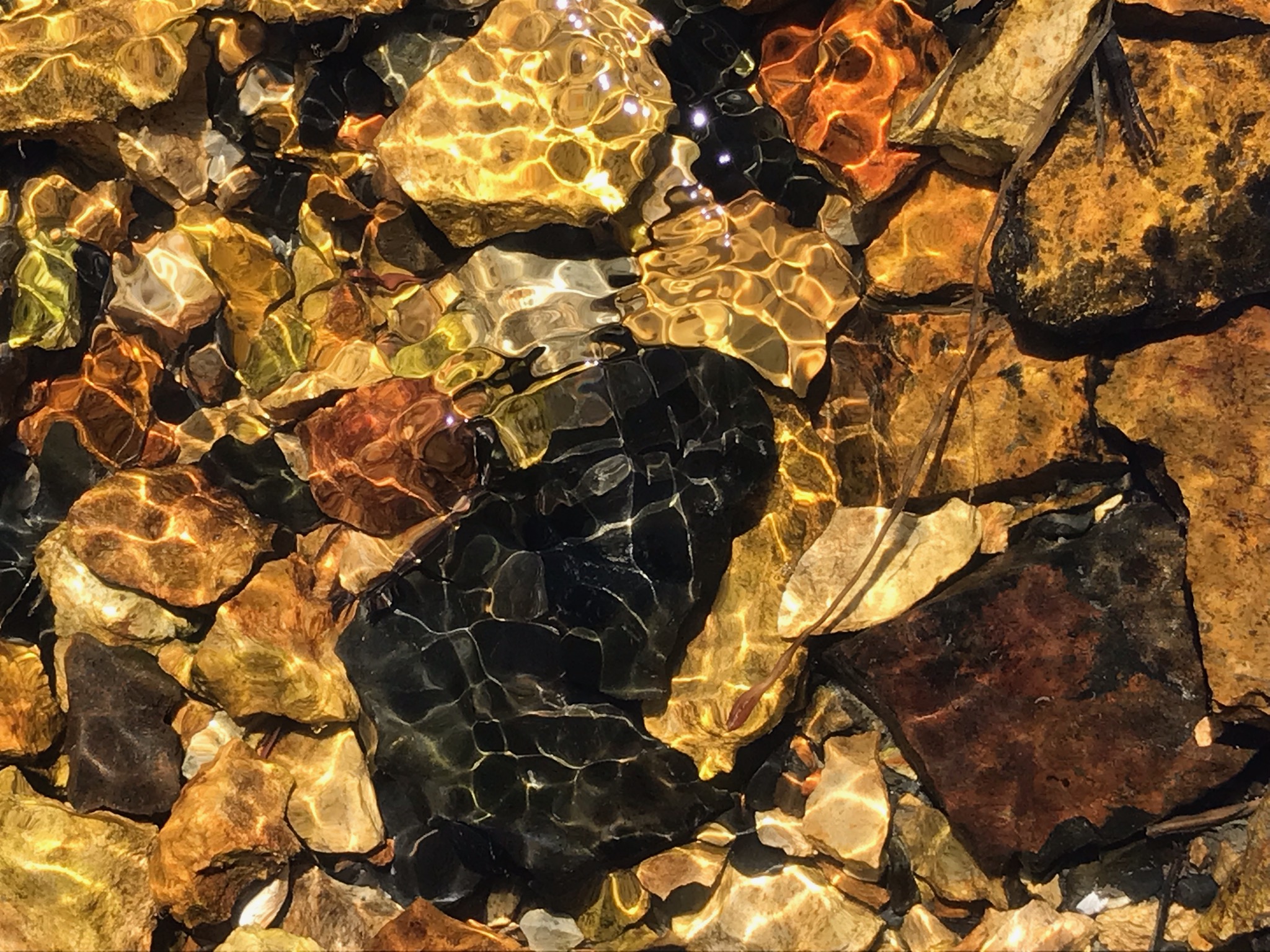
Stream Ripple Picture Courtesy & © Shannon Rhodes, Photographer
Stream Ripple Picture
Courtesy & © Shannon Rhodes, Photographer
Early Utah explorers such as John C. Fremont also chronicled meadows, springs, and plants he encountered. More recently, Ralph Becker recorded his multi-week experience hiking almost 200 miles in Utah’s Capitol Reef Waterpocket Fold like this: “Upper Muley Twist Canyon is a fine work of art. Tremendous navajo sandstone fins rise steeply to the east, creating the backbone of the Waterpocket Fold. The kayenta sandstone, a pinkish and tan ledgy rock, begins making an appearance just under it. Wingate sandstone is becoming a dominant formation. It rises in great humpbacks…In the wingate, arches appear everywhere.”

Student Nature Journal Courtesy & © Shannon Rhodes, Photographer
Student Nature Journal
Courtesy & © Shannon Rhodes, Photographer
As an educator of Utah’s young citizen scientists and budding nature writers, I delight in escorting children along trails just like these described by those writing before, watching
them notice, wonder, and then record in words and sketches the Utah that speaks to them the most clearly. It is true, as Pamela Poulsen wrote in her foreword to Claude Barnes’s chronicles of the Wasatch Range through the seasons, that “nature divulges its innermost secrets only to them who consistently tread its by-paths.” I’ve found that the longer I sit with pen and paper, the more seems to happen, or at least the more I notice and wonder.

My 6/2020 Journal Page Courtesy & © Shannon Rhodes, Photographer
My 6/2020 Journal Page
Courtesy & © Shannon Rhodes, Photographer
Sweat bees come and go;
Cumulus clouds, too.
Shadows shift,
squirrels scurry.
Winged visitors land on my pages,
tasting my sketches,
testing my adjectives,
begging me to dig deeper
through the Douglas fir cones
and caddis fly larva casings
to find the magical secrets that
capture
why I am Shannon Rhodes
who is Wild About Utah.

Credits:

Images: Courtesy & Copyright Shannon Rhodes, Photographer
Audio: Courtesy & © Kevin Colver https://wildstore.wildsanctuary.com/
Text:     Shannon Rhodes, Edith Bowen Laboratory School, Utah State University https://edithbowen.usu.edu/
Additional Reading Links: Shannon Rhodes

Additional Reading:

Barnes, Claude T. The Natural History of a Mountain Year: Four Seasons in the Wasatch Range.
University of Utah Press, Salt Lake City, Utah. 1996. https://www.amazon.com/Natural-History-Mountain-Year-Seasons/dp/0874804744
Online Version, Digitized by Google, Original within the Cornell Library https://babel.hathitrust.org/cgi/pt?id=coo.31924003085440&view=1up&seq=10

Becker, R. “Modern Wanderings Along the Waterpocket Fold,” Utah Historical Quarterly,
Vol. 83, no. 4, 2015. https://issuu.com/utah10/docs/uhq_volume83_2015_number4/s/10433654

Jones, S. “Early Explorers: Lake Legend, Quest for Silver, Brought First White Man to Area 231
Years Ago.” Deseret News, October 20, 1996. https://www.deseret.com/1996/10/20/19272182/early-explorers-lake-legend-quest-for-silver-bro
ught-1st-white-man-to-area-231-years-ago

Powell, J. W. “Down the Colorado: Diary of the First Trip through the Grand Canyon, 1869,” in Paul
Schullery, ed., The Early Grand Canyon: Early Impressions (Niwot: Colorado Associated University Press,
1981). https://www.paulschullery.com/the_grand_canyon__early_impressions_119197.htm

Rhodes, Shannon, Wild About Nature Journaling, Wild About Utah June 22, 2020, https://wildaboututah.org/wild-about-nature-journaling/

In the Eyes of a Bear

In the Eyes of a Bear: Lone Bear Courtesy and Copyright Patrick Kelly
Lone Bear
Courtesy and Copyright Patrick Kelly
We call him Old Ephraim up here in Cache Valley. He's a tale known by just about everyone: one of the last brown bears in Utah, shot and killed by Frank Clark, in August, 1923. The account that's usually told spins the bear as both highly intelligent and dastardly, almost even sub-animal, of a creature who is the last because he is the most conniving and monstrous. His death came at the hands of a shepherd who had tracked the bear for nearly a decade, taking over 40 others in his pursuit, only to finally overcome the giant with luck and a repeating rifle. In Old Ephraim's death, he was skinned, burned, and buried. His hide was eaten by moths in the slope of Clark's barn. Today, his skull resides in an exhibit at Utah State University, and his bones have been long poached by treasure hunters. His grave holds no bear but that which we imagine.

What I take away from this story, though, is not what others have typically taken away when I read the accounts. For those long-past authors, it has always been of the glorification of Clark’s struggle; for overcoming the agent of a primeval, and thus incompatible, nature; for the noble easing of future fears by finally taking that monster bear. For me, I take away how Clark, years later, bravely chose to regret his choices, which at the time of their making were too far already decided by habit rather than concise intent. Clark stated about it, “Was I happy? No, and if I had to do it over, I wouldn’t kill him… I could see the suffering in his eyes…” That suffering had been passed on to him, it seems.

Blame for the end of Utah’s last great bear, though, cannot be placed upon the man, nor the firearm, nor the bear. Blame can only be attached to what bonded them as kin: that both man and bear had been dealt their hands by their being, and they played them the only way they had been shown, descendant of a long line of teachers whose most underlying motivation was honest survival. This is what connected the two in the moment of their struggle. They were united by fate because of what made them similar, not different.

In the Eyes of a Bear: Old Ephriam's Grave Marker, The height of the the old grizzley Courtesy & Copyright Josh Bolling
Old Ephriam’s Grave Marker,
The height of the the old grizzley
Courtesy & Copyright Josh Bolling
In his telling of his regret, Clark dared who he was, with who he strove to be, even in his later life. He was, after all, a self-professed lover of nature, and held holy the wild places where he spent dozens of summers. His regret was not a fault, but a truss of strength which honored this deeper value. He understood that, if you allow it, nature will take you to the great questions through flowers and birds and a strenuous life, if even for a small while, and even after you have erred. Nature is a hopeful place; an accepting place. Out there, “its” become “thous”, and the ego and all its fleeting impulsivities are surrendered to the ultimate authority of deep experiences within the land.

Hemingway said that, “The world breaks everyone and afterward many are strong at the broken places.” In this reflection, Clark’s story is not only about the fall of a great creature, nor a man who struggled to bring him down, but about how a man painfully earned the bravery and strength to see what he thought set him above, become reflected equal from him, in the knowing eyes of the last great Utah bear.

I’m Patrick Kelly, and I’m Wild About Utah.
 
Credits:

Images: Image Courtesy & Copyright Patrick Kelly, Photographer, all rights reserved
Audio: Contains audio Courtesy & Copyright J. Chase and K.W. Baldwin
Text:    Patrick Kelly, Director of Education, Stokes Nature Center, https://logannature.org
Included Links: Lyle Bingham, Webmaster, WildAboutUtah.org

Additional Reading

Greene, Jack, Bears, Wild About Utah, October 22, 2019, https://wildaboututah.org/bears/

Boling, Josh, Old Ephraim, The Infamous Northern Utah Grizzly, Wild About Utah, August 7, 2017, https://wildaboututah.org/old-ephraim-the-infamous-northern-utah-grizzly/

Strand, Holly, The Bear Facts Old Ephriam , Wild About Utah, June 17, 2008, https://wildaboututah.org/the-bear-facts-old-ephriam/

Old Ephraim: The Legendary Grizzly of the Bear River Range, Digital Exhibits, Digital Collections,University Libraries, Utah State University, https://exhibits.usu.edu/exhibits/show/oldephraim

Old Ephraim: Utah’s most legendary bear, Lynn Arave, Standard Examiner, July 16, 2015, https://www.standard.net/Ogden-Area-History-Bin/2015/07/16/July-17-history-bin

Final resting spot of legendary grizzly ‘Old Ephraim’ worth a trip, Kate DuHadway, Herald Journal, Jul 9, 2011, https://news.hjnews.com/news/final-resting-spot-of-legendary-grizzly-old-ephraim-worth-a/article_0e974452-a9d3-11e0-8c09-001cc4c002e0.html

Old Ephriam’s Grave, Utah.com https://www.utah.com/bike/trails/old_ephraims.htm

American White Pelicans

American White Pelicans at the Bear River Migratory Bird Refuge Courtesy & Copyright © Mary Heers
Pelicans at the Bear River Migratory Bird Refuge
Courtesy & Copyright © Mary Heers

American White Pelicans Fishing at the Bear River Migratory Bird Refuge Courtesy & Copyright © Mary Heers American White Pelicans Fishing
at the Bear River Migratory Bird Refuge
Courtesy & Copyright © Mary Heers

Jordan Falslev's Pelican Perch at the Benson Marina on Cutler Reservoir, Click to view a larger image. Courtesy & Copyright © Mary Heers Jordan Falslev’s Pelican Perch
at the Benson Marina on Cutler Reservoir,
Click to view a larger image.
Courtesy & Copyright © Mary Heers

I first caught sight of the eight pelicans swimming in s straight line towards the waters edge, looking a lot like a tank division in in an old WWII movie I slammed on the brakes just in time to see them all dip their bills into the water, come up spilling water and cock their heads back And then, gulp! Fish slid down their throats.

Wow, I thought. These pelicans are working together to to drive the fish into the shallow water’s edge where they can easily scoop the up And then it got better. Fanning out, the pelicans regrouped in a circle Swimming towards the center, they tightened the noose. And bam! Dip, scoop, knock back some more fish

I was amazed at how soundless and seamless it all was and could have watched for hours, but I was on the one lane auto route at the Bear River Migratory Bird Refuge and the cars behind me were starting to honk their horns, so I reluctantly moved on.

As soon as I got home I plunged into research on this majestic bird, beginning with the bill. When the pelican dips its bill into the water, the lower portion expands into a flexible sac that allows the bird to to scoop up as much as 3 gallons of fish and water. When the pelican cocks back its head, the sac contracts, the water is expelled through a barely open bill, and the fish swallowed. The huge pelican bill, which at first glance looks like a formidable weapon, is actually an exquisitively designed fishing net.

Archeologists have found pelican skulls dating back 30 million years, so this unique bill has definitely passed the test of time.

Back at the refuge I was able to turn into a visitor pull out and pick up the rather stunning bit of information: these pelicans fly in from Gunnison Island in the Great Salt Lake, over the Promontory Mountains, daily to forage for fish. That’s a 30 mile trip each way!

Long before the Mormon pioneers arrived in Utah, pelicans were building their nest on Gunnison Island. They were briefly disturbed when an artist, Albert Lambourne, tried to homestead for a year in 1850, and a guano mining company dropped off a crew – a Pole, a Russian, a Scot and an Englishman- to mine the bird poop. But the operation wasn’t profitable, and when it closed down, the pelicans reclaimed the island. Each March the birds fly in from as far away as Mexico, build their nests, and raise their chicks. The rookery is the largest in the US. In 2017 the pop was estimated to be as high as 20,000.

Back in Cache Valley in 2010, Jordan Falslev built a viewing platform near Benson Marina, The Pelican Perch, as his Eagle scout project. There used to be hundreds of pelicans out there on the water, but when I stopped by last week I didn’t see a single one. Numbers are way down now largely because the dropping water level in the Great Salt Lake have exposed a land bridge to Gunnison Island that allows predators to ravage the nesting site.

You can still catch sight of a pelican in flight in Cache Valley. (Their wingspan is 10 ft. Rudy Gobert, in comparison, has a wingspan of 7 ft 9 in.) But for my money, the best show in town is watching packs of pelicans hunt for fish at the Bear River Migratory Bird refuge.

This is Mary Heers and I am Wild About Utah.

Credits:

Photos: Courtesy & Copyright © Mary Heers
Featured Music: Courtesy & Copyright © Anderson, Howe, Wakeman
Text: Mary Heers
Voice: Mary Heers

Additional Reading

American White Pelican Pelecanus erythrorhynchos, Species, Utah Division of Wildlife Management, Utah Department of Natural Resources, https://fieldguide.wildlife.utah.gov/?species=pelecanus%20erythrorhynchos [Link updated January 2024]

American White Pelican (AWPE), Aquatic Birds, Great Salt Lake Bird Survey 1997-2001, Utah Division of Wildlife Management, https://wildlife.utah.gov/gsl/waterbirdsurvey/awpe.htm

Larsen, Leia, As Great Salt Lake shrinks, fate of nesting pelicans unknown, Standard Examiner, October 11, 2015, https://www.standard.net/news/environment/2015/oct/11/as-great-salt-lake-shrinks-fate-of-nesting-pelicans-unknown/ [Link updated January 2024]

Butler, Jaimi, The Great Salt Lake Is An ‘Oasis’ For Migratory Birds, Science Friday, September 21, 2018, https://www.sciencefriday.com/segments/the-great-salt-lake-is-an-oasis-for-migratory-birds/

Hager, Rachel, Great Salt Lake Pelicans Under Threat, Utah Public Radio, May 28, 2018, https://www.upr.org/post/great-salt-lake-pelicans-under-threat

Leefang, Arie, Gunnison Island, Heritage and Arts, Utah Division of State History, September 16, 2019, https://history.utah.gov/exploring-the-history-and-archaeology-of-the-great-salt-lakes-gunnison-island/

Hoven, Heidi, Gunnison Island: Home of up to 20,000 nesting American White Pelicans, Audubon California, National Audubon Society, September 25, 2017, https://ca.audubon.org/news/gunnison-island-home-20000-nesting-american-white-pelicans