I’m Out Fishing

I'm Out Fishing: Hatchery Brood Fish Courtesy & © Mary Heers, Photographer
Hatchery Brood Fish
Courtesy & © Mary Heers, Photographer

Hatchery staff loading about 8 lbs of fingerling trout onto a scale before loading into a plane tank via a funnel. Courtesy & © Mary Heers Hatchery staff loading about 8 lbs of fingerling trout onto a scale before loading into a plane tank via a funnel.
Courtesy & © Mary Heers, Photographer

The minute I heard there was a well stacked community fishing pond just five miles down the road from where I live, I dusted off my old fishing pole, slipped out of the house, and threw my line into the Wellsville Reservoir. I had the place to myself. There was snow on the ground but the water wasn’t frozen. Within the first hour I felt the tug on the line and reeled in a 12 inch trout. I was hooked! I returned just about every evening to catch my limit of 2. I called all my friends who liked to eat fish, and started to consider adding fresh fish delivery to my resume.

About this time I heard that although trucks from the state hatcheries stocked the community ponds, the hatchery in Kamas delivered fish to high mountain lakes in the Unitas via airplane. A few phone calls later, and I was lucky enough to get invited to watch the loading of the fish.

It was 5 in the morning when I followed the Kamas hatchery truck out onto to tarmac at the Heber airport. A specially designed Cessna 158 was waiting for us. There – just behind the pilot’s seat- was a water tank neatly divided into 7 compartments. 7 levers stuck out from the dashboard that would open and close a portal on the belly of the plane.

The crew got right to work. One pumped water into the plane’s water tank. Another netted about 8 lbs of fingerling trout onto a scale and dumped the lot into a funnel. Suddenly an especially feisty fingerling jumped out of the funnel and landed at my feet. I picked it up, cradling it in the palm of my hand, awed by the sleek beauty of this tiny trout that was exactly the size of my index finger. I wished it well as I tossed it back.

“Flush,” said the man in charge. And another man with a red bucket of water sent the fish through the funnel into the plane. Soon the pilot took off. When he got to his target lake, he would drop down and skim over the tops of the trees on the water’s edge. He would then open the portal in the belly of the plane and the tiny trout would flutter down like leaves into the water below.

If our feisty fingerling can avoid predators (mostly birds and bigger fish) it will grow to about 5 inches by September. When the water temperature drops to 30 degrees the fish become lethargic and stop growing. Next June, if the lake warms up to 50 degrees, the trout will grow 2/3 inch an month. At 60 degrees, the fish will grow an inch a month. But if the water temperature reaches 70, the amount of oxygen in the water will drop. Any higher and the fish will be severely stressed.

Growing up and backpacking with my family, I was always delighted to come across an alpine lake because it meant that I could take off my pack and stop hiking. But once I got hooked on fishing, I found myself agreeing with the poet Edgar Guest:

    “A feller gets a chance to dream
    Out fishing.
    He learns the beauty of the stream
    Out fishing….”

Now, as far as getting up to the high mountain lakes in the Unitas, one thing is for certain. The fish are already there.

This is Mary Heers and I am Wild About Utah.

Credits:
Photos: Courtesy & Copyright © Mary Heers
Photos: Courtesy
Featured Audio: Courtesy & Copyright © Kevin Colver, https://wildstore.wildsanctuary.com/collections/special-collections/kevin-colver
Text: Mary Heers, https://cca.usu.edu/files/awards/art-and-mary-heers-citation.pdf
Additional Reading: Lyle Bingham, https://bridgerlandaudubon.org/

Additional Reading

Wild About Utah, Mary Heers’ Wild About Utah Postings

Edgar Guest, 1881–1959, Biography, Poets.org, https://poets.org/poet/edgar-guest

Edgar Albert Guest, Out Fishin’, InternetPoem.com, 2018, https://internetpoem.com/edgar-albert-guest/out-fishin-poem/

Betancourt, Sarah, Flying fish: video shows Utah wildlife agency restocking lake by plane, The Guardian, July 13, 2021, https://www.theguardian.com/us-news/2021/jul/13/fish-plane-video-utah-lake

Facer, Austin, Who says fish can’t fly?: Aerial stocking places fish in lakes via airplane drop, ABC4 Utah, July 12, 2021, https://www.abc4.com/news/digital-exclusives/who-says-fish-cant-fly-aerial-stocking-places-fish-in-lakes-via-airplane-drop/

Knighton, Conor, In Utah it’s raining fish, CBS Sunday Morning, Oct 24, 2021, https://www.cbsnews.com/video/in-utah-its-raining-fish/

John Muir and Wilderness

John Muir and Wilderness: John Muir at Glacier Bay Courtesy US NPS, Glacier Bay National Park & Preserve
John Muir at Glacier Bay
Courtesy US NPS, Glacier Bay National Park & Preserve

John Muir and Wilderness: Roosevelt and Muir at Glacier Point President Teddy Roosevelt and John Muir standing on rock at Glacier Point, Yosemite, May 1903; Yosemite Falls and cliffs of Yosemite Valley in distance. [RL012904] Courtesy US NPS Roosevelt and Muir at Glacier Point,
President Teddy Roosevelt and John Muir standing on rock at Glacier Point, Yosemite, May 1903; Yosemite Falls and cliffs of Yosemite Valley in distance.
Note: Muir visited Glacier Bay in Alaska and the Unita mountains in Utah to explore how glaciers formed Yosemite valley. [RL012904]
Courtesy US NPS

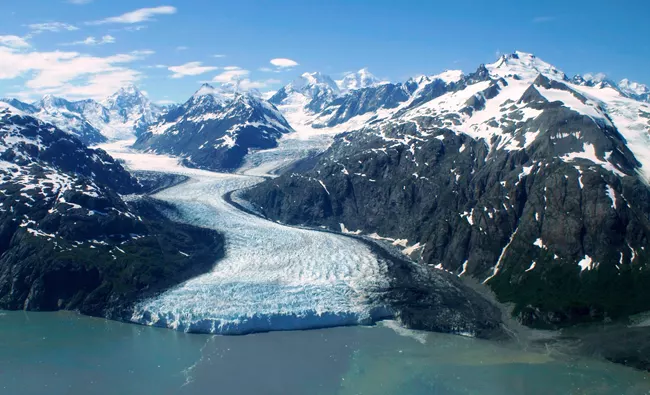
An aerial view of Margerie Glacier. The glacier begins high in the mountains and meanders down the valleys like a river of ice.  Courtesy US NPS, Glacier Bay National Park & Preserve An aerial view of Margerie Glacier. The glacier begins high in the mountains and meanders down the valleys like a river of ice.
Courtesy US NPS, Glacier Bay National Park & Preserve

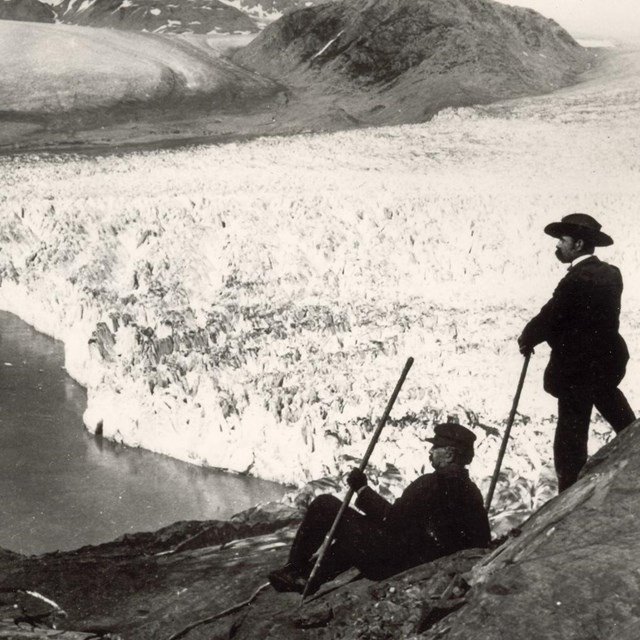
John Muir at Muir Glacier Courtesy US NPS, Glacier Bay National Park & Preserve John Muir at Muir Glacier
Courtesy US NPS, Glacier Bay National Park & Preserve

I’ve known of John Muir much of my life. A recent kayaking trip to Glacier Bay in Alaska added to my appreciation for this remarkable early American naturalist, author, and Wilderness advocate. Muir first visited Glacier Bay in 1879, where he witnessed firsthand how glaciers transform the landscape, bolstering his prescient theory of glaciology. Upon returning home, I did a bit of research on his 1877 visit to Utah. Muir was taken by the wild beauty of the Wasatch Mountains as he so eloquently expressed.

“The glacial developments of these superb ranges are sharply sculptured peaks and rests, with ample wombs between them, where the ancient snows of the glacial period were collected and transformed into ice and ranks of profound shadowy canyons, while moraines commensurate with the lofty fountains extend into the valleys forming far the grandest series of glacial monuments I have yet seen this side of the Sierra.”

In addition to Muir’s contributions to understanding how glaciers sculpt landscapes, he used his political acumen to initiate the Wilderness movement, culminating with the 1964 Wilderness Act approved by the U.S. Congress. “A wilderness, in contrast with those areas where man and his own works dominate the landscape, is hereby recognized as an area where the earth and its community of life are untrammeled by man, where man himself is a visitor who does not remain.” – written by Howard Zahniser, the principle author of the Act.

The U.S. Congress has preserved 110 million acres of the fifty states since the Wilderness Act, 1.16 million of which are found in Utah. About half are on National Forest lands, the remaining residing with the Bureau of Land Management agency. Another 3.2 million acres are managed as Roadless lands titled Wilderness Study Areas.

Other Muir quotes which champion wilderness- “Thousands of tired, nerve-shaken, over-civilized people are beginning to find out that going to the mountains is going home; that wildness is a necessity.” and “Wilderness is a necessity… there must be places for human beings to satisfy their souls.”

I’ve spent many years as a seasonal Wilderness ranger and Wilderness advocate here in N. Utah in the Naomi and Wellsville Wilderness. Managing these precious spaces to retain its wilderness character has become ever more challenging with a warmer, dryer climate enhancing wildfire, flooding, and loss to massive insect outbreaks. As Glacier Bay and Glacier National park glaciers retreat ever deeper into bays and meadows, their names may become a misnomer.

Although John Muir’s famous “Muir Glacier” had receded several miles away from where it once met the ocean, I feel blessed the few tidewater glaciers we encountered yet remain. And I feel further blessed that the U.S. Congress has seen fit to protect Utah’s wildlands by deploying the Wilderness Act- “…where the Earth and its Community of Life will remain untrammeled by man…”

Jack Greene for the Bridgerland Audubon Society, and I’m wild about Utah!

Credits:

Picture:
Audio: Courtesy & © J. Chase and K.W. Baldwin https://upr.org
Text: Jack Greene, Bridgerland Audubon, https://bridgerlandaudubon.org/
Additional Reading: Lyle W Bingham, Webmaster, and Jack Greene, Author, Bridgerland Audubon, https://bridgerlandaudubon.org/

Additional Reading:

Jack Greene’s Postings on Wild About Utah, https://wildaboututah.org/author/jack/

Glacier Bay From Above(Video), John Hopkins Inlet, Glacier Bay National Park & Preserve, US National Park Service, https://www.nps.gov/media/video/view.htm?id=C16C2BB8-1DD8-B71C-0783F58C054561C2

Fields, Lauren, Here’s what John Muir — the father of national parks —thought about early Utah, The Deseret News, Apr 20, 2018, https://www.deseret.com/2018/4/21/20643789/here-s-what-john-muir-the-father-of-national-parks-thought-about-early-utah

John Muir in Utah, Utah Stories from the Beehive Archive, Utah Humanities, https://www.utahhumanities.org/stories/items/show/180

Public Law 88-577 a.k.a. Wilderness Act, Sept 3, 1964, U.S. Government Publishing Office: https://www.govinfo.gov/content/pkg/STATUTE-78/pdf/STATUTE-78-Pg890.pdf

Biek, Bob, Willis, & Ehler, Buck, Utah’s Glacial Geology, Survey Notes, Utah Geological Survey, Utah Department of Natural Resources, September 2010, https://geology.utah.gov/map-pub/survey-notes/utahs-glacial-geology/

Hansen, Wallace R, The Geologic Story of the Uinta Mountains, Geological Survey(USGS), US Department of the Interior, 1969, 1975, 1983, https://pubs.usgs.gov/bul/1291/report.pdf

The Great Salt Lake: Important for Birds

Decreasing water levels in the southern arm of the Great Salt Lake expose microbialite communities that are normally underwater. Courtesy USGS, Hannah McIlwain, Photographer
Decreasing water levels in the southern arm of the Great Salt Lake expose microbialite communities that are normally underwater.
Courtesy USGS, Hannah McIlwain, Photographer
I first met the Great Salt Lake in 1964 with two Central Michigan University college buddies on our way to Los Angeles. We heard you could float in its magical waters. Sure enough- it worked and we bobbed in its gentle waves oblivious to the many other virtues of this extraordinary water body.

This saltwater marvel is the largest wetland area in the American West. Its 400,000 acres of wetlands provide habitat for over 230 bird species traveling from the tip of South America, north to Canada’s Northwest Territories and as far west as Siberia. These wetlands and surrounding mudflats are vital habitat for 8-10 million individual migratory birds with many species gathering at the Lake in larger populations than anywhere else on the planet.

In 1991 the Great Salt Lake was declared a site of “hemispheric importance,” the highest level of designation given to a site by the Western Hemisphere Shorebird Reserve Network. The Reserve conserves shorebird habitat through a network of key sites across the Americas. Salt Lake receives the largest percentage of the world’s population of migrating Eared Grebes, nearly one-third of Wilson’s Phalaropes, more than half of American Avocets, and 37 percent of Black-necked Stilts. The lake’s shoreline, playas and mudflats also support 21 percent of the North American breeding population of Snowy Plovers, a species identified as one of greatest conservation needs by Utah’s Wildlife Action Plan.

These shorebirds are among nature’s most ambitious, long-distance migrants. But their numbers are dropping quickly. Shorebirds are showing the most dramatic declines among all bird groups. Species that undertake hemispheric migrations rely on specific habitats and food sources to survive, but these resources are increasingly under threat from human disturbance including habitat loss and degradation, over-harvesting, increasing predation, and climate change. As humans have continued to alter the landscape, shorebird populations continue to drop, with accelerated declines in recent decades.

Of 52 shorebird species that regularly breed in North America, 90% are predicted to experience an increase in risk of extinction. This includes 28 species already considered at high risk, and 10 imperiled species that face even greater risk.

At the base of Salt Lake’s food chain are microbialites, underwater reef-like rock mounds created by millions of microbes. These structures and their microbial mats form the base of the entire Great Salt Lake ecosystem, serving as a primary food source for brine shrimp and brine flies, which are the main food source for these aquatic birds. Falling water levels exposing the microbialites to air could trigger a collapse in the lake’s food chain according to a July study by the Utah Geological Survey.

So we humans aren’t the only one’s suffering from our disappearing Lake. Thank goodness we have awakened to this extraordinary resource found on our doorstep with many organizations and agencies attempting to save what remains for our health, wealth, and for the millions of threatened feathered friends that grace our skies, and our lives. Last May, Utah Governor Cox declared 2021 the year honoring shorebirds. We can do our part by taking action on conserving water and energy.

Jack Greene for Bridgerland Audubon Society and I’m wild about Utah and its magnificent great lake.

https://youtu.be/xv07VnQnlOY

Credits:

Picture:
Audio: Courtesy & © Kevin Colver https://wildstore.wildsanctuary.com/
Text: Jack Greene, Bridgerland Audubon, https://bridgerlandaudubon.org/
Additional Reading: Lyle W Bingham, Webmaster, and Jack Greene, Author, Bridgerland Audubon, https://bridgerlandaudubon.org/

Additional Reading:

Jack Greene’s Postings on Wild About Utah, https://wildaboututah.org/author/jack/

Strand, Holly, Important Bird Areas, Wild About Utah, October 21, 2008, https://wildaboututah.org/important-bird-areas/

Strand, Holly, One of the World’s Largest Shrimp Buffets, Wild About Utah, June 3, 2008, https://wildaboututah.org/one-of-the-worlds-largest-shrimp-buffets/

Chambless, Ross, When the Great Salt Lake we know is gone, what shall we name it?, Commentary, The Salt Lake Tribune, August 19, 2021, https://www.sltrib.com/opinion/commentary/2021/08/19/ross-chambless-when-great/ [Accessed September 19, 2021]

Shorebirds are among nature’s most ambitious, long-distance migrants. Western Hemisphere Shorebird Reserve Network (WHSRN), https://whsrn.org/about-shorebirds/shorebird-status/

Drought Negatively Impacting Great Salt Lake Microbialites and Ecosystem, Utah Geological Survey (UGS), Utah Department of Natural Resources, State of Utah, July 15, 2021, https://geology.utah.gov/drought-negatively-impacting-great-salt-lake-microbialites-and-ecosystem/

Chidsey, T.C., Jr., Eby, D.E., Vanden Berg, M.D., and Sprinkel, D.A., 2021, Microbial carbonate reservoirs and analogs
from Utah: Utah Geological Survey Special Study 168, 112 p., 14 plates, 1 appendix, https://doi.org/10.34191/SS-168

Riding, Robert, Definition: Microbialites, Stromatolites, and Thrombolites, Encyclopedia of Geobiology, SpringerLink, Springer Nature Switzerland AG. Part of Springer Nature., https://link.springer.com/referenceworkentry/10.1007%2F978-1-4020-9212-1_196

Romero, Simon, Booming Utah’s Weak Link: Surging Air Pollution, The New York Times, Sept. 7, 2021, https://www.nytimes.com/2021/09/07/us/great-salt-lake-utah-air-quality.html

2015–2025 Wildlife Action Plan, Division of Wildlife Resources, Department of Natural Resources, State of Utah, July 1 2015, https://wildlife.utah.gov/discover/wildlife-action-plan.html

Governor Cox Declares 2021 as Year of the Shorebird at Great Salt Lake, Declaration celebrates 30th anniversary of Great Salt Lake as a Western Hemisphere Shorebird Reserve Network Site, Western Water News, National Audubon, May 12, 2021, https://www.audubon.org/news/governor-cox-declares-2021-year-shorebird-great-salt-lake
See also: https://wildlife.utah.gov/news/utah-wildlife-news/1182-cox-declares-2021-year-of-shorebird-great-salt-lake.html

Gov. Cox Issues Drought Executive Order, Governor.utah.gov, March 17, 2021, https://governor.utah.gov/2021/03/17/gov-cox-issues-drought-executive-order/


Written by Hall Crimmel & Dan Bedford, Filmed and Edited by Isaac Goeckeritz, iUtah EPSCor, Rachel Carsen Center Environment & Society,
Based on the book Desert Water; The Future of Utah’s Water Resources edited by Hall Crimmel and published by University of Utah Press, 2014

Carney, Stephanie, Vanden Berg, Michael D., GeoSights: Microbialites of Bridger Bay, Antelope Island, Great Salt Lake, Survey Notes, Utah Geological Survey, State of Utah, January 1, 2022, https://geology.utah.gov/map-pub/survey-notes/geosights/geosights-microbialites-of-bridger-bay-antelope-island-great-salt-lake/

Salt Lake Brine Shrimp, https://saltlakebrineshrimp.com/harvest/

Williams, Terry tempest, Opinion, I Am Haunted by What I Have Seen at Great Salt Lake, The New York Times,, March 25, 2023, https://www.nytimes.com/2023/03/25/opinion/great-salt-lake-drought-utah-climate-change.html

Williams, Terry tempest, Opinion, I Am Haunted by What I Have Seen at Great Salt Lake, The New York Times,, March 25, 2023, https://www.nytimes.com/2023/03/25/opinion/great-salt-lake-drought-utah-climate-change.html

Birch Creek Beaver Restoration

Lush Green Meadows created by beaver activity on Birch Creek above the Wilde ranch near Preston, ID Courtesy & © Mary Heers, Photographer
Lush Green Meadows created by beaver activity on Birch Creek above the Wilde ranch near Preston, ID
Courtesy & © Mary Heers, Photographer

Cascading Reservoirs created by beaver activity on Birch Creek above the Wilde ranch near Preston, ID Courtesy & © Mary Heers, Photographer Cascading Reservoirs created by beaver activity on Birch Creek above the Wilde ranch near Preston, ID
Courtesy & © Mary Heers, Photographer

When Jay Wilde graduated from Preston High School in 1963, he took off to see the world. Thirty years later he came back, bought out his siblings, and moved into the family homestead in the hills above Preston, Idaho. He had acres of pasture and two hundred mother cows. But one thing was missing. Water. Birch Creek, which had run year round when he was growing up, now dried up in June. Hiking up to the headwaters, past his deeded property and into the National Forest, Jay found something else was missing. There was no sign of the beavers he remembered seeing there in his childhood. Now there were no beaver dams to slow down the flow of melting snow, and rainfall, spread it out into tiny reservoirs, and most importantly, no way to allow the surface runoff to filter down into the ground water.

On his own dime, Jay got some beavers and released them in the mountain headwaters of Birch Creek. Nothing happened. A year passed. The beavers were gone.

But help was on the way.

Enter Joe Wheaton, a beaver specialist at Utah State University. Joe bought a truckload of poles and recruited some student volunteers. Up the canyon they went, pounding poles into the streambed and weaving a few branches between the poles. Hopefully these structures would become “kick starter dams” for the next try at releasing beavers.

In 2015 five beavers were released. The beavers took one look at the kick starter dams and decided these dams suited them fine. They moved in and went to work.

After a few years, Jay and Joe checked the beaver’s progress. They found a thriving beaver community, and counted over 12 dams. The beavers seemed to be marching to Joe’s mantra for controlling spring runoff: “Slow it. Spread it. Stow it.”

And now, for the latest update to this story.

Earlier this month I was allowed to tag along with Jay and Joe and two others as they tramped up to the headwaters of Birch Creek. We found a watery paradise. Melting snow was trickling over and around the dams, cascading down into deep pools, and spreading out into lush green meadows. There were too many dams to count, but Joe said over 200. Jay smiled and said down below Birch Creek was running 40 more days.

And I – I just burst into song!

This is Mary Heers, and I’m Wild About Utah.

Credits:
Photos: Courtesy & Copyright © Mary Heers
Featured Audio: Courtesy Friend Weller, Utah Public Radio
Text & Voice: Mary Heers
Additional Reading: Lyle Bingham, Webmaster

Additional Reading

Wild About Utah, Mary Heers’ Postings

Leavitt, Shauna, Beaver–Helping Keep Water on Drying Lands, Wild About Utah, April 17, 2017, https://wildaboututah.org/the-beaver-helping-keep-water-on-drying-lands/

Hellstern, Ron, Leave it to Beaver, Wild About Utah, July 30, 2018, https://wildaboututah.org/leave-it-to-beaver/

Heers, Mary, Beaver Tail Strike, Wild About Utah, December 27, 2021, https://wildaboututah.org/beaver-tail-strike/

Heers, Mary, Beaver Tail Slap, Wild About Utah, October 12, 2020, https://wildaboututah.org/beaver-tail-slap/
Leavitt, Shauna, Proposed Beaver Holding Facility in Millville, Utah, Wild About Utah, September 3, 2018, https://wildaboututah.org/proposed-beaver-holding-facility-in-millville-utah/

Leavitt, Shauna, Beaver in Utah’s Desert Rivers, Wild About Utah, July 6, 2020, https://wildaboututah.org/beaver-in-utahs-desert-rivers/

Strand, Holly, Beavers: The Original Army Corps of Engineers, Wild About Utah, August 16, 2012, https://wildaboututah.org/beavers-the-original-army-corps-of-engineers/

Bingham, Lyle, Welcoming Rodent Engineers, Wild About Utah, February 7, 2022, https://wildaboututah.org/welcoming-rodent-engineers/

Randall, Brianna, How Beavers Boost Stream Flows, National Wildlife Federation, January 8, 2020, https://blog.nwf.org/2020/01/how-beavers-boost-stream-flows/

Goldfarb, Ben, Eager: The Surprising, Secret Life of Beavers and Why They Matter, Chelsea Green Publishing, March 8, 2019, https://www.amazon.com/Eager-Surprising-Secret-Beavers-Matter/dp/1603589082/ref=asc_df_1603589082/