Grizzly Bear Courtesy Pixabay Angela AMBQuinn, ContributorLadies and gentlemen, boys and girls, the puppet show is about to begin!
It was Pioneer Day in Mendon, and the puppeteer’s loud cry brought the little kids running to the puppet theater on the town square. They settled down on the grass in a hushed silence as the narrator began:
This is a true story. It took place in early pioneer days in Mendon about 130 years ago.
And now introducing: the bravest man in Mendon, Tom Graham. He was so brave he would grab a rattlesnake by the neck and spit tobacco juice right down its throat.
A hidden water pistol shot a stream of water out into the audience, which caused some oohs and ahhs in the front row.
The Tom Graham puppet took a bow and disappeared
And now introducing: the biggest and baddest bear in Cache Valley at the time, The Big Slough Grizzly!
The puppeteers booed loudly. If there was any doubt that the bear puppet was the villain in the story, these doubts soon disappeared.
A small wooly lamb popped up and the bear pounced on it. Baaaaa went the lamb as it sank out of sight. The same thing happened to a calf and a small pink pig.
It was time for the hero, Tom Graham to take action.
Tom and another puppet popped up. Let’s go find that bad bear, Tom said.
They bobbed across the stage in single file, looking at the ground. Then they saw a bear paw print and they jerked back.
It’s 8 inches wide! And 12 inches long!! Not counting the claw!!!
We need to go get help, they said as they ran off the stage
In the meantime, Tom went down to the watery sloughs below Mendon to get some firewood. Bad luck. He ran right into the Big Slough Grizzly. The bear took a mighty swing at Tom and knocked his head right off his shoulders!
Now the Tom puppet was made out of a leg of panty hose. So Tom’s long neck stretched out a good two feet as his head flew out over the audience before snapping back and disappearing.
This caused quite a sensation in the audience. In fact, I used to judge the success of each show by how high the kids came off their seats.
But the story wasn’t over. After Tom lost his head, every man in Mendon picked up his rifle and headed for the slough. They found the bear’s den. Two very brave men stepped into the entrance and got a couple shots off. The bear did not come out.
Another man pushed his old flea bitten mare up to the entrance. This brought the bear out. The men opened fire.
It got really noisy as two young boys in the puppet theatre shot off their cap pistols like mad. The Big Slough Grizzly keeled over and sank out of sight. That was the end of the story.
This is Mary Heers, puppeteer (now retired), bringing you this Pioneer Day true bear story for Wild About Utah.
Underpass and Jump Ramp Near Santaquin WMA Courtesy & Copyright Lyle Bingham, Photographer
Rural Road Leading to Santaquin Wildlife Management Area Courtesy & Copyright Lyle Bingham, PhotographerDeer and other wildlife have been migrating across our state much longer than humans. When people drove horse-drawn wagons and slower vehicles, wildlife could easily pass without a problem. However, with the introduction of fenced highways and their increased speed and traffic, problems quickly arose. In this case, the problem is mostly with mule deer, because they comprise 90% of the animals migrating in Utah. Robert Frost wrote that “Good fences make good neighbors.” But neighbors need to cooperate to maintain a fence, and even with fences in place, what if the neighbors are animals? The problem is how to keep migrating deer from jumping fences and causing accidents.
Animal/vehicle encounters cause over 5,000 animal deaths in Utah each year. Beyond the loss of life, it is also an economic problem, not only for wildlife management but also for vehicle owners. Some estimate the deer are worth more than $2,500 each. Joshua Coursey wrote in the Deseret News, that the “estimated cost of collisions with mule deer in Utah reached close to $50 million in 2021.” That’s why the Utah Department of Transportation (UDOT) and the Division of Wildlife Resources (DWR) have worked for decades to reduce wildlife/vehicle encounters. As noted, fencing alone does not work; consequently, highway managers have had to find ways to get trapped deer across and away from fenced roads.
When USU researchers studied escape mechanisms in Sardine canyon, they found earthen escape mounds were superior to one-way, metal gates. Climbing a hill is more natural to deer than pushing through a metal gate. These mounds enable a one-way jump to safety. However, escape alone does not solve the driving force of migration.
A more effective way to handle migrating animals is to guide them above or below the road. UDOT explains: “Studies have shown there is a 90% reduction in wildlife/vehicle collisions when there is a crossing structure and fence in the area.” Since 1975, when UDOT built its first wildlife overpass near Beaver, Utah, deer, moose and elk, along with bear and mountain lions have begun to use wildlife underpasses and overpasses. More recently, a larger overpass was built in Parley’s Canyon on I-80. Videos show a variety of animals who successfully traverse that overpass.
But escape ramps and overpasses aren’t the only tools available. Passage is also possible using creek beds or culverts crossing under roads. Tall fences are effective in guiding animals toward structures and preventing roadway access. Then, to encourage faster adoption, contractors have found they can walk a herd of cattle through the structure, overpowering human scents
When on I-15, I-80, I-70, or in our canyons, watch for overpasses, underpasses, one-way gates and exit ramps. They demonstrate a few ways the DWR and UDOT are working together to preserve human and animal lives.
This is Lyle Bingham, and I’m Wild About Utah and our 15 years on Utah Public Radio.
Buford, Daniel, Cramer, Patricia, and Simpson, Nova, Integrating Wildlife Connectivity and Safety Concerns into Transportation Planning Processes, Federal Highway Administration, US Department of Transportation, Winter 2023, https://highways.dot.gov/public-roads/winter-2023/04
“A dynamic part of a National Cooperative Highway Research Program sponsored research project titled; ‘Evaluation of the Use and Effectiveness of Wildlife Crossings.'”, https://www.wildlifeandroads.org/
DWR: “It’s the video seen around the world! This compilation of footage shows various animals using the wildlife crossing constructed in 2018 over Interstate 80 near Parleys Summit. What’s especially notable with this crossing is how many animals are already using it; usually it takes several years for wildlife crossings to become widely used.
This video went viral near the end of 2020, and was celebrated as great progress in the problem of wildlife-vehicle collisions. Special thanks to the Utah Division of Wildlife Resources, Utah Department of Transportation and Summit County for the footage.” https://wildlifemigration.utah.gov/stories/parleys-summit-wildlife-crossing/
UDOT: Baker Canyon Wildlife Crossing Installation
DWR: “Utah’s highways are vital to the health of the state. They can present a significant barrier for wildlife migration. In order to prevent automobile/wildlife collisions and to increase habitat availability for animals, Wildlife biologists and the Utah Department of Transportation have designed and installed several overpasses and underpasses to allow wild animals to safely cross the highway.”
Then, finally, with some legislative action and a big boost from record snow and rain, the water level began to rise. The marina on the southern tip of the lake opened up.
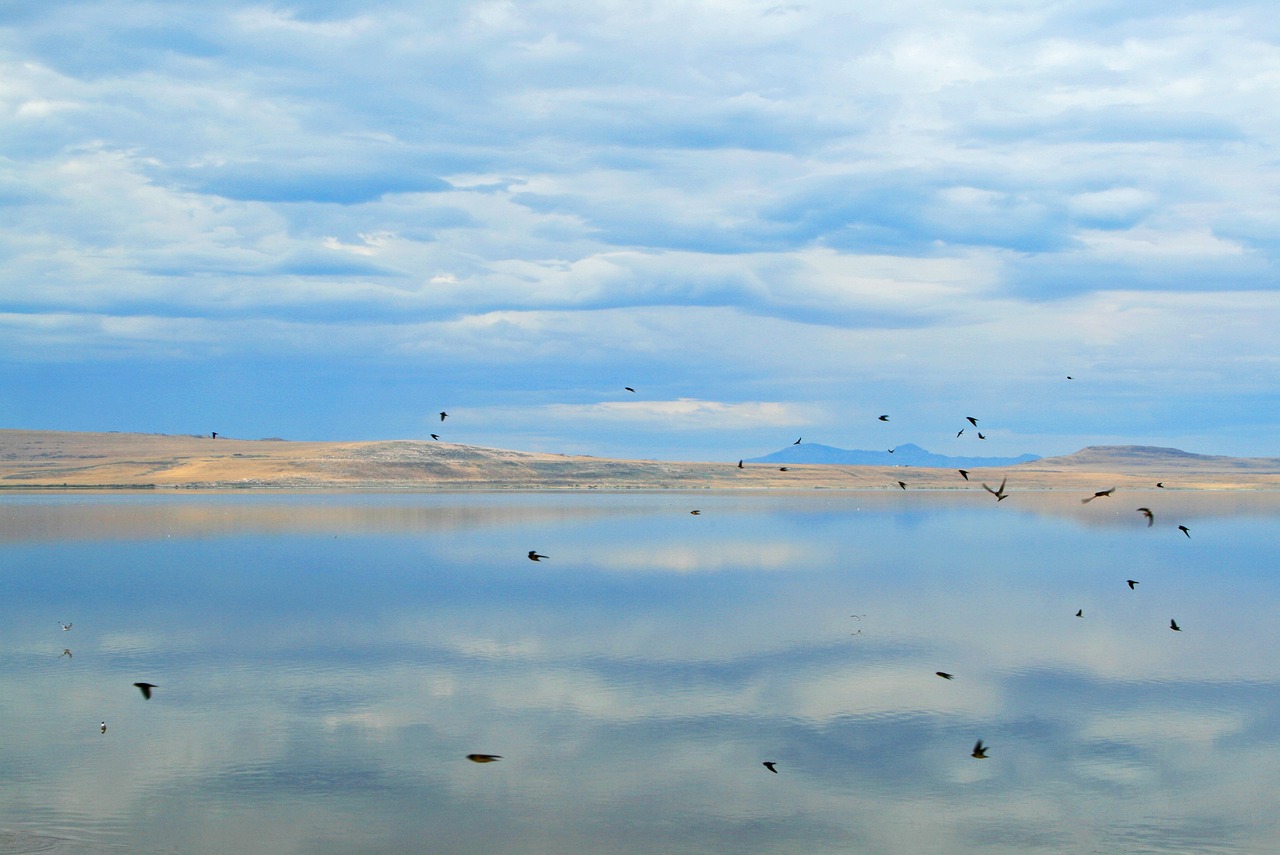
I grabbed the chance to take a boat ride out onto the lake. The water was calm and smooth and Fremont Island loomed large ahead. We were the only boat out there.
Ah, I thought, this is a lot like Kit Carson and John Fremont must have seen the island when they paddled up to it in 1843.
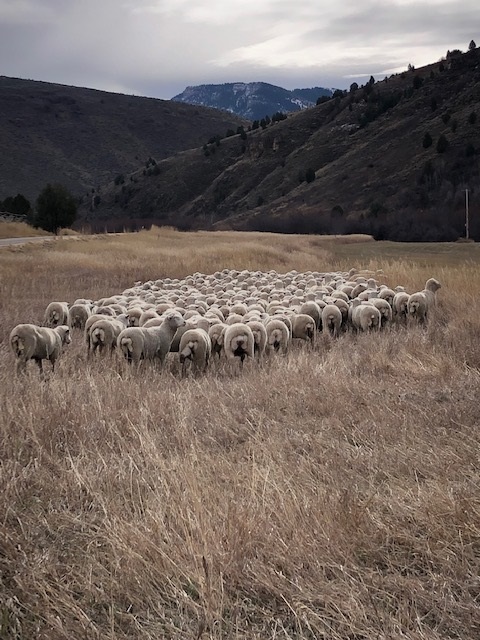
The boat operator told us some early history of the island. In 1859 two brothers, Henry and Daniel Miller, took 153 sheep out to the island and left them there. It seemed ideal – plenty of grass, adequate fresh water’ and no wild beasts. So, no need to leave a herder.
The brothers returned periodically to shear the sheep. They also built two huge vats, lit a fire of sagebrush under them, and boiled the lake water down to salt.
Business was good. Boatloads of salt were sold to the silver mines in Montana who needed it in their operations. The excess lambs were taken to market and sold.
By now the sheep, left alone on the island for long stretches of time, were becoming wild as deer. One roundup, some sheep were so determined not to get caught that they took off swimming away from the island. They were still going when they disappeared over the horizon.
But the story really took a turn when a judge from Salt Lake, Uriah Wenner, took advantage of the Desert Land Act intended to encourage irrigation and farming in the west. He filed a claim on the island and evicted the sheep. It was 1885, and Jacob Miller, now in charge of the Miller family sheep operation on the island was a polygamist “in hiding.” He didn’t dare go to court to challenge the claim.
As the last of the sheep were taken off the island, they were placed in the custody of an experienced herder. The herder was just beginning to cook his breakfast in his hut.
“You’d better watch these sheep,” he was warned.
“Don’t tell me how to herd sheep,” said the herder.
He finished his breakfast. When he came out of his hut, the sheep were gone.
The story ended, but the best was yet to come. The boat stopped and my husband and I slid into the water off the back of the boat.
Gleefully we bobbed around like corks. It was impossible to sink. I flipped on my back and stretched out. It would have been easy to doze off. Buoyancy at its best.
The current salinity of the Great Salt Lake is 16%. That’s just about halfway from the oceans at 3½ and the saltiest water on earth – the Dead Sea at 33%
The Great Salt Lake is our unique treasure. But it’s future is still at risk. Will we keep it or lose it?
Seymour Miller’s Account of an Early Sheep Operation on Fremont Island (Edited by David H. Miller and Anne H. Eckman,) Utah Historical Quarterly, Volume 56, Number 2, 1988, Utah State History, https://issuu.com/utah10/docs/uhq_volume56_1988_number2/s/157386
Death Camas Courtesy USDA Forest Service C. Webber, PhotographerI just returned from southern Indiana, another “Land of Lincoln” where I visited a beautiful monument featuring Abraham Lincoln’s early life on a farm carved from the Indiana wilderness. In 1818, Abe’s “angel mother” as he described her, suffered a violent death called milk sickness. Further reading on the interpretive sign told how a plant called white snakeroot had a toxin, which was transferred to the milk and meat when ingested by livestock.
Of course, we have our toxic plants here in Utah as well. One that is reported to have caused death in humans and livestock is the foothill death camas, one of a few extremely toxic plants found in our area, and a very common early spring plant throughout much of Utah’s foothills.
Death camas plants include several species of Zigadenus. At least 15 species are native to North America and grow in all kinds of habitats: moist mountain valleys, dry hills, forest, grassland, and even coastal and marsh areas. There may be some variation in toxicity level from one species to the next, but ALL should be considered dangerous.
I became aware of this beautiful member of the lily family when one of my more adventuresome students shared his story. As a 10 year old, he decided to experiment by eating some of the foothill death camas. Soon after he was rushed to the ER to have his stomach pumped. He reported there was no further experimentation!
Symptoms of poisoning by death camas include vomiting and excessive salivation, tremors, weakness, loss of control over body movements, convulsions, and coma. Ultimately, an animal that has eaten too much will die. A half pound consumed can be fatal to livestock.
It is possible to mistake death camas for the edible blue camas lily, sego lily, and wild onions, all of which were an early staple of native Americans and pioneers. More recently, some unfortunate railroad workers died shortly after eating the bulbs. Eight adults ingested foothill death camas (Zigadenus paniculatus) bulbs in Juab County, Utah, believing them to be nontoxic wild bulbs. All who ingested the bulbs became ill, and three of them required admission for medical treatment.
The probable fatal dose, extrapolated from animal data, ranges from less than one-tenth pound (four-five bulbs) for a young child to a pound for an adult. Other parts of the plant such as nectar and seeds are also highly toxic. Atropine and dopamine are treatments. Poisoned individuals become relatively asymptomatic within 24 hours of their ingestion. No long-term symptoms have been reported.
As with most all toxic plants, they have medicinal properties as well. The death camas root can reduce swollen knees and leg aches. Use with caution!!
Jack Greene for Bridgerland Audubon Society, and I’m wild about Utah and it’s poisonous plants.
Panter, K.E., M.H. Ralphs, J.A. Pfister, D.R. Gardner, B.L. Stegelmeier, S.T. Lee, K.D. Welch, B.T. Green, T.Z. Davis, and D. Cook. 2011. Plants Poisonous to Livestock in the Western States. U.S. Department of Agriculture, Agriculture Bulletin No. 415. https://www.ars.usda.gov/is/np/poisonousplants/poisonousplants.pdf