Blackbirds in Our Wetlands

Blackbirds in Our Wetlands
Male Red-winged Blackbird
Photo Courtesy US FWS
George Gentry, Photographer

Hi, this is Mark Larese-Casanova from the Utah Master Naturalist Program at Utah State University Extension.

Now that spring finally seems to be arriving here in Utah, marshes, ponds, and other wetlands have sprung to life. It’s impossible to walk by a wetland without seeing countless birds rushing about collecting nest material, feeding, or advertising and defending territories.

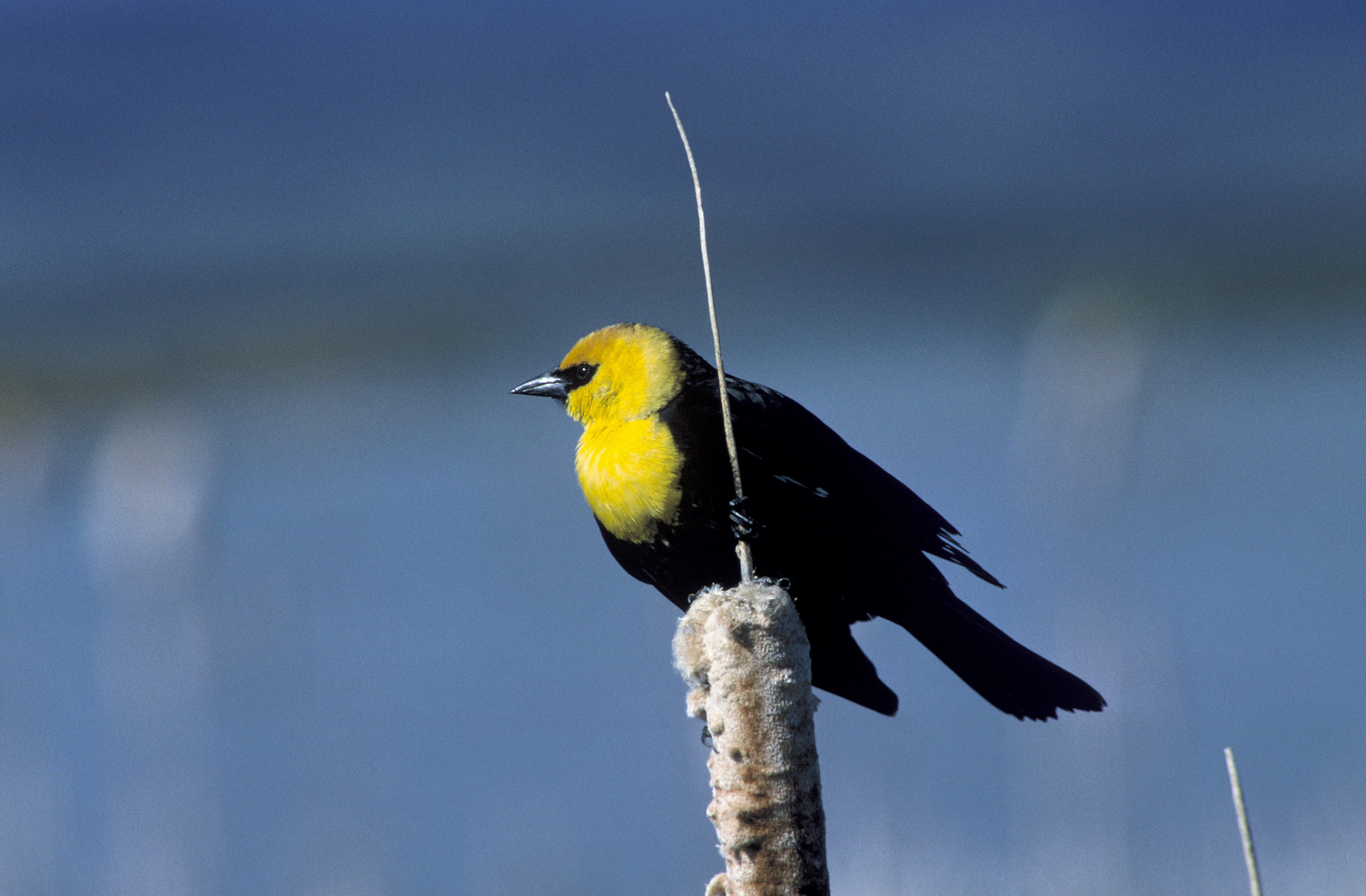
Two birds most commonly seen and heard in Utah’s wetlands are the red-winged blackbird [Red-winged Blackbird call, © Kevin Colver]and yellow-headed blackbird[Yellow-headed Blackbird call, © Kevin Colver]. As their names suggest, both are black birds a little smaller in size than a robin. The red winged blackbird has a red shoulder with a yellow bar below, and the yellow-headed blackbird has a bright yellow head.

Both the red-winged and yellow-headed blackbirds eat the same foods, which primarily include insects during the summer, and seeds at other times of the year. They also both prefer to nest in stands of cattails, bulrush, or other wetland plants emerging from standing water. So, how is it that two very similar species of birds can coexist with the same habitat preferences?

Male Yellow-headed Blackbird
Photo Courtesy US FWS
Dave Menke, Photographer

Well, competition and exclusion might be better descriptions than coexistence. While the red-winged blackbird can successfully nest in a variety of habitats near wetlands, the yellow-headed blackbird specializes in nesting in the emergent wetland plants. This could be a disadvantage for the yellow-headed blackbird if it wasn’t for the fact that it typically nests in groups, or colonies, and are better able to defend a territory from intrusion by the more solitary nesting red-winged blackbird. So, in wetlands where only red-winged blackbirds occur, they are able to nest in the preferred habitat. But, when yellow-headed blackbirds are present, they force the red-wings to nest in less suitable habitat, even in tall trees far away.

While red-winged blackbirds can often be seen year-round in Utah, the yellow-headed blackbird is usually only here for the summer breeding season. So, think of it as if we were red-winged blackbirds and our distant, out-of-state cousins came to visit for the summer. They get the most comfortable beds in the house, and they eat all of our favorite foods. But, come the end of summer, they head back south, and we can enjoy our homes to ourselves.

To see photos of the two blackbirds mentioned in this program, please visit wildaboututah.org.

For Wild About Utah, I’m Mark Larese-Casanova.

Credits:

Audio: Blackbird calls courtesy and Copyright Kevin Colver https://wildstore.wildsanctuary.com/collections/special-collections
https://wildstore.wildsanctuary.com/collections/special-collections
Images: Courtesy US FWS: https://Images.fws.gov
Text:     Mark Larese-Casanova, Utah Master Naturalist Program at Utah State University Extension.

Additional Reading:

Miller, R. S. 1968. Conditions of Competition Between Redwings and Yellowheaded Blackbirds. Journal of Animal Ecology, Vol. 37, No. 1 (Feb., 1968), pp. 43-62.

Minock, M. E., and Watson, J. R. Red-Winged and Yellow-Headed Blackbird Nesting Habitat in a Wisconsin Marsh. Journal of Field Ornithology, Vol. 54, No. 3 (Summer, 1983), pp. 324-326.


Owls and iPods

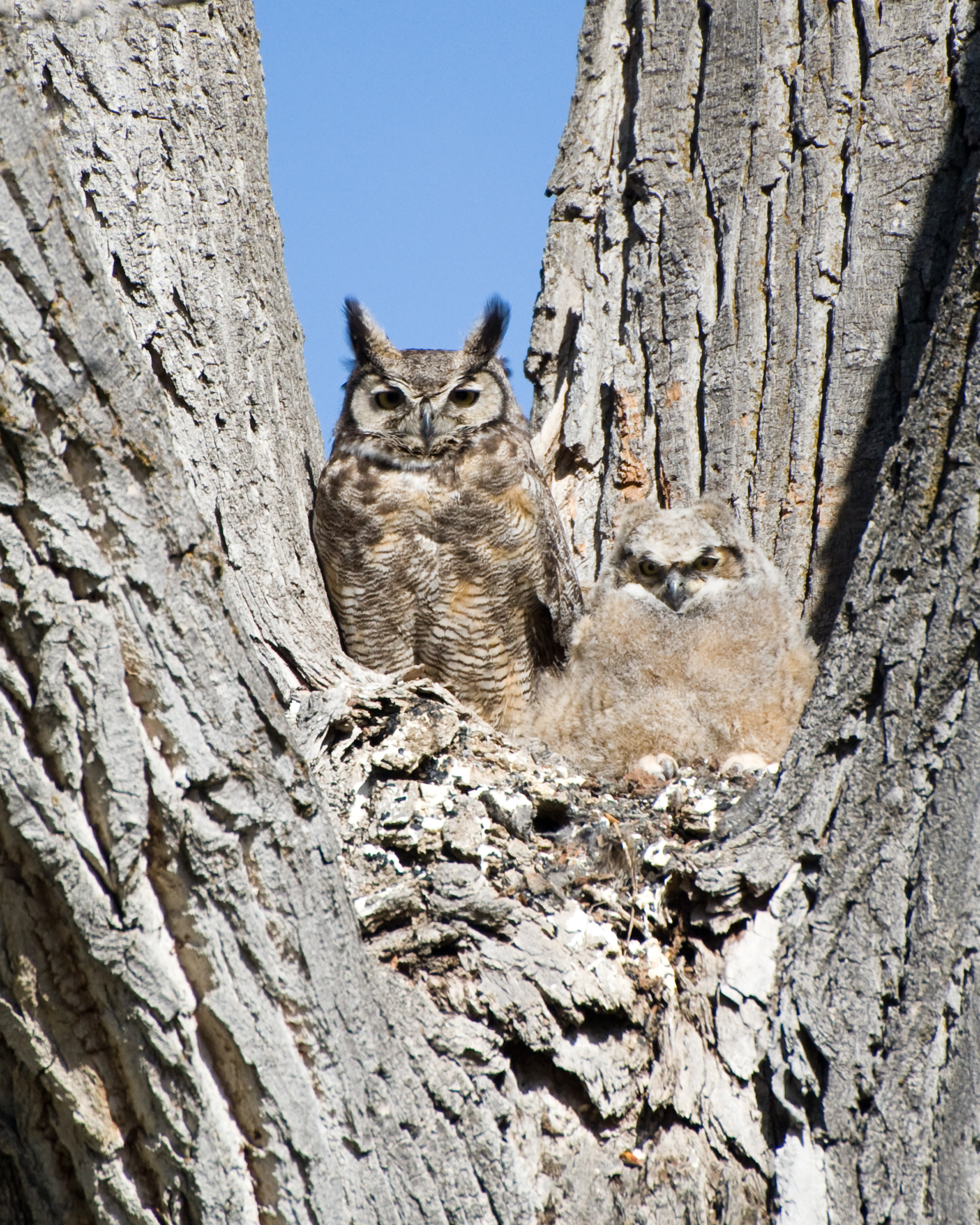
Great Horned Owl and Chick, Courtesy US FWS Digital Library, George Gentry Photographer
Great Horned Owl and Chick
Photographer: George Gentry
US FWS Digital Library

Hi I’m Holly Strand.

In early spring, my friends and I went owling in a northern Utah canyon. We were hoping for modest success—just to see or hear a northern pygmy or great horned owl — both common owls in our area.

To better the odds we brought an iPod with prerecorded owl sounds. We played the northern pygmy call for 20-30 second intervals and listened intently in between intervals.

After 10 minutes of off-and-on playbacks we heard an answering call from a nearby conifer grove. We were ecstatic that we had made contact with an actual owl. But wait! Was it an owl we heard or just another iPod user?

Pygmy Owl, Courtesy US FWS Digital Library, Bob Miles Photographer
Pygmy Owl
Photographer: Bob Miles
US FWS Digital Library

According to David Sibley, author of the Sibley Guide to Birds, the proliferation of digital audio devices and recorders among birders has both pluses and minuses. On the plus side, you can often entice certain birds out of hiding using playbacks. For example, if a territorial male thinks a rival bird is threatening to encroach on its territory, he may come out to confront the intruder. Or he may sing his “I’m Here, So Stay Away” song. A female bird might approach the recording source as a potential date. Using playbacks, you can target specific species to see or hear without disturbing others.

On the flip side, overuse of these playback devices can cause unnecessary stress and distraction in the target birds—and annoyance among other birders. In one study, the use of playbacks upset the avian apple cart by causing high-ranking black- capped chickadee males to lose status. The rest of the flock perceived them as losers as they were unable to drive away an unwanted phantom intruder.

Because the widespread use of recorded playbacks is relatively new, proper etiquette is still evolving. But here are some key points.

  • Keep the volume low and use only occasional snippets of sound—less than 30 seconds at a time. Leave a long pause between snippets. Definitely do not broadcast loud or continuous sound.
  • It is illegal to disturb endangered or threatened species. And these recordings can be interpreted as disturbance. So stick with sounds of non-threatened species.
  • Finally, check the rules at your birding location. The use of playback is prohibited in some parks and refuges.

For source material and websites with bird sound recordings, go to www.wildaboututah.org.

For Wild About Utah, I’m Holly Strand.

Credits:

Photos: Courtesy US FSW Digital Media Library
Text: Holly Strand

Sources & Additional Reading:

Sibley, David. 2011. The Proper Use of Playback in Birding. Sibley Guides: Identification of North American birds and trees. https://www.sibleyguides.com/2011/04/the-proper-use-of-playback-in-birding/ [Accessed May 19, 2011]

Recordings:

Soundscapes for Birders by Kevin Colver https://wildstore.wildsanctuary.com/collections/special-collections

https://www.xeno-canto.org/ shared bird sounds from the whole world

Beletsky, Les, editor. 2010. Bird Songs Bible: The Complete, Illustrated Reference for North American Birds Contains digital audio player.

Ipods and mp3 apps:

iBird https://www.ibirdexplorer.com

Audubon Birds Field Guide https://www.audubonguides.com/field-guides/mobile-apps.html

The Sibley eGuide to the Birds of North America https://www.mydigitalearth.com

Sage Grouse, Pronghorn Antelope and Fences

Sage Grouse, Pronghorn Antelope and Fences: Greater Sage Grouse, Courtesy US FWS, images.fws.gov, Stephen Ting, Photographer
Greater Sage Grouse
Courtesy US FWS
Stephen Ting, Photographer

As Robert Frost famously wrote in his poem, Mending Wall, “Good fences make good neighbors”.

Fences keep livestock from crops, children from traffic and delineate boundaries. In the intermountain West, fences are important to keep livestock where we want them and away from where we don’t. But wildlife of open sagebrush habitat did not evolve with fences. Sage Grouse and Pronghorn Antelope have had a particularly difficult time adapting.

Sage Grouse are stout, chicken-like birds found only in sagebrush, whose foliage features prominently in their diet. Sage Grouse were once abundant, but their numbers have plummeted due to habitat loss. Today they are candidates for listing as an endangered species. In flight, these large bodied birds like to skim over the sagebrush canopy and so doing, careen right into fences. One Utah study attributed 1/5 of Sage Grouse deaths to fence collisions.

[Kevin Colver recording: https://wildstore.wildsanctuary.com/collections/special-collections]

Pronghorn
Courtesy US FWS
James C. Leupold, Photographer

At dawn during the spring, male Sage Grouse congregate on ancestral dancing grounds to attract mates. The birds fly to these lek areas before sunrise so may not be able to see a fence before they collide. Other areas of special concern include the crest of low hills and the midst of wide open flats. Where grouse are common, flagging a fence or otherwise making it more visible can help considerably to reduce airborne fence collisions.

For Pronghorn Antelope, however, the top of the fence is not the issue. They are the swiftest game animal in North America. As with bison, market hunting in the 19th century decimated their populations. This trend has reversed, but here also, fences are a problem. Pronghorn are sprinters, not hurdlers and rarely jump a barrier over 3 feet tall. They choose to go under or through fencelines. A simple solution for barbed wire fences is to string smooth wire for the bottom strand at least 18 inches above the ground. This simple fence fix enables pronghorns to scoot below the fence unscathed as they migrate between winter and summer grounds

The perspective of Pronghorn Antelope and Sage Grouse could be summed up in the lyrics from a Cole Porter song: Don’t fence me in.

This is Linda Kervin for Bridgerland Audubon Society.


Credits:

Photos: Courtesy US FWS: Images.fws.gov
Audio: Kevin Colver, https://wildstore.wildsanctuary.com/collections/special-collections
Text: Linda Kervin, Bridgerland Audubon Society
Additional Reading:

Resources:

Lives of North American Birds. Kenn Kaufman. 1996, Houghton Mifflin Company., https://www.amazon.com/American-Peterson-Natural-History-Companions/dp/0395770173

Don’t Fence Me In: If sage-grouse had a song it would be “Don’t Fence Me In”, USDA Natural Resource Conservation Service, https://www.mt.nrcs.usda.gov/technical/ecs/biology/sagegrouse/dontfence.html

Safer Fencing Can Help Save Western Birds, Environmental Defense Fund, https://www.edf.org/article.cfm?contentID=9126

Owl Vision

Barn Owl Sleeping in a Tree
Copyright © 2010 Mike Fish

Hi I’m Holly Strand.

Great-horned and other nocturnal owls have phenomenal nighttime vision. In some respects—they see much better by night than we can by the light of the sun. The visual acuity of owls springs from a number of interesting adaptations.

Of course you’ve noticed that owls have big eyes. If our eyes were in the same proportion to the size of our head, they would be the size of grapefruits! Large owl corneas and lenses help maximize the amount of light received by the retina.

There are two types of photo receptors in the retina. Cones operate in bright light and give fine detail and color vision. Rods work with much less light but compromise somewhat on detail and color. Owl eyes contain considerably more rods than cones while the eyes of daytime animals–like us –contain many more cones than rods.

Great Horned Owl
Copyright © 2010 Mike Fish

Owls –and other nocturnal creatures—have a mirror-like structure behind the retina called a tapetum. Light passes through the rods and cones, strikes the tapetum and is reflected back through the eye to the light source. The tapetum ensures that any light unabsorbed by receptor cells is reflected back through the eye. This gives the receptor cells a second chance at stimulating the rods.

Owls, like most predators, have eyes positioned forward on the face and looking in the same direction. The resulting binocular vision gives the owl a three dimensional perspective. By accurately sensing depth, the owl can zero in on a tasty little mouse scurrying across a field and make adjustments on the wing as it closes in for a kill. To help triangulate even more precisely, owls will often bob or weave their heads to get several viewpoints of an object.

Finally, because of their unique eye structure, owls cannot move their eyes within the sockets. No worries! The owl just moves its whole head instead. On an exceptionally mobile neck, an owl head can rotate at least 270 degrees from side to side and 90 degrees up and down.

For some great pictures of owls and their enigmatic eyes, go to www.wildaboututah.org

For Wild About Utah, I’m Holly Strand.

Credits:

Photos: Courtesy and Copyright 2010 Mike Fish

Text: Holly Strand

Sources & Additional Reading:

Cornell Lab of Ornithology. https://www.birds.cornell.edu/

Utah Division of Wildlife Resources. Utah Conservation Data Center. https://dwrcdc.nr.utah.gov/ucdc/

Scholz, Floyd. 2001. Owls. Mechanicsburg PA: Stackpole Books

Sparks, John and Tony Soper. 1989. Owls: Their Natural and Unnatural History. NY: Facts on File.