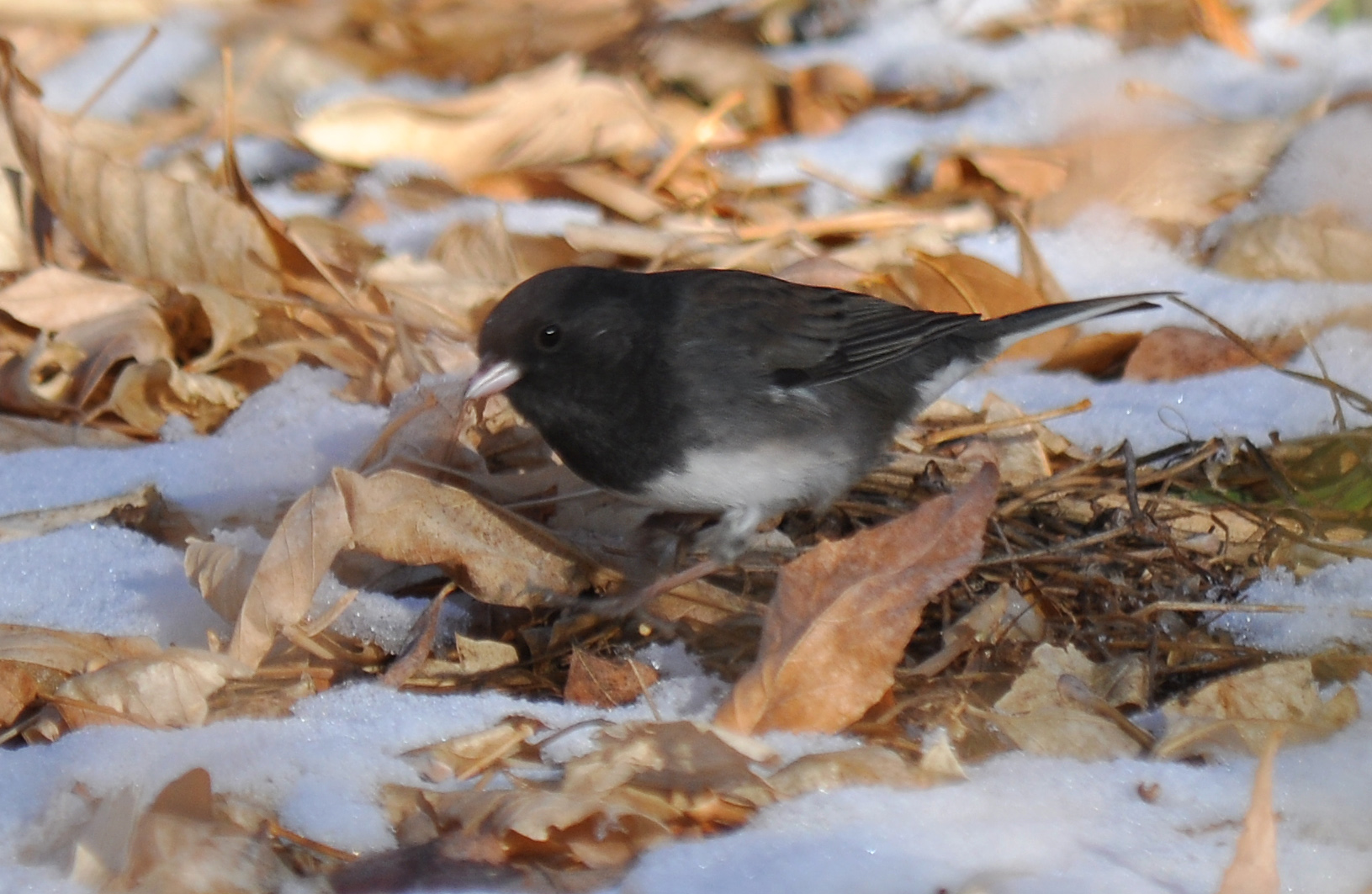
Dark-eyed Juncos

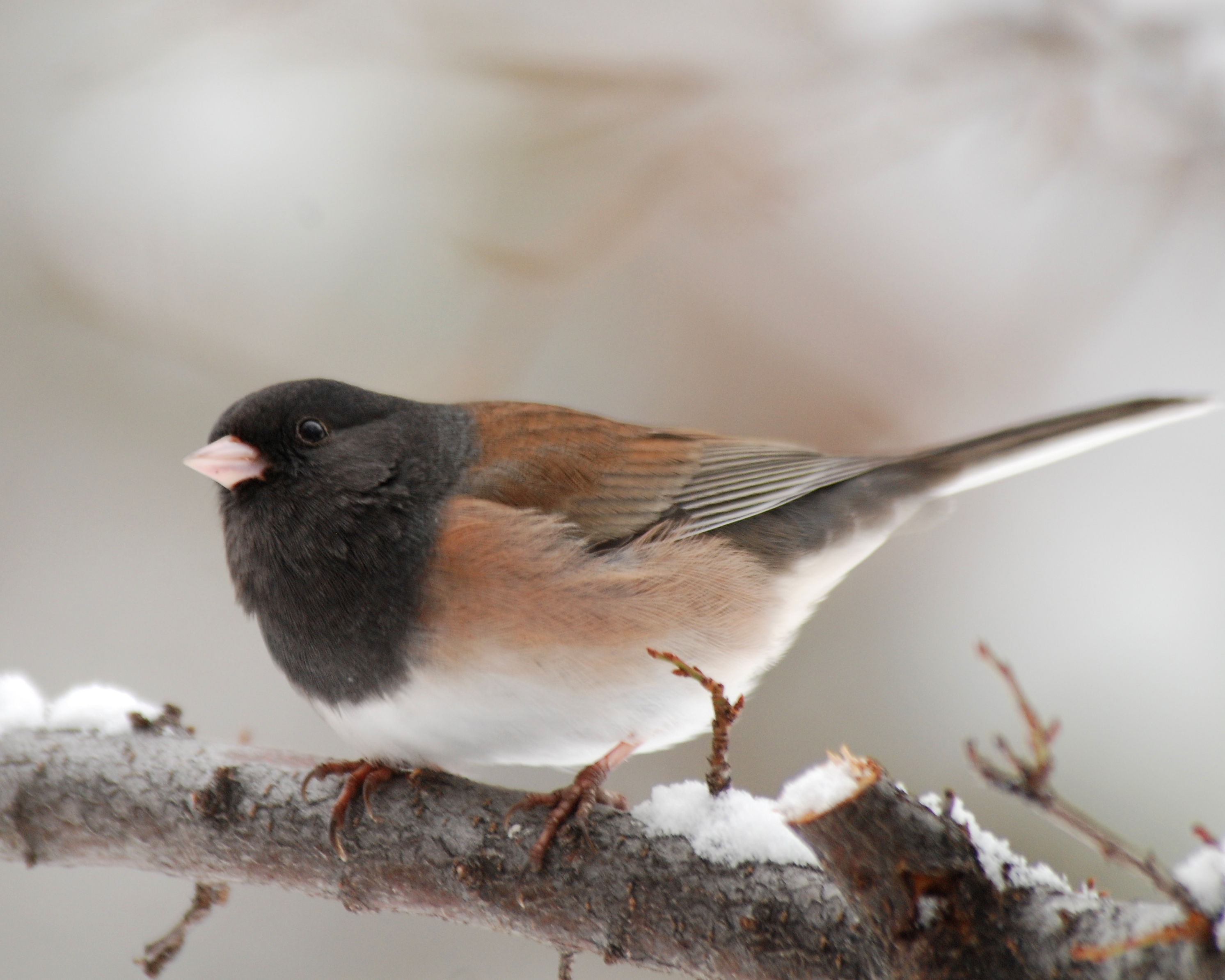
Dark-eyed Junco “Oregon” Male
Junco hyemalis montanus
Courtesy & © 2008 Ryan P. O’Donnell 

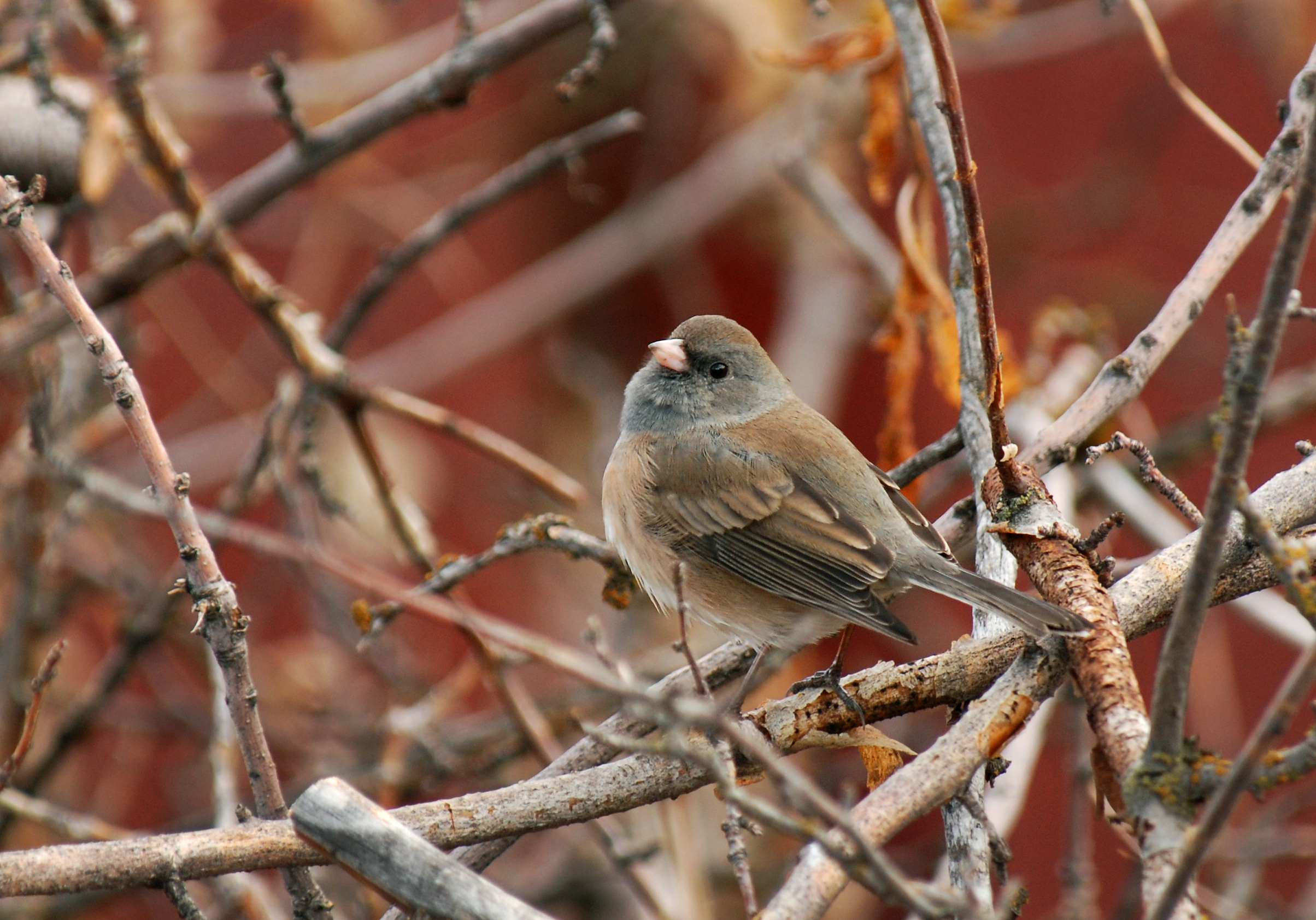
Dark-eyed Junco “Oregon” Female
Junco hyemalis montanus
Courtesy & © 2011 Ryan P. O’Donnell 

Dark-eyed Junco “Pink Sided”
Junco hyemalis mearnsi
Courtesy & © 2011 Ryan P. O’Donnell 

Dark-eyed Junco “Cassiar”
Junco hyemalis cismontanus
Courtesy & © 2011 Ryan P. O’Donnell 

Dark-eyed Junco “Gray-headed”
Junco hyemalis caniceps
Courtesy & © 2011 Ryan P. O’Donnell 

My backyard bird feeders are a busy place this time of year. I enjoy keeping track of who visits – especially as a relative newcomer to the Utah bird scene. Last winter, however, I was baffled by the identity of what turned out to be a fairly ordinary bird.

Dark-eyed juncos are a common sight throughout the United States, but as it turns out, they exhibit an incredible geographic variation in plumage colors. There is a ‘slate-colored race’ which I was used to seeing in the Midwest – uniformly gray above with a white underbody. During Utah winters, the ‘Oregon race’ is common, with its black hood, brown back and peachy sides. Another ‘gray-headed race’ sports varying shades of gray with a distinct reddish brown patch on its back.

Depending on who you ask, there are up to fifteen different races, also called sub-species, of dark-eyed junco – all quite visually distinct, but all considered to be the same species. It wasn’t always this way, however. In the late 1950’s what we now call dark-eyed juncos were recognized as four different species, and in the 1890’s there were six.

These changes beg the question, at what point does speciation occur? And the answer lies in the ability of these birds to interbreed. One scientific definition of a species is those organisms or populations of organisms that are “potentially capable of interbreeding.”

Unique plumage patterns have evolved in a number of geographic locations across the junco’s range, however all of the dark-eyed junco variants could potentially interbreed if they happened to meet. Indeed in places where these geographic territories overlap inter-breeding does take place resulting in blends of the usually-distinct color patterns.

Juncos aren’t the only bird species with recognized color variants. Any raptor enthusiast will be familiar with variations in plumage colors that many birds of prey exhibit, such as merlins and red-tailed hawks. What makes dark-eyed juncos unique is that they are being studied as a possible case of speciation in progress. It turns out that there is more than just a difference in color among dark-eyed juncos. Some sub-species also exhibit variation in song patterns, social behavior, body size, and migration patterns, any of which may eventually cause these groups to stop interbreeding and allow a new species to emerge.

To see pictures of dark-eyed junco subspecies, visit our website at www.wildaboututah.org. Thank you to Rocky Mountain Power Foundation for supporting the research and development of this Wild About Utah topic.

For the Stokes Nature Center and Wild About Utah, this is Andrea Liberatore.

Credits:

Photos: Courtesy & © Ryan P. O’Donnell
Text:    Andrea Liberatore, Stokes Nature Center, logannature.org

Additional Reading:

Atwell, J.W., O’Neal, D.M, and Ketterson, E.D. (2011) Animal Migration as a Moving Target for Conservation: Intra-species Variation and Responses to Environmental Change, as Illustrated in a Sometimes Migratory Songbird. Environmental Law. Vol. 41:289 p. 289-319, https://www.amazon.com/Animal-migration-moving-target-conservation/dp/B005C29H7I

Alderfer, Jonathan (editor) (2005) National Geographic Complete Book of Birds. National Geographic Press. Dark-eyed junco information available online at: https://animals.nationalgeographic.com/animals/birding/dark-eyed-junco/

Cornell Lab of Ornithology, All About Birds: Dark-eyed Junco. https://www.allaboutbirds.org/guide/Dark-eyed_Junco/id/ac

History of Name Changes for Juncos. Cornell Lab of Ornithology. https://www.birds.cornell.edu/pfw/News/junco_taxonomy.pdf

Peregrine Falcons: Fierce predators rescued from the abyss

Peregrine Falcons: Fierce predators rescued from the abyss: Falco peregrinus, Tooele County, Utah, 21 Jun 2009. Photo Courtesy & Copyright Kent R. Keller and found on utahbirds.org
Peregrine Falcon, Falco peregrinus
Tooele County, Utah, 21 Jun 2009
Courtesy & Copyright © Kent R. Keller
Courtesy utahbirds.org/birdsofutah/

PeregrinePeregrine Falcon
Courtesy US FWS
Frank Doyle, Photographer
 
Click to view larger image of a Peregrine Falcon in Flight. Courtesy US FWS, Katherine Whittemore, PhotographerPeregrine Falcon in Flight
Courtesy US FWS
Katherine Whittemore, Photographer

What predatory bird can guide a screaming 200 MPH freefall dive to intercept a flying duck, killing it with a blow from a fist of talons? Tornado winds howl at 200MPH. Even flying horizontally, this bird can accelerate to 70MPH. No animal is faster. It must therefore be a falcon, in today’s case, the Peregrine Falcon. This species inhabits all continents but Antarctica. The Peregrine likes cliff ledges for nesting, such as the high basalt walls at the Birds of Prey Refuge along the Snake River near Boise. In such places, listen for its call, which is very similar to this Prairie Falcon:

Kevin Colver recording: Songbirds of the Southwest Canyon Country

Fifty years ago, the Peregrine Falcon was in a different dive, a plunge to extinction. The culprit was DDT. It wasn’t poisoning the birds, but it insidiously interfered with birds’ calcium metabolism, leaving thin-shelled eggs that broke under brooding parents. DDT is persistent. Worse, DDT bioaccumulates in fats of species high on the food chain, birds like falcons, eagles, and pelicans. Robins provided the first persuasive evidence of DDT bioaccumulation.

On December 28, 1973, President Nixon signed the Endangered Species Act into law. The peregrine falcon was immediately listed. DDT use in the United States was banned. Worried wildlife researchers undertook a bold program to rescue intact eggs from cliff-face nests. The captive nestlings were raised up and taught to hunt. Over the years, 1600 peregrines were released into the wild. The peregrine’s population plunge was halted, then reversed. In 1999, it was formally delisted. By 2003, 3000 pairs bred in Canada, the U.S. and Mexico. Peregrines have never been common, but today, you are four times more likely to see a Peregrine Falcon in Utah than 30 years earlier. You can see similar rebounds in Red-tailed Hawks, Brown Pelicans and other predatory birds by going to the website of the National Audubon Christmas bird counts. This is an environmental success story worth celebrating.

This is Linda Kervin for Bridgerland Audubon Society.

Credits:

Photo: Courtesy & Copyright Kent R. Keller and
Courtesy images.fws.gov
Text: Jim Cane, Bridgerland Audubon Society
Voice: Linda Kervin, Bridgerland Audubon Society
Bird Recordings Courtesy and Copyright Dr. Kevin Colver,https://wildstore.wildsanctuary.com/collections/special-collections & WildSanctuary, Soundscapes, https://www.wildsanctuary.com

Additional Reading:

Peregrine Falcon (Falco peregrinus), U.S. Fish & Wildlife Service, May 2006, https://www.fws.gov/species/american-peregrine-falcon-falco-peregrinus-anatum

Christmas Bird Count, National Audubon Society, https://birds.audubon.org/christmas-bird-count

The Birder’s Handbook: a field guide to the natural history of North American birds : including all species that regularly breed north of Mexico [Book] by Paul R. Ehrlich, David S. Dobkin, Darryl Wheye
https://www.amazon.com/Birders-Handbook-Natural-History-American/dp/0671659898

Feathers: The Evolution of a Natural Miracle, Thor Hanson, Illustrated. 336 pages. Basic Books.
https://www.amazon.com/Feathers-Evolution-Natural-Thor-Hanson/dp/0465028780/

Salt Lake City Peregrine Falcon Cameras, Wildlife.utah.gov, See YouTube, https://youtu.be/L9DQW1uBMzY

Feed the Birds

Pine Siskins and a Goldfinch feed on thistle from a sock feeder. Photo Courtesy and Copyright 2008 Jim Cane
Pine Siskins and an
American Goldfinch feed
feed on thistle from a sock feeder
Copyright © 2008 Jim Cane

Hopper Feeder
Copyright © 2008 Jim Cane

Hopper Feeder with Squirrel
Copyright © 2008 Jim Cane

Suet Feeder
Copyright © 2008 Jim Cane

Many of our songbirds have flown south to spend the winter. I confess that on frigid days I envy them. Like you and I, though, many birds remain behind. They fluff their feathers to trap body heat and spend these short days in a perpetual hunt for food to keep them warm. You can help their hungry quest by feeding our diverse songbirds using a convenient birdfeeder.

For loose seed, I use a hopper feeder. The hopper resembles a tiny roofed house which is filled with seed that is dispensed from a trough at its base. Another common style of seed feeder is a broad tray. It will need a roof and drain holes to keep the seed dry and free of mold.

(https://wildstore.wildsanctuary.com/collections/special-collections)

Our feeder is above a stone walkway for birds like juncos that prefer seed spilled on the ground. A ring of upturned tomato cages around this area excludes cats, and the season’s discarded Christmas tree will provide cover for the birds.

(https://wildstore.wildsanctuary.com/collections/special-collections)

Chickadees and finches prefer black oil sunflower seed, rich in fats and proteins, with a thin shell. If you buy seed mixes, juncos and sparrows will take white millet, but milo or so-called red millet is a filler. Doves and jays like cracked corn.

(https://wildstore.wildsanctuary.com/collections/special-collections)

Goldfinches and pine siskins flock to Niger thistle seed dispensed from a fine mesh sock that you can buy where you purchase the seed. Woodpeckers and nuthatches appreciate a suet feeder, which is a wire mesh cage containing a block of seed-filled suet. Expect magpies to hammer chunks off the suet block occasionally.

Don’t forget water, a scarce commodity for birds in winter. Plug in models remain ice free with scant power use.

Nothing quite cheers a wintry day for me like colorful songbirds noisily bustling at our feeders. If you do put up feeders, consider joining in Project Feeder Watch. You can find details on our Wild About Utah website.

Credits:

Photo: Courtesy & Copyright 2008 Jim Cane, Bridgerland Audubon Society, www.bridgerlandaudubon.org
Text: Jim Cane & Linda Kervin, Bridgerland Audubon Society

Bird Recordings Courtesy and Copyright Dr. Kevin Colver, WildSanctuary, Soundscapes, https://wildstore.wildsanctuary.com/collections/special-collections

Additional Reading:

Project Feederwatch, Cornell Lab of Ornithology, https://feederwatch.org/

How to Attract Birds to your Yard, All About Birds, Cornell Lab of Ornithology, https://www.allaboutbirds.org/Page.aspx?pid=1138

The Great Backyard Bird Count, Birdsource.org, https://www.birdcount.org/

Creating landscapes for Wildlife — A Guide for Backyards in Utah, A production of the Utah Division of Wildlife Resources, Utah State University Cooperative Extension Service & Department of Landscape Architecture and Environmental Planning, https://wildlife.utah.gov/pdf/landscapingforwildlife.pdf

Why Do Birds Stand on One Leg?

Black-Necked Stilt
Himantopus mexicanus

Copyright © 2011 Holly Strand

Hi I’m Holly Strand.

On a recent Saturday my family and I visited Tracy Aviary in Salt Lake City. Walking through the wetland exhibit we saw a couple of black-necked stilts—a common Utah shorebird–snoozing near the boardwalk. They stood at the exhibit shoreline, each one balancing on a single, long, skinny, leg—the other leg drawn into the plumage underneath their bodies. Rotated almost 180 degrees, their heads and bills were tucked snugly under folded wings.

Why do birds choose to stand on just one leg? Wouldn’t it be more comfortable to distribute one’s weight on two? I’ve tried standing on one foot during yoga practice. It doesn’t feel like a good position for rest or sleep.

Over the years, several theories have emerged about this behavior in birds. One is that standing on one leg will reduce fatigue in the other leg. Then, if threatened, the bird could escape more quickly by using the rested leg to initiate motion.

Another theory is camouflage. Two parallel legs may look suspicious to ground level or aquatic prey. In contrast, one leg might resemble a reed or branch.

Perhaps the most common speculation is that birds are conserving heat via one-leggedness.

I wanted to test this last theory by standing barefoot in last weekend’s snow. First on one leg–and then on two for comparison. But I had a bad cold. I asked my biologist husband to do it for me, thinking he would be happy to support rational scientific thinking in the household. Alas, he rolled his eyes and made a noise that I’ve learned to translate as “You’ve got to be kidding me.”

Giving up on him, I dug deeper into the scientific literature.

At last I found a recent study conducted by Matthew Anderson and Sarah Williams of St. Joseph’s University. By observing Carribbean flamingoes these researchers showed that more birds stand on one foot at lower temperatures than at higher temperatures. Further, we know that loss of body heat to water is significantly greater than to air. So it would make sense to see more birds standing on one foot in the water than on land. And indeed this was the case. 80% of birds in water stood on one leg. On land, significantly less did so. Thus it does seem that temperature regulation is at least one reason for standing around on one leg.

In Utah look for one legged roosting among stilts, American avocets, night herons, double-breasted cormorants, and storks. Ducks, magpies and pigeons also stand on one foot for several minutes at a time
–it’s just harder to notice it in them because of their short legs.

For Wild About Utah, I’m Holly Strand.

Credits:

Table: Courtesy & Copyright © 2011 Holly Strand
Text: Holly Strand

Sources & Additional Reading:

Anderson, Mathew and Sarah A. Williams. 2010. Why do flamingos stand on one leg? Zoo Biology. Volume 29, Issue 3, pages 365–374, May/June 2010

Clark Jr., GA. 1973. Unipedal postures in birds. Bird-Banding, 44:22–26.

Tracy Aviary in Salt Lake City https://www.tracyaviary.org/