Our Winterless Winter: Drought conditions across the United States as of January 2, 2018. Moderate drought (peach) expanded in size across Arizona according to the first United States drought monitor of 2018. Overall, much of the Four Corners region of the southwestern United States is in some form of drought. Climate.gov map, based on data from the National Drought Monitor project. Courtesy: NOAA Climate.gov Data: NDMCI’ve been in this lovely valley over 30 years and have never experienced such a balmy January, and now February. The thaw began January first and never ended. As an avid cross country skier, I fear my days of low elevation skiing have ended over a month early.
And I’m well aware that my home state of Michigan is having an epic winter of extreme cold and snow. While we westerners are crying global warming, those across the Mississippi are saying “bring it on!”
So what do the computer models tell us about these phenomena as they predict our future in a warming climate? Our jet stream is acting might wimpy and limpey these days, which was what the climatologists saw coming in their modeling. I will attempt a brief explanation.
The jet streams are high-altitude, racing rivers of air that can influence the path of storms as they track over North America from the Pacific Ocean. The jet streams meander and shift from day to day, but during La Niña events, they tend to follow paths that bring cold air and storms into the Upper Missouri River Basin. Map based on original graphics from NOAA’s Climate Prediction Center. Courtesy NOAAThe jet stream is highly impacted by the temperature differences between the poles and the mid latitudes where we reside. The greater this difference, the more robust the jet stream. The poles have been warming at a crazy rapid pace- several times faster than the lower latitudes. This has reduced the temperature differences which has two profound effects on the jet stream. First, with less energy to move it along, it stalls out so to speak and its patterns linger longer over our continent. Thus the prolonged extreme warm temps in the west, and prolonged cold in the east. A month ago my son living in Atlanta, GA called to say he was walking his dog in a foot of snow, a new experience for that southern boy!
Jet streams also “follow the sun” in that as the sun’s elevation increases each day in the spring, the average latitude of the jet stream shifts poleward. (By Summer in the Northern Hemisphere, it is typically found near the U.S. Canadian border.) As Autumn approaches and the sun’s elevation decreases, the jet stream’s average latitude moves toward the equator. Courtesy NOAAThe second effect is the deep trough that allows the cold to reach well into those once toasty southern states. These sags can be shown with a jump rope. As you slow the energy, or rate of whip moving the rope, it begins to sag, creating a deeper, slower moving trough that even I can leap over!
So our western part of the jump rope is stuck in an inverted trough (the upward swing of the rope), creating a high pressure system that has dominated our state and much of the west with very warm temps and very little precip. This does not bode well for our ski industry nor our water supply, which is locked in our scant snow pack.
Many students from around the state have been working on a resolution with their state legislators which addresses this climate weirding. Bill HCR7 now resides in the House Natural Resources Committee, where it will probably be heard before you hear this. It may even have been on the House floor by then, and on to the Senate. The students are filled with hope that our state leaders will hear their testimonies in behalf of a future we all wish them to have.
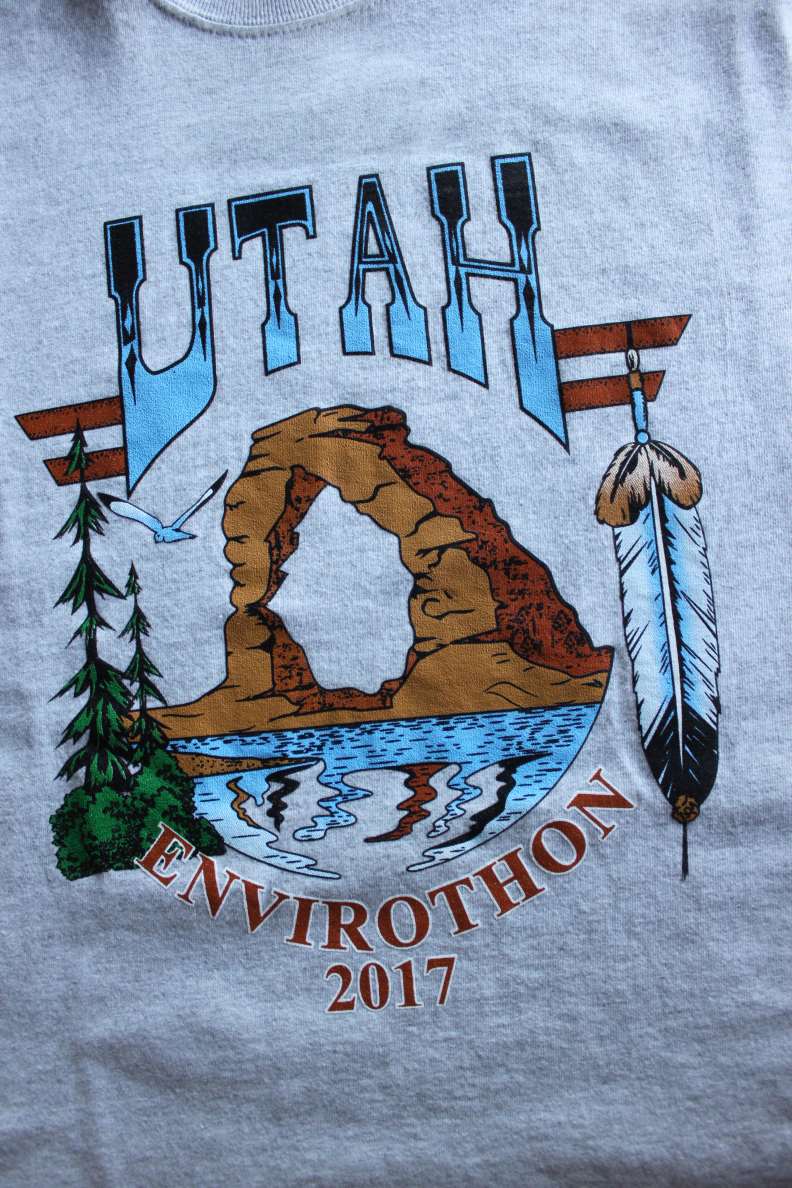
Utah Envirothon 2017 T-Shirt Courtesy Ron Hellstern, PhotographerNo matter where you live in the State of Utah, you are located in one of the 38 Conservation Districts managed by the Utah Conservation Commission. Each of those Districts sponsor and support a wonderful program for High School students called the Utah Envirothon (which simply means a marathon competition to understand Utah’s environments).
The program started in 1979 in Pennsylvania. In 1995 a handful of teachers from the Cache and Logan School Districts, Utah State University, and the Natural Resource Conservation Service in Logan started the program in Utah.
The Envirothon is unique in science and Ag contests because teams of five students from each school get to work together as they compete in the subjects of Forestry, Wildlife, Soils and Land Use, Aquatic Ecology, and a Current Issue which changes topics each year. This isn’t a typical Science Fair where a student displays a cardboard backdrop explaining an experiment they may have done. In the Envirothon, without teachers present, the students are given written tests AND all day outdoor field-tests where they use professional scientific equipment to understand the functions of the natural world around them. They are also given an actual current problem that deals with Utah’s wild lands or agricultural settings and they must produce an Oral Presentation regarding their solution to a panel of Agency Judges. The students also get to learn about dozens of outdoor careers in the Natural Resources, Forest Service, Agriculture, Wildlife Management, and the National Park Service
The Judges are not acquainted with any of the students, who are required to wear identical team T-Shirts, during the entire competition. Scores are compiled from tests, equipment use, and the oral presentation to determine the State Champion who is presented with Olympic-quality medals and scholarships to universities within our State, and then goes on to the North American Envirothon, which is held in a different location in the U.S. or Canada each summer. Last year, about 60 State and Provincial winning teams went to Maryland to compete for the North American Championship.
The Utah competition has been held the last weekend in April, in places ranging from Logan to Saint George, on university campuses, forests, rangelands, farms, and even in Zion National Park.
Currently, more than half a million students participate throughout all the United States, Canada, and China. Europe, Mexico, Japan and Australia are also investigating how to establish the program.
For more information contact your local Conservation Districts or online at utahenvirothon.org for the simple rules, learning resources, and training videos about each topic. The North American website has even more detailed information at www.envirothon.org.
This is Ron Hellstern and I’m Wild About Utah!
Credits:
Images: Courtesy & Copyright Ron Hellstern, Photographer
Text: Ron Hellstern, Cache Valley Wildlife Association
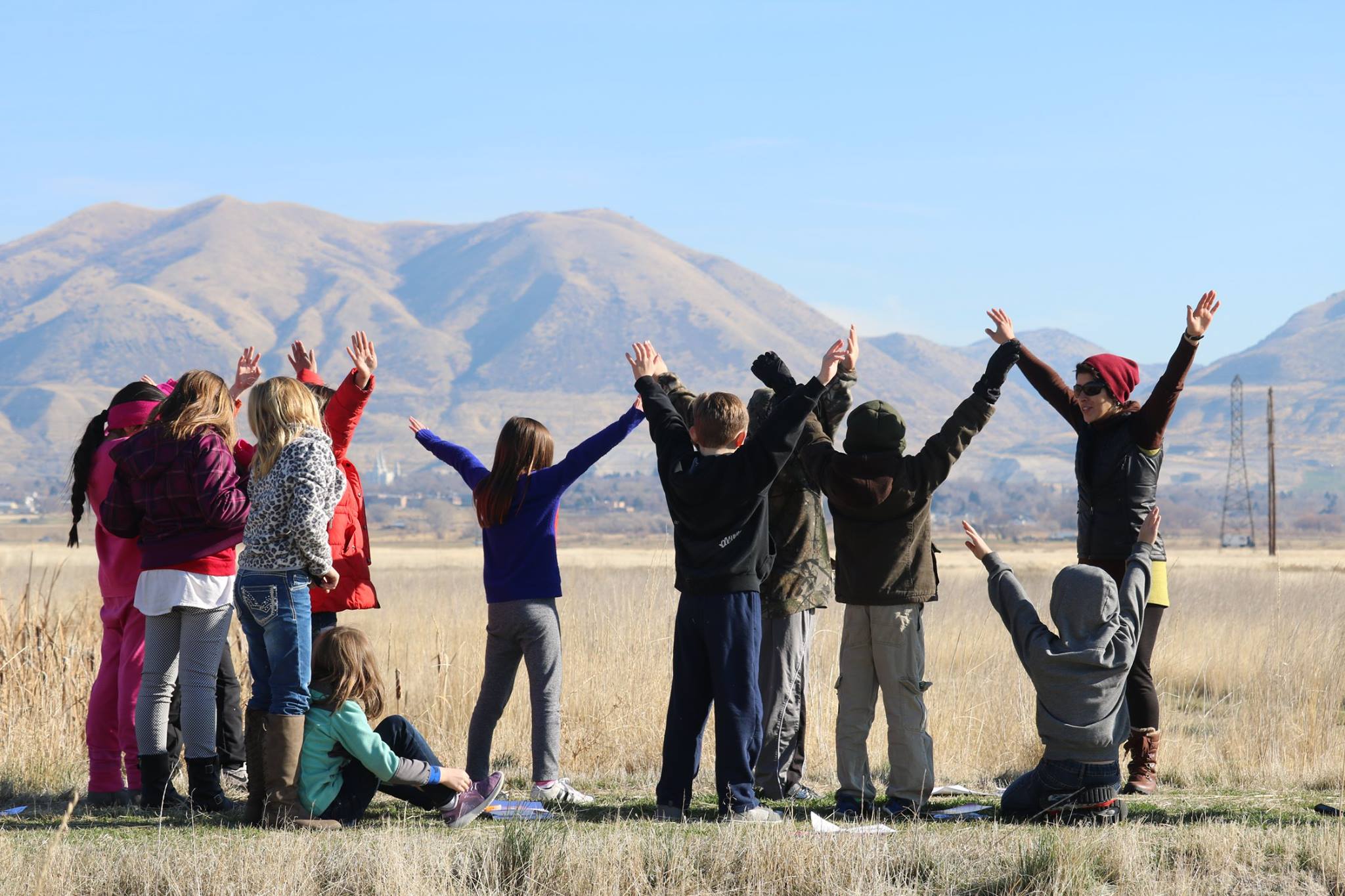
Isa and Students Imitating Raptor Flight Patterns at the Bear River Migratory Bird Refuge Courtesy & Copyright Edith Bowen Laboratory School(EBLS) Experiential Learning Eric Newel Director & Photographer
*Field Recording:
Isa Identifies Raptors
So eagles fly how?
Student: Straight. Isa:
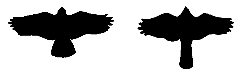
How do buteos fly? Like a red tail? They are modified dihedral.
How do vultures fly? They are wobbly and in a V
How do Accipitors fly? Flap-flap-glide
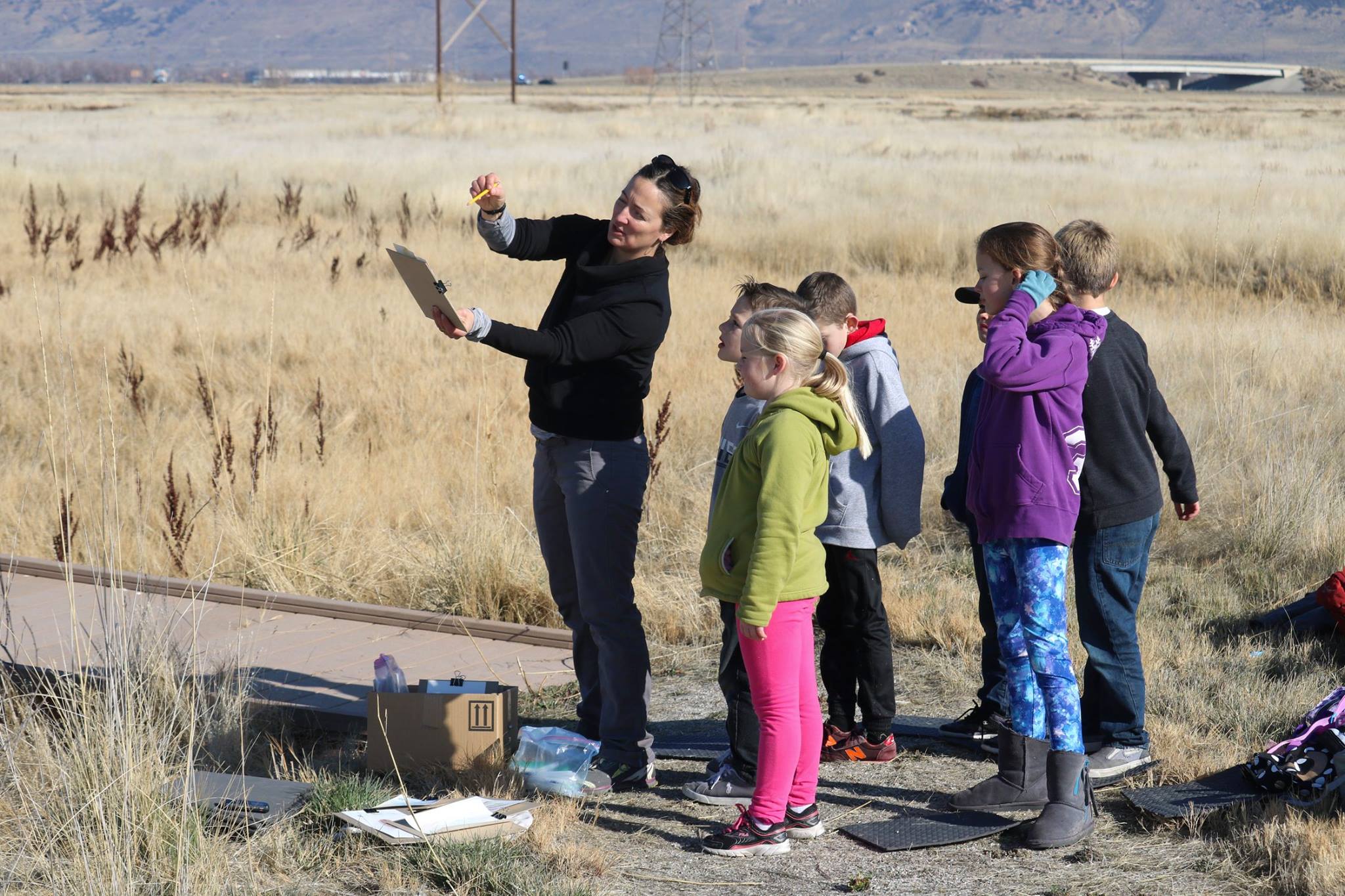
Lisa Saunderson teaching students to observe and ponder the landscape before rendering their horizons in watercolors at the Bear River Migratory Bird Refuge Courtesy & Copyright Edith Bowen Laboratory School(EBLS) Experiential Learning Eric Newel Director & Photographer
Edith Bowen third graders recently had the opportunity to visit the Bear River Migratory Bird Refuge in Brigham City. The day was chock a block full of exciting activities like the one we just heard meant to engage students’ senses and ground their understanding of core curriculum within the context of the place we were visiting.
[We] learn better when we’re immersed in the context of the thing we study. Courtesy & Copyright Edith Bowen Laboratory School(EBLS) Experiential Learning Eric Newel Director & Photographer
Place-based and experiential education are relatively new terms for old human evolutionary qualities. Basically, we humans learn better when we’re immersed in the context of the thing we study. Being in a place, engaging each of our senses in its character, and learning how that character and our own are interdependent builds powerful context. When educators can insert their core curriculum into that context each strand of understanding becomes deeper and richer.
So we had people like my friend Isa, who you heard at the beginning of the segment, racing with students through the grasslands, imitating the flight patterns of raptors to drive home an understanding of adaptive specificity in different bird species.
Art at the Bear River Migratory Bird Refuge Courtesy & Copyright Edith Bowen Laboratory School(EBLS) Experiential Learning Eric Newel Director & Photographer
Our art teacher, Lisa Saunderson, sat with students to observe and ponder the landscape before teaching them to expertly render their horizons in watercolors. For my small part, I sat with students- six or seven at a time- and introduced them to Aldo Leopold. As it was the final day of November, I read from the Chapter of A Sand County Almanac honoring the month.
In reading Leopold’s words, I wanted to model for my students how close, careful observation can deepen our experience of a place and even transcend time through the words we write down- fleeting thoughts becoming immediately eternal with the stroke of a pen. When I gave them time of their own to sit, observe, and write, what they came up with gave me goosebumps.
Field Recording: Avery’s reading
All Around Me by Avery F.
In front, water is weaving around a maze of marsh
Beside me there is a bench standing all alone.
Behind there is a wall of stalks, some almost as tall as me.
Beside there is an endless walk waiting for men to walk and talk.
Field Recording: Lila’s reading
November ends
The deep coolness flows through the cheeks and the nose
The water is as still as rock
Cattails are stuck in black tar
The birds whistle and sing
It spreads and spreads until you can’t hear
The grass flows as the wind blows
Where am I?
Recording Observations at the Bear River Migratory Bird Refuge
Courtesy & Copyright Edith Bowen Laboratory School(EBLS) Experiential Learning
Eric Newel Director & Photographer
Awareness of a place produces powerful perspectives of it, especially among the tiny human sponges we call children. The day went on and on like this, students building deep contextual understandings of their place. What were once the far hinterlands of their home range became an intimate, familiar setting they knew and spoke of fondly. Eyes lifted to goose music and the whistle of flight feathers thereafter.
To finish our visit, we heard a welcome interpretation of the natural history of the bird refuge- a bit of geographical orienting for the kids to digest and incorporate into their understanding of the place.
Field Recording: Ranger Interpretor
You live in what is called, (And this is a 4th-grade concept, but your guys are so smart, you know it just like that.)
The Bear River Watershed.
Okay, it is the corridor, in this valley, through which the rivers travel.
“Hey,” Johnny cried suddenly, catching the Ranger off guard. He pointed 20 yards beyond her as a raptor cut quick and low across our field of vision. “Look! Flap, flap, glide! It’s an accipiter!” If awareness was what we were after, we had gotten it in spades!
This is Josh Boling, writing and reading for Wild About Utah
Credits:
Photos and Sound: Courtesy Eric Newell, 2017
Text: Josh Boling, 2017
Called the Christmas Bird Count, this event is the longest citizen science program in the world, where data has been collected since 1899. Here in Cache Valley it began in 1955. It occurs throughout the state and world with many countries participating. Visit your local Audubon chapters if you care to be involved. Wasatch, Salt Lake and St George all have chapters. Bear Lake, Vernal and Provo also do counts. And I am sure there are others in your area if you inquire.
Along with the fun it brings, the count has special significance for our changing climates’ impact on birds, which is disrupting populations and their spacial distribution are changing at an accelerating rate.
The data collected by observers over the past 118 years has allowed researchers to study the long-term health and status of bird populations across North America and Central and South America. When combined with other surveys such as the Breeding Bird Survey, it provides a picture of how the continent’s bird populations have changed in time and space. This long term perspective is vital for conservationists. It informs strategies to better protect birds and their habitat, and helps identify environmental issues with implications for people as well.
Audubon’s 2014 Climate Change Report is a comprehensive study that predicts how climate change could affect the range of 588 North American birds. Of the bird species studied, more than half are likely to be in trouble. The models indicate that 314 species will lose more than half of their current range by 2080.
Audubon’s Common Birds in Decline Report revealed that some of America’s most beloved and familiar birds have taken a nosedive over the past forty years.
142 species of concern are found in our state, including our state bird, the California gull and our national bald eagle.
If you aren’t up to braving the elements, Project FeederWatch and Great Backyard Bird Count are other options you may find by googling. I’m hoping for good visibility and temperatures above zero as I prepare my optical instruments and hot chocolate.
And please keep those bird feeders full as we enter the coldest month of the year!
This is Jack Greene writing and reading for Wild About Utah.
Project FeederWatch is a winter-long survey of birds that visit feeders at backyards, nature centers, community areas, and other locales in North America. FeederWatchers periodically count the birds they see at their feeders from November through early April and send their counts to Project FeederWatch. FeederWatch data help scientists track broadscale movements of winter bird populations and long-term trends in bird distribution and abundance. https://feederwatch.org/
Launched in 1998 by the Cornell Lab of Ornithology and National Audubon Society, the Great Backyard Bird Count was the first online citizen-science project to collect data on wild birds and to display results in near real-time. https://gbbc.birdcount.org/about/



![[We] learn better when we’re immersed in the context of the thing we study. Courtesy & Copyright Edith Bowen Laboratory School(EBLS) Experiential Learning Eric Newel Director & Photographer](https://wildaboututah.org/wp-content/uploads/newell.eric_.24210275_1682307758487950_3483302022023119046_o.jpg "[We] learn better when we’re immersed in the context of the thing we study. Courtesy & Copyright Edith Bowen Laboratory School(EBLS) Experiential Learning Eric Newel Director & Photographer")