Sagebrush

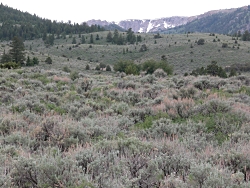
Sagebrush near Raft River, UT
Sagebrush near Raft River, UT – Photo Courtesy and Copyright 2007 Dr. Leila Shultz
Hi, I’m Holly Strand of Stokes Nature Center in beautiful Logan Canyon.

I was always prone to homesickness when I spent long periods in the Eastern US and abroad. Returning to Colorado for visits, I would break off a small branch to pack in my suitcase. That way I could always take some essence of home along with me. Now I don’t need to do that. The desert air and cold winters here in Utah make it a sagebrush heaven.

The scent that has become so dear to me comes from the volatile oils of the sagebrush plant. Ironically, the smell that appeals so much to me repels most animals. The aromatic properties of the sagebrush are a by-product of chemicals that evolved as a pest deterrent and as anti-freeze. Sagebrush oils have a very bitter taste. Browsers, such as deer and elk avoid the plants, nibbling on sagebrush only in winter months when the concentration of oils has decreased. And even then, only as a last resort. The pronghorn– a North American native that co-evolved with sagebrush–can tolerate it better than other herbivores.

Within the sunflower family, sagebrush belongs to the genus Artemisia – a group of wind-pollinated plants spread mostly across the northern hemisphere. The 400 or so species in this genus include a variety of sagebrushes, sageworts, and wormwoods.

The Atlas of Vascular Plants of Utah lists 19 different species in the Artemisia genus. Among the most common, you’ll find sand sagebrush in the dunes and deep sand regions in southern Utah. Black sagebrush is found on gentle, rocky slopes and windswept ridges in dry, shallow soils, in the foothills and desert mountain ranges. Bud sagebrush is common in salt-desert shrub communities from 4-6000 ft. Almost everywhere, however, big sagebrush dominates. It occurs in valleys, basins, and mountain slopes, at elevations between 2,500 and 10,000 feet. In Utah, you’ll also hear the big version called Great Basin, Wyoming or mountain sagebrush.

Humans have put the unique qualities of sagebrush and its relatives to good use. The volatile oils are toxic to many intestinal parasites, therefore early Americans used it to rid themselves of worms. Oils have also been used to combat infections and to treat internal wounds. Eurasian wormwood–an introduced plant in Utah–is the defining ingredient, in the liquor absinthe, and is used for flavoring in other spirits and wines, including bitters and vermouth. The spice tarragon comes from dragonswort, an Artemisa species found in both Eurasia and N. America.

Ecologists used to think that the presence of sagebrush discourages or suppresses other forms of life. Certainly, sagebrush desert steppes are generally poor in species. The truth is that few species can tolerate the temperature extremes, soil conditions and lack of water the way that it can. So the next time you see some, pick a leaf, crush it, smell it, and admire this tough but well-adapted Utah native.

Dr. Leila Shultz, a Utah State University expert on sagebrush provided the science information for this piece.

Thanks to the Rocky Mountain Power Foundation for supporting research and development of Wild About Utah topics.

For Wild About Utah and Stokes Nature Center I’m Holly Strand.


Credits:

Photo Courtesy & Copyright 2007 Dr. Leila Shultz
Text: Stokes Nature Center: Holly Strand

Additional Reading:

Digital Atlas of the Vascular Plants of Utah, https://digitalcommons.usu.edu/wild_facpub/1649/

Shultz, Leila. 2012. Pocket Guide to Sagebrush. PRBO Conservation Science. https://digitalcommons.usu.edu/sagestep_reports/20/
As pdf: https://rdjzr2agvvkijm6n3b66365n-wpengine.netdna-ssl.com/wp-content/uploads/2018/06/sagebrush_pock_guide_reduced.pdf

Shultz, L. M. 2006. The Genus Artemisia (Asteraceae: Anthemideae). In The Flora of North America north of Mexico, vol. 19: Asterales, pp. 503–534. Flora of North America Editorial Committee, eds. Oxford University Press. New York and Oxford.

USDA, NRCS. 2012. The PLANTS Database, National Plant Data Team, United States Department of Agriculture (USDA), Natural Resource Conservation Service (NRCS): https://www.plants.usda.gov

VanBuren, R., J. C. Cooper, L. M. Shultz and K. T. Harper. 2011. Woody Plants of Utah. Utah State University Press & Univ. Colorado. 513 pp. https://upcolorado.com/utah-state-university-press/woody-plants-of-utah

Artemisia, Garden Plant Collection, Red Butte Gardens, University of Utah, https://redbuttegarden.org/media/documents/Artemisia-plant-collection.pdf

Mushrooms in Utah

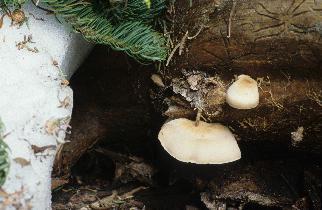
Russula emetica
Courtesy &Copyright 2008 Michael Piep

Does the mere mention of stuffed or sauteed mushrooms start your mouth to water? Perhaps you start your day dreaming of morels, porcini, truffles or chanterelles. Alas, what is poor mushroom aficionado to do? Michael Piep of the Utah State Intermountain Herbarium tells me that tasty wild mushrooms can be as close as our own backyards.

From among the most delicate and delicious to the most deadly, Utah has them. Many people are astonished to learn that Utah is home to a diversity of mushrooms. Our state has several thousand species of fungi, from molds that inhabit that old jar of jelly to the delicious King Bolete of our conifer forests.

Adroit at camouflage, Utah’s fungal wealth can be discovered by the dedicated. What is better than a day spent searching the forests for edible mushrooms? Few activities compare to traipsing along riverbeds after morels in spring, all the while avoiding poison ivy. There is a reason they call it mushroom hunting.

Fungi can be both blessing and curse… Some are innocuous decomposers of dead plant material, or active partners in mycorrhizal relationships with plant roots, but others cause dread illnesses in both plants and animals…. the fungi do it all. In each of our state’s plant communities live unique species of mushrooms, as any avid mushroom hunter can tell you.
Of course, the fruiting or our devious little friends is weather dependant. So petition your local weather service for wet weather. Dry air and soils inhibit fruiting by mushrooms.

The next time you eat a slice of bread, uncork a bottle of wine, quaff a beer, or simply savor grilled mushrooms on your steak, thank a fungus. If you wish to explore more, contact one of the two mushroom societies in the state. There, your fellow mushroom lovers will be happy to help you get on the path to fungal enlightenment.

Credits:

Photo: Courtesy and Copyright 2008 Michael Piep

Text: Michael Piep, Utah State University, Intermountain Herbarium https://herbarium.usu.edu

Additional Reading:

Bridgerland Mushroom Society will meet 18 February 2009 See https://herbarium.usu.edu/ for details

Mushroom Society of Utah https://www.utahmushrooms.org/

The Mushroom Journal, https://www.mushroomthejournal.com/

Utah State University: Intermountain Herbarium, https://herbarium.usu.edu

Fun Facts about Fungi, Utah State University, Intermountain Herbarium, https://herbarium.usu.edu/fungi/FunFacts/factindx.htm

Autumn Colors

Autumn Colors: Fall Colors in Cache County Photo © 2006 Bridgerland Audubon Society
Fall Colors in Cache County
Photo © 2006 Bridgerland Audubon Society

In autumn, our days shorten noticeably and frosty dawns become the norm across most of Utah. Now leafy plants must be preparing for winter. Their summer of intense metabolic activities must gradually give way to winter’s dormancy. Photosynthesis and respiration are gradually shut down as nutrients and sugars are withdrawn from leaves, to be shunted to the stem and roots for storage.

The brilliant autumn yellows of our aspens, ash trees and cottonwoods, as well as the crimsons of our maples and sumacs, are all indicative of leafy plants frugality with their valuable nutrient stores. The foliar pigment phytochrome first registers the lengthening nights, initiating the cascade of physiological events that prepare a tree for the icy blasts of winter. Before discarding their leaves, deciduous trees and shrubs rescue and store what they can of sugars and nutrients found in their leaves.

The key photosynthetic green pigment, chlorophyll, and its attendant enzymes are all broken down, their components moved to storage for recycling next spring. Essential nutrients, such as nitrogen and phosphorus, are likewise extracted from foliage for later reuse. With chlorophyll gone, the other colorful leaf pigments are revealed in all their glory. These accessory pigments have been there all along, they just have been masked by the dominant green of chlorophyll.

These accessory pigments serve several functional purposes for the leaf. Some pigments protect the leaf from sunburn, some scavenge free radicals, but most capture energy from wavelengths of light missed by chlorophyll. The multi-hued spectrum of sunlight, as revealed by a prism or a rainbow, not only allows us to see splashy fall foliage colors, it is the reason for their existence.

For the plant physiologist and chemist, then, the palette of colorful leaf pigments have complex functional explanations. More mysterious psychological stirrings accompany the aching beauty of our autumn foliage, but it gives an undeniable tug at my heart. Standing before a blazing yellow stand of aspens, I smile to think that recycling can be so beautiful.

Credits:
Photo: Courtesy www.bridgerlandaudubon.org
Text: Bridgerland Audubon Society – Jim Cane, Linda Kervin

Additional Reading:
Utah Scenic Byways, https://www.utah.com/byways/fallcolorstour.htm
Utah Fall Colors, https://travel.utah.gov/Fallcolors.htm

Endemic Plants of Utah

Rabbit Valley Gilia or Wonderland Alice-Flower
Courtesy State of Utah:
Utah Division of Wildlife Resources
Ben Franklin, Photographer

Rabbit Valley Gilia or Wonderland Alice-Flower
Photo: Ben Franklin,
Courtesy State of Utah: Utah Division of Wildlife Resources

Other Utah Endemics on DWR pages:
Deseret Milkvetch
San Rafael Cactus
Welsh’s Milkweed

When something is unique to a particular geographic area it is said to be endemic to that area. Not too long ago, while preparing for a lecture on Utah’s biodiversity, I was amazed to discover that Utah ranks sixth in the nation for its number of endemic species. Only Hawaii, California, Texas, Florida and Georgia have more. The Hawaiian islands are totally isolated –a factor that encourages endemics. California and Texas have enormous land area so I’m not surprised they have the space for more species to evolve. And Georgia and Florida are warm and wet states where you would expect biological richness! So what’s Utah doing so high on this list?

It turns out that our unique plants give us this high ranking. Utah has 2602 plants in all plus 393 subspecies or varieties. With 247 endemics Utah has an endemism rate of 8.2%. That’s pretty amazing.

Some areas of Utah have a lot more endemic plants than others. The Colorado Plateau in the south and east of Utah has the most. On the Plateau, erosion has exposed a long succession of different rock layers, and the rock has weathered into a patchwork of locally unique soils. Ecologists have found that isolated or peculiar soil types are like a nursery for endemics. Fine textured soils, saline soils or those that are highly alkaline are associated with highest levels of endemism.

Environmental extremes in the desert such as high temperature or low rainfall prompt evolutionary adaptations that eventually lead to speciation. For example, cushion plants are common on the Plateau—these are compact, low growing, mats often with large and deep tap roots adapted to slow growth in a nutrient- poor and water-restricted environment. In Utah deserts, many different buckwheat and milkvetch species adopted the cushion plant structure thus forming new species.

Variations in elevation can isolate species and create localized versions of widespread plants. High elevation areas can act as islands within the Colorado Plateau separating plants into distinct populations until they diverge over time. The La Sal, Abajo and Henry Mountains form mid-high elevation islands whose resident species are becoming more and more unique, forming endemics such as Chatterly onion, La Sal daisy, Cronquist’s buckwheat, Navajo Mountain penstemon, and Dwarf mountain butterweed.

We all know that Utah is a special place to live, but just knowing that our plants are so unique is another good reason to go out and explore.

Credits:

Photos: Courtesy State of Utah; Division of Wildlife Resources

Text: Stokes Nature Center: Jessica Welsh and Holly Strand

Sources & Additional Reading:

Stein, Bruce A. 2002. States of the Union: Ranking America’s Biodiversity. A NatureServe Report Prepared for The Nature Conservancy. Arlington, Virginia: NatureServe. https://www.natureserve.org/Reports/stateofunions.pdf

Utah Division of Wildlife Resources June 1998. Inventory of sensitive species and ecosystems of Utah: Endemic and rare plants of Utah an overview of their distribution and status.

Utah Native Plant Society. January 2007 Volume 30 No.1 UNPS Annual Members Meeting, Oct 21, 2006, Logan, UT.

Welsh, Stanley L.1993. A Utah Flora (second edition) Provo: Brigham Young University.