Phragmites-Utah’s Grassy Invader

Invasive Phragmites
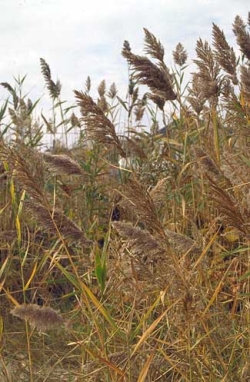
Phragmites australis
Photo Courtesy
Plant Conservation Alliance
Alien Plant Working Group
As found on
nps.gov/plants/alien/fact/phau1.htm
Photographers credited on Factsheet

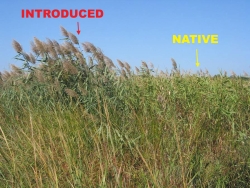
Invasive Phragmites vs. Native

Photo Courtesy
Plant Conservation Alliance
Alien Plant Working Group
As found on
nps.gov/plants/alien/fact/phau1.htm
See guide to distinguish
Invasive from Native plants
Photographers credited on Factsheet

Hi, this is Mark Larese-Casanova from the Utah Master Naturalist Program at Utah State University Extension.

When exploring wetlands, streambanks, and the shores of Great Salt Lake this time of year, it’s common to see tall grasses, over ten feet high, blowing in the breeze. While it is very abundant, the common reed known as Phragmites australis is anything but normal.

Phragmites was introduced from Europe over a century ago, and is now found in all 50 states and on every continent except Antarctica. It can grow to more than 15 feet in height, with long blade-like leaves. It flowers from July to October, producing dense, feathery clusters of small flowers that are purple while flowering and turn light brown after producing seeds. Each stem can produce up to 2,000 wind-dispersed seeds that are particularly effective at colonizing new areas. Because of this, Phragmites can take over a disturbed area quickly and prevent native plants, such as bulrush and cattail, from becoming established.

Like other invasive plants, Phragmites is successful at outcompeting native plants. Once a plant is established from seed, Phragmites spreads quickly through rhizomes, or underground stems, that can produce many additional stalks. While Phragmites may start growing among other wetland plants, it quickly outcompetes them for nutrients and sunlight. However, the native “Phragmites australis subspecies americanus” does not grow nearly as dense or tall, and tends to not be invasive.

Because introduced Phragmites can quickly grow into solid stands, it can greatly reduce plant diversity in wetlands, ultimately reducing the quality of wildlife habitat. Wetlands along the shore of Great Salt Lake are particularly important habitat for many migratory birds species, some of which occur here in the largest populations in North America or the world. The rapid takeover by Phragmites in these wetlands could eventually have dramatic impacts to the entire Great Salt Lake ecosystem.

In order to combat this threat, wetland managers have tried several methods for controlling or removing Phragmites, including spraying with herbicide, burning, livestock grazing, and mowing. Dr. Karin Kettenring, a Utah State University researcher, and her graduate students are currently studying the effects of several of these Phragmites control methods along the shores of Great Salt Lake. By experimenting with the timing of mowing and herbicide treatment, as well as covering mowed Phragmites with heavy black plastic, Dr. Kettenring and her team hope to find the most effective combination of treatments. With the continual conversion of native wetland habitats to a monoculture of Phragmites, Dr. Kettenring’s research is of particular importance to maintaining the health of the Great Salt Lake ecosystem- one of our state’s greatest natural wonders.

For Wild About Utah, I’m Mark Larese-Casanova.

Credits:
Images: Courtesy & Copyright
            Jil M. Swearingen, National Park Service, Center for Urban Ecology, Washington, DC
            Dr. Kristin Saltonstall, Adjunct Research Scientist, Horn Point Laboratory,
                  University of Maryland Center for Environmental Science, Solomon, MD
            Robert Meadows, Environmental Scientist, North DE Wetland Rehabilitation Program,
                  DE Mosquito Control Section, Newark, DE
            As found on https://www.nps.gov/plants/alien/fact/phau1.htm
Text:     Mark Larese-Casanova, Utah Master Naturalist Program at Utah State University Extension.


Additional Reading:

Evans K, Martinson W (2008) Utah’s featured birds and viewing sites: a conservation platform for Important Bird Areas and Bird Habitat Conservation Areas. Salt Lake City, Utah

Kulmatiski A, Beard KH, Meyerson LA, Gibson JR, Mock KE (2010) Nonnative Phragmites australis invasion into Utah wetlands. Western North American Naturalist 70:541-552

Long, A.L., C.M.U. Neale, and K.M. Kettenring. 2012. Management of Phragmites in the Great Salt Lake watershed. Final report to the Utah Department of Natural Resources, Division of Forestry, Fire & State Lands. 15 pp.

Beavers: The Original Army Corps of Engineers

Beavers: The Original Army Corps of Engineers: Click for larger picture, Beaver with branch in water, Courtesy US FWS
Beaver with branch in water
Courtesy US FWS,
Steve Hillebrand, Photographer


Hi, I’m Holly Strand from Stokes Nature Center in beautiful Logan Canyon.

Beavers and beaver dams are a common feature of the Utah landscape. You’ll see the dams on smaller streams and side channels, constructed of branches, downed trees and mud. The still, deep water of the resulting pond creates ideal conditions for a beaver lodge. Beavers can escape and hide from predators by slipping into the pond and disappearing into the lodge. Beavers also use their ponds to cache their favorite
food—aspen and willow.

Because of their tree cutting and dam making skills, humans tend to have two divergent opinions of beavers: 60-pound nuisance or environmental engineer.

Click for larger picture, Beaver Lodge, Courtesy US FWS
Beaver lodge
Courtesy US FWS
Hans Stuart, Photographer

Beavers are considered a nuisance when they gnaw down trees that humans want to keep. Dams can flood roads or stop up irrigation canals. When beaver activity conflicts with human interests, they—the beavers–are likely to be trapped and killed.

However, beaver activity has many positive environmental consequences that we are just beginning to appreciate. Wetlands created by beaver dams help soak up sediments, improving downstream water quality. Because of beaver dams, the winter snowpack isn’t lost in a short spring pulse, This results in a more constant stream flow through the summer –and that’s important as Utah’s climate is predicted to become drier. Finally, beaver dams enhance habitat for many other fish and wildlife species and plants.

Click for larger picture, Beaver in pond, Courtesy US FWS
Beaver in pond
Courtesy US FWS
Steve Hillebrand, Photographer

According to Dr. Joe Wheaton, a geomorphologist at Utah State University, there’s a lot of untapped potential for employing beaver engineers in stream and floodplain restoration. Say you want to restore a stream by reconnecting it with its floodplain. You need to excavate channels, redirect stream flow, revegetate and nurture the
area for a long period of time. To accomplish this, you often need a
number of highly trained professionals and some large Tonka toys.

Alternatively –under the right conditions– you might transplant a
colony of beavers and let them apply their vigorous work ethic to your
landscape and get quite satisfying results.

Recognizing that nuisance beavers can be rehabilitated into hard
working wetland engineers and stream habitat restorationists, the Utah
Division of Wildlife Resources has rolled out the state’s first beaver
management plan in 2010. This plan encourages live trapping of entire
families of beavers in nuisance areas and moves them to specific sites where their
environmental services can be appreciated and put to use.

Click for larger picture, Beaver in snow, Courtesy US FWS
Beaver in snow
Courtesy US FWS

Thanks to the USU College of Natural Resources for supporting this Wild about Utah topic.

For Wild About Utah and Stokes Nature Center, I’m Holly Strand.

Credits:
Images:
Text: Stokes Nature Center: Holly Strand

Sources & Additional Reading


ARKive Images of Life on Earth, Information Sheet on Castor Canadensis (including some outstanding videos) https://www.arkive.org/ – (BBC Natural History Unit)

  • American Beaver – Overview
  • American Beaver in the Lodge with Young
  • American beaver felling trees and storing food for the winter
  • American beaver scaring moose away from its lodge
  • American beaver returning to its lodge with food

  • Collen, P. and R.J. Gibson. 2001. The general ecology of beavers (Castor spp.), as related to their influence on stream ecosystems and riparian habitats, and the subsequent effects on fish – a review. Reviews in Fish Biology and Fisheries 10: 439–461, 2001. https://web.archive.org/web/20230202160926/https://www.researchgate.net/publication/227028536_The_general_ecology_of_beavers_Castor_spp_as_related_to_their_influence_on_stream_ecosystems_and_riparian_habitats_and_the_subsequent_effects_on_fish_-_A_review [ Accessed May 1, 2010]

    Prettyman, B. 2009. Utah wildlife: Leave it to the beavers. Article in Salt Lake Tribune, October 16, 2009. https://www.sltrib.com/ci_13570110 [ Accessed April 29, 2010]

    Smithsonian Castor Canadensis Information Page https://www.mnh.si.edu/mna/image_info.cfm?species_id=32 [ Accessed April 29, 2010]

    Big Bend Habitat Restoration Project: A Natural Work of Heart, Open Spaces-A Talk on the Wild Side, US FWS, https://www.fws.gov/news/blog/index.cfm/2016/3/25/Big-Bend-Habitat-Restoration-Project-A-Natural-Work-of-Heart [Accessed March 31, 2016]

    Beaver Dams Strengthened by Humans Help Fish Rebound
    60-Second Science – July 25, 2016 – By Jason G. Goldman02:29 https://www.scientificamerican.com/podcast/episode/beaver-dams-strengthened-by-humans-help-fish-rebound/ Also available through the podcast https://itunes.apple.com/us/podcast/60-second-science/id189330872?mt=2

    Goldfarb, Ben, Eager: The Surprising, Secret Life of Beavers and Why They Matter, Chelsea Green Publishing, March 8, 2019, https://www.amazon.com/Eager-Surprising-Secret-Beavers-Matter/dp/1603589082/ref=asc_df_1603589082/

    Wetlands-What’s in a name?

    Wetlands- What’s in a name?

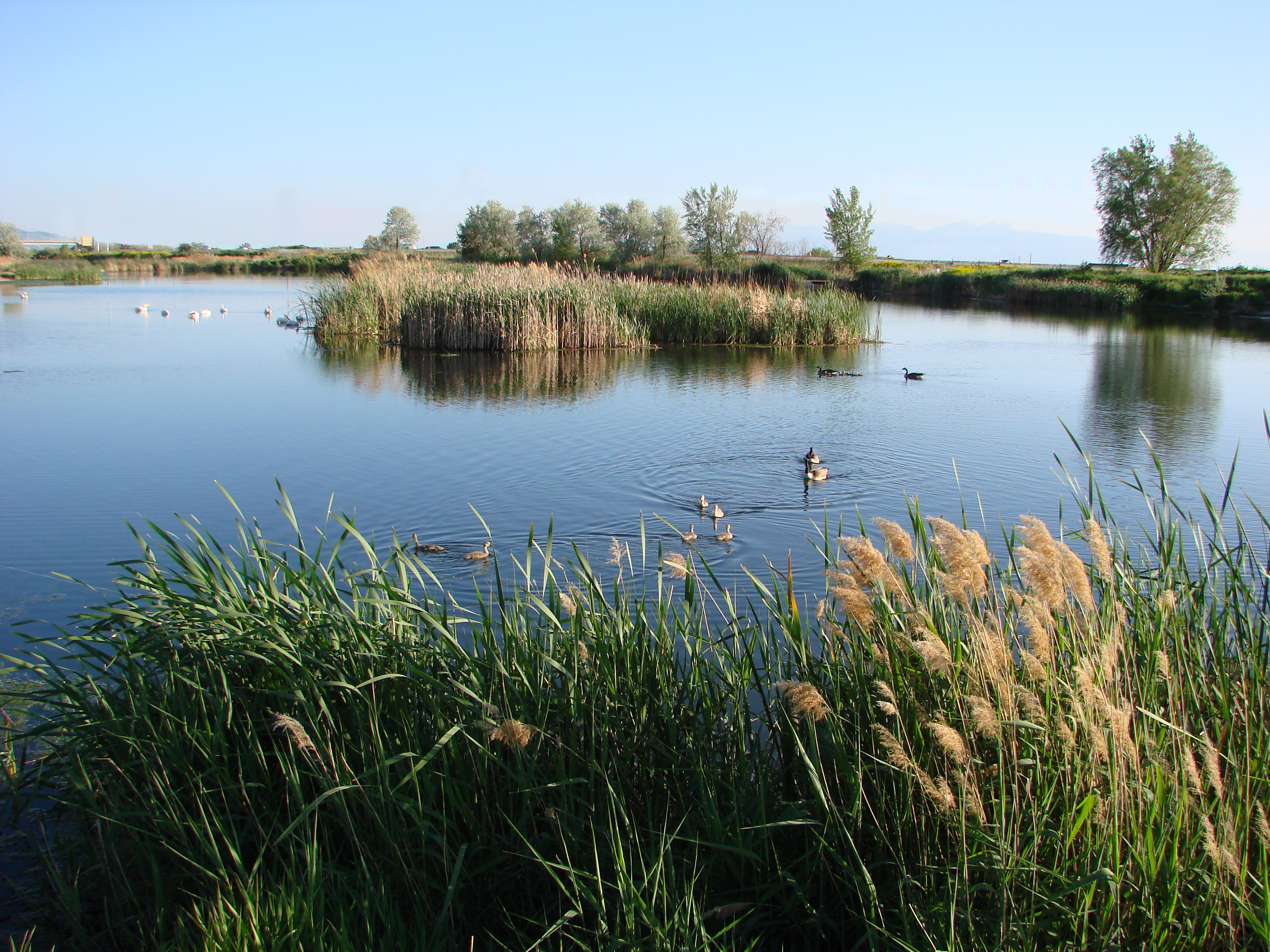
    Wetlands- What’s in a name? Pond and marsh showing wetland plants with Canada geese goslings and pelicans. Photo Courtesy and Copyright Mark Larese-Casanova
    Pond and marsh showing
    wetland plants with
    Canada geese goslings and pelicans.
    Courtesy & Copyright ©
    Mark Larese-Casanova

    Wetlands- What’s in a name? Pickleweed growing in a salt playa is adapted to growing in saline soils. Photo Courtesy and Copyright Mark Larese-Casanova
    Pickleweed growing in a salt playa
    is adapted to growing in saline soils.
    Courtesy & Copyright ©
    Mark Larese-Casanova

    Hi, this is Mark Larese-Casanova from the Utah Master Naturalist Program at Utah State University Extension.Wetlands- What’s in a name?

    A wetland really is more than just ‘land that is wet’. There are certain key ingredients that need to go into a wetland for it to truly be a wetland. Of course, water needs to be present for at least part of the growing season. It can simply be in the form of temporarily saturated soils or even standing water a few feet deep.

    As soil becomes saturated with water, oxygen levels are greatly reduced. Quite often, bacteria in saturated soils will create hydrogen sulfide, giving wetland soils that stinky odor of rotten eggs. As plants grow in a wetland over several years, their decaying matter helps to create a thick, dark layer of organic soil.

    The presence of water in a wetland encourages the growth of hydrophytes, or ‘water-loving’ plants, that are specially adapted to living in wet environments. Many wetland plants have open spaces within the leaves and stems- often referred to as aerenchyma. This allows oxygen to diffuse down to the roots, sometimes creating an oxygen-rich environment in the soil around a plant. Also, many wetland plants reproduce both by floating or wind-dispersed seeds and by rhizomes, which are underground roots that can travel great distances. Some plants that grow in salty wetlands around the Great Salt Lake are able to control the salt in their tissues by depositing it on the outside of the leaf or containing it in chambers within their cells.

    Like plants, specially adapted animals also call wetlands their home. Mammals and birds have oily fur or feathers that allow them to swim in cold water without losing much body heat. They also often have webbed feet to aid in swimming. Other animals, such as fish, amphibians, and insects, have gills to breathe in water.

    Despite being the second driest state in the country, Utah has a high diversity of wetlands. Vast marshes surround the Great Salt Lake, providing habitat to enormous populations of migratory birds. Less obvious wet meadows provide unique habitat to butterflies and other insects. Salty playas, which are shallow basins with no outlet, are found throughout the West Desert, creating unique ecosystems of highly adapted plants. Riparian wetlands can grow along the edges of rivers, providing a unique transition between the swift water and upland habitats. Southern Utah is home to some peculiar wetlands such as potholes and hanging gardens, both associated with sandstone bedrock. A hanging garden clings to the side of a moist cliff, creating a microhabitat for rare plants, such as orchids and monkeyflower. Potholes can simply be eroded basins in the sandstone where water collects in spring. A pothole is an oasis that provides water for desert wildlife and a home for fairy shrimp and spadefoot toads.

    Spring is the perfect time of year to visit a wetland. The constant chorus of birds, insects and amphibians are a testament to the importance of wetlands, teeming with life in the middle of a desert.

    For Wild About Utah, I’m Mark Larese-Casanova.

    Credits:

    Images: Courtesy & Copyright © Mark Larese-Casanova

    Text:     Mark Larese-Casanova, Utah Master Naturalist Program at Utah State University Extension.
    Additional Reading:

    Mitsch, W.J., and J.W. Gosselink. (1993). Wetlands. Van Nostrand Rheinhold.

    Tiner, R. W. (1999). Wetland Indicators: A Guide to Wetland Identification, Delineation, Classification, and Mapping. CRC Press

    Utah Division of Wildlife Resources. (1995). Playas to Marshes…Where Water Meets Land. Growing WILD Newsletter. https://www.wildlife.utah.gov/education/newsletters/95spring-gw.pdf

    Utah Division of Wildlife Resources. (2003). Utah’s Wonderful Wetlands Activity Guide. https://wildlife.utah.gov/education/pdf/wetlands_activity_guide.pdf
    Wetlands- What’s in a name?
    Wetlands- What’s in a name?
    Wetlands- What’s in a name?

    A Grand Old River

    A Grand Old River: The Island Acres Part of James M. Robb Colorado River State Park Fruita, CO Courtesy Daniel Smith, Photographer
    The Island Acres Part of
    James M. Robb Colorado River State Park
    Fruita, CO
    Courtesy Daniel Smith, Photographer

    The Colorado River from Dead Horse Point State Park, near Moab,Utah, USA Courtesy Phil Armitage, Photographer The Colorado River from
    Dead Horse Point State Park,
    near Moab,Utah, USA
    Courtesy Phil Armitage, Photographer

    Confluence of the Colorado and Green Rivers in Canyonlands National Park Courtesy USGS Photo by Marli Miller, Photographer Confluence of the Colorado and Green Rivers
    in Canyonlands National Park
    Courtesy USGS
    Photo by Marli Miller, Photographer

    Confluence of the Colorado and Green Rivers in Canyonlands National Park Courtesy National Park Service Confluence of the Colorado and Green Rivers
    in Canyonlands National Park
    Courtesy National Park Service

    Map of the Colorado River Watershed by Karl Musser based on USGS data This file is licensed under the CCA ShareAlike 2.5 License. Map of the Colorado River Watershed
    by Karl Musser based on USGS data
    This file is licensed under the
    CCA ShareAlike 2.5 License.

    Hi, I’m Holly Strand of Stokes Nature Center in beautiful Logan Canyon.

    The Colorado River is the largest waterway in the southwest. 1,450 miles long, the Colorado River basin drains 248,000 square miles in 7 large states. In Utah, the river enters near Cisco south of I-70, winds its way through Arches and Canyonlands National Parks, then flows through Glen Canyon and exits south into Arizona.

    Less than 100 years ago, the Colorado River wasn’t in Utah or even in Colorado. Until 1920, “Colorado River” referred only to the river section downstream from Glen and Grand Canyons. Upstream, it was called the Grand River all the way up the headwaters in the Colorado Rockies. Thus we have Grand County in Utah and the town of Grand Junction in Colorado.

    According to Jack Schmidt, professor in Utah State University’s Department of Watershed Sciences and a longtime scholar of the river, the good citizens of the state of Colorado weren’t pleased with the Colorado River’s location.
    So in 1920, the Colorado Legislature renamed Colorado’s portion of the Grand River, with a somewhat awkward result: The Colorado River began in Colorado, became the Grand River at the border with Utah and then became the Colorado River again at the confluence with the Green.

    This arrangement did not last long –again because of a Colorado legislator. U.S. Representative Edward T. Taylor, petitioned the Congressional Committee on Interstate and Foreign Commerce to rename the entire river as the Colorado. Despite objections from Utah and Wyoming representatives and the U.S. Geological Survey, the name change was made official by the U.S. Congress on July 25, 1921.

    The objections were legitimate: In the 1890s the Federal Board on Geographic Names established the policy of naming rivers after their longest tributary. The former Grand River of Colorado and Utah was shorter than the Green River tributary by quite a bit. So the Green river should have prevailed and the Colorado should have been one of its tributaries.

    However, if you judge tributary primacy by volume, the Colorado wins hands down. 100 years ago, the upper Colorado (or former Grand River) had a significantly higher total flow than the Green.

    But what’s in a name? Prior to widespread European settlement, the Grand River was known as Rio Rafael and before that, different parts of the river had numerous Native American and Spanish names. A thousand years from now the rapidly evolving Colorado could have an entirely different identity. The main thing is that Utahns can enjoy and appreciate the habitat, scenery and many resources that this important waterway provides.

    Thanks to the USU College of Natural Resources and the Rocky Mountain Power Foundation for supporting research and development of this Wild About Utah topic.

    For Wild About Utah and Stokes Nature Center, I’m Holly Strand.

    Credits:


    Images:

    JamesMRobbColorado_riverDanielSmith.jpg: Taken in the Island Acres Part of James M. Robb Colorado River State park by Daniel Smith and released into the Public domain.

    DeadHorsePtSP_UtahPhilArmitage.jpg: The Colorado River from Dead Horse Point State Park, near Moab, Utah, USA. Photo by Phil Armitage (May be used for any purpose)

    ConfluenceUSGSMarliMiller.jpg: Confluence of the Colorado and Green Rivers in Canyonlands National Park. USGS Photo by Marli Miller.

    ConfluenceNPS.jpg: Confluence of the Colorado and Green Rivers in Canyonlands National Park. National Park Service.

    Colorado River Watershed Map, by Karl Musser based on USGS data, licensed under the
    Creative Commons Attribution ShareAlike 2.5 License: In short: you are free to share and make derivative works of the file under the conditions that you appropriately attribute it, and that you distribute it only under a license identical to this one. Official license


    Text: Mary-Ann Muffoletto, Holly Strand, Content reviewed by Jack Schmidt of Utah State University’s Department of Watershed Sciences and a longtime scholar of the Colorado River.

    Sources & Additional Reading:


    Benke, A. C., and C. E. Cushing (editors). 2005. Rivers of North America. Academic/Elsevier. Amsterdam/Boston, 1168 pages.

    Casey, Robert L. Journey to the High Southwest. Guilford, CT: Globe Pequot, 2007, p. 20.

    Colorado Historical Society, Frontier Historical Society, www.bioguide.congress.gov

    https://www.postindependent.com/article/20080325/VALLEYNEWS/68312863

    ”First Biennial Report of the Utah Conservation Commission, 1913,” Salt Lake City, Utah: The Arrow Press Tribune-Reporter Printing Co., 1913. p. 131.

    McKinnon, Shaun. “River’s headwaters determined by politicians, not geography.” The Arizona Republic, 25 July 2004.

    James, Ian, Scientists have long warned of a Colorado River crisis, The Los Angeles Times, July 15, 2022, https://www.latimes.com/california/story/2022-07-15/scientists-have-long-warned-of-a-colorado-river-crisis