Colorado vs. Utah Snow

Utah snow in author's backyard: relatively light and dry--and definitely deep, Photo Copyright 2010 Holly Strand
Utah snow in author’s backyard:
relatively light and dry
–and definitely deep.
Copyright © 2010 Holly Strand

Hi I’m Holly Strand.

Growing up in Colorado, it never crossed my mind that the snow might be better somewhere else. I believed that my state was the center of the universe– at least as far as snow and skiing were concerned. A couple of decades passed and now I am a Utah resident. I couldn’t help but notice that snow quality here is well beyond satisfactory. And many Utah license plates claim the Greatest Snow on Earth. So, I wondered… Who has better snow? Colorado or Utah?

People usually assume that “great snow” means voluminous and powdery. So let’s compare the 2 states using measures of snow depth for volume and measures of water content for powder.

As far as snow depth, Alta takes the cake and wins mega points for Utah. According to data collected by ski area avalanche professionals, Alta’s average annual snowfall from Nov 1-Apr 30 is 530 inches. That’s 44 feet of snow ! A few other Utah resorts,–plus Colorado’s Wolf Creek Pass–come next with 400 + inches. After that, you get several 300+ inches resorts in both states. More in Colorado, but that’s just because there are more resorts in general. Colorado also has a bunch of areas with 200+ inches. But the point is that a handful of super-snowy resorts lead the pack and most of them are in Utah.

Next I located National Weather Service data for the average water content of freshly fallen snow. The lower the value, the drier the snow. It turns out that the mean water content of new snow decreases as you move eastward from the Pacific Coast to the Rockies. You get values around 12 % water content for the Sierras. This is the infamous Sierra Cement. Intermountain (including the Wasatch Mountains) values hover around 8.5%. The mean water content value for Central Rocky Mountain stations was close to 7%. So in general, Colorado has less watery snow. Of course there are localized anomalies in each state. But overall, Colorado appears to edge out Utah for light, dry, and fluffy snow.

So who has the best snow overall? Well, I guess I still haven’t solved that issue. Best to discuss it further after an exhilarating day on the slopes. Let us know what you think: Send us an email at wildaboututah@gmail.org

For data sources and archives of past Wild About Utah episodes visit www.wildaboututah.org

For Wild About Utah, I’m Holly Strand.

Credits:

Photos: Courtesy and Copyright 2010 Holly Strand

Text: Holly Strand

Sources & Additional Reading:

Armstrong, R.L. and B.R. Armstrong. 1987. Snow and avalancheclimates of the western United States: a comparison of maritime, intermountain and continental conditions. IAHS Publ. 162
(Symposium at Davos 1986 – Avalanche Formation, Movement and Effects), 281–294

Baxter, M.A., C.E. Graves, and J.T. Moore, 2005: A Climatology of Snow to Liquid Ratio for the Contiguous United States, Weather and Forecasting, 20, 729-744.

Crocker, Tony. BESTSNOW.NET – an independent statistical analysis of snow characteristics (based on data collected by ski area avalanche professionals) at major North American ski resorts. https://webpages.charter.net/tcrocker818/ [accessed December 14, 2010]

Steenburgh, W. J., and T. I. Alcott, 2008. Secrets of the “Greatest Snow on Earth.” Bull. Amer. Meteor. Soc., 89, 1285-1293.


Utah’s Desert Fox

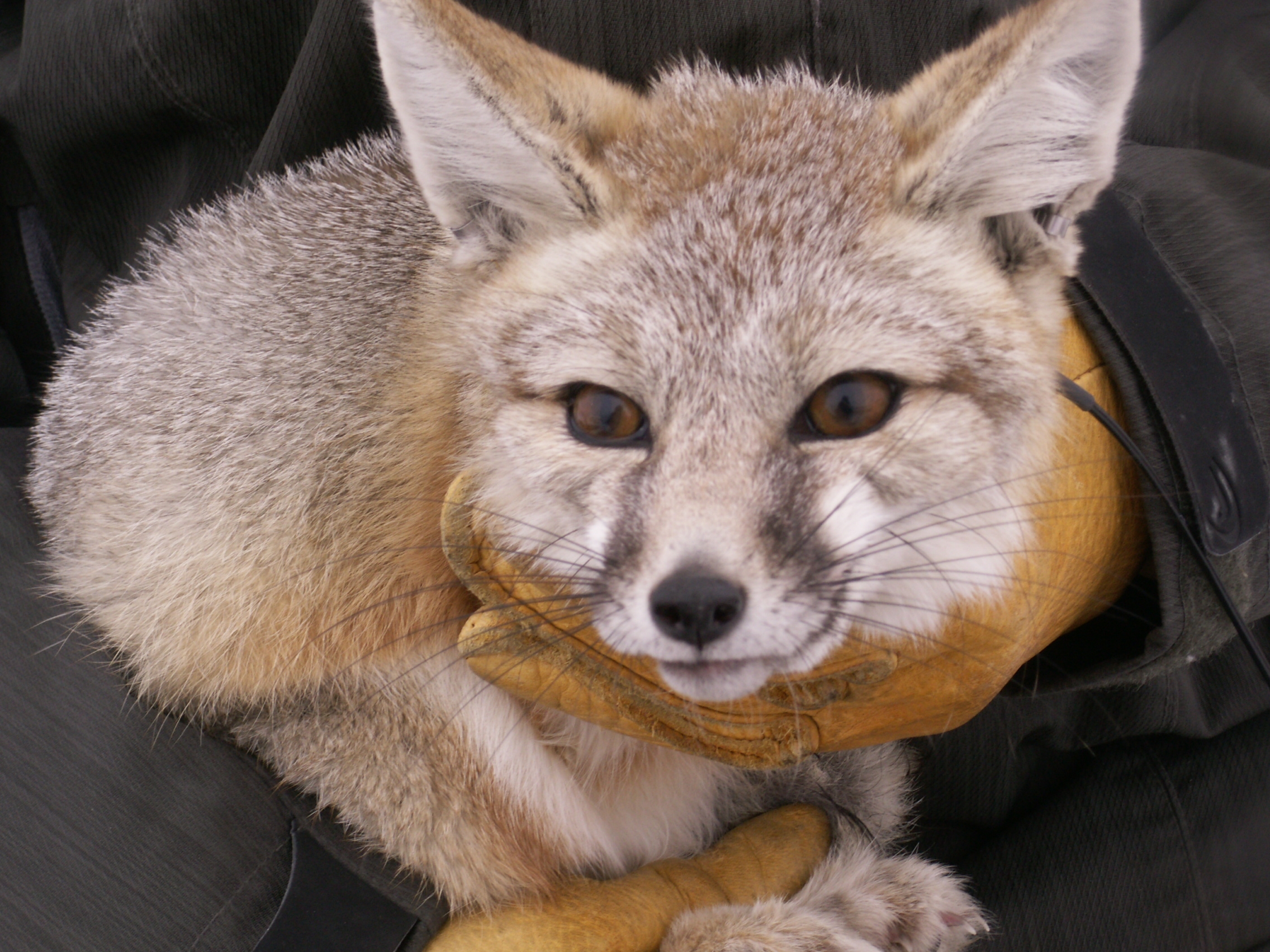
Kit Fox, click to view larger image, Photo Courtesy and Copyright © 2009 Bryan Kluever, graduate research assistant, Utah State University Department of Wildland Resources
PhD student Bryan Klueve
with an adult kit fox
that was captured
with a box trap.
Kit foxes are weighed,
fitted with a radio collar,
and then released
Courtesy & Copyright © 2010
Bryan Kluever
Graduate Research Assistant
Utah State University
Dept of Wildland Resources

Hi, I’m Holly Strand from Stokes Nature Center in beautiful Logan Canyon.

The kit fox just might be Utah’s cutest mammal. Weighing in at four to five pounds or so, the kit fox is about a third of the size of the more common red fox.. The kit fox has delicate cat- like features and it has comically large, furry ears. It’s desert-colored coat is tinged with rusty orange finishing in a long black-tipped bushy tail.

The kit fox is the only desert dwelling fox in North America. In Utah, you’ll find it mostly in the western part of the state, where it lives off field mice and jackrabbits as well as insects, birds, amphibians and fish.

The kit fox has evolved a number of adaptations to deal with the desert’s harsh conditions.. First of all those big ears aren’t just for looks. They help the kit fox dissipate body heat through evaporative cooling.

Secondly, kit foxes are nocturnal, avoiding the high temperatures of the daytime hours. During the day they lounge in subterranean dens.

Kit fox legs are relatively short for a fox. That helps them zig-zag through the brush when chasing prey or being chased. And the pads of their paws are furry which gives them better traction in the sandy soil of desert habitats.

Long droughts are common in desert environments and kit foxes have developed ways to deal with them. During a drought, fewer vixens breed and litters become smaller. Kit fox families maintain large territories—larger than necessary for normal years. So when a drought hits, and the population of prey species plummets, the foxes have a larger area in which to hunt.

Adult kit fox prior to being
released. Note the black
collar antenna on the right
side of the fox.
Courtesy & Copyright © 2010
Bryan Kluever

Kit foxes get top marks in water conservation. Little goes in and little comes out.. A kit fox can exist for many months without ever drinking water. Instead, the fox can draw water from the food that it eats. And that water is used with great efficiency. Little is lost through metabolic processes such as urination, defecation breathing and panting.

Too see pictures of the diminitive kit fox, go to www.wildaboututah.org

Thanks to Brian Kleuwer and Mary-Ann Muffoletto of Utah State University’s College of Natural Resources for supporting this Wild about Utah topic.

For Wild About Utah and Stokes Nature Center, I’m Holly Strand.
Credits:
Images: Courtesy & Copyright Bryan Kluever, USU Department of Wildland Resources
Text:     Mary-Ann Muffoletto, Utah State University College of Natural Resources

Additional Reading:

White, P. J. and K. Ralls. 1993. Reproduction and spacing patterns of kit foxes relative to changing prey availability. Journal of Wildlife Management 57:861–867 The Wildlife Society, https://si-pddr.si.edu/dspace/bitstream/10088/510/1/White1993.pdf

Kit Fox (Vulpes macrotis), Wildlife Notebook Series No. 9, Utah Division of Wildlife Resourceswildlife.utah.gov/publications/pdf/2010_kit_fox.pdf

Kit Fox (Vulpes macrotis), Species Fact Sheets, Utah Conservation Data Center, Utah Division of Wildlife Resources, https://dwrcdc.nr.utah.gov/rsgis2/Search/Display.asp?FlNm=vulpvelo

Beavers: The Original Army Corps of Engineers

Beaver with branch in water
Courtesy US FWS,
Steve Hillebrand, Photographer


Hi, I’m Holly Strand from Stokes Nature Center in beautiful Logan Canyon.

Beavers and beaver dams are a common feature of the Utah landscape. You’ll see the dams on smaller streams and side channels, constructed of branches, downed trees and mud. The still, deep water of the resulting pond creates ideal conditions for a beaver lodge. Beavers can escape and hide from predators by slipping into the pond and disappearing into the lodge. Beavers also use their ponds to cache their favorite
food—aspen and willow.

Because of their tree cutting and dam making skills, humans tend to have two divergent opinions of beavers: 60-pound nuisance or environmental engineer.

Beaver lodge
Courtesy US FWS
Hans Stuart, Photographer

Beavers are considered a nuisance when they gnaw down trees that humans want to keep. Dams can flood roads or stop up irrigation canals. When beaver activity conflicts with human interests, they—the beavers–are likely to be trapped and killed.

However, beaver activity has many positive environmental consequences that we are just beginning to appreciate. Wetlands created by beaver dams help soak up sediments, improving downstream water quality. Because of beaver dams, the winter snowpack isn’t lost in a short spring pulse, This results in a more constant stream flow through the summer –and that’s important as Utah’s climate is predicted to become drier. Finally, beaver dams enhance habitat for many other fish and wildlife species and plants.

Beaver in pond
Courtesy US FWS
Steve Hillebrand, Photographer

According to Dr. Joe Wheaton, a geomorphologist at Utah State University, there’s a lot of untapped potential for employing beaver engineers in stream and floodplain restoration. Say you want to restore a stream by reconnecting it with its floodplain. You need to excavate channels, redirect stream flow, revegetate and nurture the
area for a long period of time. To accomplish this, you often need a
number of highly trained professionals and some large Tonka toys.

Alternatively –under the right conditions– you might transplant a
colony of beavers and let them apply their vigorous work ethic to your
landscape and get quite satisfying results.

Recognizing that nuisance beavers can be rehabilitated into hard
working wetland engineers and stream habitat restorationists, the Utah
Division of Wildlife Resources has rolled out the state’s first beaver
management plan in 2010. This plan encourages live trapping of entire
families of beavers in nuisance areas and moves them to specific sites where their
environmental services can be appreciated and put to use.

Beaver in snow
Courtesy US FWS

Thanks to the USU College of Natural Resources for supporting this Wild about Utah topic.

For Wild About Utah and Stokes Nature Center, I’m Holly Strand.

Credits:
Images: Courtesy US FWS, Photographers: Steve Hillebrand and Hans Stuart, https://images.fws.gov
Text: Holly Strand, Stokes Nature Center

Sources & Additional Reading

Collen, P. and R.J. Gibson. 2001. The general ecology of beavers (Castor spp.), as related to their influence on stream ecosystems and riparian habitats, and the subsequent effects on fish – a review. Reviews in Fish Biology and Fisheries 10: 439–461, 2001. https://web.archive.org/web/20230202160926/https://www.researchgate.net/publication/227028536_The_general_ecology_of_beavers_Castor_spp_as_related_to_their_influence_on_stream_ecosystems_and_riparian_habitats_and_the_subsequent_effects_on_fish_-_A_review [ Accessed May 1, 2010]

Prettyman, B. 2009. Utah wildlife: Leave it to the beavers. Article in Salt Lake Tribune, October 16, 2009. https://www.sltrib.com/ci_13570110 [ Accessed April 29, 2010]

Smithsonian Castor Canadensis Information Page https://www.mnh.si.edu/mna/image_info.cfm?species_id=32 [ Accessed April 29, 2010]

Big Bend Habitat Restoration Project: A Natural Work of Heart, Open Spaces-A Talk on the Wild Side, US FWS, https://www.fws.gov/news/blog/index.cfm/2016/3/25/Big-Bend-Habitat-Restoration-Project-A-Natural-Work-of-Heart [Accessed March 31, 2016]

Beaver Dams Strengthened by Humans Help Fish Rebound
60-Second Science – July 25, 2016 – By Jason G. Goldman02:29 https://www.scientificamerican.com/podcast/episode/beaver-dams-strengthened-by-humans-help-fish-rebound/ Also available through the podcast https://itunes.apple.com/us/podcast/60-second-science/id189330872?mt=2

Restoring Degraded Waters, One Pest at a Time, Utah State Magazine, Utah State University, December 7, 2021, https://utahstatemagazine.usu.edu/environment/restoring-degraded-waters-one-nuisance-at-a-time/

Goldfarb, Ben, Eager: The Surprising, Secret Life of Beavers and Why They Matter, Chelsea Green Publishing, March 8, 2019, https://www.amazon.com/Eager-Surprising-Secret-Beavers-Matter/dp/1603589082/ref=asc_df_1603589082/

Hot Springs

Utah Hot Springs
Click map for larger view
Map by H. Strand, Data from
Blackett and Wakefield 2002.
Hi, I’m Holly Strand from Stokes Nature Center in beautiful Logan Canyon.

Cold weather getting to you? Can’t swing a trip to Hawaii or the Carribean this year?

Fortunately for us, there’s a natural antidote to winter right here in Utah Hot springs abound in the Beehive State. According to a Utah Geological Survey database, there are 106 known springs with waters above 25 degrees Celsius or 77 degrees Fahrenheit. The hottest temperature recorded in a Utah spring is 91 degrees Celsius or 195 degrees Fahrenheit at Crystal Hot Springs in Salt Lake County.

Hot springs develop when rain and melted snow infiltrate into the ground. This ground water then sinks deep enough to be warmed by the heat contained in the earth’s interior. Because hot water is less dense it is pushed back to the surface by the continued sinking of incoming heavier, cold water. Replenishment through surface precipitation creates a continuous cycle.

Why do some areas have hot springs and others do not? While there is heat in the earth beneath any spot on the surface, in some areas, this heat is concentrated closer to the surface. For instance, in and around volcanoes–this is the case in Yellowstone area.

Luckily, we don’t know of any volcanoes lurking beneath us. But we know that the Basin and Range area of western Utah, southeastern Idaho, Nevada and eastern California, is expanding or spreading. This spreading movement leaves a relatively thin crust. And a thinner crust means heat is closer to the surface. Furthermore, crustal movement create surface faults that allow cold water to seep down and warm water to flow out. Thus with few exceptions, the higher temperature geothermal areas in Utah occur either in the Basin and Range Province or within the Basin and Range-Colorado Plateau transition zone.

Geothermal sources have many practical uses. The Blundell power station at the Roosevelt Hot Springs geothermal area near Milford produces commercial energy. There are several greenhouses and aquaculture facilities in Utah using geothermal resources. But my favorite application of geothermal waters would be the hot spring spa or swimming pool. Soakersbible.com lists 16 of these in Utah. And for those of us in northern Utah there’s at least ten more right across the border in Idaho.

For maps and sources of information on hot springs and spas, see Wildaboututah.org.
Thanks to the Lion’s Gate Manor in Lava Hot Springs for supporting research and development of this Wild About Utah topic.

For Wild About Utah and Stokes Nature Center, I’m Holly Strand.
Credits:

Images: Map by H. Strand, Data from Blackett and Wakefield 2002.

Text:     Holly Strand, Stokes Nature Center

Sources & Additional Reading:

Blackett, R.E., and Wakefield, S.I., 2002, Geothermal resources of Utah, a digital atlas of Utah’s geothermal resources: Utah Geological Survey, OFR-397, CD-ROM. Available online https://ugspub.nr.utah.gov/publications/open_file_reports/ofr-431/ofr-431_geothermal-resources-utah.pdf

https://geology.utah.gov/map-pub/maps/interactive-maps/wells-springs/ [Updated February 1, 2026]

Blackett, R.E. Utah Geothermal Wells & Springs Interactive Map. 1:500,000. Utah Geological Survey, Cedar City Office. https://geology.utah.gov/publication-details/?pub=OFR-431dm. [ Updated February 1, 2026]

DeTar, R.E. Thermal Waters. Digital Atlas of Idaho. https://www.isu.edu/digitalatlas/ [ Updated February 1, 2026]

Oregon Institute of Technology. Geothermal Resources of Utah. Geo-Heat Center Quarterly Bulletin Vol. 25. No. 4. https://www.oit.edu/docs/default-source/geoheat-center-documents/quarterly-bulletin/vol-25/25-4/25-4-bull-all.pdf[ accessed January 10, 2010, Viable target not found February 1, 2026]

Utah Geological Survey. Geothermal Occurrences in Utah. https://www.geology.utah.gov/emp/geothermal/geothermal_occurrences_in_utah.htm

Major Thermal Springs of Utah, Utah Geological Survey, https://ugspub.nr.utah.gov/publications/water_resources_bulletins/WRB-13.pdf

Travel:
Lion’s Gate Manor in Lava Hot Springs. (208) 776-5118 https://www.lionsgatemanor.com/index.html

The Soakers Bible: the definitive guide to hot springs and natural spas in the Western United States. https://www.soakersbible.com/ [Removed May 27, 2018, Website Terminated]

Geothermal Springs in Idaho, https://www.energy.idaho.gov/renewableenergy/recreation.shtml
Replaced with Geothermal Resources in Idaho, https://oemr.idaho.gov/wp-content/uploads/2016/06/geothermal_book_complete_2007.pdf [Added February 1, 2026]