Spontaneous Moments

Spontaneous Moments: Binoculars on the Trail Courtesy & Copyright Joseph Kozlowski, Photographer
Binoculars on the Trail
Courtesy & Copyright Joseph Kozlowski, Photographer
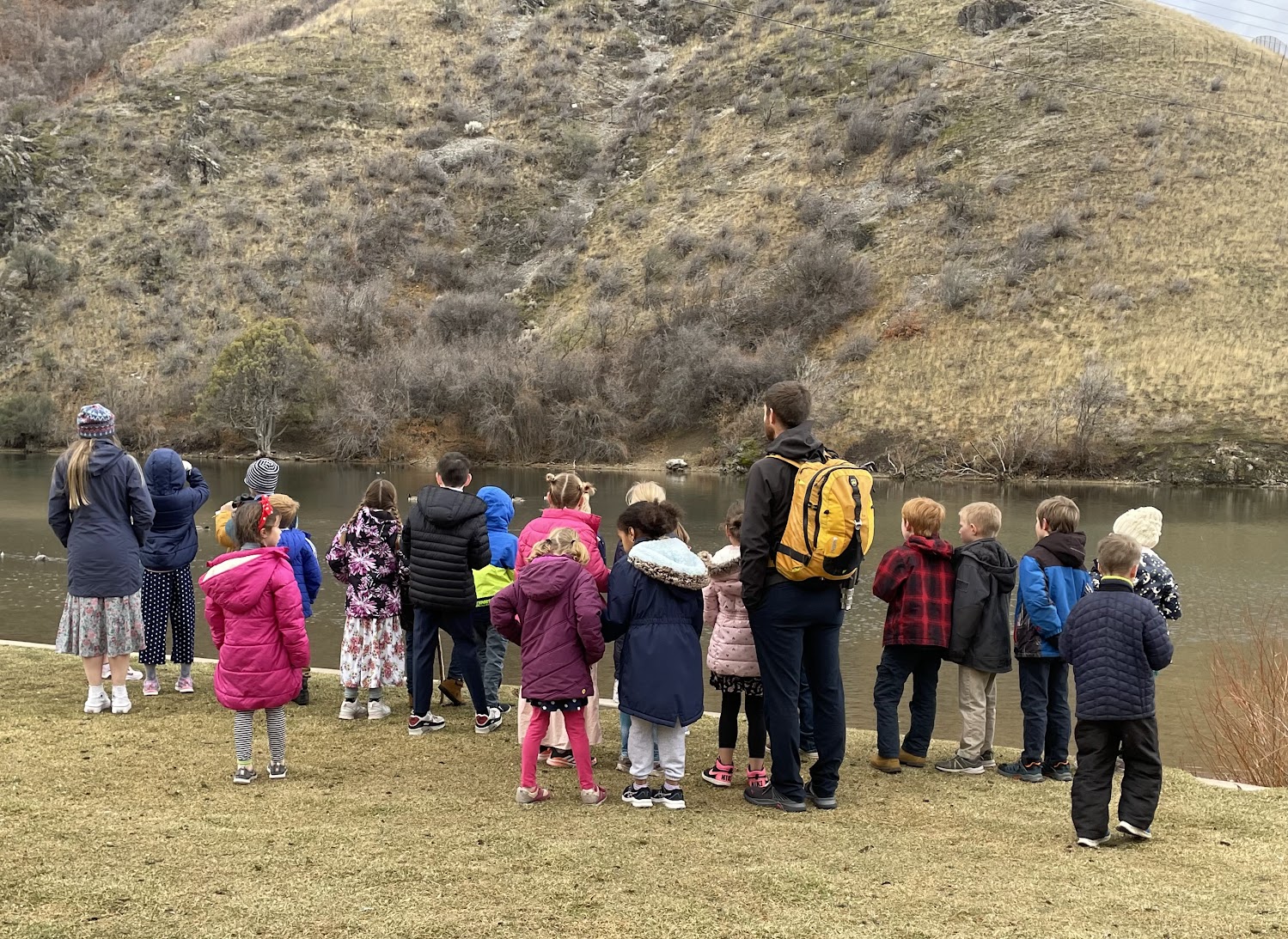
Twelve sweaty, 2nd-grade birders and one worn out teacher stumbled into the shade of the Green Canyon trailhead bathroom facility. It was nearly 90 degrees under the bluebird Utah sky. No one had been quite prepared for the sun, heat, and amount of water they’d need for the journey; they were only halfway done with the hike. Students had discovered several birds along the hike with their binoculars (e.g., Golden Eagle, Yellow-Rumped Warbler, Black-Billed Magpie, and Townsend’s Solitaire), but by the time they reached the trailhead bathroom, their water bottles were empty, their bodies baked, and fatique was setting in.

Cooling Off Courtesy & Copyright Joseph Kozlowski, Photographer
Cooling Off
Courtesy & Copyright Joseph Kozlowski, Photographer

Class and DNR Team in Green Canyon Courtesy & Copyright Joseph Kozlowski, Photographer Class and DNR Team in Green Canyon
Courtesy & Copyright Joseph Kozlowski, Photographer

As the weary birders rested in the shade of the outhouse, they noticed a trail crew from the Department of Natural Resources (DNR) relaxing in some maples nearby, taking a break from their digging and construction project. “You guys look hot, want some water?” called a young DNR crewman. Of course, a chorus of positive replies echoed from the 7-and-8-year-olds. The crewman got out an orange Home Depot cooler and slung it on the back of a work trailer, “Here you go!” and another went to a fancy pull-behind trailer on their work truck, which was equipped with a hose and a nozzle, “This is drinking water too!” The kids dispersed, some leaning their head under the cooler spout and others tentatively holding their mouth wide open, like a baby robin waiting for regurgitated worms, for the crewman to jet water into mouths, still only partially filled with grown-up teeth. Kids laughed and the whole DNR crew chuckled. As kids were drinking a commotion started near the pull-behind trailer with the water hose. What had been a hose and nozzle for administering drinks had become a cooling fountain station. Water was being launched into the air and kids were dancing around underneath with screams of joy. After a minute or two, the teacher gathered the students, thanked the crew, grabbed a picture with them, and started their trip back seeming more refreshed than ever.

Spontaneous moments, unrepeatable circumstances. These are the memory makers. These kids may likely forget every bird they saw on their hike, but they’ll never forget the relief from the heat by playing in the crewman’s water fountain, or leaning under a cooler to grab a quick drink. As a wise outdoor educator, Eric Newell, once told me “Never be too busy outdoors to stop and experience something that excites the kids.”

This is Dr. Joseph Kozlowski and I am Wild About Outdoor Education in Utah!

Credits:

Images: Courtesy & Copyright Joseph Kozlowski, Photographer, Used by Permission
Featured Audio: Courtesy & Copyright © Kevin Colver, https://wildstore.wildsanctuary.com/collections/special-collections/kevin-colver
Text:     Joseph Kozlowski, Edith Bowen Laboratory School, Utah State University https://edithbowen.usu.edu/
Additional Reading Links: Joseph Kozlowski & Lyle Bingham

Additional Reading:

Joseph (Joey) Kozlowski’s pieces on Wild About Utah: https://wildaboututah.org/author/joseph-kowlowski/

Kozlowski, Joseph, Learning Through Birding, Wild About Utah, October 9, 2023, https://wildaboututah.org/learning-through-birding/

A Place for Growth

A Place for Growth: Blackberries, Courtesy & Copyright Joseph Kozlowski
Blackberries
Courtesy & Copyright Joseph Kozlowski
A Place for Growth
A Place for Growth: Grapes, Courtesy & Copyright Joseph Kozlowski Grapes
Courtesy & Copyright Joseph Kozlowski

A Place for Growth: Nectarines, Courtesy & Copyright Joseph Kozlowski Nectarines
Courtesy & Copyright Joseph Kozlowski

A Place for Growth: Peaches, Courtesy & Copyright Joseph Kozlowski Peaches
Courtesy & Copyright Joseph Kozlowski

I was raised in Laramie, WY, which boasts many qualities making it a pleasant place to live. It’s got a safe hometown feel, cool summers, a relatively close proximity to Colorado’s front range, and access to outdoor recreation opportunities such as the geologically magnificent Vedauwoo. However, Gem City is extremely dry and windy, making gardening of any sort challenging. I say this not to bash on my Alma Mater, but to explain why, when I moved to Logan for graduate school I was captivated by the astonishing climate, notably its ability to support gardening!

It was August, 2018 when I first arrived to Logan in my ’98 Tacoma packed to the brim with what I’d need for this next stage of life, and of course my Black Lab, Josi. I vividly remember emerging from Logan Canyon to a view of Cache Valley and being stunned by the lush surroundings. Later that day I discovered an apricot tree in a grass strip next to my new residence; orange/yellow apricots littered the branches and smushed ones lined the sidewalk below. As I casually picked and gobbled a few of the delectable treats, I realized there was a possibly for growing fruit here that I had had little experience with thus far in my life.

Naturally, filled with excitement and intrigue about being able to grow produce, I went to the local Anderson’s Seed and Garden with my visiting sister and bought raspberry, blackberry, and grape starts; as well as a small peach, pear, nectarine, and cherry tree. By the end of that day and with dirt on about every square inch of our bodies, we stood back and admired the newly planted additions, not sure whether they were planted correctly or if they’d survive the first winter. Well, 6 years later and miraculously, all the plants are bearing fruit, despite the constant battle with aphids, over and under watering, and the local Mule Deer thinking the leafy foliage is as tasty as the fruit the trees will produce.

This all brings us to the best part, enjoying nature’s candy! There is a wonderful sense of delight when I pick a peach from my self-planted, backyard tree and bite into the juicy, sweet meat. So, if you are like I was and have no experience growing, well, anything, don’t let that stop you from going to your local nursery and giving it a try. It’s a great way to take advantage of the beautiful climate the great state of Utah offers!

If by chance you find yourself with more fruit than you can manage, make sure to contact USU’s Harvest Rescue program who may be able to salvage leftover fruit and make it accessible to others.

This is Dr. Joseph Kozlowski, and I am wild about Utah!

Credits:

Images: Courtesy & Copyright Joseph Kozlowski, Photographer, Used by Permission
Featured Audio: Courtesy & Copyright © Kevin Colver, https://wildstore.wildsanctuary.com/collections/special-collections/kevin-colver Friend Weller, UPR.org, and Anderson, Howe, Wakeman.
Text:     Joseph Kozlowski, Edith Bowen Laboratory School, Utah State University https://edithbowen.usu.edu/
Additional Reading Links: Joseph Kozlowski

Additional Reading:

Joseph (Joey) Kozlowski’s pieces on Wild About Utah: https://wildaboututah.org/author/joseph-kowlowski/

USU Harvest Rescue, Center for Community Engagement, Christensen Office of Social Action and Sustainability, Utah State University, https://www.usu.edu/social-action-sustainability/get-involved/cache-gleaning

Anderson Seed & Garden, https://andersonseedandgarden.com

Outdoor Experiences in High-Def

First Look Used with permission Courtesy & Copyright Joseph Kozlowski
First Look
Used with permission
Courtesy & Copyright Joseph Kozlowski

The Whole Class with Binoculars Used with permission Courtesy & Copyright Joseph Kozlowski The Whole Class with Binoculars
Used with permission
Courtesy & Copyright Joseph Kozlowski

Finding a Dead Nuthatch Used with permission Courtesy & Copyright Joseph Kozlowski Finding a Dead Nuthatch
Used with permission
Courtesy & Copyright Joseph Kozlowski

A Pine Siskin Courtesy & Copyright Joseph Kozlowski A Pine Siskin
Courtesy & Copyright Joseph Kozlowski

A Crow Courtesy & Copyright Joseph Kozlowski A Crow
Courtesy & Copyright Joseph Kozlowski

Two Nests Courtesy & Copyright Joseph Kozlowski Two Nests
Courtesy & Copyright Joseph Kozlowski

A hot, sunny, May day was Christmas for my avid 2nd-grade birders, when 35 pairs of high-quality Vortex binoculars and chest harnesses were delivered to our Edith Bowen Laboratory School classroom. We had secured a grant from the Utah Division of Outdoor Recreation to purchase supplies to enrich our school’s outdoor education program, specifically my classroom’s integrated focus on birding. Kids cheered when the binos arrived, knowing that we’d be able to put these powerful tools to work in the field. They scrambled to set up the harnesses and prepare the equipment for use.

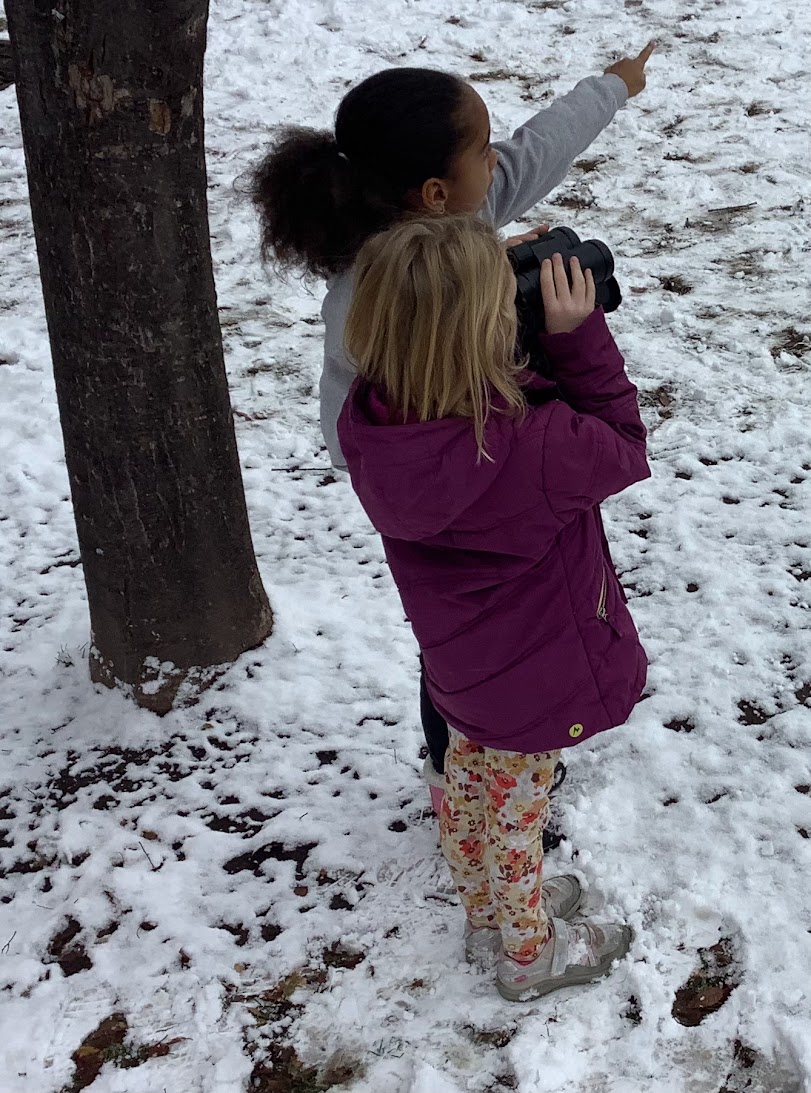
Although the adjacent Logan City Cemetery is one of our frequent birding locations, it was going to be our first outing where all students had their own set of binoculars to view the world in high definition. We left the school equipped with our new binoculars, and students were thrilled about the awaiting possibilities. Long before we arrived at the cemetery the binoculars were put to good use, “Everyone look!” a little girl yelled, “an American Crow!” The sighting stirred commotion as 25, 7-year-olds scrambled to get into position where they could see the large black bird with their binoculars, as it bounced around the USU sidewalks looking for morsels of college students’ neglected snacks. Then ensued a student debate over whether or not the bird of interest was an American Crow or a Common Raven; the victorious crow-supporters claimed victory only when the bird flew away, revealing a fan-shaped tail.

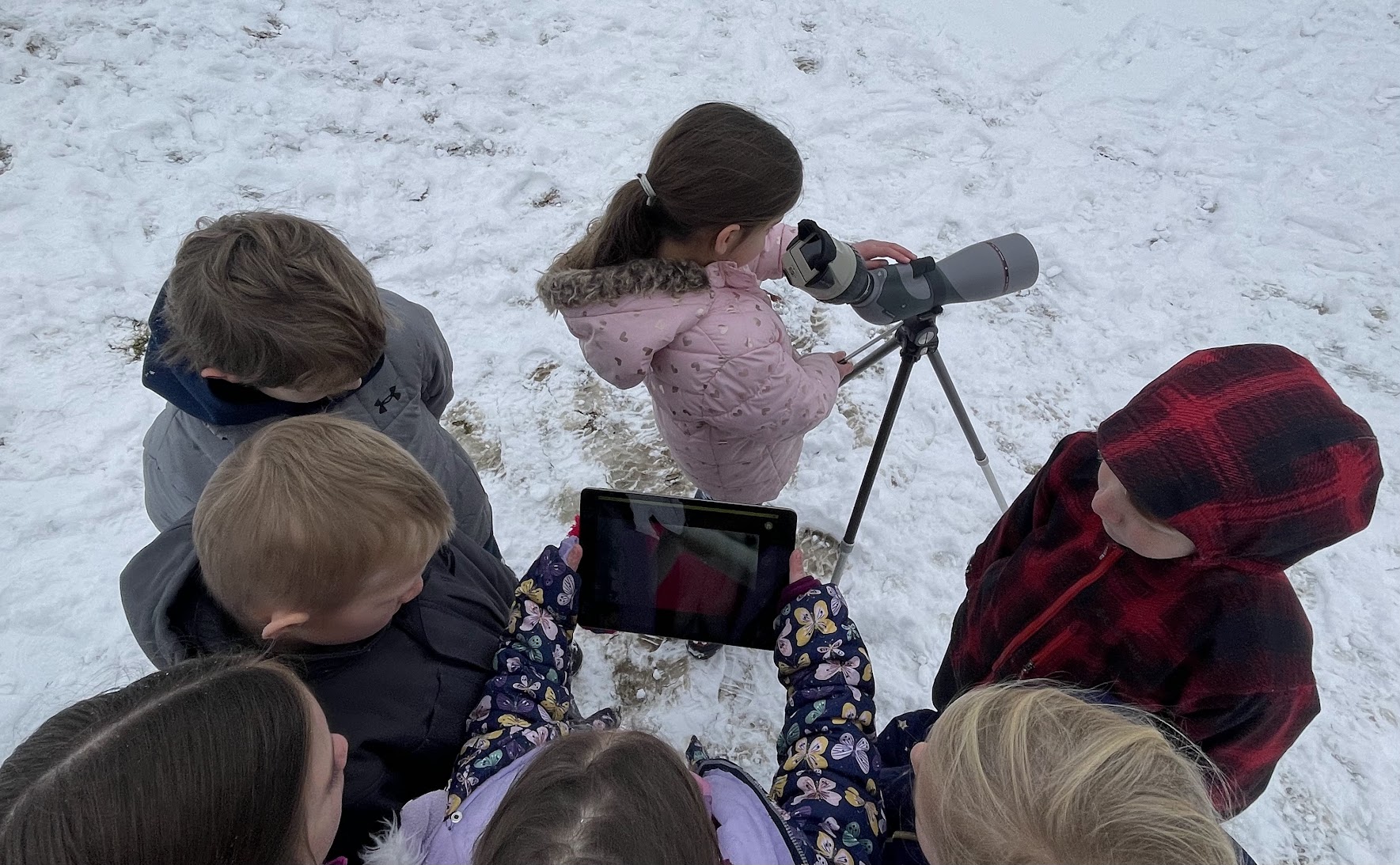
Once we arrived at the cemetery, it was clear students were experiencing this environment in an enriched way thanks to the binoculars. Students spent much more time in each location throughout the cemetery, and there was more advanced and technical dialogue between students about what they were seeing. Students would call each other over to their specific viewing area to show them a bird they had viewed, and they would describe to the person how to find it in their binoculars. This description facilitated incredible spatial language regarding the location and reference of the bird, such as “It is halfway up the largest pine tree on the right” or “Look on the ground next to smaller bush!” One exciting shared discovery was sparked by a high-pitched, upsweeping zreeeeeeeeeeet sound that the students kept hearing. Throughout the walk, students kept using their binoculars to look for the culprit of the sound, to no avail. Then near the end of the outing a student erupted in excitement, calling everyone over to see the bird making the noise. Eventually directing everyone’s focus on the bird, the students discovered a small, white and brown bird atop a sycamore tree, which they identified as a Pine Siskin due to the distinguishing yellow color on the wings.

Other special encounters on this outing included the finding of a dead, Red-Breasted Nuthatch aside the pathway, and the scientific reasoning about who could have been the engineers of two different bird nests found in the grass under trees –a large one with a mud base and a small one full of human hair!

Reluctantly, hot, sweaty, and ecstatic kids returned to school after their first ever birding outing with binoculars and experiences they’ll draw upon forever. No doubt, the binoculars that brought these students these magical discoveries will do so for many kids to come in the future.

This is Dr. Joseph Kozlowski, and I am Wild about Outdoor Education in Utah!

Credits:

Images: Courtesy & Copyright Joseph Kozlowski, Photographer, Used by Permission
Featured Audio: Courtesy & Copyright © Kevin Colver, https://wildstore.wildsanctuary.com/collections/special-collections/kevin-colver
Text:     Joseph Kozlowski, Edith Bowen Laboratory School, Utah State University https://edithbowen.usu.edu/
Additional Reading Links: Joseph Kozlowski

Additional Reading:

Joseph (Joey) Kozlowski’s pieces on Wild About Utah: https://wildaboututah.org/author/joseph-kowlowski/

Grants & Planning, Utah Outdoor Recreation, Utah Department of Natural Resources, https://recreation.utah.gov/utah-outdoor-recreation-grant/

Binoculars, Vortex Optics, https://vortexoptics.com/optics/binoculars.html

Grant assistance provided by Bridgerland Audubon Society: https://bridgerlandaudubon.org/about-us/grant-funded-projects/

YOU can inspire the next generation of birders, email seeking support for American Birding Association’s Young Birder mentoring program, June 12, 2024, https://api.neonemails.com/emails/content/N_INi5O3fy9qblwkA6KQ0BSTBplt7i-KGshPfQ0eZWg=

Mallard Musings

Mallard Musings: Fall Migration at the Bear River Migratory Bird Refuge, Courtesy & Copyright Brian W. Ferguson, Photographer
Fall Migration at the Bear River Migratory Bird Refuge
Courtesy & Copyright Brian W. Ferguson, Photographer
The Bear River Mountains near the Utah/Idaho border are the headwaters of the Logan River, which flows southwest through Logan Canyon, works its way westward through Logan, and converges with the Little Bear and Bear River about 5 miles west of town. All three rivers are halted by Cutler Dam to form Cutler Reservoir. The Bear River exits the dam which continues southwest and drains into the Great Salt Lake. The portion of the Great Salt Lake where the Bear River drains is managed by the federal Bear River Migratory Bird Refuge which holds spectacular opportunities to view some of nature’s most stunning birds. With a lovely visitor’s center and an auto tour route, even an inexperienced outdoorsman is likely to have a magnificent adventure observing birds interacting in an unmolested manner, unpressured by many elements of human development. If you haven’t ventured there, I recommend doing so and I suggest starting your journey at the visitor’s center near Brigham City. However, this segment is not about the fantastical birds at the Bear River Migratory Bird Refuge. Instead, it’s about a bird that many people see daily, and like me, have drifted through years of life without appreciating their beauty or their behavior.

Labs Alert by Passing Mallards, Courtesy & Copyright Joseph Kozlowski, Photographer
Labs Alert by Passing Mallards
Courtesy & Copyright Joseph Kozlowski, Photographer

Perfectly Camouflaged Pair, Courtesy & Copyright Joseph Kozlowski, Photographer Perfectly Camouflaged Pair
Courtesy & Copyright Joseph Kozlowski, Photographer

Ready for Takeoff, Courtesy & Copyright Joseph Kozlowski, Photographer Ready for Takeoff
Courtesy & Copyright Joseph Kozlowski, Photographer

Game of Tag, Courtesy & Copyright Joseph Kozlowski, Photographer Game of Tag
Courtesy & Copyright Joseph Kozlowski, Photographer

My back yard abuts the Logan River as it gently meanders through Logan, UT and my two Labrador Retrievers and I spend many sunny hours sitting in a lawn chair by its banks, enjoying the sound of water and wildlife that call this riverway home. Along with the typical presence of the Black-Capped Chickadees, Belted Kingfishers, American Robins, and Mourning Doves, the stunning green-headed Mallard Duck is a daily companion; one I have grown quite fond of. Often moving in pairs, these boisterous ducks go up and down the river. Sometimes they are flying, one way or the other, wings gliding but six inches off the top of the water. My wet tongued friends are always first to alert me of the flying passers when their heads pop up and ears prick alert. It seems like a dance for the ducks, as one launches from the water for no apparent reason, luring the others to follow. They fly but 50 yards up or down and raucously splash back into the water. No doubt, it seems that a hen is always leading the charge with one, or multiple, green heads following her around. Other times these ducks are bobbling along on the water this way or that. On their way downstream, they seem to stay in the middle and just bounce in the current like a bobber bobs on windy ripples. But on their way upstream, the perfectly camouflaged birds blend into the twigs and boulders on the bank as they pick their way along the side eddies and dabble as they go, heads down and butts erect, foraging for any aquatic insect or vegetation they may find nestled in the stones and debris along the riverbed.

These ducks don’t just stay in the waterway, and often frequent the yards along the river. When on land, these Mallards engage in a game of tag that seems both exhausting and exciting. The drakes seem to chase anything that comes their way, whether it is another drake or a hen. With obvious intentions, the game seems to escalate in the late winter/early spring months as the greenheads become vehemently passionate. These courtship rituals are quite a fascinating site to behold.

So thank you Mallards, for my time by the river just wouldn’t be the same without you to keep me company, and to stir observation and reflection.

This is Dr. Joseph Kozlowski, and I am Wild about Utah!

Credits:

Images: Fall Migration at the Bear River Migratory Bird Refuge-Courtesy & Copyright Brian W. Ferguson, Photographer, Used by Permission
All other images, as marked, Courtesy & Copyright Joseph Kozlowski, Photographer
Audio: Courtesy & © Friend Weller, https://upr.org/, Kevin Colver https://wildstore.wildsanctuary.com/collections/special-collections and J. Chase and K.W. Baldwin. https://upr.org/
Text:     Joseph Kozlowski, Edith Bowen Laboratory School, Utah State University https://edithbowen.usu.edu/
Additional Reading Links: Joseph Kozlowski & Lyle Bingham

Additional Reading:

Joseph (Joey) Kozlowski’s pieces on Wild About Utah: https://wildaboututah.org/author/joseph-kowlowski/

Mallard, Ducks Unlimited, https://www.ducks.org/hunting/waterfowl-id/mallard

Mallard Overview, All About Birds, Cornell Lab of Ornithology, https://www.allaboutbirds.org/guide/Mallard/overview

Bear River Migratory Bird Refuge, US Fish & Wildlife Service, US Department of the Interior, https://www.fws.gov/refuge/bear-river-migratory-bird

About Logan, Logan City, UT, https://www.loganutah.org/visitors/about_logan/index.php

Leavitt, Shauna, The Ecology in and around the Logan River, Wild About Utah, December 2, 2018, https://wildaboututah.org/the-ecology-in-and-around-the-logan-river/