Fall Frost

Frost on a Hairy Leaf
Copyright © 2012 Andrea Liberatore
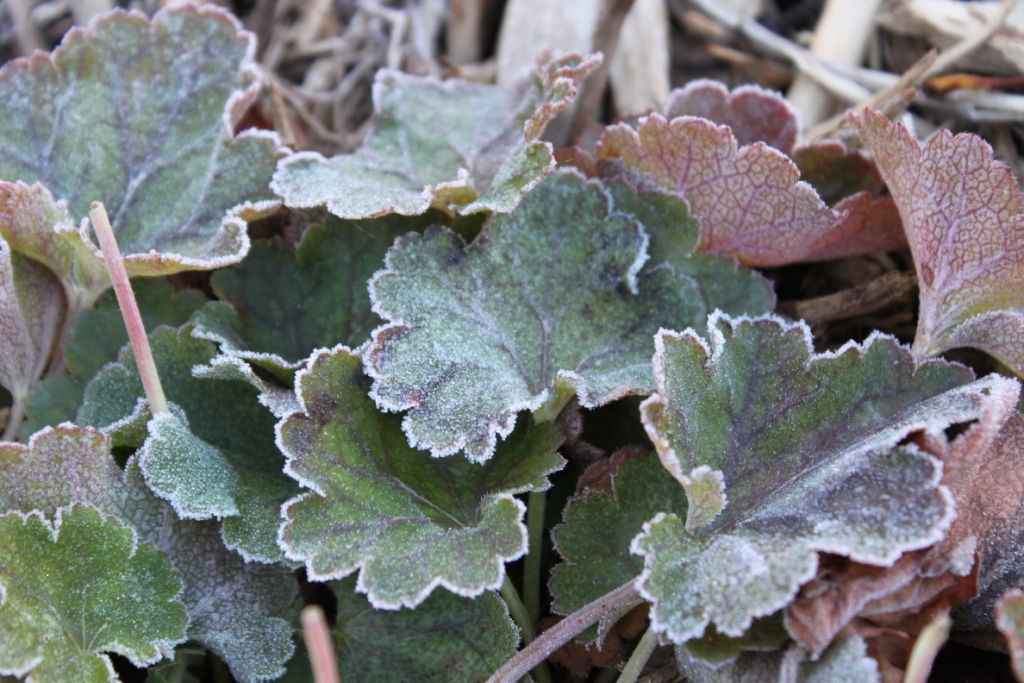
Frost on a Leaf
Copyright © 2012 Andrea Liberatore

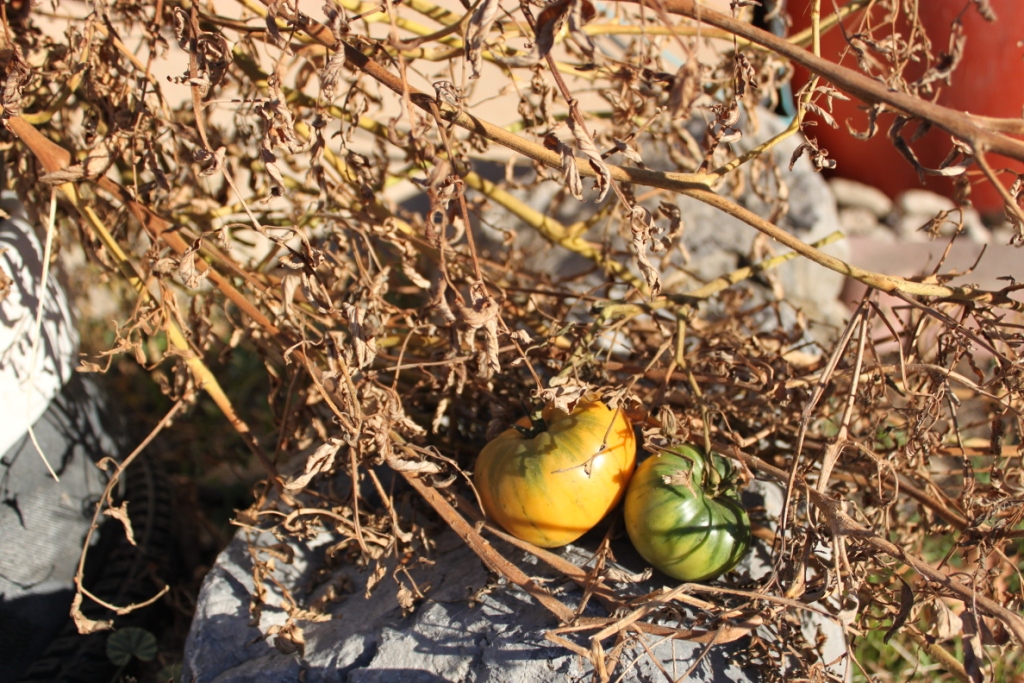
Frost Damage on a Tomato
Copyright © 2012 Andrea Liberatore

Evergreens take hardiness
to the Extreme
Two-needle Pinion Pine
Copyright © 2009 Linda Kervin

Fall has descended in earnest across Utah. Leaves have flashed their colors and dropped to the ground. Juncos have replaced the flycatchers on my backyard’s best perches, and my garden has been cleaned up and tilled under. As I watched the fall weather affect plants in my vegetable garden, I began to wonder about the different reactions they had to the changing temperatures. My tomatoes and squash turned brown and wilted at the merest suggestion of cold temperatures. Other plants, like kale, carrots and onions are still bright and fresh, even after an early snowfall. What is it about some plants that allow them to withstand frost, while others succumb right away?

Frost occurs when the temperature of an object – in this case a plant leaf – falls below the dew point of the air. Moisture from the atmosphere collects on the surface of the leaf and freezes when temperatures drop below 32 degrees. Just seeing frost on a plant doesn’t necessarily mean it will die – it’s the internal tissue temperature that counts. Like humans, plants are made mostly of water – upwards of 80-90% in an herbaceous plant like lettuce. When temperatures drop, the water inside plant cells expands as it freezes, tearing cell walls and causing irreparable damage.

The amount of harm done to a plant depends on many different factors and is generally referred to as a plant’s hardiness. Species or individuals that are more compact will incur damage at a lower temperature than others due to their reduced surface area. Those growing close to the ground are more protected by their proximity to the warm earth. Plants with darker colored leaves such as the deep greens of spinach and chard may be hardier because their leaves absorb and retain heat better than lighter-colored leaves. Fuzzy or hairy leaves also fend off cold temperatures better than their smooth counterparts.

Perhaps the best defense of all is found in plants that protect themselves with natural antifreeze. When frost hits these plants, the relatively pure water in the space between leaf cells freezes first, which in turn draws more water out of the surrounding cells. The remaining cellular fluid contains a high concentration of sugars and other molecules, which reduces the fluid’s freezing point and protects the cell’s contents from ice.

Evergreens, of course, take hardiness to the extreme, utilizing a number of different tactics to remain alive and photosynthesizing throughout the winter. These tactics include compact leaf size, a thick leathery consistency, and a waxy coating that both insulates and prevents water from escaping into the dry winter air.

Frost damage to less hardy plants can be postponed by human interventions such as covering with blankets, but as the cold spells get longer and more frequent, damage is inevitable. Everything has its season, and now is the time to harvest the last of those hardy fall greens and tuck the garden in for the coming winter.

For the Stokes Nature Center and Wild About Utah, this is Andrea Liberatore.

Credits:
Images: Courtesy &
            Copyright 2012 Andrea Liberatore
            Copyright 2009 Jim Cane
Text:     Andrea Liberatore,
            Stokes Nature Center in Logan Canyon.

Additional Reading:


Savonen, Carol (2012) Some plants make natural antifreeze to cope with winter’s wrath. Oregon State University Extension Service. Available online at: https://extension.oregonstate.edu/gardening/node/847


Frost And Your Plants: What You Need To Know, Farmer’s Almanac, November 17, 2021, https://www.farmersalmanac.com/frost-temperature-outdoor-plants-9788

Huber, Kathy (Feb 16, 2002) What Happens When a Plant Freezes. The Houston Chronicle. Available online at: https://www.chron.com/life/gardening/article/What-happens-when-a-plant-freezes-1635570.php

Monarch Butterflies

Click to view a closer view of Andrea Liberatore's photograph of a Monarch butterfly (Danaus plexippus).  Courtesy and Copyright 2009 Andrea Liberatore, Photographer
Monarch Butterfly
Danaus plexippus
Courtesy & Copyright 2009
Andrea Liberatore, Photographer


Click to view a closer view of a Monarch butterfly caterpillar, (Danaus plexippus), Courtesy US FWS, images.fws.govMonarch Butterfly Caterpillar
Danaus plexippus
Courtesy US FWS, images.fws.gov

Click to view a closer view of a Monarch butterfly chrysalis (Danaus plexippus).  Courtesy NASA JPL, climate.nasa.gov, Plant a butterfly garden!, Climate Kids: Earth NowMonarch Butterfly Chrysalis
(Enlarged)
Danaus plexippus
Courtesy NASA JPL, climate.nasa.gov
Plant a butterfly garden!
Climate Kids: Earth Now


Click to view a closer view of Andrea Liberatore's photograph of Gene Nieminen's photograph of Monarch butterflies resting during migration.  Courtesy US FWS, Gene Nieminen, PhotographerA Rest Stop During the
Monarch Butterfly Migration
Courtesy US FWS, images.fws.gov
Gene Nieminen, Photographer

One sure sign that the end of the summer is near are the holes that appear in milkweed leaves this time of year. Take a peek underneath and you might find a great treasure – a chubby caterpillar boldly dressed in yellow, black, and white stripes.

We are currently playing host to two of these voracious larvae at the Stokes Nature Center, satiating their appetites with fresh milkweed leaves in the hopes of witnessing their transformation into a Monarch butterfly.

The incredible story of a Utah monarch begins in southern California in spring. After being dormant throughout winter, an adult female will rouse itself, mate, and begin flying. Monarchs are gliders, meaning they don’t flap their wings much when traveling. Instead they rely on thermal air currents to keep them aloft and moving – traveling up to 80 miles per day. The female flies until she finds habitat suitable for reproduction. There she will lay up to 400 eggs, exclusively on milkweed plants, which contain a toxin that makes caterpillars and adults inedible, or at least unpalatable, to predators.

Eggs of the second generation hatch in April or May. Larvae eat, undergo metamorphosis and keep traveling until they find an ideal place to mate and lay eggs. The adults then die within a few weeks. The third generation hatches in June and July, traveling still farther north and east. This group’s offspring, the fourth generation of the year, are the caterpillars and butterflies we are currently seeing. And this fourth generation does things a little differently.

Once in their adult stage, eating is priority number one. As temperatures turn cool, migration is triggered and the butterflies head for southern California, back to the same place from which their great-grandparents set out in spring. These butterflies live significantly longer than their parents and grandparents, for successful individuals will survive the winter, and start the entire four-generation process over again next year.

Much of a monarch’s migration remains a mystery, and not just how they know when and where to go, but also what routes they use, what habitats they need along the way, and how humans are affecting their movements.

A number of citizen science projects have been established to try and answer these questions. The Monarch Program monitors migration in the western U.S. each fall. Adults are fitted with a small, sticky tag on their right forewing with a color code specific to the tagging site. As these butterflies are spotted again either during migration or at their final destination, data is collected that can help us better understand their journey.

Recent declines in monarch populations make this research all the more important. You can help by cultivating milkweed in your garden to provide habitat to resident monarchs. Anyone with information on the location of caterpillars or chrysalises can contact local Monarch Program volunteer Ron Hellstern for tagging. For more information on tagging and how you can help monarch butterflies, visit our website at www.wildaboututah.org.

For the Stokes Nature Center and Wild About Utah, this is Andrea Liberatore.

Credits:

Images: Courtesy &
Copyright 2009 Andrea Liberatore
Courtesy NASA JPL, climate.nasa.gov
Courtesy US Fish and Wildlife Service,
images.fws.gov
Text:     Andrea Liberatore,
Stokes Nature Center in Logan Canyon.
For Information On Tagging:

The Monarch Program: https://www.monarchprogram.org

To tag butterflies found in Cache Valley, please contact Monarch Program volunteer Ron Hellstern at 435-245-9186. Please note that captive caterpillars or chrysalises are easiest to tag, as capturing adults can harm their wings.

Growing milkweed:

Monarch Watch, Propagation (Growing Milkweeds). https://www.monarchwatch.org/milkweed/prop.htm


Additional Reading:

Pyle, Robert Michael. 1981. National Audubon Society: Field Guide to Butterflies, North America. Alfred A. Knopf: New York.

Monarch Watch: Monarch Life Cycle. https://monarchwatch.org/biology/cycle1.htm

National Geographic: Monarch Butterfly (Danaus plexippus). https://animals.nationalgeographic.com/animals/bugs/monarch-butterfly/

NRCS Partners with Farmers, Ranchers to Aid Monarch Butterflies, Posted by Jason Weller, Chief, Natural Resources Conservation Service, on November 12, 2015, USDA Blog, https://blogs.usda.gov/2015/11/12/nrcs-partners-with-farmers-ranchers-to-aid-monarch-butterflies/

NRCS Working Lands for Monarch Butterflies, https://arcg.is/0TjueO

Spider Silk

Orb Spider Web
Contains 3 Types of Silk

Courtesy & Copyright 2011
Terry Greene, Photographer

Spider silk has long been of interest to scientists and engineers for its incredible strength. Silk can be, by weight, a stronger fiber than steel or Kevlar. But new research has discovered that the strength of the individual fibers does not explain the durability of a web, which can remain functional after sustaining extreme stress. The web’s overall design adds to silk’s durability to create a truly functional product.

Spiders utilize silk for many different reasons – transportation, lining burrows, protecting and securing egg cases, and of course for catching prey. Amazingly, an individual spider has the ability to manufacture several different types of silk, which are used for different purposes. In a typical orb-style web there are at least three kinds of silk at work. One is strong and dry, making up the ‘spokes’ of the web. These are the strands upon which the spider itself moves around, so as not to get stuck in its own trap. The strands which create the characteristic spiral pattern are actually made of two types of silk – one is a fine, stretchy fiber, and the other a sticky, glue-like substance. Together, these two silks make up the part of the web responsible for snaring prey.

Another important property of silk is that when stretched the fiber stiffens. As more pressure is applied, the properties of the silk change, allowing it to become stretchy and flexible. If still more pressure is added, the silk stiffens again, until finally it breaks. Originally, this stiff-stretchy-stiff response to stress was viewed as a weakness, but when analyzed as part of an interconnected web, that’s not the case. A team of scientists from MIT noted that webs could be subjected to a lot of force with only minimal damage. Whether the force was localized – for example while ensnaring a large insect – or more widespread over the entire surface – such as pressure from strong winds – the damage incurred by the web was minimal. Only the individual strands that endure the most pressure break, while others stiffen, flex, and remain intact.

Localized damage allows the spider to more often than not simply repair a web instead of abandoning it and starting over. Creating silk and weaving a web is a costly process for a spider – it takes up a lot of the arachnid’s energy. The ability to simply patch the broken parts is a more efficient strategy which requires less energy expenditure and fewer materials than weaving a new web.

Figuring out how to mimic this response to stress on a material could be infinitely useful in the human world. Imagine a skyscraper in an earthquake that fails in one small place where the forces are strongest – not in its entirety as is currently the case. That same earthquake-damaged building might also need only minimal repairs, saving time, money, and materials. Oh the lessons we could learn from one of nature’s smallest creatures…

Thank you to the Rocky Mountain Power Foundation for supporting the research and development of this Wild About Utah topic. For the Stokes Nature Center and Wild About Utah, this is Andrea Liberatore.

For the Stokes Nature Center and Wild About Utah, this is Andrea Liberatore.

Credits:
Images: Courtesy & Copyright 2011 Terry Greene
Text:     Andrea Liberatore, Stokes Nature Center in Logan Canyon.

Additional Reading:

Chandler, David L. (2012) How Spider Webs Achieve Their Strength. MIT News Office. Available online at: https://web.mit.edu/newsoffice/2012/spider-web-strength-0202.html

National Science Foundation press release (2012) A Spider Web’s Strength Lies in More Than its Silk. Available online at: https://www.nsf.gov/news/news_summ.jsp?cntn_id=123041

Law, Steven (2012) Curious Things About Spider Webs. Available online at: https://www.ksl.com/?nid=968&sid=20488145

Utah Prairie Dogs

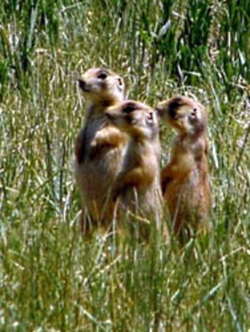
Three Utah Prairie Dogs
Cynomys parvidens
Courtesy US NPS, Bryce Canyon NP

White-tailed Prairie Dog
Cynomys leucurus
Courtesy US FWS
Rhonda Foley, Photographer

Throughout certain areas in southwestern Utah, construction is currently underway. New neighborhoods and subdivisions are being worked on daily, with mounds of dirt displaced. But this isn’t your typical suburban development. Its inhabitants are only 12 inches tall and furry.

The Utah prairie dog is the westernmost of five prairie dog species in the US and is unfortunately the most threatened. Since 1973 it has been a regular feature on the endangered species list, though it was downgraded to ‘threatened’ in 1984 and populations continue to show signs of growth.

Utah prairie dogs are very social creatures, living in large groups called colonies or towns which consist of hundreds or even thousands of individuals and their vast networks of underground burrows. While the group forages for grasses, seeds, leaves, and insects, colony guards or lookouts take turns watching for danger. If a hazard is identified, loud barks echo throughout the colony and foraging dogs run for cover.

Earlier this spring, Utah Prairie dogs in Parowan made national news when the town started construction on a $300,000 fence to keep these industrious critters from burrowing under and buckling the local airport’s runway. Their threatened status means special care must be taken in removing the dogs from airport property and relocating them to nearby public lands. Airport personnel waited until the beginning of July, after this year’s offspring had matured and left home, to begin the specialized trapping and relocation process.

While some consider prairie dogs and their digging habits to be a nuisance, these diminutive creatures are an incredibly important part of their ecosystem. Ecologists have a name for organisms whose role is disproportionately large – a keystone species. In architecture, a keystone is the uppermost piece in an arch – the one on which all the other stones lean. Ecologically speaking a keystone species is one that supports many others that live around it.

It has been estimated that more than 170 species – many of them also threatened or endangered – depend in some way on the Utah prairie dog, generally for either food or shelter. For example, the quirky and unique burrowing owl depends upon abandoned prairie dog homes for constructing its underground nests. Black – footed ferrets, whose population was at one time reduced to only 18 individuals, inhabit abandoned burrows within a large prairie dog colony and rely almost 100% upon the rodents for food.

Other animals that are linked to the Utah prairie dog include badgers, coyotes, sage grouse, Swainson’s hawks, and kit foxes. Like its architectural counterpart, if an ecological keystone is removed the whole system is prone to collapse. Thankfully, with a species recovery plan in place, and a dedicated inter-agency group of supporters, the Utah prairie dog’s housing market continues to boom.

Thank you to the Rocky Mountain Power Foundation for supporting the research and development of this Wild About Utah topic.

For the Stokes Nature Center and Wild About Utah, this is Andrea Liberatore.

Credits:
Images: Courtesy & US FWS, images.fws.gov
            Courtesy US NPS, https://www.nps.gov/brca/naturescience/upd.htm

Text:     Andrea Liberatore, Stokes Nature Center in Logan Canyon.


Additional Reading:

Hengesbaugh, M.G. (2001) Creatures of Habitat: The Changing Nature of Wildlife and Wild Places in Utah and the Intermountain West. Utah State University Press: Logan, UT,

U.S. Fish & Wildlife Service – Mountain-Prairie Region. (2012) Endangered Species: Utah Prairie Dog. Available online at: https://www.fws.gov/mountain-prairie/species/mammals/UTprairiedog/

National Park Service – Bryce Canyon National Park, Utah. (2012) Utah Prairie Dog. Available online at: https://www.nps.gov/brca/naturescience/upd.htm

Carlton, J. (2012) In Utah, A Town Digs Deep to Battle Prairie Dogs. Wall Street Journal, May 6 2012. Available online at: https://online.wsj.com/article/SB10001424052702304020104577384642186959960.html