Hummingbird Nests

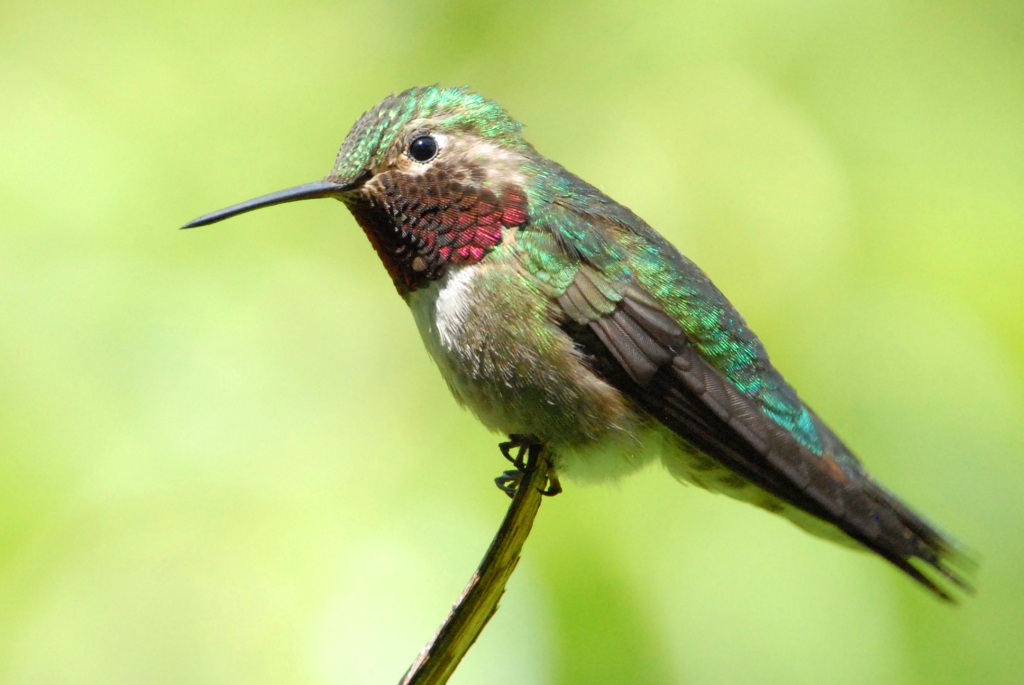
Male Broad-tailed Hummingbird
Selasphorus platycercus
Copyright © 2010 Michael Fish

Glacier Lilies
Erythronium grandiflorum
Copyright © 2010 Andrea Liberatore
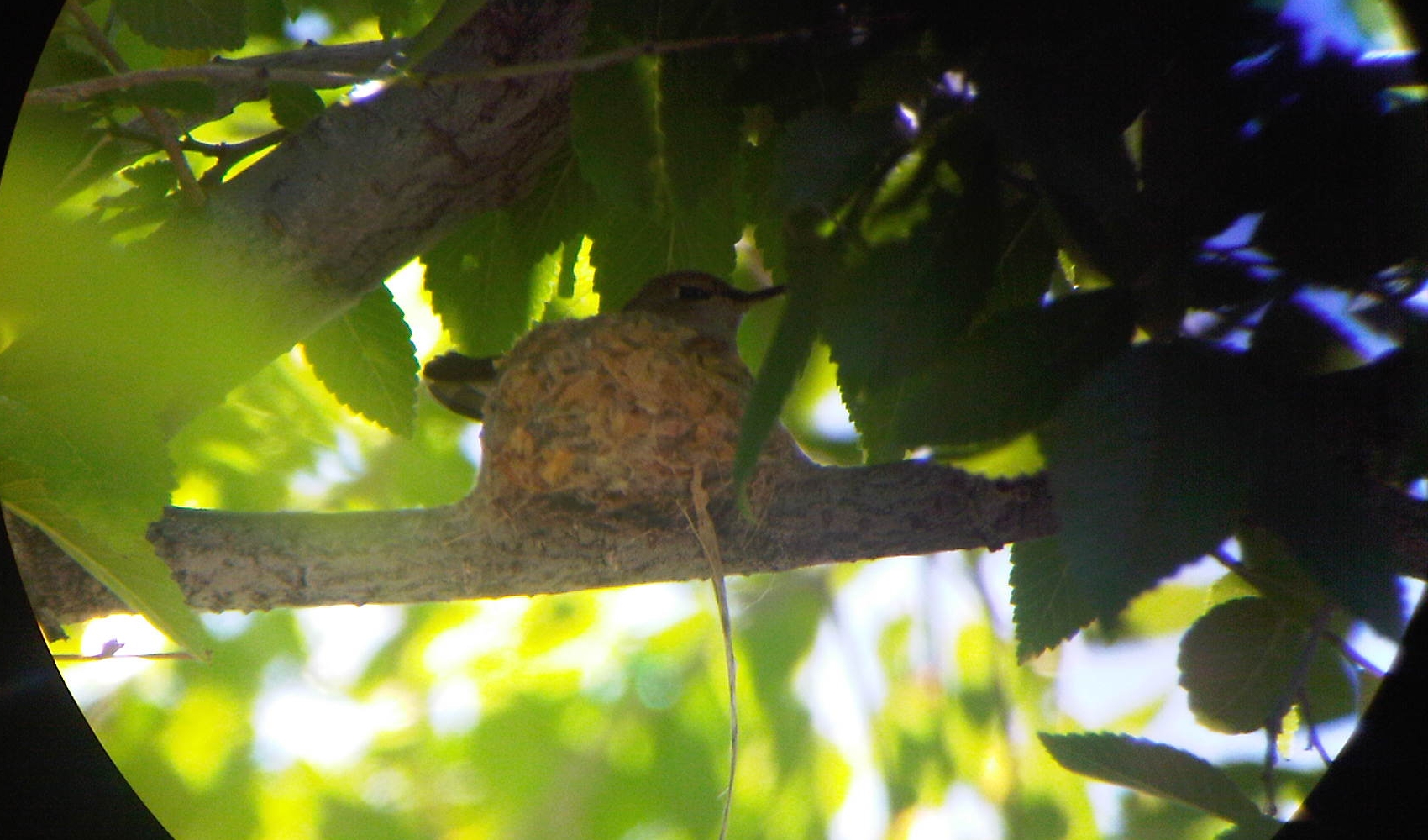
Adult Black-chinned Hummingbird
incubating eggs in nest
Archilochus alexandri
Copyright © 2010 Lyle Bingham
(cell phone through spotting scope)

Young Black-chinned Hummingbird
with beak hanging out of nest
Archilochus alexandri
Copyright © 2010 Lyle Bingham

The hummingbird feeders at Stokes Nature Center are a busy place this time of year. Little bullets of metallic green zoom in and out jockeying for position, while others rest or await their turn in the branches of nearby box elder trees. The birds are a great source of wonder and amusement for staff and guests alike.

June signals the start of nesting season for Utah hummingbirds. At this point in the year, the birds have mainly recovered from their lengthy migration from places as far away as Central America, and are ready to focus on their next set of challenges: establishing a territory, courtship, mating, and rearing young.

Hummingbird nests are a wonder all their own. Tiny and cup-like, they are generally found affixed to small branches near riparian areas. Nests are constructed primarily of plant materials and are lined with plant down such as the fluffy seeds produced by cottonwood trees. Materials used on the exterior of the nest vary from species to species. Black-chinned hummingbirds use leaves and flowers, while Broad-tailed hummingbirds are partial to decorating with lichens or shredded bark. Regardless of the exterior appearance, hummingbird nests have one important material in common – spider webs. Hummingbirds collect the webs and use them to plaster the outside of the nest, which serves two important purposes: acting as a glue that holds nest materials together while at the same time providing some flexibility that allows the nest to stretch and grow with the developing young.

Nests are occasionally constructed on the foundation of last year’s home, and two eggs around half-an-inch in length are laid and incubated by the female for about 16 days before hatching. Young will fledge and join their mother at your feeder about 20 days later. If nesting is successful, the family migrates south in the fall and will return to the same general area next May.

Finding food in early spring, however, is becoming more of a challenge each year to hummingbirds in the American West. A recent study published in the journal Ecology shows that hummingbird migrations and spring flower blooms are becoming out of sync. Broad-tailed hummingbirds in particular rely upon the nectar of petite, yellow glacier lilies – one of the first flowers to bloom in spring. Scientists have found that due to global temperature increases glacier lilies are blooming about 17 days earlier than they did in the 1970’s. The birds, however, haven’t altered their migration timing and so often arrive to find the flowers already in full swing. If this trend continues, scientists predict that within the next 20 years, the birds could miss the glacier lily bloom entirely. Hope lies in the hummingbirds’ ability to adapt– either by migrating farther north to places where lilies bloom later, or shifting their own migration time to match the changing bloom dates.

Photos of glacier lilies, Utah hummingbirds, and their nests, can be found on our website, www.wildaboututah.org. Thank you to the Rocky Mountain Power Foundation for supporting the research and development of this Wild About Utah topic.

For the Stokes Nature Center and Wild About Utah, this is Andrea Liberatore.

Credits:
Images: Courtesy & Copyright 2010 Mike Fish
            Courtesy & Copyright 2010 Andrea Liberatore
            Courtesy & Copyright 2010 Lyle Bingham
Text:     Andrea Liberatore, Stokes Nature Center in Logan Canyon.


Additional Reading:

Harrison, H. H. (1979) Peterson Field Guides: Western Birds’ Nests. Houghton Mifflin Co: Boston

Ehrlich, P.R., Dobkin, D.S., Wheye, E. (1988) The Birder’s Handbook: a field guide to the natural history of north American birds – The Essential Companion to Your Identification Guide. Simon & Schuster/Fireside Books: New York.

National Science Foundation press release, 05-30-2012, Where Have All the Hummingbirds Gone? Retrieved online at: https://www.nsf.gov/news/news_summ.jsp?cntn_id=124345&WT.mc_id=USNSF_51&WT.mc_ev=click

Live Webcam of black chinned hummingbird nest:
https://www.livestream.com/hummingbirdsociety

Nature News, Evolution News and Views, David Klinghoffer, The Genius of Birds: Watch a Hummingbird’s Tongue in Action – See more at: https://www.evolutionnews.org/2013/06/the_genius_of_b073491.html

Coro Arizmendi Arriaga, Maria del, Hummingbirds of
Mexico and North America, In Spanish and English, CONABIO, 2014, https://www.biodiversidad.gob.mx/Difusion/pdf/colibries_mexico_y_norteamerica.pdf
The smell of rain

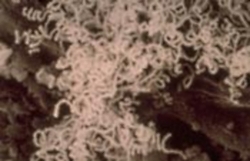
Electron micrograph showing
the filamentous structure of
actinomycetes
Photo Courtesy:
Soil Science Society of America

Spring is my favorite season. I love watching our landscape turn from brown to green, the first butterfly sighting, and the rain. During a recent April shower, I stepped outside and inhaled that magical springtime scent – the smell of rain. Which got me thinking – what is that smell, anyway?

What seems like a simple question, begs a complicated answer. That smell, however, does have a name – petrichor – and there are many things that contribute to its scent. One of the biggest culprits may actually be soil bacteria – mostly from the genus actinomycetes – which grow in unfathomable concentrations in soils all around the world. These bacteria play an important role in decomposition and soil health. Periods of relative dryness trigger their reproductive cycle, causing the production of spores, which are considerably more drought-tolerant. When rain finally does fall, the spores are launched into the air, where they may eventually reach our nose. Scientists have identified the chemical compound responsible for the spore’s odor and have named it geosmin, which literally translates to ‘earth smell.’

Humans noses are particularly sensitive to geosmin, but we’re not the only ones. Camels, too, are sensitive to its smell and some scientists believe this helps them find oases in the desert. Our ability to detect this odor might be a throwback to our nomadic ancestors for whom finding water in a vast landscape was of utmost importance.

But the scent trail doesn’t end with geosmin. The chemical compound ozone may also be a part of petrichor especially after a thunderstorm, as ozone is produced by lightning. Another aroma is provided by chemicals called volatile oils which are produced by all plants, and which collect on the ground during dry periods. With rain, they evaporate into the air, contributing to the musty, earthy odor. Acidic rain has also been shown to create scents by reacting with chemicals on the ground such as spilled gasoline. And further complicating the matter is the fact that rain hitting the earth throws dust and other particles from countless sources into the air.

If all of these smells are around us all the time, why is it that they are distinctly associated with rain? The answer lies in the properties of odors and how they travel. Everything that produces a scent is releasing chemical compounds into the air. The ability to evaporate – or volatility – of these compounds increases with the heat and moisture levels of the air around them. The humid air that produces rain creates ideal conditions for conveying scents to our noses.

In the end, it’s not the rain itself that causes odor, but the interaction of water and a number of chemical and organic compounds. Test this theory at home by throwing a bucket of water on the lawn or a hot driveway to see if you can recreate the smell of rain. Likewise, smell a stick, leaf, or rock when it is dry, then wet it and see how the odor changes. For those seeking answers to the origins of the smell of rain, it’s often best to follow your nose.

Thank you to the Rocky Mountain Power Foundation for supporting the research and development of this topic.

For the Stokes Nature Center and Wild About Utah, this is Andrea Liberatore.

Credits:
Images: Photo Courtesy Soil Science Society of America
Text:     Andrea Liberatore, Stokes Nature Center in Logan Canyon.
Special thanks to Joel Martin from the Utah Climate Center
Additional Reading:

National Public Radio (2007) The Sweet Smell of Rain. All Things Considered, August 11 2007. Interview of Dr. Charles Wysocki by Debbie Elliott. Transcript available online at: https://www.npr.org/templates/story/story.php?storyId=12716163

Gerritsen, V.B. (2003) The Earth’s Perfume. Protein Spotlight, Issue 35. Accessible online at: https://web.expasy.org/spotlight/back_issues/035/

Gerber, N.N, and Lechevalier, H. A., (1965) Geosmin, an Earthy-Smelling Substance Isolated from Actinomycetes. Applied Microbiology. 13,6. Accessible online at:
https://www.ncbi.nlm.nih.gov/pmc/articles/PMC1058374/pdf/applmicro00362-0105.pdf

Live Worldwide Network for Lightning and Thunderstorms in Real Time, Blitzortung, https://en.blitzortung.org/live_lightning_maps.php?map=30

Wily Coyotes

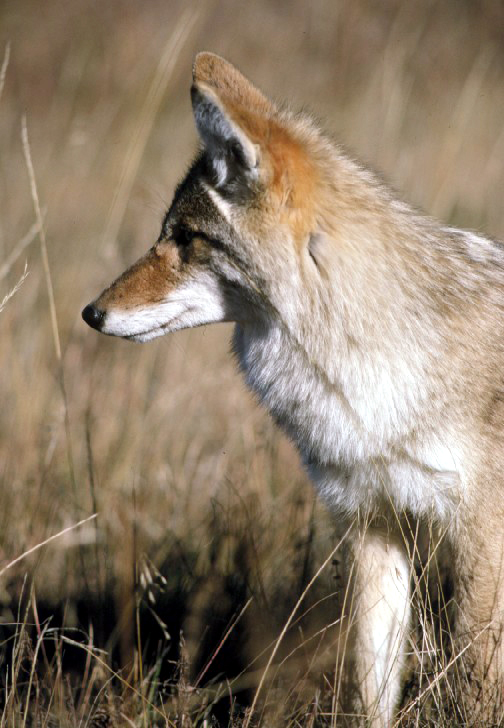
Coyote Canis latrans
Photo Courtesy & Copyright © 1991
Eric Gese, Photographer

Coyote Canis latrans
Photo Courtesy & Copyright © 1991
Eric Gese, Photographer

In many of the diverse Native American storytelling traditions, the coyote plays the same role over and over: that of the smart, sly trickster. For those who study coyote behavior, this characterization is well deserved. Coyotes are incredibly adaptable creatures – intelligent, observant, curious and well, wily.

Their ability to adjust how they live to fit their circumstances can be seen in almost every aspect of the coyote’s life. For starters, coyotes will eat just about anything. As omnivores and opportunistic feeders, coyotes might be found hunting creatures as diverse as small mammals, birds, snakes, mule deer fawns, insects, or fish, and also seek out grasses, berries and seeds. They can hunt alone or in packs, and are not below feasting on carrion, rummaging through your garbage, or raiding the cantaloupe patch.

The environments in which coyotes can be found are similarly diverse. While once restricted to the American West, coyotes are now widespread across all of North America and parts of Central America, and can be found in nearly every ecosystem from deserts to forests to urban areas from Belize to Alaska.

Sometimes called ‘song dogs’ these social creatures are known for their nighttime solos and choruses. Their scientific name, Canis latrans literally means ‘barking dog’, and their many vocalizations help pack members and families bond and communicate over long distances. Coyotes have strong family ties, especially during spring, when puppies are born to monogamous coyote couples.

Coyotes are territorial and defend their space vigorously – especially when breeding and denning. Mating occurs from January through February and after a gestation period of only 60 to 62 days, 3 to 12 pups are born blind and helpless in March or April. Young coyotes are nursed for 4-5 weeks at which point they transition to regurgitated meals brought by both parents. Youngsters tag along on family hunts at 8 weeks old and are able to hunt independently by fall.

Interestingly, studies have shown that even coyote breeding is adaptable – a phenomenon called ‘density dependent reproduction’. In areas where coyote populations are stable, females bear lower numbers of pups. But in areas where there is disturbance to the population – for example through increased predation or hunting – females have larger litters. On average, newborn pups have less than a 50% chance of surviving to adulthood due to threats from disease, predators, and starvation. It therefore makes sense for females to bear more offspring in areas where threats may be even greater.

To learn more about coyote adaptability, join the Stokes Nature Center for a tour of the USDA/National Wildlife Research Center Predator Research Facility on June 16th. For more information visit www.logannature.org. Thank you to the Rocky Mountain Power Foundation for supporting the research and development of this Wild About Utah topic.

For the Stokes Nature Center and Wild About Utah, this is Andrea Liberatore.

Credits:
Images: Courtesy and Copyright © Eric Gese
            National Wildlife Research Center, Predator Behavior and Ecology
Text:     Andrea Liberatore, Stokes Nature Center in Logan Canyon.


Additional Reading:

Stettler, Brett. 2009. Coyote (Canis latrans). Utah Division of Wildlife Resources Wildlife Notebook Series No. 19. Found online at:
https://wildlife.utah.gov/publications/pdf/2010_coyote.pdf

Video: Coyotes Cruise NYC, Science Friday & Mark Weckel, https://www.sciencefriday.com/videos/watch/10444

Bald Eagles

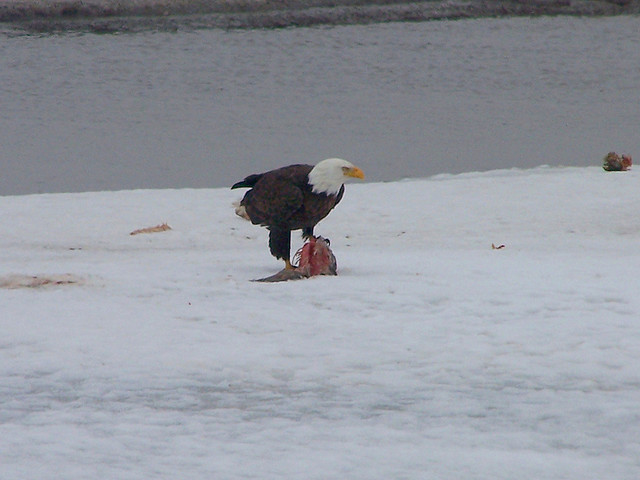
bald eagle feeding, Courtesy and Copyright 2011 Bryan Olsen, Photographer

Bald Eagle Feeding
Copyright © 2011 Bryant Olsen

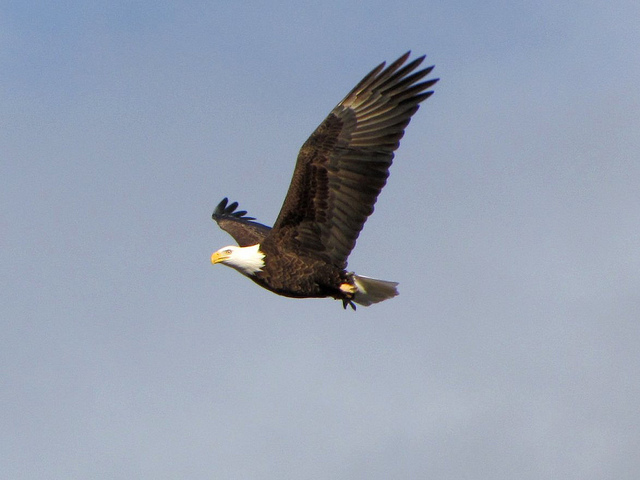
 bald eagle in flight, Courtesy and Copyright 2011 Bryan Olsen, Photographer Bald Eagle in Flight
Copyright © 2011 Bryant Olsen

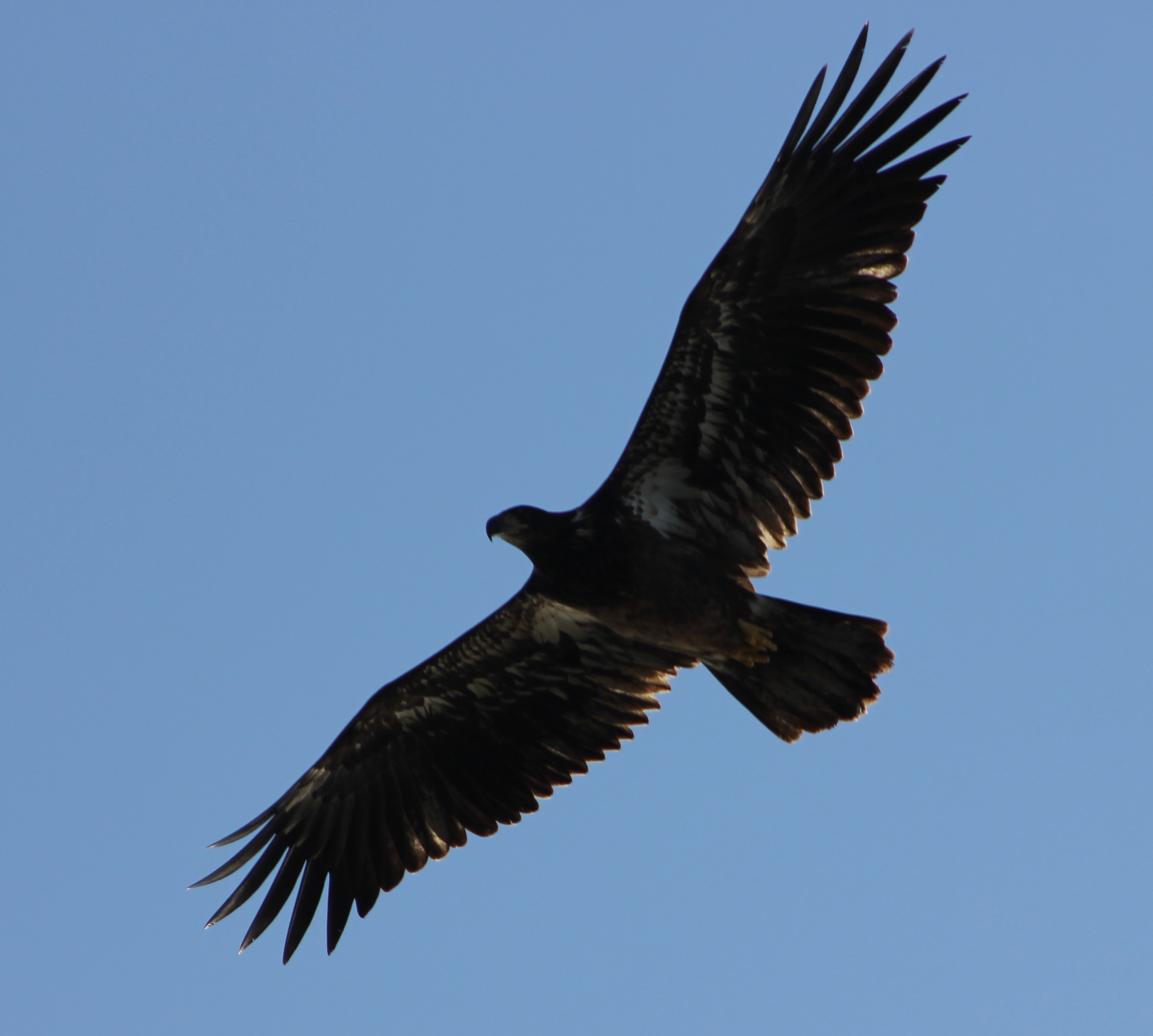
juvenile bald eagle in flight, Courtesy and Copyright 2011 Terry Greene, Photographer Juvenile Bald Eagle in Flight
Copyright © 2011 Terry Greene

flying immature Bald Eagle, Courtesy & Copyright 2011 Terry Greene, Photographer Flying Immature Bald Eagle
Copyright © 2011 Terry Greene

Flying Immature Bald Eagle

Copyright © 2011 Terry Greene, Photographer

When winter arrives in Utah, a number of our bird species hit the road – some flying thousands of miles to Mexico and Central America in search of a warm winter home.

But there is one notable bird that actually migrates to Utah in the winter – the bald eagle. In general, birds migrate because of seasonal food shortages. Think of the hummingbirds that rely on flower nectar and insects, which Utah cannot provide in winter, but which are abundant other times of the year. The same is true for bald eagles, whose main food source is fish. Winter comes on strong in Alaska and Canada, freezing lakes, ponds, and all but the strongest flowing rivers. So the birds travel to seek out the relatively mild winters found farther south.

One of the largest birds of prey you’ll see in our Utah skies, a mature bald eagle can have a wingspan of 6 to 8 feet and stand almost three feet tall. Only the golden eagle rivals it in size. Pairs are thought to mate for life, and they are also responsible for the largest nests of any bird in North America. One record-setting abode measured 9 feet wide, 20 feet deep, and weighed more than 2 tons.

And to think, we almost lost this incredible species. Since DDT and hunting heavily affected bald eagle numbers in the early half of the 20th century, the birds have made a truly remarkable comeback. From a low point around 4,000 individuals in the lower 48 states, they are now thought to number in the tens of thousands, and have been removed from the Threatened and Endangered Species lists.

Perhaps as their comeback continues, Utah will once again see these majestic animals make their massive nests here, fishing in our many rivers and lakes year round. For now, though, aside from a few rare exceptions, bald eagle enthusiasts will have to make the most of their short winter stay. To observe bald eagles, consider a visit to the Great Salt Lake Nature Center at Farmington Bay. Every year, the Bay plays host to hundreds of eagles, from November to March, and while this milder-than-usual winter has brought in fewer numbers of eagles, you may still be able to catch a glimpse. They will likely be heading north later this month, however, so don’t delay. And be sure to keep your ears tuned into the bald eagle’s haunting song:

[Bald Eagle call from https://wildstore.wildsanctuary.com/collections/special-collections Kevin Colver https://wildstore.wildsanctuary.com/collections/special-collections]

Thank you to the Rocky Mountain Power Foundation for supporting the research and development of this Wild About Utah topic. For the Stokes Nature Center and Wild About Utah, this is Andrea Liberatore.

For the Stokes Nature Center and Wild About Utah, this is Andrea Liberatore.

Credits:

Audio: Courtesy & Copyright Kevin Colver
Photos: Courtesy & Copyright Bryant Olsen and
            Courtesy & Copyright Terry Greene
Text:    Andrea Liberatore, Stokes Nature Center, logannature.org

Additional Reading:

Parrish, J. and Walters, B., Editors. (2009) Bald Eagle (Haliaeetus leucocephalus). Utah Division of Wildlife Resources: Wildlife Notebook Series No. 3. https://wildlife.utah.gov/publications/pdf/2010_bald_eagle.pdf

National Geographic Society (2012) Animals: Bald Eagle (Haliaeetus leucocephalus)
https://animals.nationalgeographic.com/animals/birds/bald-eagle/