Brushes

Paintbrush (Castilleja) Courtesy and Copyright © by Shannon Rhodes, photographer
Paintbrush (Castilleja)
Courtesy and Copyright © by Shannon Rhodes, photographer
Of all the lovely wildflowers to enjoy in Utah, indian paintbrush has to top my list. The nickname “prairie fire” is an accurate one, highlighting the variety of colors we find: reds, oranges, yellows, pinks, purples, and sometimes a mixture of two. In Tomie dePaola’s children’s picture book “The Legend of the Indian Paintbrush,” Little Gopher discovers “brushes filled with paint, each one a color of the sunset.” The legend is a flashy tale celebrating this member of the figwort family and stories captured in rock art. Of course, our petroglyphs are fascinating, but I like to imagine how the pictographs adorning many of Utah’s “learning rock” sandstone walls may have been painted with brushes, fingers, and other tools many centuries ago.

Often, when we see indian paintbrush, whether we’re in Utah’s deserts up in elevation through subalpine meadows, we also see sagebrush. They are both native to Utah. In fact, some species of indian paintbrush are root-parasites for sagebrush, intertwining roots to access water and nutrients because they lack small hairs on their own.
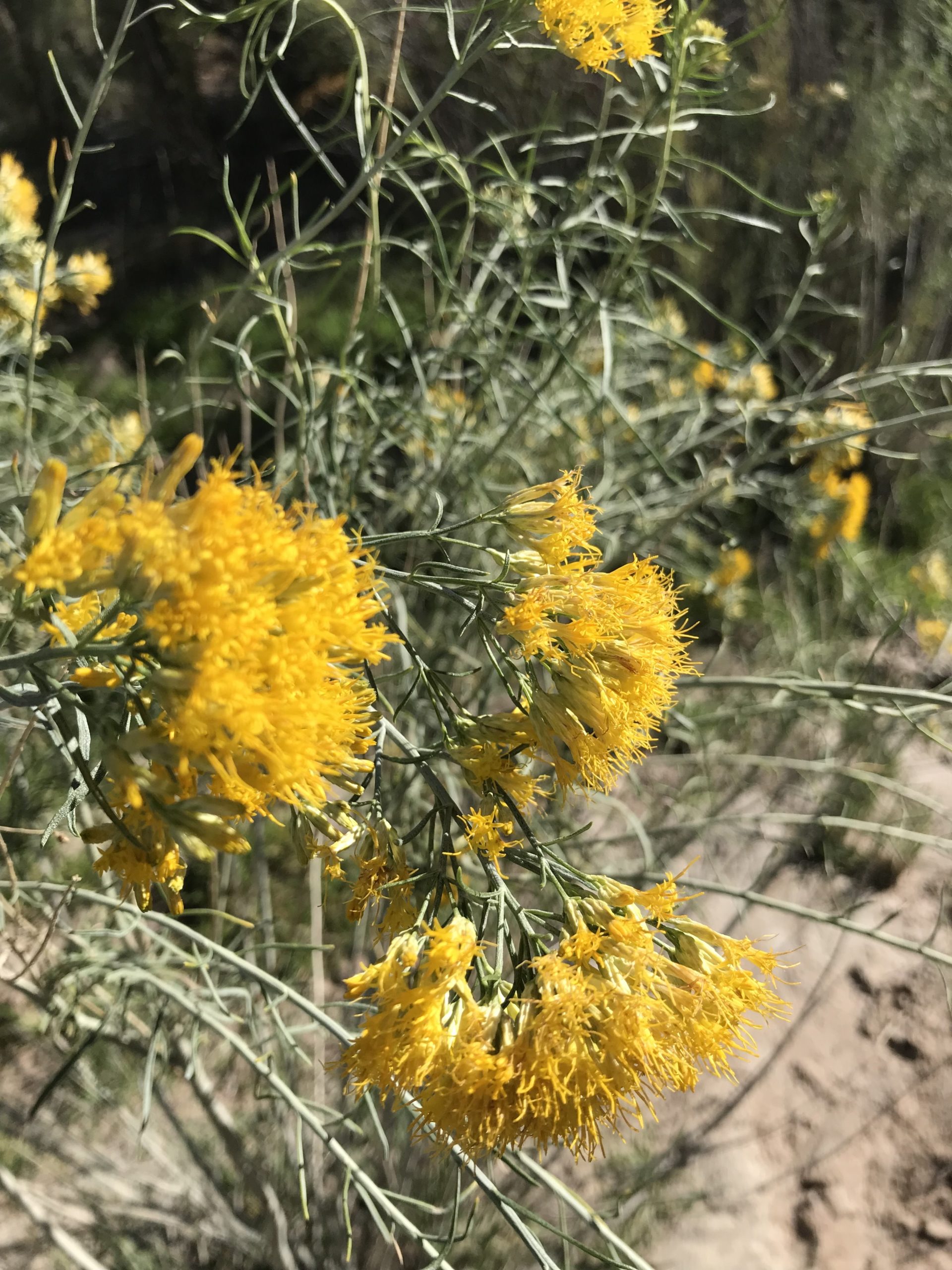
Rabbitbrush (Chrysothamnus nauseosus) Courtesy and Copyright © by Shannon Rhodes, photographer
Rabbitbrush (Chrysothamnus nauseosus)
Courtesy and Copyright © by Shannon Rhodes, photographer
The Utah State University fight song captures the love we have for the spots in Utah where sagebrush grows. To celebrate Aggie homecoming, my first grade class went out this week to explore describing adjectives of sagebrush compared to those for rabbitbrush, another brush native in Utah. One student wrote that rabbitbrush smells like strawberries and is bushy yellow. Another thought that it looks like a banana, smells sweet, and likes bees and rocks. Alternately, a student wrote that sagebrush is minty, soft, and “smells horrible.” We learned to recognize the sagebrush leaf three-toothed tridents and the magical way rubbing the leaves on paper both releases and traps that distinctive fragrance.

Mae Timbimboo Parry, once a recordkeeper of the Northwestern Band of the Shoshone, sketched how to identify sagebrush in much the same way. In his appendix of “The Bear River Massacre: A Shoshone History,” Darren Parry shares his grandmother’s handwritten field notes about sagebrush, indicating its use in tea and purifying ceremonies. I was surprised at first that she did not include indian paintbrush in the list of plants until I realized that willow, wildrose, sego lily, and sunflower all had practical uses beyond their beauty. Some have said that the sagebrush is the backbone of the West, and I would add that indian paintbrush adds a splash of color.
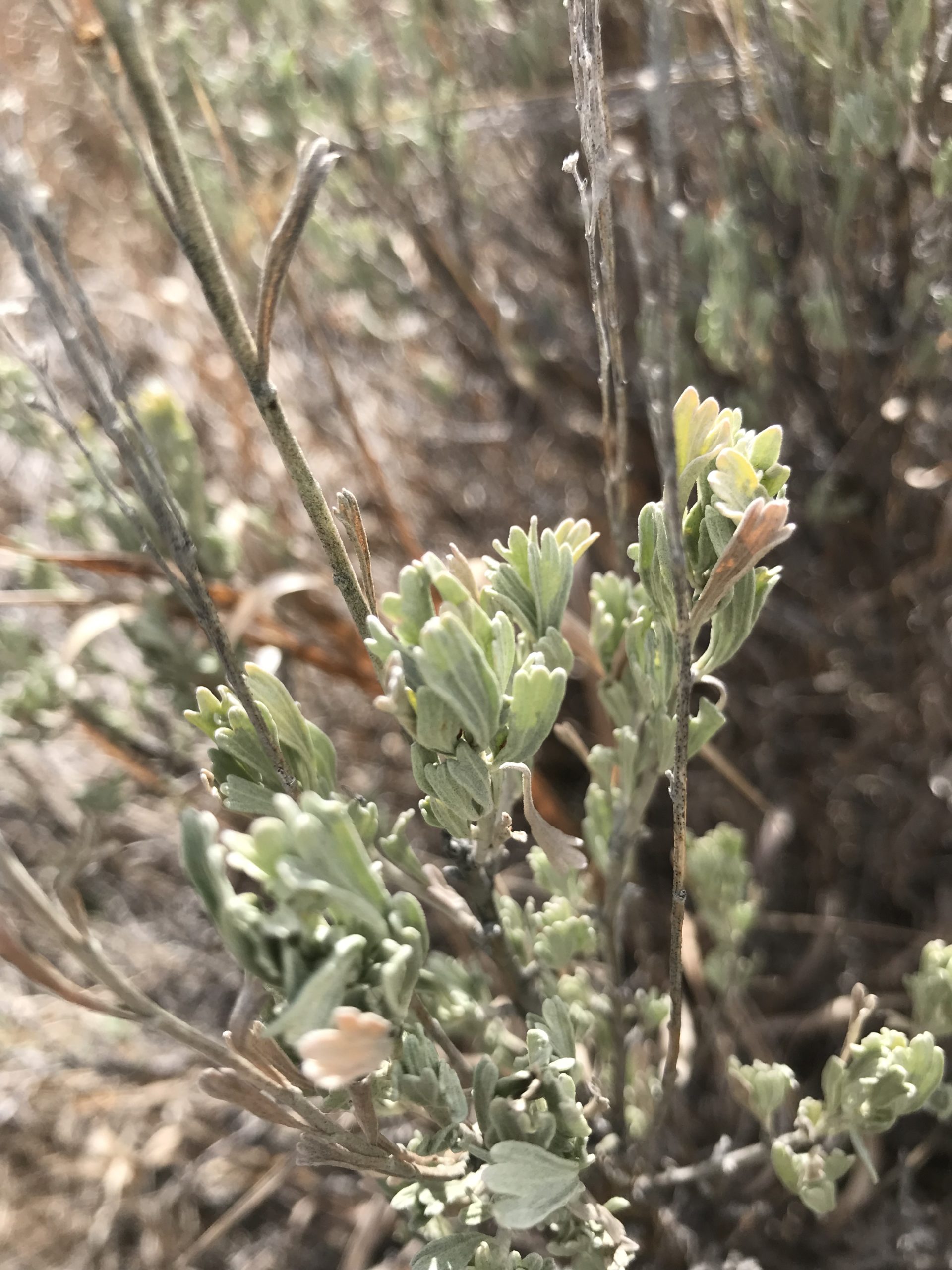
Sagebrush (Artemisia tridentata) Courtesy and Copyright © by Shannon Rhodes, photographer
Sagebrush (Artemisia tridentata)
Courtesy and Copyright © by Shannon Rhodes, photographer
Along with horsebrush, buckbrush, blackbrush, bitterbrush which is also known as antelopebrush, and rabbitbrush, indian paintbrush and sagebrush tell a Utah story as distinctive as that portrayed in the brushstrokes of the pictographs of this land.

I’m Shannon Rhodes, and I’m wild about Utah.

Credits:
Images: Courtesy & Copyright © Shannon Rhodes, Photographer
Audio: Courtesy & © Kevin Colver https://wildstore.wildsanctuary.com/
Text:     Shannon Rhodes, Edith Bowen Laboratory School, Utah State University https://edithbowen.usu.edu/
Additional Reading Links: Shannon Rhodes

Additional Reading:

Alpine Nature Center. Is It Rabbitbrush or Is It Sagebrush? https://www.alpinenaturecenter.org/rabbit-vs-sage.html

de Paola, Tomie. The Legend of the Indian Paintbrush. Penguin Putnam Books for Young Readers. 1988. https://www.tomie.com/https://www.audubon.org/news/celebrating-sagebrush-wests-most-important-native-plant

Johnson, Jeff. Head of Sinbad Pictographs in San Rafael Swell. https://thetrekplanner.com/head-of-sinbad-pictographs-san-rafael-swell-utah/

Larese-Casanova, Mark. Desert Plants Field Book. Utah Master Naturalist. https://digitalcommons.usu.edu/cgi/viewcontent.cgi?article=1911&context=wats_facpub

Mozdy, Michael. Bold Figures, Blurred History: The Great Gallery in Horseshoe Canyon. October 2, 2016. https://nhmu.utah.edu/blog/2016/09/29/bold-figures-blurred-history-great-gallery-horseshoe-canyon

Miller, Pam, and Blaine Miller. Rock Art in Utah. https://www.uen.org/utah_history_encyclopedia/r/ROCK_ART.shtml

Parry, Darren. The Bear River Massacre: A Shoshone History. https://heritageandarts.utah.gov/the-bear-river-massacre-a-shoshone-history-a-conversation-with-darren-parry/

Repandshek, Kurt. Traces of a Lost People. The Smithsonian Magazine. March 2005. https://www.smithsonianmag.com/arts-culture/traces-of-a-lost-people-84026156/

Scotter, Troy, and Nina Bowen. The Rock Art of Utah. Utah Rock Art Research Association. May 13, 2020. https://urara.wildapricot.org/page-18203

Strand, Holly. Woody Plants of Utah. Wild About Utah, December 15, 2011. https://wildaboututah.org/tag/rabbitbrush/

Strand, Holly. Sagebrush. Wild About Utah, January 14, 2009. https://wildaboututah.org/sagebrush/

Susec, David. The Barrier Canyon Rock Art Style. The B.C.S. Project. https://www.bcsproject.org/barrierstyle.html

U.S. National Park Service. Seeing Rock Markings in a Whole New Way. https://www.nps.gov/articles/cany-rock-markings-photo.htm

Wampler, Fred. Paintbrush and Sagebrush. University of Mary Washington Gallery. https://www.umwgalleries.org/paintbrush-and-sagebrush/

Young, Lauren. Saving the American West’s Sagebrush Sea. May 19, 2001. https://www.sciencefriday.com/articles/saving-sagebrush/

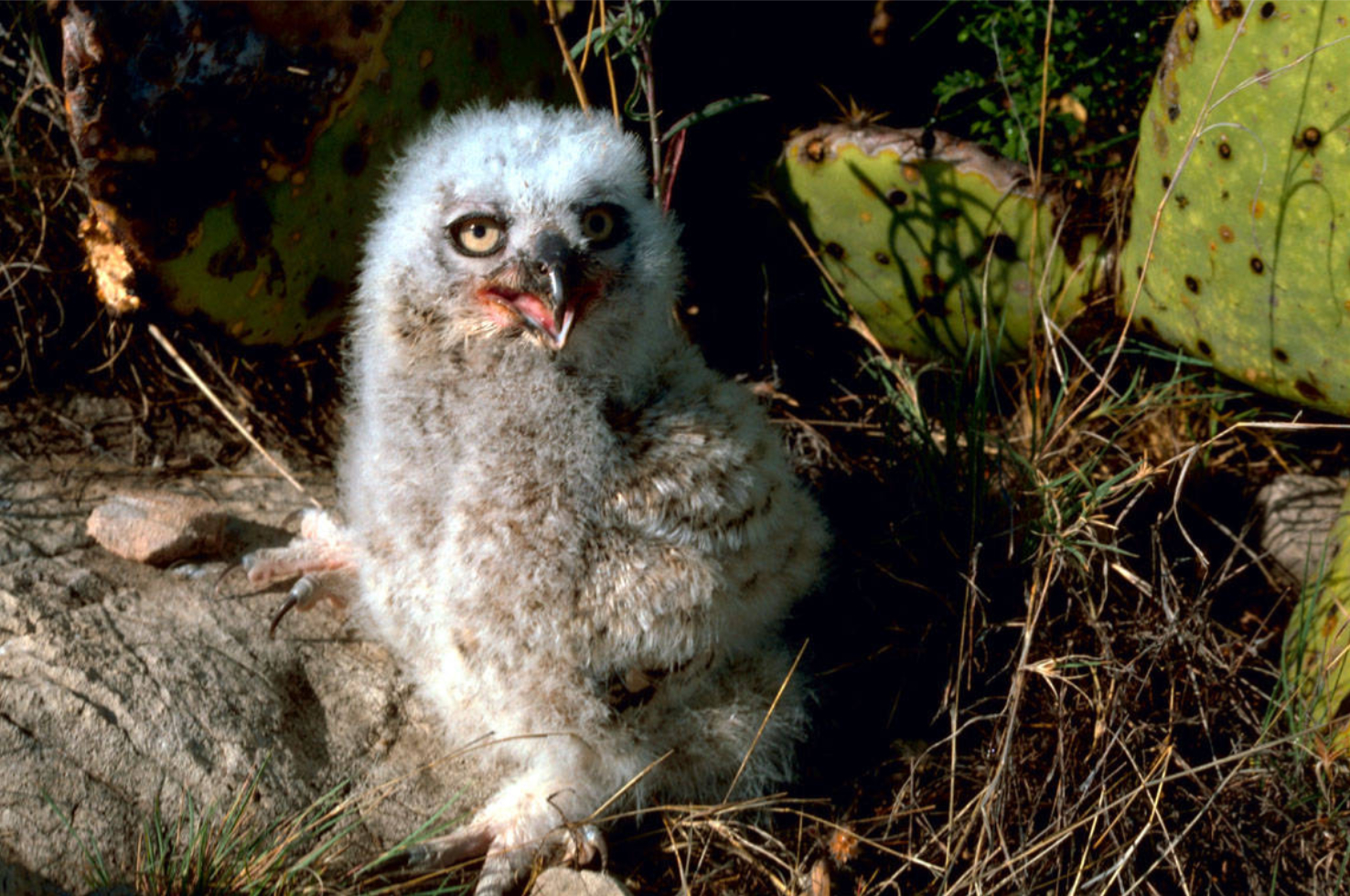
Great Horned Owl

Great Horned Owl and Chick Courtesy US FWS George Gentry, Photographer
Great Horned Owl and Chick
Courtesy US FWS
George Gentry, Photographer
No, I did not hear the owl call my name- meaning my number is up and death is imminent according to some native tribes. But I do hear them call. The great horned owl is also referred to as the “hoot owl”. There are few owl species that hoot in our area, and those who do so are extremely rare.

Great horned owls are great in stature- second only to great grays among N. American owls. Further, they are fierce predators and valiant protectors of their young. Don’t mess with their nest!

Great Horned Owl Chick Courtesy US FWS Gary Stolz, Photographer
Great Horned Owl Chick
Courtesy US FWS
Gary Stolz, Photographer
Due to its ferocious nature it is often referred to as the “Tiger of the Air”. When established in a territory, the Great Horned Owls drive other owls away, and may eat a few for good measure. They are both nocturnal and diurnal hunters, especially during the breeding season & when they are raising their young. They have a large variety of prey including insects, most small mammals including skunks, foxes, domestic cats, & birds up to size of herons and Redtail hawks. Its prey can often weigh up to 3 times the weight of bird itself.

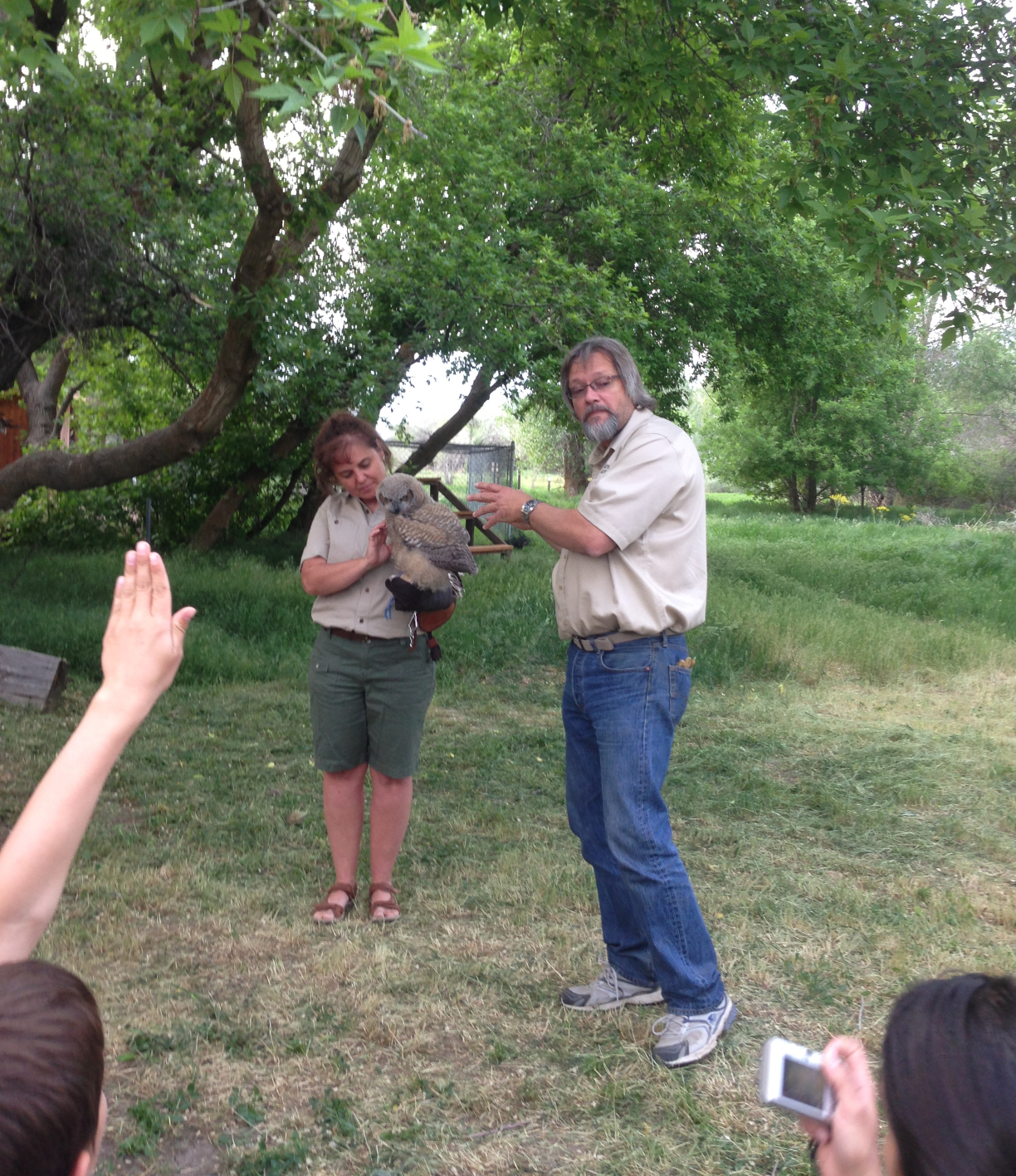
Bryce King and Michelle Groncki with Winston, a Young Great Horned Owl at the Ogden Nature Center, May 16, 2018 Courtesy & © Lyle Bingham, Photographer
Bryce King and Michelle Groncki with Winston, a Young Great Horned Owl at the Ogden Nature Center, May 16, 2018
Courtesy & © Lyle Bingham, Photographer
The Great Horned Owl is found throughout the Americans, from Alaska & Northern Canada down to the southern most tip of South America. It’s found in woodlands, mountains, deserts, coastal swamps, and urban areas which make it unique amongst owls. There was a pair nesting near the Logan Tabernacle for many years. There is only a single species of Great Horned Owl, though there are a large number of subspecies.

Great Horned owls are often monogamous. They usually nest in old nests made by other raptors, often by Red-Tailed Hawks. They have been known to nest in caves, on cliff ledges, rocky outcrops and in cactuses. They usually start breeding very early in comparison to most owls, often from December to March when hooting reaches its peak.

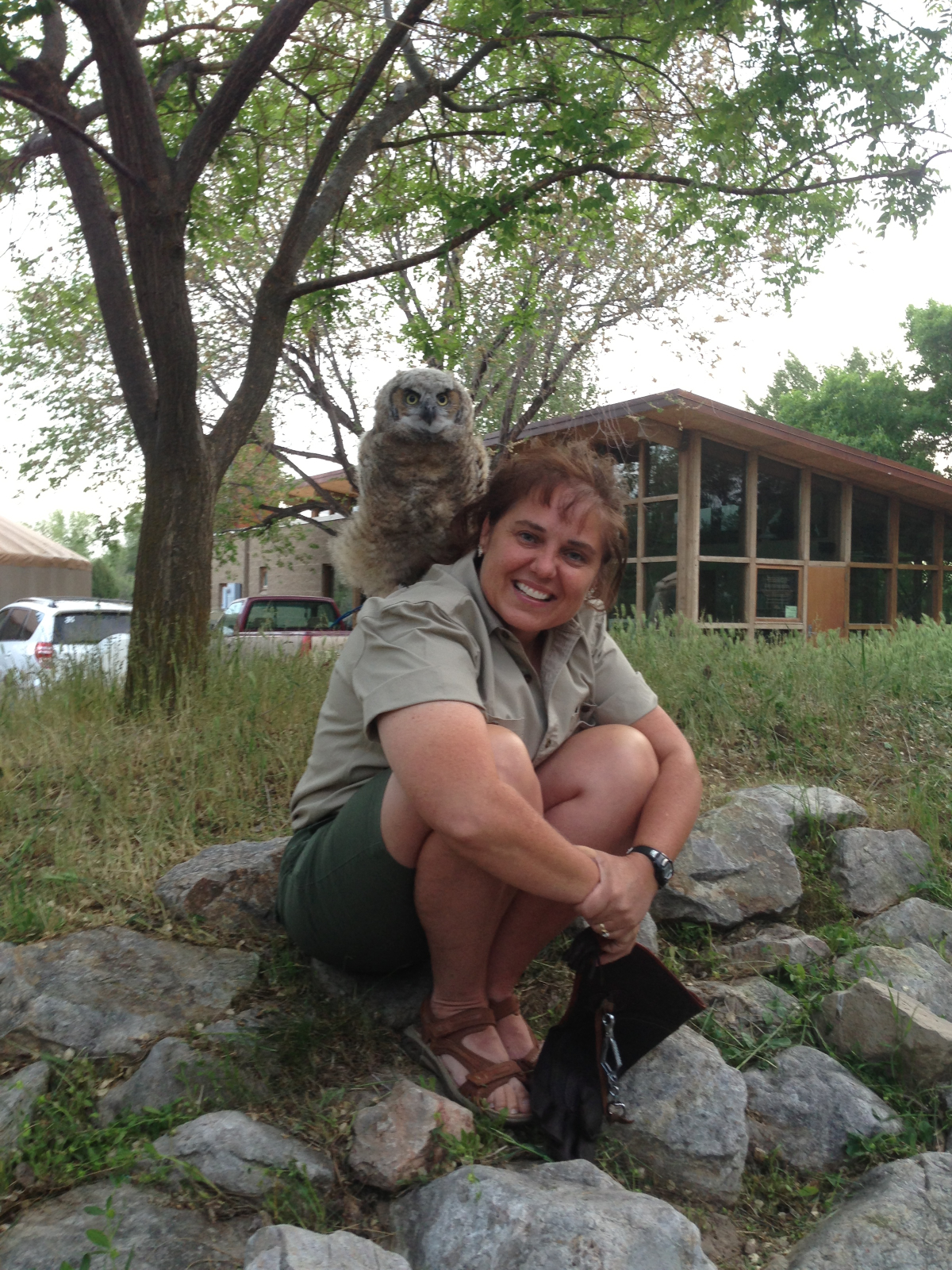
Winston, a Young Great Horned Owl hopped up on Michelle Groncki's Shoulder May 16, 2018 Courtesy & © Lyle Bingham, Photographer
Winston, a Young Great Horned Owl hopped up on Michelle Groncki’s Shoulder, May 16, 2018
Courtesy & © Lyle Bingham, Photographer
In the wild the life expectancy of Great Horned Owl is from 15 to 20yrs. In captivity, their lifespan is usually from 25 to 30yrs, with the oldest recorded individual reaching 42 years. The Ogden Nature Center had an owl named Chitters, who was near 40 years before its spirit flew off. During its long life as an educational bird, Chitters entertained thousands of students in the Ogden, Davis, and Weber school districts.

Several American Indian tribes believe owls are associated with the souls of the dead. When a virtuous person died, they would become a Great Horned Owl. If wicked, they would become a Barn Owl. The Hopis Indians believed that the Great Horned Owl helped their peaches grow. They were believed to be a symbol of divine wisdom by Creek Indians.

I’m sure glad to have these divine, wise birds in my neighborhood!

Great Horned Owl Courtesy US FWS, Karen Laubenstein, Photographer
Great Horned Owl
Courtesy US FWS, Karen Laubenstein, Photographer
Jack Greene for Bridgerland Audubon Society, and I’m wild about Utah!

Credits:

Images: Courtesy US FWS
Audio: Contains Audio Courtesy and Copyright J. Chase and K.W. Baldwin https://upr.org
Text:     Jack Greene, https://bridgerlandaudubon.org/

Additional Reading:

Ogden Nature Center, Bear River Migratory Bird Refuge, US Fish & Wildlife Service, US Bureau of the Interior, https://www.fws.gov/nwrs/threecolumn.aspx?id=2147485206 Last Updated: May 18, 2012

Wright, Becky, Beloved owl ‘Chitters’ at Ogden Nature Center dies, Ogden Standard Examiner, Mar 18, 2013, https://www.standard.net/lifestyle/beloved-owl-chitters-at-ogden-nature-center-dies/article_5f57019c-7279-587e-9983-7b4f5a2d2a48.html

Great Horned Owl, All About Birds, The Cornell Lab of Ornithology, Cornell University, https://www.allaboutbirds.org/guide/Great_Horned_Owl/overview

Sego Lily

Sego lily bulbs are edible, either raw or cooked, and were used as food by the Cheyenne. The sweet-tasting bulbs were often dried for later use. Caption & Photo Courtesy US NPS,  Michael Wheeler, Photographer
Sego lily bulbs are edible, either raw or cooked, and were used as food by the Cheyenne. The sweet-tasting bulbs were often dried for later use.
Caption & Photo Courtesy US NPS,
Michael Wheeler, Photographer
With Pioneer Day’s a few weeks away, it’s time to honor a very special plant that saved many Utah pioneers.

It’s been a banner year for our state flower. The sego lily has graced our meadows since early June, now in its late stages at lower elevations. It has generated many stories in our state. Before I launch them, I must compliment it’s delicate beauty and love for adverse conditions- the dry, rocky soils in which it’s found. The sego lily personifies the tough, resilient, beautiful pioneer spirit.

Brigham Young declared the sego lily “a heaven sent source of food.” Friendly Native Americans taught Mormon settlers how to harvest and prepare the bulbs for much needed survival food when a devastating cricket infestation destroyed crops.

From pioneer journals:

Sego Lily Courtesy US NPS, Nancy Julian, Photographer
Sego Lily
Courtesy US NPS, Nancy Julian, Photographer
“”In the spring of 1848, our food was gone. Along the month of April we noticed all the foothills were one glorious flower garden. The snow had gone, the ground was warm. We dug thousands of sego roots, for we heard that the Indians had lived on them for weeks and months. We relished them and carried them home in bucketful’s. How the children feasted on them, particularly when they were dried, for they tasted like butternuts.”
Elizabeth Huffaker, Salt Lake City

And here is another one:
“In my childhood our whole group of children used to go east of town, each carrying a sego digger. It was a piece of wood sharpened on one end, and flat on the other. We would just go out of town and look for segos, which were plentiful. When we found them we each went to digging by putting the sharp end of the stick into the ground close beside the sego, and pressing down on the flat end of the digger until it was a few inches in the ground. Sometimes we pounded on the top of the digger with a rock…when the stick was far enough into the ground to suit us, we just pushed it to one side and up came the segos. Then we ate them, and oh how we enjoyed hunting them.”
Lorena Washburn Larsen, 1868, Manti, UT

Native Americans considered the sego lily a sacred plant and developed culinary uses for its bulbs, seeds, and flowers. Many tribes created a healthful porridge from roasted or boiled sego lily bulbs. Several tribes considered it sacred. For the Navajo it was one of the “Life Plants” used for ceremonial purposes. Sego was derived from the Indian word Sego. Many Indian women were named Sego or Sego-go-chee. The Spanish named it mariposa, their word for butterfly for these beautiful mountainside flowers looked like butterflies.

The sego lily was formally designated as the Utah State Flower in 1911 chosen for its natural beauty as well as its historical significance.

The lily gets its scientific name Calochortus Nuttalli, from Thomas Nuttall, a naturalist, who collected the sego lily in 1811 while traveling along the Missouri River. It’s found throughout the western states. Please do not disturb this iconic beauty. Photos are encouraged!

Jack Greene for Bridgerland Audubon Society, I continue to be infatuated with Utah’s wildness!

Credits:

Images: Courtesy US NPS, Michael Wheeler, Photographer
      Courtesy US NPS, Nancy Julian, Photographer
Audio: Courtesy & Copyright Friend Weller, Utah Public Radio
Text:     Jack Greene, USU Sustainability Program Volunteer, Bridgerland Audubon Society

Additional Reading:

Sego Lily, Cedar Breaks National Monument, National Park Service, U.S. Department of the Interior, https://www.nps.gov/cebr/learn/nature/sego-lilly.htm

Utah State Facts and Symbols, Utah.com, Deseret Digital Media, https://utah.com/things-to-do/plan-your-trip/state-facts-and-symbols/

Utah State Flower – Sego Lily, Pioneer-Utah’s Online Library, Utah State Library Division, Utah Department of Heritage and Arts, https://www.utah.gov/about/state-symbols.html

Sego Lily, Calochortus nuttallii Torr. & A. GrayShow https://plants.usda.gov/plant-profile/CANU3 [updated Feb 19, 2025]

Liliaceae Calochortus nuttallii, Arches National Park, US National Park Service, US Department of the Interior, https://www.nps.gov/arch/learn/nature/liliaceae_calochortus_nuttallii.htm

Sego Lily and Friends, Wikimedia Commons, https://commons.wikimedia.org/wiki/File:Sego_Lily_and_Friends_(14368043194).jpg

LORENA EUGENIA WASHBURN, Autobiography, Published by her Children, Brigham Young University Press, 1962, [Abandoned & misappropriated link removed Feb 19, 2025]

Young, Levi Edgar, The Sego Lily (See quote from Mrs. Elizabeth Huffaker, a pioneer of 1847, p.7), The Great West in American History, Bulletin of the University of Utah, Volume 11, Issue 9, Department of Western History, University of Utah, https://books.google.com/books?id=4LfOAAAAMAAJ

Sagers, Larry A., Utah Sego Lily Thrives In Dry, Sandy Hillsides – Not Gardens, Deseret News July 25, 1990, Larry A. Sagers, https://www.deseret.com/1990/7/25/18873035/utah-sego-lily-thrives-in-dry-sandy-hillsides-not-gardens

The Henry Mountain Bison

The Henry Mountain Bison: American Bison Courtesy US FWS Ryan Moehring, Photographer
American Bison
Courtesy US FWS
Ryan Moehring, Photographer
The Henry Mountains of southeast Utah are famous for being the last mountain range in the contiguous United States to have been officially mapped. Indeed, before they were mapped, they were often referred to as the “Unknown Mountains.” Another relative unknown detail about this range is that it harbors one of only five genetically pure, free roaming bison herds on North American public lands.

In 1941, a seed herd of 18 American Plains Bison (B. b. bison) were transplanted from Yellowstone National Park to the arid desert of Utah’s Robbers Roost. A year later, five more bulls were introduced to the herd in hopes of sufficiently diversifying the gene pool and sustaining the herd. The bison must not have found Robbers Roost as appealing as Butch Cassidy had, though, because this new Wild Bunch set out for literal greener pastures that very same year.

The small herd forded the Dirty Devil River and travelled southwest toward the Burr Desert. The herd stopped here for a while, enjoying their newfound buffet atop the Aquarius Plateau. 21 years later, though, in 1963, the still small herd grew tired of the desert and abandoned it altogether for the higher, more verdant snow fed meadows of the nearby Henry Mountains. Here, the herd thrived and quickly swelled in numbers.

Today, the herd’s population is estimated to be between 300 and 400 animals, which ecologists and wildlife biologists regard as the maximum carrying capacity of their Henry Mountain range. The Utah Division of Wildlife Resources has responded accordingly. In an effort to perpetuate the health of the herd and their range, the DWR began issuing “Once-in-a-lifetime” permits to hunters hoping to fulfill not only a tag but also a burning sense of adventure. The Henry Mountains, after all, were mapped last for a reason. They remain one of the most rugged and remote places in a state known for its rugged and remote places.

Fittingly, quite unlike their more quintessential Plains Bison brethren, the Henry Mountains bison can be found almost anywhere in the Henrys between the desert lowlands and timberline. Apparently no one has told the herd that Plains Bison don’t typically like high elevations or steep mountain slopes. This unique proclivity of the Henry Mountains herd to cast off behavioral stereotypes works in their favor when hunting season rolls around and they abandon the high, open meadows for steep, wooded canyons and thick groves of aspen and evergreens.

This highly adaptive nature unique to the Henry Mountains herd made it an obvious candidate to serve as a seed population in early 2010 when 39 individuals were transplanted from the Henry Mountains to the Book Cliffs along the Utah-Colorado border. These 39 animals were to serve as a genetic supplement to a relatively new herd first reintroduced to the Book Cliffs by the Ute Indian Tribe in 1986. The now 600-strong Book Cliffs herd is well on its way to reestablishing the American Plains Bison’s historic range in the Book Cliffs.

The story of the Book Cliffs and Henry Mountains Bison give us reason to hope that one day soon, the American Bison might reclaim its territory, a historic range that once ran from Alaska through the Canadian territories and the Great Plains to the Eastern Seaboard and the Gulf of Mexico. And, if so, the role the Henry Mountains herd will play in that expansion may be a significant one.

I’m Josh Boling, and I’m Wild About Utah.

The Henry Mountain Bison-Credits:

Photos: Courtesy US FWS, Ryan Moehring, Photographer
Audio: Includes audio from
Text: Josh Boling, 2019

The Henry Mountain Bison-Additional Reading

Wild About Utah pieces authored by Josh Boling

Utah’s Book Cliffs Herd, Bison Bellows Series, National Park Service, June 30, 2016, https://www.nps.gov/articles/bison-bellows-6-30-16.htm

How scientists brought bison back to Banff, National Public Radio, Feb 28, 2017, https://www.pbs.org/newshour/show/scientists-brought-bison-back-banff

Buffalo (Bison) on the Henry Mountains, Capitol Reef Country, Wayne County Tourism, https://capitolreef.org/blog/buffalo-bison-on-the-henry-mountains/

Henry Mountains, Utah.com, https://utah.com/henry-mountains

Bison Unit Management Plan, Unit #15 Henry Mountains, Utah Division of Wildlife Management, https://wildlife.utah.gov/hunting/biggame/pdf/bison_15.pdf

Gilman, Don, Rare, genetically-pure bison found in Utah’s Henry Mountains, St George News, Jan 12, 2016, https://www.stgeorgeutah.com/news/archive/2016/01/12/djg-genetically-pure-bison-found-in-utahs-henry-mountains/#.XB7nRs9KjfY

Henry Mountain Outfitters, HuntersTrailhead, https://www.hunterstrailhead.com/index.php?ID=147

Brian, Jayden, Utah Henry Mountain Bison Hunts, Bull Mountain Outfitters, LLC, https://henrymtnbisonhunts.com/

Henry Mountains bison herd, Wikipedia, https://en.wikipedia.org/wiki/Henry_Mountains_bison_herd