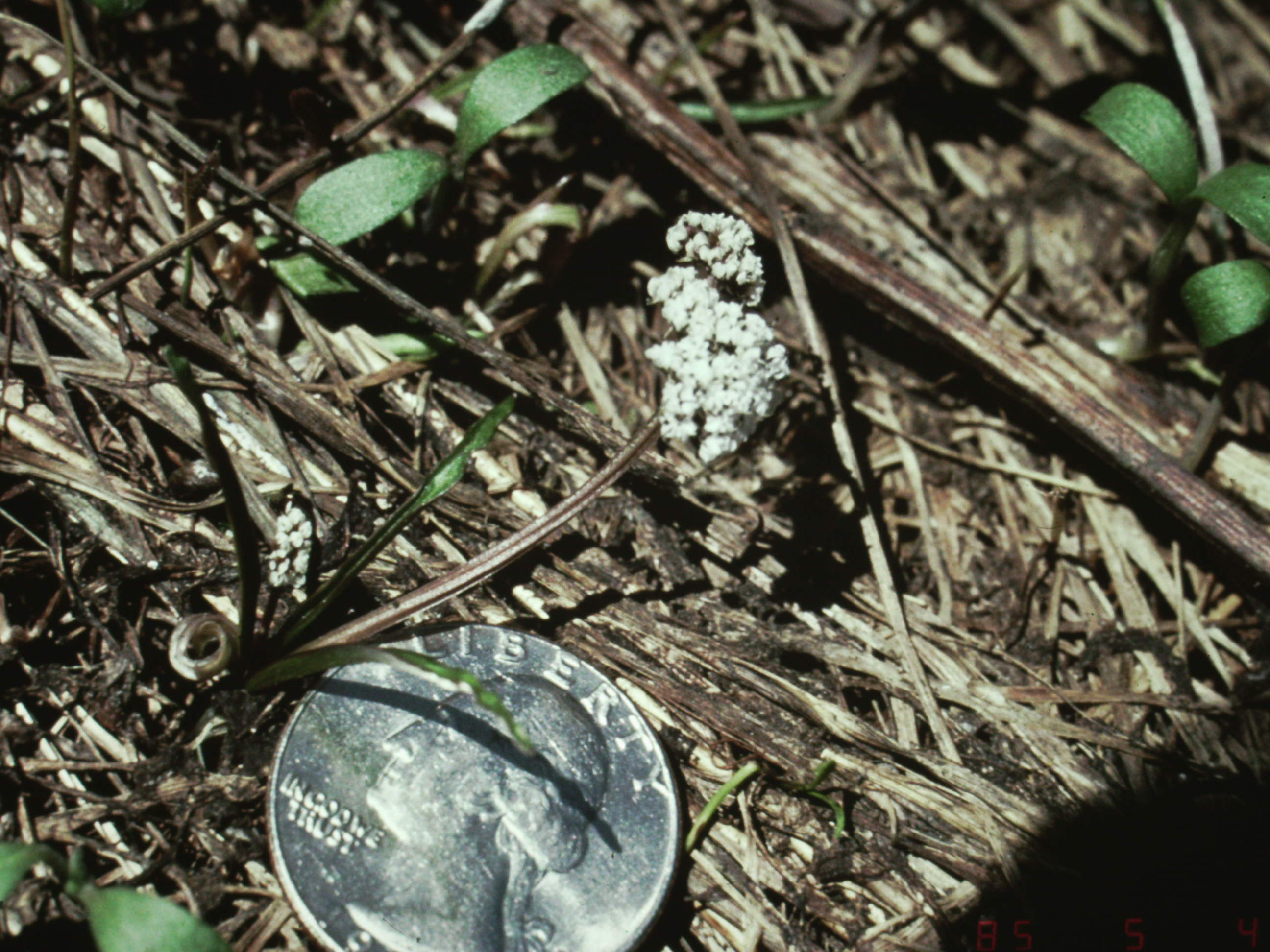
Pygmy Rabbits

Pygmy Rabbit
Brachylagus idahoesis
Courtesy & Copyright 2007 Len Zeoli

Pygmy rabbits!! Sure, like there’s these little rabbits running around out there, and nobody’s seen them. Right!

Well pygmy rabbits do exist and they’re cute as a button. They are found living it up in sagebrush from Utah north into Idaho and west to California. They eat sagebrush year-round but to fight monotony, they add a few forbs and grasses during spring, summer and fall.

Pygmy rabbits look like cottontails, but different. There’s no conspicuous white fluff ball on their tail. The fur is more slate gray than the pale gray of the desert cottontail. The pygmy rabbit is dinky, with significantly smaller ears and weighing less than a pound. Pygmy rabbits favor dense stands of big sagebrush, sometimes near riparian areas. Based on Val Grant’s experience they can also be found in sparse sagebrush and well away from water.

These rabbits are not as easy to see as they are to identify by their sign: fecal pellets, browse patterns and mobility patterns in snow. When you’re out in sagebrush, check the ground under a sage plant. If you see small piles of pellets the size of BBs, you may be onto the wily pygmy. They dig burrows beneath the sage plants and frequently fresh pellets are found at the entrance. The sage branch tips will show distinct browsing on the new growth. In winter, launching pads used by pygmy rabbits are a sure way to identify their presence. Rather than frolic through the snow like cottontails and jackrabbits, leaving a distinct trail, these little guys leap from pad to pad when traveling across the snow during the winter. This adds skiers and snowshoers to the list of observers who should be on the lookout for these diminutive rabbits with a big appetite for sagebrush.

This is Linda Kervin for Bridgerland Audubon Society.
Credits:

Photos: Courtesy & Copyright 2007 Len Zeoli

Text: Val Grant, Bridgerland Audubon Society

Additional Reading:

Pygmy Rabbit, The Rabbits Archive, https://www.rabbitsarchive.com/species/pygmy-rabbit.php

Pygmy rabbit pictures and facts, https://thewebsiteofeverything.com/animals/mammals/Lagomorpha/Leporidae/Brachylagus/Brachylagus-idahoensis.html

Endangered Rabbit Beats the Odds, College of Agricultural, Human and Natural Resource Sciences, Washington State University, https://cahnrsnews.wsu.edu/2007/06/13/endangered-rabbit-beats-the-odds/

Pygmy rabbit, mondo adorable, L.A. Unleashed, LA Times Local, February 8, 2009, https://latimesblogs.latimes.com/unleashed/2009/02/pygmy-rabbit.html

Pygmy Rabbits, Western Watersheds Project, https://www.westernwatersheds.org/wildlife/pygmy-rabbits

Heading South

US Flyways
Courtesy US FWS

Hi I’m Holly Strand.

Every fall, I scan the sky for the fluid lines of birds heading south to their winter homes. Although the flocks are fascinating to watch, I get a bit melancholy. I imagine the warm and balmy weather ahead of them and the frigid temperatures that are in store for me.

Migration behavior in birds –and other animals– evolved to help them cope with a scarcity of resources during a particular time of the year. Severe weather and lack of food are characteristic of winters in the far north of the Northern Hemisphere. Therefore almost all of the birds migrate. Although more hospitable than the arctic, Utah winters are no picnic. Therefore, birds that breed in Utah have also bought heavily into migration.

Huge numbers of Wilson’s Phalarope
gather at the Great Salt Lake
before migration.(female)
Photo courtesy and
Copyright © 2008 Stephen Peterson

Looking at a map of Western Hemisphere migration routes –or flyways—you might be reminded of the route map of a major airline. There are short regional flights, say to an adjacent state to the south or sometimes just to a lower altitude. There are medium distance flights to Mexico or Central America. And then there are the long haul flights, with birds flying from northern tundra all the way to Argentina, Chile or Antarctica.

Wilson’s phalarope is one of Utah’s long-distance migrators. After the breeding season, about 500,000 birds form the largest staging concentration of phalaropes in the world at the Great Salt Lake. After fueling up on brine shrimp and brine flies, the birds head off to wetlands in Bolivia and Argentina.

Huge numbers of Wilson’s Phalarope
gather at the Great Salt Lake
before migration.(male)
Photo courtesy and
Copyright © 2008 Stephen Peterson

Swainson’s hawk travels farther than any other North American hawk. It migrates to the Argentinian pampas in huge flocks with as many as 5,000–10,000 individual. If a Swainson’s hawk begins migration in the northern part of its range, total round trip distance will exceed 20,000 km.

The rufous hummingbird doesn’t breed in Utah but flies though on its remarkable journey from the northwest and Alaska to Central America. If you measure its travel in body lengths as opposed to distance, this tiny little aviator makes world’s longest known migration.

For pictures and sources please go to www.wildaboututah.org

Thanks to the knowledgeable folks on the UtahBirds chatline for their help in developing this story.

The Swainson’s hawk photographed
in Starr, UT will overwinter
in Argentina.
Photo courtesy and
Copyright © 2006 Lu Giddings

For Wild About Utah, I’m Holly Strand

Credits:
Photo: Courtesy US FWS National Digital Library
Swainson’s Hawk: Courtesy and Copyright 2006 Lu Giddings
Text: Holly Strand

Sources & Additional Reading

Bechard, Marc J., C. Stuart Houston, Jose H. Sarasola and A. Sidney England. 2010. Swainson’s Hawk (Buteo swainsoni), The Birds of North America Online (A. Poole, Ed.). Ithaca: Cornell Lab of Ornithology; Retrieved from the Birds of North America Online: https://bna.birds.cornell.edu/bna/species/265

With a length of 9.5 cm,
the rufous hummingbird
has the longest migration
in the world in relation to its size.
Photo courtesy and
Copyright © 2010 Michael Fish

Berthold, Peter. 2001. Bird Migration: A General Survey (second edition). Oxford Ornithology Series. Oxford University Press. https://www.amazon.com/Bird-Migration-General-Survey-Ornithology/dp/0198507879

Colwell, M. A. and J. R. Jehl, Jr. 1994. Wilson’s Phalarope (Phalaropus tricolor), The Birds of North America Online (A. Poole, Ed.). Ithaca: Cornell Lab of Ornithology; Retrieved from the Birds of North America Online: https://birdsoftheworld.org/bow/species/wilpha/cur/introduction/

Elphick, Jonathan, Ed. The Atlas of Bird Migration. 1995. NY: Random House. https://www.amazon.com/Random-House-Atlas-Bird-Migration/dp/0679438270

Healy, Susan and William A. Calder. 2006. Rufous Hummingbird (Selasphorus rufus), The Birds of North America Online (A. Poole, Ed.). Ithaca: Cornell Lab of Ornithology; Retrieved from the Birds of North America Online: https://birdsoftheworld.org/bow/species/rufhum/cur/introduction

A Rufous hummingbird
collects nesting material
Photo courtesy US FWS
George Gentry, Photographer

USGS. Northern Prairie Wildlife Research Center Migration of Birds. https://www.npwrc.usgs.gov/resource/birds/migratio
/routes.htm
[ Accessed October 28, 2010]

Weidensaul, Scott 1999. Living on the Wind. NY: North Point Press https://www.amazon.com/Living-Wind-Across-Hemisphere-Migratory/dp/0865475911

Salt Lake Brine Shrimp, https://saltlakebrineshrimp.com/harvest/

Pickleweed Splendor

Pickleweed in Cache Valley
Courtesy & Copyright 2010 Linda Kervin

Utah’s mountains and foothills blaze with the brilliant foliar colors of aspens, maples, sumacs and more. But autumn colors can be found in less likely habitats too, even across our flat, desolate salt pans. There the usually drab stage has been given a splash of deep, dusty rose color by its sole botanical performers, the pickleweeds.

Also known as glassworts or samphire, our two species of pickleweed are in the genus Salicornia. They belong to the same plant family as beets, chard and spinach., but you’d never guess that from their appearance. The ankle-high Salicornia’s leaves are reduced to tiny scales that hug the green, branching, cylindrical stems. Pickleweeds are halophytic, or salt loving. Due to their unique physiology, they can thrive in extremely saline environments that kill normal plants. Pickleweed roots filter out some of the salt before it can move into the plant. The remaining excess salt is stored in balloon-like cavities in their cells called vacuoles. When its vacuole is full, a cell ruptures, and newer younger cells continue to accumulate incoming salt.

Pickleweed in Cache Valley
Courtesy & Copyright 2010 Linda Kervin

The common name, pickleweed, derives from the taste of the salt stored in the vacuoles of the succulent, crisp stems. You may be surprised to learn that gourmet websites report that pickleweeds are all the rage in Europe as a salad garnish or pickled vegetable.

[Kevin Colver: Songbirds of the Southwestern Canyon Country]

In the Great Basin, winter flocks of Horned Larks forage in the snow for Salicornia’s tiny oil-rich seeds as do other birds. The seeds’ proteins and oils are valuable dietary supplement in the sparse salt pan habitat where the picklweed’s unique physiological adaptations allow them to thrive. If your travels this fall take you by a salt pan, take the time to enjoy the rosy glow of the humble pickleweed or view pictures on the Wild About Utah website.

Pickleweed in Cache Valley
Courtesy & Copyright 2010 Linda Kervin

This is Linda Kervin for Bridgerland Audubon Society.
Credits:

Photos: Courtesy & Copyright Linda Kervin

Text: Jim Cane and Linda Kervin, Bridgerland Audubon Society

Additional Reading:

https://plants.usda.gov/java/profile?symbol=SALIC

https://en.wikipedia.org/wiki/Salicornia_oil

https://www.efloras.org/florataxon.aspx?flora_id=1&taxon_id=129055

https://people.westminstercollege.edu/faculty/tharrison/gslplaya99/pickleweed.htm

A Scary Nature Story

Thread-waisted wasp with caterpillar
Copyright 2010 Andrea Liberatore

Hi, I’m Holly Strand from Stokes Nature Center in beautiful Logan Canyon.

“The thousand injuries of Fortunato I had borne as I best could, but when he ventured upon insult, I vowed revenge.” So begins the classic tale, “The Cask of Amontillado” by Edgar Allan Poe. In it, the vindictive Montressor lures his rival, Fortunado, into an underground wine vault, leads him into an interior crypt and chains him to a granite wall. Then he walls poor Fortunato in, using building stone and mortar.

Being buried alive is usually a theme of fictitious horror films or novels. However, in nature, the practice is often a way of life—so to speak.

Take predatory wasps as an example. These are wasps that have evolved to eat other creatures instead of pollen. You may know some of them by their common names, such as mud dauber, cicada killer, beewolf, or digger wasp. Only the female is a predator and she captures prey to feed to her young. Depending on the species, she might dig an underground burrow, find a natural cavity in a tree, or construct a special nest chamber made of mud. Once the nursery is complete, she flies off in search of a suitable “host” – a.k.a. victim. This could be an unsuspecting caterpillar, grasshopper, spider, or beetle. She stings her prey, injecting a highly specialized venom that paralyses the insect within seconds, but does not kill it. Keeping the host alive is important so that its body will not spoil. . The victim is hauled back to the burrow, and carefully interred in its burial chamber. One or more eggs are laid upon or near the body, and the young larvae, which hatch a few days later, dig into their living meal.

Pretty creepy. The fate of the wasp victims makes Poe’s Fortunato seem almost fortunate. But in spite of their gruesome eating habits, predatory wasps are generally regarded as beneficial. They feed on pests that attack the crops of farmers and gardeners. So we actually want them around. It’s just easier not to think about their dining regime.

For more scary stories, as well as creepy crafts, come to Stokes Nature Center’s Halloween Program on October 29, 5:00 to 8:00 p.m. Go to www.logannature.org for details.

For Wild About Utah and Stokes Nature Center, I’m Holly Strand.

Credits:

Photo: Courtesy & Copyright 2010 Andrea Liberatore, Stokes Nature Center

Text: Stokes Nature Center: Andrea Liberatore & Holly Strand

Sources & Additional Reading

University of Kentucky Entomology. 2007. Narrow-waisted solitary wasps. Kentucky Critter Files: Kentucky Insects. https://www.uky.edu/Ag/CritterFiles/casefile/insects/wasps/solitary/solitary.htm [Accessed October 6, 2010]

University of Minnesota. Class Insecta, Order Hymenoptera: Sawflies, bees, wasps, ants, parasitoids. https://www.entomology.umn.edu/cues/4015/handouts/Hymenopteraf.htm. [Accessed October 6, 2010]

Sears, Anna et al. 2001. Nesting Behavior and Prey Use in Two Geographically Separated Populations of the Specialist Wasp Symmorphus cristatus (Vespidae: Eumeninae). American Midland Naturalist. Vol 142 p 233-246 https://www.jstor.org/pss/3083103