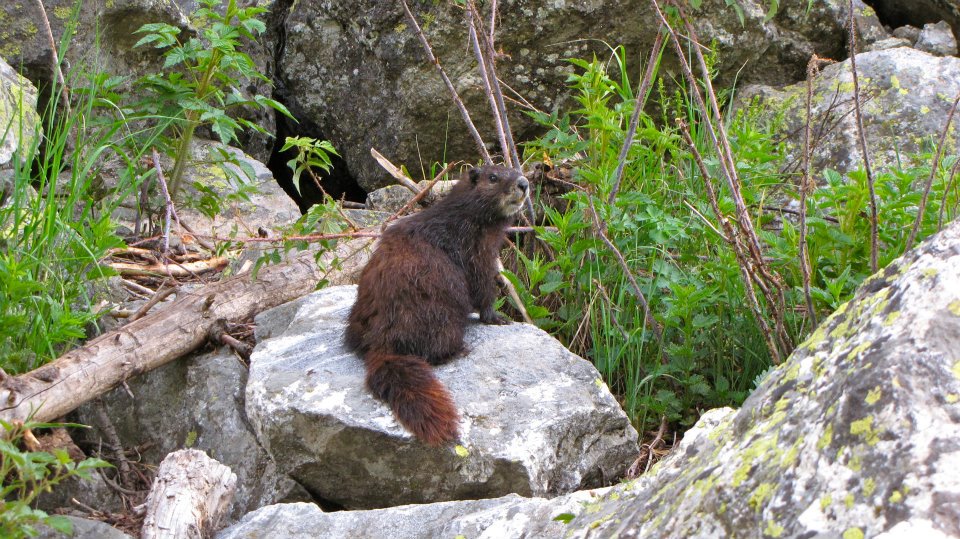
Yellow-Bellied Marmot

Yellow-bellied Marmots, Photo courtesy and copyright Roslynn Brain, Photographer
Yellow-bellied Marmots
Photo courtesy and copyright
Roslynn Brain, Photographer

Yellow-bellied Marmots, Photo courtesy and copyright Roslynn Brain, PhotographerYellow-bellied Marmots
Photo courtesy and copyright
Roslynn Brain, Photographer

Yellow-bellied Marmots, Photo courtesy and copyright Roslynn Brain, PhotographerYellow-bellied Marmots
Photo courtesy and copyright
Roslynn Brain, Photographer

Yellow-bellied Marmots, Photo courtesy and copyright Roslynn Brain PhotographerYellow-bellied Marmots
Photo courtesy and copyright
Roslynn Brain, Photographer

If you have explored the mountains of Utah, you’ve inevitably heard the iconic high-pitched chirp associated with Utah’s Yellow-Bellied Marmot.

Sporting chubby cheeks, large front teeth, a reddish-brown tail that spins like a helicopter rotor when fleeing, a greyish-brown back, white patch of fur between the eyes, and a yellow-orange belly, these sun-loving, flower-chewing mammals exude a Buddhist-type nature, especially when compared to their frantic neighbors, the pika.

Yellow-bellied marmots belong to the mammalian order Rodentia, in the squirrel family Scirudae. This family includes all species of prairie dog, chipmunk, and the woodchuck. Marmots fall under the genus “marmota.” The scientific name of yellow-bellied marmots is “Marmota flaviventris.” Although the origin of the term marmota is not certain, one accepted interpretation stems from a similar Latin word meaning “mountain mouse.” Flaviventris means “yellow belly” in Latin.

There are 15 species of marmot worldwide, all in the northern hemisphere. Most live in mountainous areas such as the Alpine marmot found only in Europe, though some live in rough grasslands. Although commonly believed to be in the same genus, the prairie dog is not classified in the genus Marmota, but in the related genus Cynomys.

When alarmed, yellow-bellied marmots emit a shrill whistle which earned them the nickname “whistle pigs,” by early settlers. Sometimes they make a “chucking” sound, which could explain another nickname, “rock chuck.” Additional monikers for marmots include “whistlers”, “mountain marmots”, and “snow pigs.”

Yellow-bellied marmots live at average elevations of 6,000-13,000 feet throughout western North America. They are often found in highland meadows and steppes, and almost always near rocks. Burrows are usually constructed in areas with plentiful plants which comprise the marmot’s main diet: herbaceous grasses and forbs, flowers, legumes, grains, fruits, and insects. Marmots spend the summer months sunning on warm rocks and fattening up in preparation for winter hibernation which can last up to 8 months.Thus, they are especially plump in the fall, right before hibernation, and reach weights of around 8-11 pounds. They may also estivate in June in response to dry conditions and a lack of green vegetation, only to reappear later in the summer when food is once again plentiful.

The typical social structure of yellow-bellied marmots includes a single male with a range of one up to four females. Males are territorial and aggressively protect their harem from other male marmots and smaller predators such as the ermine. Other predators to the yellow-bellied marmot include coyotes, foxes, badgers, bears, and eagles. Females raise their annual offspring of 3-8 jointly with other females within the harem. Baby marmots or pups are born relatively undeveloped and require large amounts of care until they emerge from the nest three weeks later. Only about half of marmot pups survive and become yearlings. If they make it through the first year, marmots may live up to 15 years of age.

Given that they spend about 80% of their life in a borrow, 60% of which is in hibernation, consider yourself lucky the next time you encounter a chubby, sun-bathing, whistling marmot!

For Utah State University Extension Sustainability, this is Roslynn Brain.

Credits:
Images: Courtesy and copyright Roslynn Brain McCann, Photographer
Text:     Roslynn Brain McCann, Utah State University Extension Sustainability
Additional Reading:

Yellow-bellied Marmot, Species, Division of Wildlife Resources, Utah Department of Natural Resources, https://fieldguide.wildlife.utah.gov/?species=marmota%20flaviventris

Marmot Burrow, UCLA, Daniel Blumstein, https://www.marmotburrow.ucla.edu/watching.html

Marmot, Rocky Mountain National Park, https://www.nps.gov/romo/learn/nature/marmot.htm

Yellow-bellied Marmot (Rockchuck), Deseret News, 14 Mar, 1998,
https://www.deseretnews.com/article/629775/Yellow-bellied-Marmot-Rockchuck.html
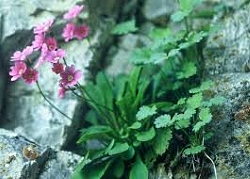

Maguire Primrose – A True Utahn Species

Maguire Primrose
Photo Courtesy US FWS
Larry England, Photographer

Hi, I’m Ru Mahoney with Stokes Nature Center in Logan Canyon. Utah is home to several iconic species – as indelible to our state’s identity as the craggy mountain landscapes and red rock deserts we call home. Gnarled bristlecone pines stand like abstract architecture for multiple millennia. Elusive mountain lions roam our alpine meadows in the north, all the way to our red rock canyons in the south. And curious coyotes – as resourceful as our native and pioneer ancestors – are truly wily wayfarers, as adaptable to suburban environments as to open range. But however pervasive iconic species may be to perceptions about our state, there are lesser known residents that are the true Utahns – species found absolutely nowhere else in the world.

The word “endemic” refers to a plant or animal whose distribution is restricted to a specific region. Utah ranks 6th in the nation for endemic species, with 247 endemic plant species alone. One of these is Primula cusickiana maguirei, or Maguire Primrose. This unassuming reddish violet-blossomed wildflower, standing just 2-4 inches high, makes a living in the cracks and depressions of limestone and quartzite outcrops along a 10 mile corridor through Logan Canyon in northern Utah. And that’s it! You won’t find it anywhere else on the planet. Of that narrow home range, Maguire Primrose is further isolated into two distinct populations within the canyon. Subtle differences in spring temperatures between the canyon walls often lead to one population blooming before the other. And while some species of primrose can survive by occasionally self-pollinating, Maguire Primrose is entirely dependent upon pollinators like bees, moths and the occasional hummingbird for reproduction. Therefore the success of Maguire Primrose requires a precise balance between cool temperatures for development and blooming, warmer temperatures to encourage pollinator activity, and a sufficient number of compatible mates blooming at the right time in the right place. In addition to these natural challenges, the US Forest Service reports that Maguire Primrose is increasingly impacted by recreational rock climbers, who clear cracks and crevices to accommodate permanent anchors along popular routes. Stokes Nature Center, and our forest service partners in the Logan Canyon Children’s Forest, hope to increase community awareness about Maguire Primrose to recruit our fellow nature lovers, including rock climbers and other canyon visitors, to become informed stewards of this rare and vulnerable wildflower.

Wildflower enthusiasts can find Maguire Primrose blooming from mid-April to mid-May at elevations of 4,800 to 6,000 feet. Flowers are more prevalent on north-facing cliffs where moisture from spring snowmelt is abundant and cooler temperatures nurture bud development. Stokes Nature Center, in partnership with the Logan Canyon Children’s Forest, offers seasonal guided field tours where canyon visitors can learn more about natural and human threats to Maguire Primrose, and enjoy a chance to see a true Utahn species found nowhere else in the world.

For Wild About Utah and Stokes Nature Center, I’m Ru Mahoney.

Credits:
Images: Courtesy US FWS, Larry England, Photographer
Text:     Ru Mahoney, Stokes Nature Center in Logan Canyon.


Additional Reading:

Natural History of Maguire Primrose, Primula cusickiana var. Maguirei (Primulaceae)
Jacob B. Davidson and Paul G. Wolf
Western North American Naturalist Nov 2011 : Vol. 71, Issue 3, pg(s) 327-337 doi: 10.3398/064.071.0301

Maguire Primrose Fact Sheet, US Fish & Wildlife Service(FWS), https://www.fws.gov/mountain-prairie/factsheets/MaguirePrimroseFactSheet.pdf

Maguire Primrose, Primula cusickiana maguirei, Utah Rare Plant Guide, Utah Native Plant Society, www.UtahRarePlants.org

Ringtails

Ringtail (Bassariscus astutus), Photo Courtesy US FWS
Ringtail (Bassariscus astutus)
Photo Courtesy US FWS
San Andres NWR
I’ve long been intrigued by ringtail cats. I wasn’t quite sure where they fit in the grand scheme of things until I did some research while working in Zion N.P. where they were known to vandalize building contents and other mischievous behaviors.
These “mystery” cats are mostly nocturnal, highly secretive, very bright, and full of tricks and athletic feats that place them in an elite animal category. I was intent on seeing one but knew my chances were slight. On a midmorning hike into Hidden Canyon I was startled by something not far ahead of me scrambling up giant boulders. To my amazement, there they were- two ringtails hightailing in broad daylight- my first, and possibly last, sighting of these amazing animals!
The name “ringtail” comes from the seven or eight black rings on the animal’s tail. Although they are not related to cats, people have referred to them as miner’s cat, civet cat, and cacomistle (an Aztec Nahuatl term meaning half mountain lion). Along with raccoons and coatimundis, ringtails are members of the Procyonidae (raccoon) family. The scientific name, Bassariscus astusus, comes from bassar (fox), isc (little), and astut (cunning).

If one were to design an animal to climb along ledges and up vertical cliffs, the ringtail might be it. Their large tail provides balance for narrow ledges and limbs, even allowing them to reverse directions by doing a cartwheel. They can rotate their hind feet 180 degrees to quickly climb back down cliffs or trees as well as cacti. Furthermore, ringtails can ascend narrow passages by stemming (pressing all feet on one wall and their back against the other or pressing both right feet on one wall and both left feet on the other), and wider cracks or openings by ricocheting between the walls.

A ringtail’s total length ranges between inches with a tail length of 12 to 17 inches. They weigh two pounds or so. Vocalizations include squeaks, metallic chirps, whimpers, chitters, chucking, hisses, grunts, growls, and howls.
Like most omnivores, these hunters eat a wide variety of food. They have a seasonal diet, with plants and insects the favorite fall food, mammals and birds more common in winter, and insects dominate in summer. Preferred mammals include mice, woodrats, squirrels and rabbits. Ringtails also feed on nectar from agaves. Great horned owls are their major predator, along with coyotes, raccoons and bobcats.

Primarily nocturnal, ringtails don’t like daylight at a young age. Ringtails inhabit rough, rocky habitat, usually not too far from water, although they can subsist without free water if their diet consists of high protein prey or fruit and insects. In addition, they occur in semi-arid landscapes such as pinyon-juniper pygmy forests and oak woodlands. Ringtails den in tree hollows, rock crevices, other animals’ abandoned burrows or even abandoned buildings. Except in bad weather, they move frequently, rarely spending more than three straight nights in one den.

Mating occurs between February and May with one to four, hairless young born in May or June. Eyes open and fur covers their bodies by five to six weeks. They are weaned by fall and can mate near the end of their second year. Ringtails range across the southwestern USA and most of Mexico with outliers in northern California, Nebraska, Missouri and extreme southwest Wyoming.The genus Bassariscus consists of only one other species which lives in Central America. Because ringtails do not walk on the soles of their feet, unlike coatis or raccoons, they are sometimes placed in their own family, Bassariscidae. The ringtail became the State Mammal 1986.

For Wild About Utah, this is Jack Greene.

Credits:

Pictures: Courtesy US FWS, San Andres NWR
Text: Jack Greene, Bridgerland Audubon Society

Additional Reading:

Animal Fact Sheet: Ringtail, Arizona-Sonora Desert Museum, https://www.desertmuseum.org/kids/oz/long-fact-sheets/Ringtail.php

Ringtail (Bassariscus astutus), Wildscreen Arkive, https://www.arkive.org/ringtail/bassariscus-astutus/

The Arches of Zion National Park

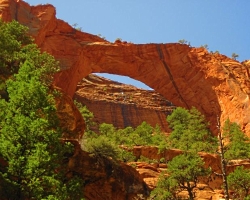
Kolob Arch
Zions National Park
Photo Courtesy NPS

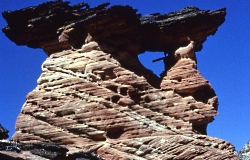
Hoodoo Arch
Zions National Park
Photo Courtesy NPS

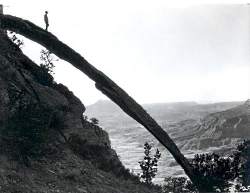
Historic Crawford Arch
Zions National Park
Photo Courtesy NPS

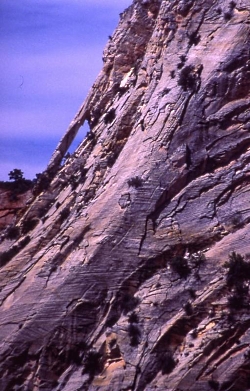
Hidden Arch
Zions National Park
Photo Courtesy NPS


Though another national park in Utah is famous for arches, Zion National Park has more than you might imagine.

Doubt it? Next time you visit the park, take a good look around. All the elements for arch building are readily on hand in Zion.

A natural arch is formed when deep cracks penetrate into a sandstone layer. Erosion wears away the exposed rock layers and the surface cracks expand, isolating narrow sandstone walls, or fins. Water, frost, and the release of tensions in the rock cause crumbling and flaking of the porous sandstone and eventually cut through some of the fins. The resulting holes become enlarged to arch proportions by rockfalls and weathering.

Worldwide, arches number in the tens of thousands, and probably no place is more suited for their creation than the Colorado Plateau, home of Zion National Park. The vast geology of Zion has created environments as widespread and varied as the topography of the park itself.

Hidden in its geologic grandeur are dozens, perhaps hundreds, of freestanding arches of all shapes and sizes. Although freestanding arches may be found in many different types of geologic formations, the Navajo Sandstone formation, which makes up the magnificent cliffs of Zion, provides a fertile setting for the creation of these ribbons of rock.

Among the many arches in Zion, two stand out: Crawford Arch and Kolob Arch. Crawford Arch is the most visible, clinging to the base of Bridge Mountain a thousand feet above the Zion Canyon floor. It’s frequently pointed out to casual observers by an interpretive sign located on the front patio of the Human History Museum.

The other famous arch in Zion is not so easily seen. Located deep in the backcountry of the national park’s Kolob Canyons District — it takes a seven-mile hike in to reach– Kolob Arch is hidden in a small side canyon, perched high on the canyon wall.

For most of the 20th century, many believed that Kolob was in fact the world’s largest freestanding arch, leading to years of debate and the motivation for various parties of adventurous thrill seekers to climb on and around the massive span in hopes of securing a defensible measurement.

The Natural Arch and Bridge Society long has pondered this question, and using lasers and an agreed upon definition of what should be measured says Landscape Arch is the world’s longest stone arch. But don’t be surprised if the debate continues.

The definition used by the society centers on the “maximum horizontal extent of the opening.” That opening beneath Landscape Arch measures right around 290.1 (plus or minus 0.8 feet) feet across.

The opening beneath Zion National Park’sKolob Arch, which long had been in the running for world’s largest, measures 287.4 feet (plus or minus 2 feet), according to the group.

Despite its isolated location, Kolob Arch has become a favorite backcountry destination for thousands of visitors to Zion. They discover what most arch seekers will tell you: while beauty awaits every seeker at the end of the path, the reward begins unfolding at the trailhead.

Anxious to see another arch, but not ready for a 14-mile roundtrip hike? Then head for Double Alcove ARch. A 5-mile roundtrip along the Taylor Creek Trail takes you into a narrow box canyon toward the Double Arch Alcove, where erosion has carved out natural openings in the Navajo sandstone.

For Wild About Utah and National Parks Traveler, I’m Kurt Repanshek.

Credits:
Images: Courtesy and Copyright Kurt Repanshek, www.nationalparkstraveler.com
Text:     Kurt Repanshek/, NationalParksTraveler.com.


Additional Reading:

https://www.nationalparkstraveler.com/browse/Arches%20National%20Park

https://www.nps.gov/zion/index.htm