Shrubby-Reed Mustard: The Best Little Plant You’ve Never Heard of (Aug 2016)

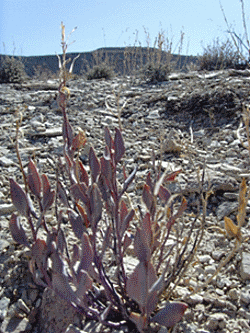
Shrubby-Reed Mustard Bush, Hesperidanthus suffrutescens
Shrubby-Reed Mustard Bush
Hesperidanthus suffrutescens
Courtesy & Copyright Matt Lewis
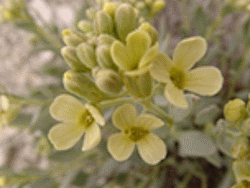
Shrubby-Reed Mustard Blossoms, Hesperidanthus suffrutescens Shrubby-Reed Mustard Blossoms
Hesperidanthus suffrutescens
Courtesy & Copyright Matt Lewis

Shrubby-Reed Mustard Blossoms Closeup, Hesperidanthus suffrutescens Shrubby-Reed Mustard Blossoms
Hesperidanthus suffrutescens
Courtesy & Copyright Matt Lewis

Tucked into isolated pockets of the Uintah Basin’s arid wildlands is the best little plant you’ve never heard of. Known to exist only in Duchesne and Uintah Counties, Shrubby-reed Mustard seems to occupy only the semi-barren “islands” of white shale in areas of the Green River Formation’s Evacuation Creek region. The endangered plant features thick, almost succulent, blue-green leaves and small yellow flowers.

“The habitat of Shrubby-reed Mustard is visually striking,” says USU alum Matt Lewis, a botanist with the Bureau of Land Management in Vernal, Utah. “It grows in very shallow, fine-textured soils and shale fragments that form narrow bands in the desert shrub community.”

Among the first plants to flower in spring, the perennial herb is visited by large number of insects, including many native bee species that forage for pollen. Scientists believe these bees may be critical in the plant’s reproduction and survival.

Lewis says the plant, also known as Toad-Flax Cress and Uintah Basin Waxfruit, offers an understated beauty to the stark landscape. With a shrub-like form and multiple stems, Shrubby-reed Mustard grows to about 20 centimeters in height. Its leaves, which feel almost like leather, change to a bright purple in the fall.

The plant is also enticingly fragrant, Lewis says. “Its scent reminds me of roses mixed with apples and pears.”

Despite its fragile status, Shrubby-reed Mustard is a long-lived plant. USU ecologist Geno Schupp says some individual plants may be one hundred years old.

The elusive species has outlived scientists’ attempts to classify it and has undergone several taxonomic changes. It currently boasts the scientific name Hesperidanthus suffrutescens, placing it solidly in the mustard family.

Lewis knows of no history of Shrubby-reed Mustard as a culinary or medicinal herb, though documented reports of such uses for mustard plants date back to ancient times. The plant appears to provide welcome forage for some four-legged creatures, he says, as he recently witnessed plants that had been grazed completely and ripped from the ground.

“Whether that was due to livestock or native ungulates, I’m not sure.”

Credits:
Images: Courtesy & Copyright Matt Lewis
Text:     Mary-Ann Muffoletto, Utah State University College of Natural Resources
Credits:
Matt Lewis, botanist, Bureau of Land Management, Vernal, Utah.
Eugene “Geno” Schupp, professor, USU Department of Wildland Resources.

Additional Reading:

https://www.fws.gov/mountain-prairie/factsheets/ShrubbyReed-mustardFactSheet.pdf

https://www.fws.gov/mountain-prairie/species/plants/shrubbyreedmustard/5YearReview2010.pdf

Bird Banding in Red Butte Canyon

Bird Banding Red Butte Canyon: Volunteers and members of the Şekercioğlu lab who run the bird banding station in Red Butte Canyon. From left to right: Kyle Mika, Jennifer Bridgeman, Kylynn Clare, Anna Vickrey, JJ Horns, Ahmed Bwika, and Patricia Gao.
Volunteers and members of the Şekercioğlu lab who run the bird banding station in Red Butte Canyon. From left to right:
Kyle Mika, Jennifer Bridgeman, Kylynn Clare, Anna Vickrey, JJ Horns, Ahmed Bwika, and Patricia Gao.
Courtesy & Copyright Jessie Bunkley, Photographer

[Sound of walking on gravel]

J.J. Horns – Our lab name is the Biodiversity and Conservation Ecology lab and our work focuses on how human land use affects different types of wildlife.

J.J. – I’m J.J. Horns.
Patricia Gao – I’m Patricia.
Ahmed Bwika – I’m Ahmed.
Anna Vickrey – I’m Anna Vickrey.
Kyle Mika – I’m Kyle Mika.
Jennifer Bridgeman – I’m Jennifer Bridgeman.
Kylynn Clare – I’m Kylynn Clare.

Bird Banding in Red Butte Canyon: J.J. Horns, a graduate student in the University of Utah Biodiversity and Conservation Ecology lab, observes a yellow warbler (Setophaga petechia) that was recently measured and banded.
J.J. Horns, a graduate student in the University of Utah Biodiversity and Conservation Ecology lab, observes a yellow warbler (Setophaga petechia) that was recently measured and banded.
Courtesy & Copyright Jessie Bunkley, Photographer

J.J. – Here in Red Butte Canyon we monitor migratory songbirds as they move through and try and get a picture of one, what is the bird community like in Utah. That’s why Red Butte Canyon is such a nice place to work because it’s a protected canyon so it gives an idea of what the natural state of birds along the Wasatch should be like. And we monitor their populations, look for any population level changes, and we look for changes in their migration, in the health of the birds, and try and understand how human effects like land development and climate change are affecting these bird communities.

Metal leg bands with unique numbers are attached to each bird, like this spotted towhee (Pipilo maculatus), allowing individuals to be identified in the future if they are recaptured.
Courtesy & Copyright Jessie Bunkley, Photographer

Ok, so we’re ready to go around and check our nets.

Anna – The mist net is this really superfine, hard to see material with shelves in it. So when the bird flies into the net it kind of falls into one of these net shelves and that material is so fine, especially if you put it in front of a tree, that the birds don’t see it and so they’ll just fly right into it, fall in, and we come around frequently enough that they’re not in there for a long time.

J.J. – So this is a bird called a spotted towhee and based on how brown that head is

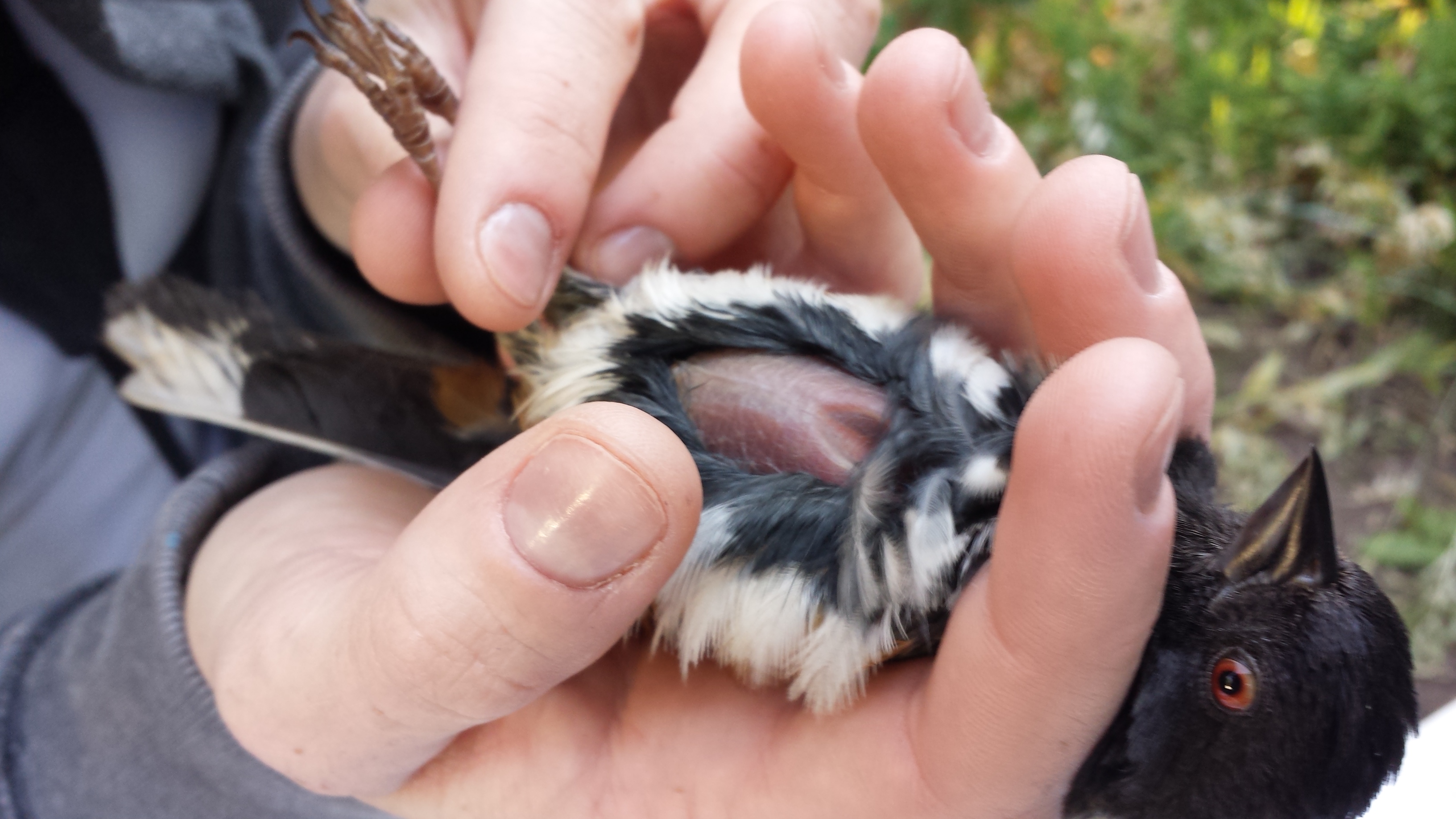
Blowing the feathers away from the body allows researchers to examine a bird's fat levels and overall health. An inspection of this spotted towhee also reveals a brood patch, indicating it is incubating eggs.
Blowing the feathers away from the body allows researchers to examine a bird’s fat levels and overall health. An inspection of this spotted towhee also reveals a brood patch, indicating it is incubating eggs.
Courtesy & Copyright Jessie Bunkley, Photographer

Anna – And the eye color, right?

J.J. – and the eye color, we can tell that it’s a little baby, just born this year. Towhee squawking in the background. When the bird lands in the net like this they get all tangled up, they get the net around their wings and around their legs, and so what we do is we carefully take it off of any part of their body where it’s tangled up and then we put them in these little bird bags. And the bird bags are just little cloth sacks that keep the bird warm and because they’re kind of dark the bird stays really calm.

Blowing feathers away from the head reveals the skull beneath, enabling the bird's age to be determined. The pattern of skull ossification on this black-headed grosbeak (Pheucticus melanocephalus) indicates it is an adult.
Blowing feathers away from the head reveals the skull beneath, enabling the bird’s age to be determined. The pattern of skull ossification on this black-headed grosbeak (Pheucticus melanocephalus) indicates it is an adult.
Courtesy & Copyright Jessie Bunkley, Photographer

Jennifer – It’s a baby yellow warbler!

Kylynn – Spotted towhee.

J.J. – Black-headed grosbeak.

Mourning dove.

Kyle – Song sparrow.

J.J. – So this is a yellow warbler. So as part of the banding we take the age and the sex and then a bunch of morphological measurements. We can tell this one’s a male by those brown streaks on the breast and we can also tell it is an older bird. It’s been around for at least one year because of that nice yellow edging on those tiny feathers there.

[Sound of JJ blowing the bird’s feathers away from its body.]

A mourning dove is examined closely by a scientist at the Red Butte Canyon bird banding station. Courtesy & Copyright Jessie Bunkley, Photographer
A mourning dove is examined closely by a scientist at the Red Butte Canyon bird banding station.
Courtesy & Copyright Jessie Bunkley, Photographer

Let’s say a CP of one. A CP is a cloacal protrusion, it’s what males get when they’re breeding. Sound of blowing. No brood patch. Brood patches are where birds will loose feathers on their stomachs so they can incubate eggs. Sound of blowing. No fat. Birds deposit fat in a really predictable way. They have a little cavity where their collar bone is. Sound of blowing. No body molts. Not growing any feathers on his body. Wing is sixty-two and his weight is 8.4.

If anyone is interested in helping out bird conservation just in their day to day life, if you have cats either keep them inside or buy them a cat bib or a couple of bell collars. That’s probably the number one thing you can do to help bird conservation.

Everyone – For Wild About Utah this is the Şekercioğlu lab in Red Butte Canyon!

Bat Netting at Antelope Island State Park

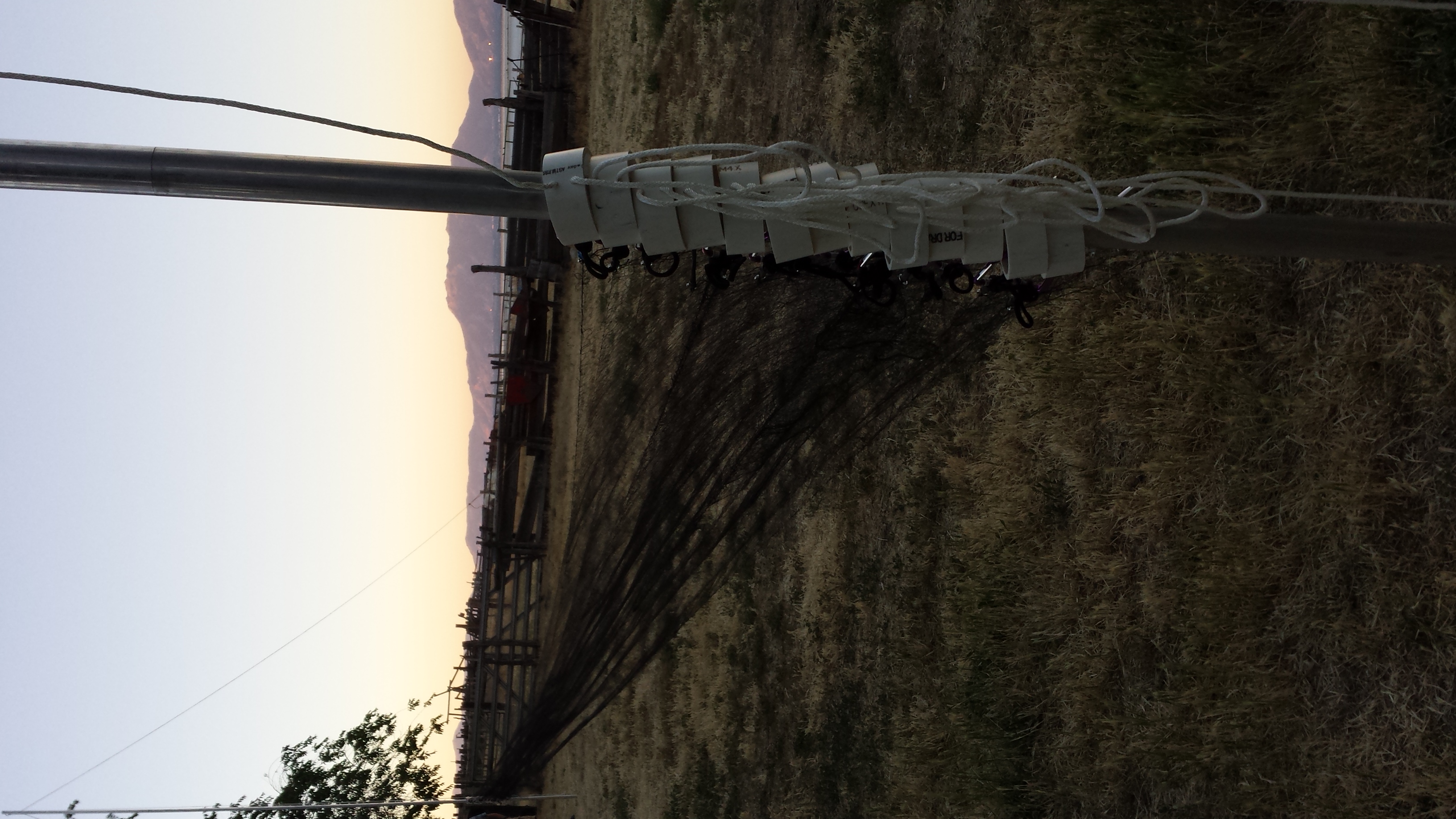
After the sun sets, fine mist nets are raised high into the air to capture passing bats. Courtesy and © Jessie Bunkley, Photographer
After the sun sets, fine mist nets are raised high into the air to capture passing bats.
Courtesy and © Jessie Bunkley, Photographer

[Sounds of a bat echolocating]

Jessie Bunkley – The sound you are hearing is a bat echolocating through the darkness of the night. Bats use sound to detect their surroundings. They produce frequencies that are much higher than what we’re able to hear and as those sound waves hit objects in front of them and reflect off the bats interpret the echoes to sense their environment. What you’re hearing is a bat detector that has taken these high frequency sounds and cut them down to a level that we can hear.

Adam Brewerton – I’m Adam Brewerton. I’m the wildlife conservation biologist for the Northern Region with the Division of Wildlife Resources.

Jessie – And I’m Jessie Bunkley. I’m a wildlife technician with UDWR.

Large ears and prominent nose glands are conspicuous features of this appropriately name Townsend’s big-eared bat. Her thumbs are also visible as she holds them in front of her face. Courtesy and © Jessie Bunkley, Photographer
Large ears and prominent nose glands are conspicuous features of this appropriately name Townsend’s big-eared bat. Her thumbs are also visible as she holds them in front of her face.
Courtesy and © Jessie Bunkley, Photographer

Adam – And our bat survey tonight out at Antelope Island we’ve been pretty successful so far. We’ve caught a little brown bat and we’ve caught seven Townsend’s big-eared bats. It’s part of the statewide species distribution and occupancy study and we’ve got several survey locations that have been randomly selected out of a grid system. So Antelope Island is just one of those randomly selected sites. In addition to that it’s also close and convenient for people to come out and learn about bats so that’s why we’ve invited [the] public to come out and join us tonight.

Jessie – To capture the bats we’ve set up several mist nets, which are very long, fine nets. We have stacked the nets two or three nets high and we use a pulley system to raise and lower them.

Adam – They fly into the net and they get caught and tangled. We go get the bats out as gently as we can and we come back for the measuring and weighing and identifying. It helps us to track relative species occurrence throughout the state. So being able to say that the species is doing well or declining or increasing. We can really only say that based off of how frequently we catch it in different places relative to other species.

[Bats echolocating and squeaking in the background]

A Townsend’s big-eared bat (Corynorhinus townsendii) is carefully untangled from a mist net. Courtesy and © Jessie Bunkley, Photographer
A Townsend’s big-eared bat (Corynorhinus townsendii) is carefully untangled from a mist net.
Courtesy and © Jessie Bunkley, Photographer

Jessie – Bats are the second most diverse group of mammals, right behind rodents. There are over twelve hundred species of known bats throughout the world and this represents about twenty percent of all mammals. In Utah we have eighteen species that regularly occur in the state.

Adam – The wing membranes connect all their fingers together so their hand is shaped very much like ours, their thumb sticks up with a little claw hook on it, and then that membrane stretches between their finger digits. They’re cool because they’re interesting, they’re unique, they’re the only mammals that fly, they’re skeletal structure is totally different than other mammals, they echolocate, they’re intelligent, social, they live in a completely foreign world that we can’t really understand how they view the world through echolocation. What makes them interesting too is just so much that we don’t know and [there is] so much more to learn about them.

Jessie – For Wild About Utah that was Adam Brewerton and I’m Jessie Bunkley signing off from Antelope Island State Park.

Adam Brewerton, the conservation biologist for the Utah Division of Wildlife Resources Northern region, holds a Townsend’s big-eared bat after taking measurements and examining her. Courtesy and © Jessie Bunkley, Photographer
Adam Brewerton, the conservation biologist for the Utah Division of Wildlife Resources Northern region, holds a Townsend’s big-eared bat after taking measurements and examining her.
Courtesy and © Jessie Bunkley, Photographer

Bats & Echolocation, Holly Strand, Wildaboututah, https://wildaboututah.org/bats-and-echolocation/

Bat Echolocation recordings from the Western Soundscape Library at the University of Utah Marriott Library,

Credits:
Images: Courtesy US FWS and USDA Forest Service
Text: Jessie Bunkley. Wildlife technician, Utah DWR/Jessie Bunkley, Graduate Teaching Assistant, BNR, Utah State University

Sources & Additional Reading

Bat Conservation International. 1997. Bat Chat: An Introduction to Echolocation
https://www.batcon.org/, https://www.batcon.org/resources/media-education/learning/bat-squad/bat-squad-ep-4-bat-chat-join-the-bat-squad

Wilson, Don E. 1997 Bats in Question: The Smithsonian Answer Book. Smithsonian Institution Press, Washington, DC https://www.amazon.com/Bats-Question-Smithsonian-Answer-Book/dp/1560987391

Bats Live, Prince William County Public Schools, Manassas, VA, https://batslive.pwnet.org/

Bat Week 2015
Sometimes misunderstood, bats are important and fascinating animals. Watch this video to learn some bat facts, find out what challenges are facing bats today and what you can do to help #savethebats.
Bat Week Video

13 Facts About Bats, US Department of the Interior, Blog, 10/24/2016, https://www.doi.gov/blog/13-facts-about-bats

Butterflies

Click to view a closer view of Andrea Liberatore's photograph of a Monarch butterfly (Danaus plexippus).  Courtesy and Copyright 2009 Andrea Liberatore, Photographer
Monarch Butterfly
Danaus plexippus
Courtesy & Copyright 2009
Andrea Liberatore, Photographer


Click to view a closer view of a Monarch butterfly caterpillar, (Danaus plexippus), Courtesy US FWS, images.fws.govMonarch Butterfly Caterpillar
Danaus plexippus
Courtesy US FWS, images.fws.gov

Click to view a closer view of a Monarch butterfly chrysalis (Danaus plexippus).  Courtesy NASA JPL, climate.nasa.gov, Plant a butterfly garden!, Climate Kids: Earth NowMonarch Butterfly Chrysalis
(Enlarged)
Danaus plexippus
Courtesy NASA JPL, climate.nasa.gov
Plant a butterfly garden!
Climate Kids: Earth Now


Click to view a closer view of Andrea Liberatore's photograph of Gene Nieminen's photograph of Monarch butterflies resting during migration.  Courtesy US FWS, Gene Nieminen, PhotographerA Rest Stop During the
Monarch Butterfly Migration
Courtesy US FWS, images.fws.gov
Gene Nieminen, Photographer

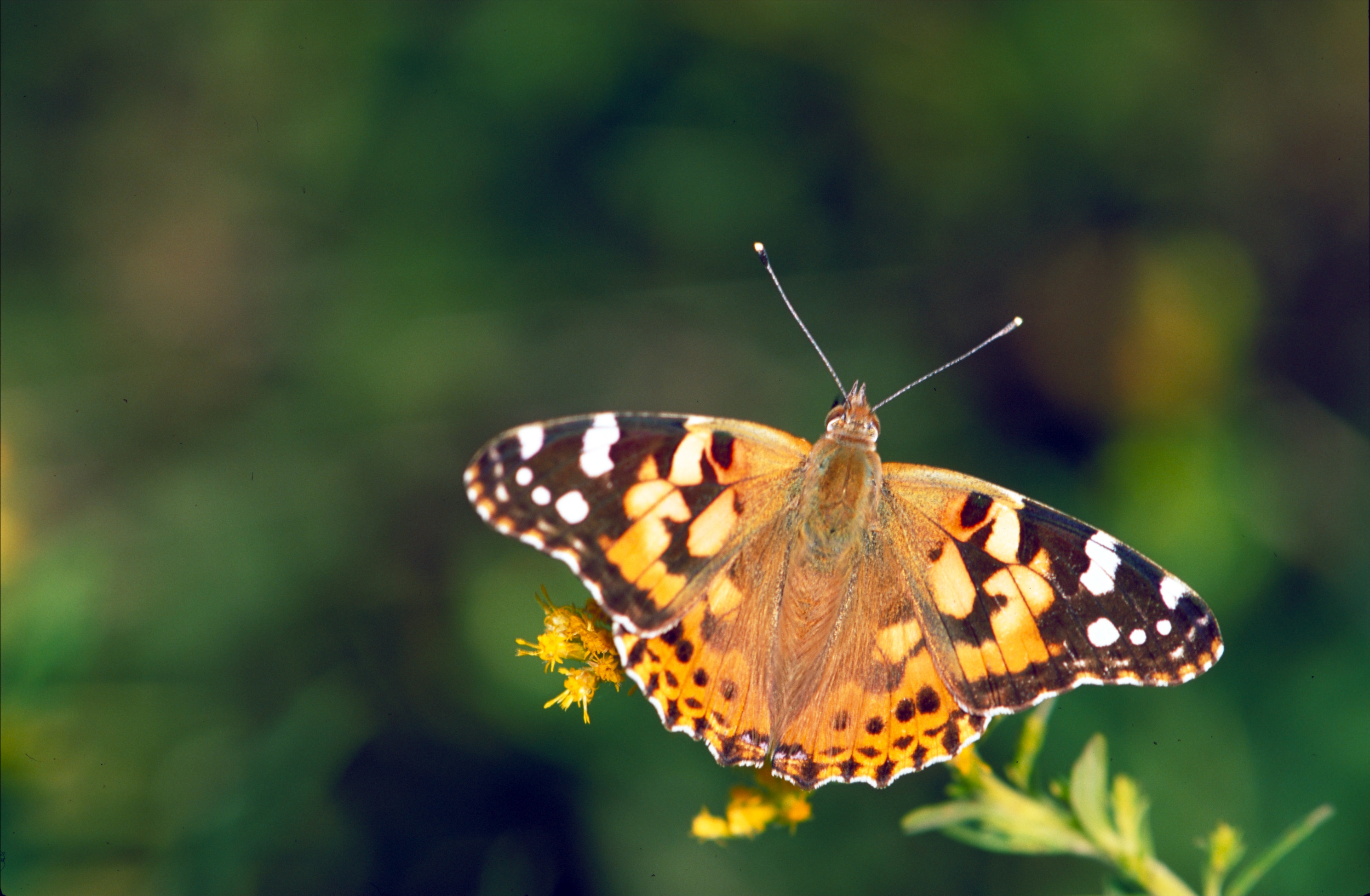
Painted Lady Butterfly, Click to view of a Painted Lady Butterfly, Courtesy US FWSPainted Lady Butterfly
Click to view of a Painted Lady Butterfly, Courtesy US FWS

Viceroy Butterfly, Click to view the butterflies page from Lee Metcalf National Wildlife Refuge, MontanaViceroy Butterfly
Click to view the butterflies page from Lee Metcalf National Wildlife Refuge, Montana

Rivaling flowers and tropical fish in their beauty, butterflies or lepidopterans, have been icons of peace and reverence for millennia. There are eight different families to which butterflies belong- at least 250 species of which are found in Utah.

Fortunately, these beauties have been inherently resilient. This resiliency comes from a host of survival strategies. Loss of habitat, misuse of Insecticides, and climate change are the primary threats to their future.

It was from early elementary school that I learned of their amazingly complex metamorphosis, commonly used as a metaphor for a transformative experience by many- merging from a destructive plant eating caterpillar to an adult plant propagating pollinator.

Two of the most celebrated butterflies are the migrating Monarchs and Painted Ladies. Their extraordinary journey involves many generations that fly unerringly to distant destinations.​
On to some remarkable survival strategies.

Called Batesian Mimicry, Viceroy’s are protected because their avian predators’ mistaken identity with the yucky tasting Monarch’s.

In order to protect themselves, many butterfly species have wing coloration and patterns for camouflage and mimicry- large eye spots which frighten predators away or mimic their host plants. Often, their caterpillars do so as well.

In Utah, there are several species of butterflies from the Gossamer-wings family whose caterpillars have a unique relationship with ants. These caterpillars secrete a liquid containing sugars and amino acids which help sustain the ants. In turn, the ants tend the caterpillars protecting them from any would-be predators similar to their relationship with aphids. A study found that “Ant-tended larvae were 4 to 12 times more likely to survive to pupation than an otherwise similar group of untended larvae.”)

Most butterfly females lay around 300 eggs in their brief existence. The few that survive inclimate weather, predation, parasitism, genetic defect, crop spraying, etc., will provide enough offspring to support adults for the next generation. If butterflies didn’t have natural enemies such as spiders, birds, earwigs, wasps, etc. to keep their population numbers in check, natural systems would soon be overwhelmed.

Most butterflies have a season–usually in the winter–where they hibernate or diapause until spring. They are tightly associated with their larval hostplants. One of the remarkable butterflies of Utah’s Mojave Desert is the Pima orange tip. Their pupae are both photoperiod sensitive and moisture sensitive. If the Mojave Desert does not get sufficient moisture somewhere in the window of time between ~January 1 and ~February 15, none of the three known hostplants of this butterfly will not germinate in sufficient numbers.

If their chrysalis doesn’t sense sufficient humidity, it will extend its diapause another year and repeat its cycle of critically analyzing humidity during the same time frame as it did a year before. In the lab, pupae of the Pima orange-tip have been known to survive up to 11 years before emerging because these critical parameters were not met.

The next time you go birding, include these wined beauties in you binocular’s view!

This is Jack Greene reading for “Wild About Utah”

Credits:

Pictures: Courtesy
      Andrea Liberatore, Photographer
      US FWS,
      NASA JPL
      US FWS, Gene Nieminen, Photographer
      US FWS, Lee Metcalf National Wildlife Refuge
Text: Jack Greene, USU Sustainability & Bridgerland Audubon Society

Additional Reading:

North American Butterfly Association, https://www.naba.org/

Butterfly Conservation, The Xerces Society for Invertebrate Conservation, https://www.xerces.org/endangered-species/butterflies

NRCS Working Lands for Monarch Butterflies, https://arcg.is/0TjueO