Crow vs. Raven

Crow vs. Raven: Ravens in Bryce Canyon National Park
Common Raven (Corvus corax)
Bryce Canyon National Park
Courtesy US National Park Service
And found on Wikipedia

Image of the American Crow, Corvus brachythynchosby, Courtesy and Copyright 2011 Wayne WhaleyAmerican Crow Juvenile & Parent
(Corvus brachythynchosby)
Copyright © 2011 Wayne Whaley

Image of the American Crow, Corvus brachythynchosby, Courtesy and Copyright 2011 Wayne WhaleyAmerican Crow, Orem, UT
(Corvus brachythynchosby)
Copyright © 2011 Wayne Whaley

The American Crow, Corvus brachythynchosby, Courtesy and Copyright 2011 Wayne WhaleyAmerican Crow Pair, Orem, UT
(Corvus brachythynchosby)
Copyright © 2011 Wayne Whaley

Hi I’m Holly Strand.

As you might have guessed, the American crow and the common raven are birds of a feather—two closely related species of the same genus Corvus. Both of them are residents of Utah. Together with family members magpies and jays, crows and ravens are among the brainiest animals on the planet.

Many times I’ve heard someone ask “Is that a crow or a raven?” or “What’s the difference between them?”

Perhaps the easiest way to tell these two apart is by size. If you are thinking to yourself “Wow! That’s a huge crow!” You are probably looking at a raven. Ravens can weigh over 2.5 pounds while crows typically weigh less than 1. The Raven’s wingspan can clear 4.5 feet while that of crows is less than 3. Proportional to their bodies, the bill on a Raven is larger and thicker.
The crow has a thinner, more pointed bill.

Take a look at the tail in flight: a crow tail is fan shaped with a straight tail edge. A raven tail has a rounded wedge shape.

In the air, ravens usually soar, while crows will flap a lot more. It’s not always apparent why, but some ravens will perform acrobatic rolls during flight—usually half rolls, but sometimes full rolls and even double rolls!

Common ravens are abundant throughout Utah, They can be found in almost all habitats and in all seasons. They are more wilderness-oriented than crows who prefer forest edges, savannas, agricultural fields and urbanized areas. In cities and towns humans provide lots of easy food in the form of garbage. The crows’ intelligence allows them to take advantage of novel food items– like pizza and Cheetos–that don’t really resemble food in the wild.

Finally, listen to the difference in sound: Here are two crows calling—an adult and a juvenile https://xeno-canto.org/72977 . Now listen to the throatier sound of the raven https://xeno-canto.org/12581 [Updated February 11, 2026]
Crows will also scream, rattle, whine and coo, but most of the time they just caw. Ravens have a richer, more complex vocabulary. They’ll scream, trill, knock, croak, cackle, warble, yell, and kaw. Young birds reared in isolation have even been taught to say “Nevermore.”

Thanks to Ryan O’Donnell and Andrew Spencer for their recordings available on the web at www.xeno-canto.org

For Wild About Utah, I’m Holly Strand.

Credits:

Theme: Courtesy & Copyright Don Anderson as performed by Leaping Lulu
Photos: Courtesy US National Park Service &
Courtesy & Copyright © 2011 Wayne Whaley
Text & Voice: Holly Strand

Sources & Additional Reading:

Boarman, William I. and Bernd Heinrich. v1.9 March 4, 2020. Common Raven (Corvus corax), The Birds of the World. Ithaca: Cornell Lab of Ornithology; Retrieved from the Birds of the World: https://birdsoftheworld.org/bow/species/comrav/cur/introduction [Updated February 11, 2026]

Kilham, Lawrence. 1989. The American crow and the common raven. W. L. Moody Jr. Natural History Series. College Station: Texas A&M University Press. https://www.amazon.com/American-Common-Raven-Natural-History/dp/0890964661/ [Updated February 11, 2026]

Marzluff, John M. 2005. In the company of crows and ravens. Yale University Press. https://www.amazon.com/Company-Crows-Ravens-John-Marzluff/dp/0300122551/ [Updated February 11, 2026]

Savage, Candace Sherk , 1997. Bird brains: the intelligence of crows, ravens, magpies, and jays. Sierra Club Books. https://www.amazon.com/Bird-Brains-Intelligence-Ravens-Magpies/dp/1771644257/ [Updated February 11, 2026]

Verbeek, N. A. and C. Caffrey. v1.5, December 24, 2025. American Crow (Corvus brachyrhynchos), The Birds of the World Online. Ithaca: Cornell Lab of Ornithology; Retrieved from the Birds of the World Online: https://birdsoftheworld.org/bow/species/amecro/cur/introduction [Updated February 11, 2026]

Sphinx Moths

Sphinx Moths; Big Poplar Sphinx, Pachysphinx occidentalis, Courtesy Whitney Cranshaw, Colorado State University, bugwood.org
Big Poplar Sphinx
Pachysphinx occidentalis
Courtesy Whitney Cranshaw
Colorado State University
bugwood.org

White-lined Sphinx
Hyles lineata
Courtesy Whitney Cranshaw
Colorado State University
bugwood.org

White-lined Sphinx Caterpillar
Hyles lineata
Courtesy Whitney Cranshaw
Colorado State University
bugwood.org

I vividly remember the first time I saw one – a small winged creature whirring from flower to flower in the evening light, its long tongue dipping for nectar within tube-shaped blooms. I was mesmerized, and struggled for a closer look.Sphinx Moths

If you’re thinking that I must have seen a hummingbird, you would be making a very common mistake. A mistake, in fact, that has given this critter one of its many nicknames. The winged wonder I saw that summer night was a sphinx moth, also called a hummingbird or hawk moth because of their large size and bird-like characteristics.

In all stages of their life, these insects are large. Caterpillars grow to a robust 4 inches in length and adult wingspans can measure more than 5 inches. Sphinx moths are also some of the fastest insects on earth and have been clocked flying at over 30 miles per hour. Their size, speed, and flying ability reflect those of the hummingbird so closely that they are commonly misidentified.

Sphinx moths are a beloved sight in many Utah gardens. However, they also hold a bit of a devious surprise. The larvae, or caterpillar, of one common species of sphinx moth are well known by vegetable gardeners. They are large and bright green with a distinctive horn near their hind end. Like the adults, these larvae go by many names, the most common being the tomato hornworm. Hornworm caterpillars, unlike their adult counterparts, are not beloved by gardeners. They are voracious beasts with the ability to strip the vegetation off a tomato or pepper plant in one day.

Aside from our garden plants, young hornworms of other species feed on a variety of vegetation including willow, poplar and cottonwood trees. Adult moths rely on a host of flowers such as columbine, honeysuckle, larkspur and evening primrose. Here in Utah you might come across one of a handful of different species in the sphinx moth family including the five-spotted hawk moth and the white-lined sphinx. Look for them in the late summer evenings as daylight begins to fade. But be sure to look twice to avoid mistaking them for something they’re not.

And the next time you find a hornworm on your tomatoes, maybe just relocate the little bugger so that you can enjoy it once metamorphosis changes the beast into a beauty.

For more information and pictures of our native sphinx moths, visit our website at www.wildaboututah.org. Thank you to Rocky Mountain Power Foundation for supporting the research and development of this Wild About Utah topic.

For the Stokes Nature Center and Wild About Utah, this is Andrea Liberatore.
Credits:

Theme: Courtesy & Copyright Don Anderson as performed by Leaping Lulu
Photos: Courtesy Whitney Cranshaw, Colorado State University, Bugwood.org
            Images licensed under Creative Commons Attribution 3.0 License
Text:    Andrea Liberatore, Stokes Nature Center, logannature.org

Additional Reading:

Cranshaw, W.S. 2007. Hornworms and “Hummingbird” Moths. Colorado State University Fact Sheet 5.517. Found online at: https://extension.colostate.edu/resource/hornworms-and-hummingbird-moths/

Buchman, Steve. 2010. Pollinator of the Month: Hawk Moths or Sphinx Moths (Sphingidae). US Forest Service. https://www.fs.usda.gov/wildflowers/pollinators/pollinator-of-the-month/hawk_moths.shtml

The Mud-Daubing Wasp

Female Sceliphron caementarium
completing nest cell
Courtesy and
Copyright © 2011 Jim Cane

Pupa of
Sceliphron caementarium
Courtesy and
Copyright © 2011 Jim Cane

The recession has slowed housing starts, but builders of clay dwellings remain busy. Millions of clay homes are built this and every summer in Utah. These dwellings can disintegrate in a summer cloudburst, so you’ll find them beneath overhangs like rock cliffs, or under bridges and the eaves of your house.

These free-standing mud homes are built by a few dozen species of solitary bees and wasps. Among them is the mud dauber, Sceliphron caementarium, a big leggy wasp found throughout Utah. The female wasp constructs hollow clay units one at a time, each the dimensions of a pitted date. The mother mud dauber gathers the wet clay in pellets. At the nest site, she draws the pellet into a ribbon of clay which becomes the next arch of the tubular nest. While working the clay, she audibly buzzes her flight muscles. This vibration visibly liquefies the clay for a few seconds. This strengthens its bond, much as workers in concrete do using large vibrating probes.

The mother wasp then collects spiders, often plucking them straight from their webs after a pitched battle. She permanently paralyzes each spider using her venomous sting. The venom is not lethal. Rather, it is paralytic, keeping the spider alive and fresh but helplessly immobile, a gruesome spider buffet for her grub-like larva to eat. Each hollow nest is packed with a half dozen spiders, one of which receives her egg. In a few weeks time, the growing wasp larva finishes eating its buffet and pupates, becoming dormant for the winter.

Nest building and provisioning by these wasps is a complex result of heritable instincts tailored to local circumstances by learning. It is also a rare trait among insects, most of whom simply lay their eggs and leave. Through observation and manipulative experiments, students of animal behavior have investigated mud-building wasps for well over a century. If you have mud daubers around your home, grab a cool drink, pull up a chair, and enjoy watching their home-making labors.

This is Linda Kervin for Bridgerland Audubon Society.

Credits:

Images: Courtesy & Copyright Jim Cane, Bridgerland Audubon Society
Text: Jim Cane, Bridgerland Audubon Society

Additional Reading:

“The Wasps”, Evans, Howard E. and Eberhard, Mary Jane West, 1970. Ann Arbor, University of Michigan Press. 265 p. illus. https://www.amazon.com/Wasps-Howard-Evans/dp/0715360604

“Bees, wasps, and ants : the indispensable role of Hymenoptera in gardens”, Grissell, Eric. 2010, 335 p. https://www.amazon.com/Bees-Wasps-Ants-Indispensable-Hymenoptera/dp/0881929883

Great Basin Bristlecone Pines Utah’s Mountain Sentinels

Bristlecone Pine
Photo Courtesy & Copyright
Mark Larese-Casanova, Photographer

Bristlecone Pine Grain
Compared to a Dime
Photo Courtesy & Copyright
Mark Larese-Casanova, Photographer

Hi, this is Mark Larese-Casanova from the Utah Master Naturalist Program at Utah State University Extension.

Utah’s cold mountaintops, like its hottest deserts, are rather inhospitable to most plants. Although more precipitation falls at higher elevations, colder temperatures prevent much of the water from being used by plants, since most of it falls as snow in winter. High winds also inhibit growth and can contribute to frost or wind damage to plants. Any plants that grow here must be especially hardy.

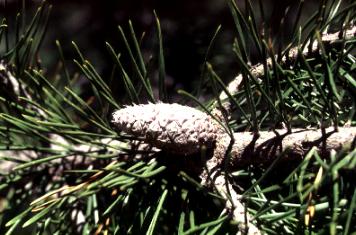
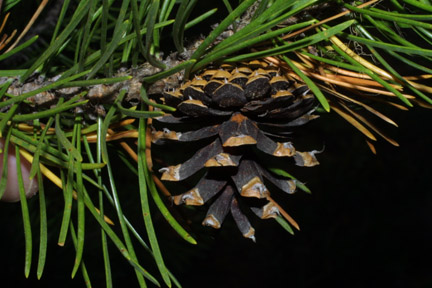
The Great Basin bristlecone pine is a grand sentinel of our rocky, high mountain ridges. Its shorter needles are grouped in bundles of five, and grow densely at the end of the branches, creating a ‘bottlebrush’ or ‘foxtail’. However, the growth of the wood is the most interesting aspect of the Great Basin bristlecone pine. For a tree, each ring represents one year of growth. Because of the colder temperatures and shorter growing season, each growth ring of a bristlecone pine is particularly small, usually around 1/32th of an inch. The tight growth rings result in especially dense, resinous wood that is resistant to decay and insects.

At higher elevations, a bristlecone pine’s growth form becomes more twisted and contorted by the wind. Over time, much of the tree may die, and the living portion may simply be a strip of bark up the trunk and just a few branches.

These adaptations allow the Great Basin bristlecone pine to live an exceptionally long life despite such harsh conditions. It is common for a bristlecone pine to live for thousands of years, and the oldest recorded specimen was aged at approximately 5,000 years old. That means it germinated from seed a few hundred years before the first Egyptian pyramid was even built! Bristlecone pines can even remain standing for thousands of years after they die. Growth ring patterns can be compared between living and dead bristlecone pines to reveal a chronology of our climate for the past seven, eight, maybe ten thousand years!

To see bristlecone pines in Utah, hike the Bristlecone Pine Trail in Bryce Canyon National Park or the Ramparts Trail at Cedar Breaks National Monument. Be sure to take only photos, and not wood or cones. Bristlecone pines will be around a lot longer than we will, and they could use all the help they can get.

For Wild About Utah, I’m Mark Larese-Casanova.

Credits:
Images: Courtesy & Copyright Mark Larese-Casanova
Text:     Mark Larese-Casanova, Utah Master Naturalist Program at Utah State University Extension.


Additional Reading:

Lanner, R.M. 2007. The Bristlecone Book: A Natural History of the World’s Oldest Trees. Mountain Press Publishing Company.

Cohen, M. P. 1998. A Garden Of Bristlecones: Tales Of Change In The Great Basin. University of Nevada Press.