Sixty In-stream Habitat Structures in Four Days: Demonstrating Creek Restoration Techniques

In-stream Habitat Structures: Crews from multiple agencies gather in the encroaching pinyon-juniper forest to begin building the in-stream structures in Birch Creek, UT. Courtesy & Copyright Shauna Leavitt, Photographer
Crews from multiple agencies gather in the encroaching pinyon-juniper forest to begin building the in-stream structures in Birch Creek, UT.
Courtesy & Copyright Shauna Leavitt, Photographer
The job of building 60 in-stream habitat structures in one week seems like a daunting task. But an energetic group of 16 natural resource managers, researchers and volunteers, finish all 60 in four days.

The crew members come from numerous agencies including the Bureau of Land Management, Utah Division of Wildlife Resources, the National Forest Service, interagency firefighting hotshots, and Utah State University.
The purpose of the project is to demonstrate how effective various in-stream structures are at improving habitat for Bonneville cutthroat trout and restoring riparian habitat on a two-mile stretch of Utah’s Birch Creek, located southeast of Beaver, Utah.

In-stream Habitat Structures: Crews from multiple agencies building in-stream structures to restore Birch Creek. Courtesy & Copyright Shauna Leavitt, Photographer
Crews from multiple agencies building in-stream structures to restore Birch Creek. Courtesy & Copyright Shauna Leavitt, Photographer
At one time Birch Creek was rich with beaver, riparian vegetation and diverse in-stream habitat making it an ideal home for Bonneville Cutthroat trout and sage grouse.

The beaver are now gone, and the once woody riparian vegetation has been largely replaced by an encroaching pinyon-juniper forest. The creek is one narrow ditch-like channel.

According to Joseph Wheaton, Associate Professor in the Department of Watershed Sciences and Principal Investigator, “Without the help [of man-made structures or beaver dams] recovery from this type of degradation could take centuries.”

The crews built a variety of simple structures, some designed to mimic beaver dams and others to imitate natural accumulations of wood and debris jams.
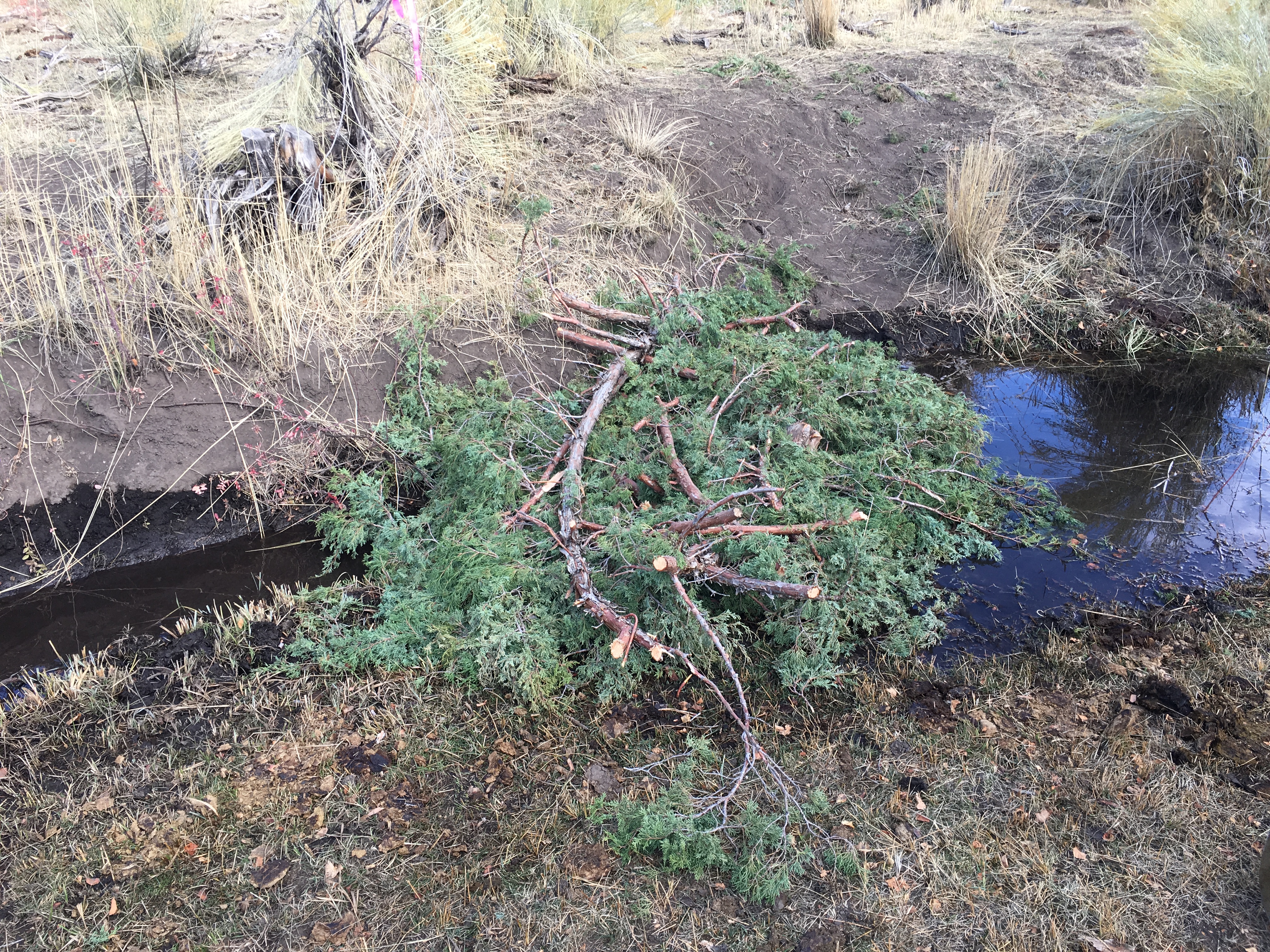
In-stream Habitat Structures: An in-stream structure build from juniper branches, cobble, gravel and mud. Courtesy & Copyright Shauna Leavitt, Photographer
An in-stream structure build from juniper branches, cobble, gravel and mud. Courtesy & Copyright Shauna Leavitt, Photographer
The largest structures are built with an excavator. The machine pulls up large junipers and drops them in the stream so the water can run over, around and through the juniper and its root wads.
Wheaton explains, ”By putting the [Juniper} in the channel we’re making habitat for fish and at the same time raising water tables, which support a whole range of riparian vegetation and wetland vegetation.”
Another structure is the Beaver Dam Analogues (BDAs), which is a simple, cost-effective method of using posts and juniper branches then adding rocks and mud to partially plug up the deliberately leaky dams, designed to be passable to fish.
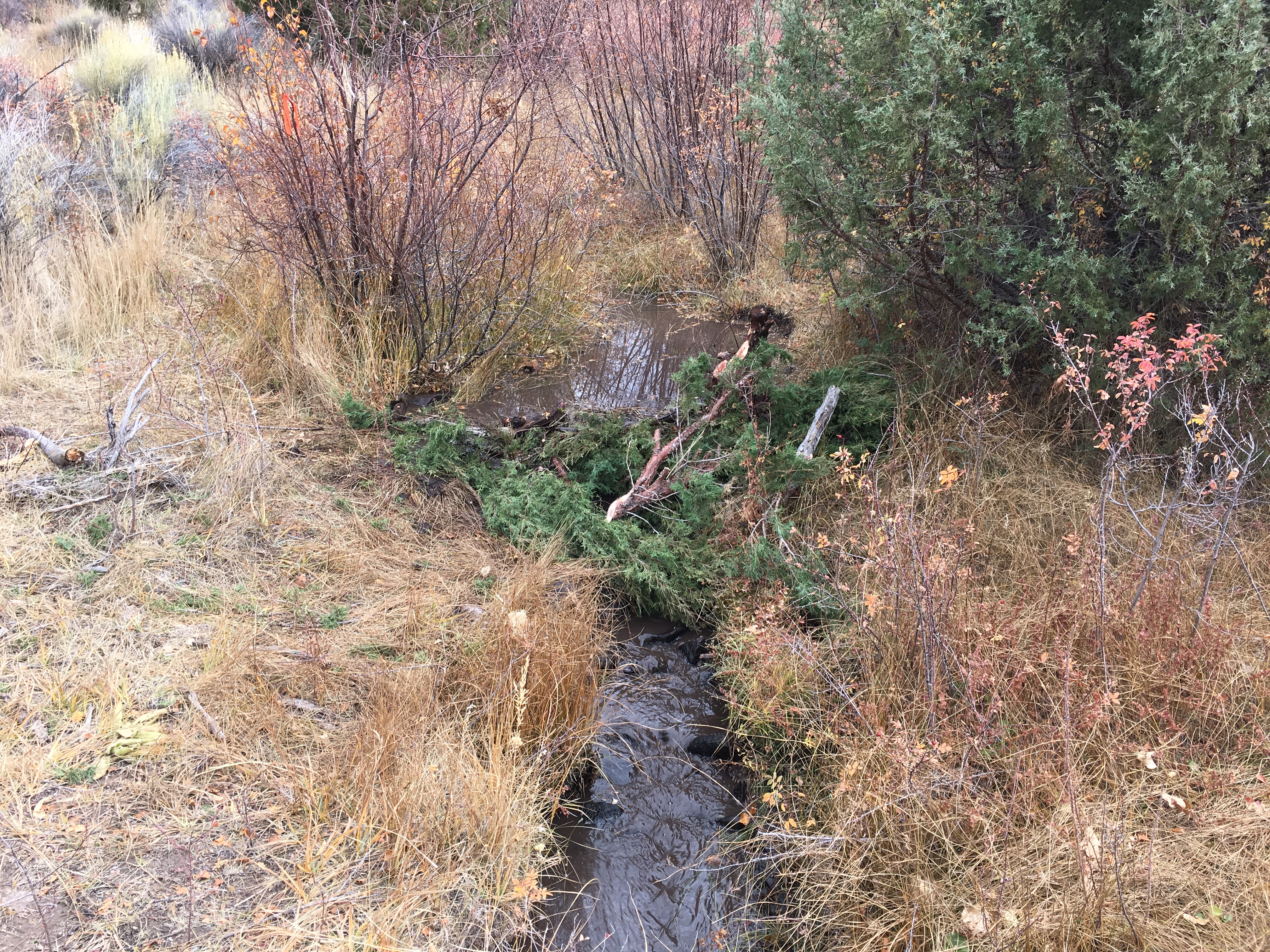
In-stream Habitat Structures: A pool forming behind a newly build in-stream habitat structure. Courtesy & Copyright Shauna Leavitt, Photographer
A pool forming behind a newly build in-stream habitat structure. Courtesy & Copyright Shauna Leavitt, Photographer
Crews see immediate improvements after each structure is built. New pools form, old-channels that haven’t seen water for decades begin to flow parallel to the main channel, and formerly dry floodplains become wet sponges and wetlands.

These wet sponges will release their water later in the season providing additional moisture in dryer times.
Justin Jimenez, Fisheries Riparian Program Manager with Bureau of Land Management explains why these pools are essential, “We’re working to improve the habitat for native fish by increasing the pool frequency and depth. The depth provides thermal cover.” Which is cooler for summer rearing habitat, and warmer for winter survival.
Before this project began, downstream water-rights holders were concerned about how these structures would impact water for irrigation.

In response to their concerns, Gary O’Brien, a Geomorphologist in the Fluvial Habitat Center at USU installed a common measuring device called a V-notch weir at the top and bottom the of the two-mile stretch to measure the discharge of the stream.

According to O’Brien, “once all the structures fill their pools and the system adjusts for infiltration, we expect the top and the bottom weirs to measure a relatively consistent discharge.”
By the addition of a pressure transducer in the pool behind the weirs, O’Brien will have continuous flow of data at every stage.

With these readings the ranchers can be kept up-to-date on the impact the structures are having on the water resources. The agencies have agreed to remove the structures if gaging shows the structures are negatively impacting downstream water users.

Throughout the project, UDWR, BLM and the USFS will be monitoring cutthroat trout response, and USU will be monitoring how the habitat responds and changes through time.

By monitoring the responses, managers and researchers will be able to make more informed decisions about which types and mix of structures can be most effectively used to restore similar streams cheaply across the state.

This is Shauna Leavitt for Wild About Utah.

Credits:
Photos: Courtesy and Copyright Shauna Leavitt
Text: Shauna Leavitt

Sources & Additional Reading

Streams & Rivers Restoration, Restoration Center, NOAA Habitat Conservation, National Marine Fisheries Service,
https://habitat.noaa.gov/restoration/techniques/srrestoration.html

White, Courtney, Thinking Like a Creek, originally published by The Carbon Pilgrim, March 6, 2014,
https://resilience.org/stories/2014-03-06/thinking-like-a-creek/

Stream Restoration, United States Department of Agriculture(USDA), Natural Resources Conservation Service(NRCS),
https://nrcs.usda.gov/wps/portal/nrcs/main/national/water/manage/restoration/

Rubenstein, Marcus, CPESC, Stream Restoration, Purpose Practice and Methods, Southeast Storm Water Association,
https://seswa.org/assets/Services/Annual-Conference/2010/11%20-%20stream%20restoration%20%20methods%20purpose%20and%20practices%20rubenstein.pdf

Cache Valley Christmas Bird Count (CBC) and Climate Change

Cache Valley Christmas Bird Count Courtesy Audubon.org Camilla Cerea, Photographer All Rights Reserved
Christmas Bird Count
Courtesy Audubon.org
© Camilla Cerea, Photographer
All Rights Reserved
It might be worth checking one’s mental state if they were to spend many hours in frigid temperatures hoping to find a bird. There are many of those crazies in our valley here in northern Utah. Citizen Scientists they call us. After all, we do follow strict protocol that defines boundaries, time and what is legitimately called a bird siting or sounding. Yes, there are errors in counts when a flock of European starlings darken the sky, or when trying to identify a distant raptor, that is scarcely more than a black dot in the heavens.

Called the Christmas Bird Count, this event is the longest citizen science program in the world, where data has been collected since 1899. Here in Cache Valley it began in 1955. It occurs throughout the state and world with many countries participating. Visit your local Audubon chapters if you care to be involved. Wasatch, Salt Lake and St George all have chapters. Bear Lake, Vernal and Provo also do counts. And I am sure there are others in your area if you inquire.

Along with the fun it brings, the count has special significance for our changing climates’ impact on birds, which is disrupting populations and their spacial distribution are changing at an accelerating rate.
The data collected by observers over the past 118 years has allowed researchers to study the long-term health and status of bird populations across North America and Central and South America. When combined with other surveys such as the Breeding Bird Survey, it provides a picture of how the continent’s bird populations have changed in time and space. This long term perspective is vital for conservationists. It informs strategies to better protect birds and their habitat, and helps identify environmental issues with implications for people as well.

Audubon’s 2014 Climate Change Report is a comprehensive study that predicts how climate change could affect the range of 588 North American birds. Of the bird species studied, more than half are likely to be in trouble. The models indicate that 314 species will lose more than half of their current range by 2080.
Audubon’s Common Birds in Decline Report revealed that some of America’s most beloved and familiar birds have taken a nosedive over the past forty years.

142 species of concern are found in our state, including our state bird, the California gull and our national bald eagle.

If you aren’t up to braving the elements, Project FeederWatch and Great Backyard Bird Count are other options you may find by googling. I’m hoping for good visibility and temperatures above zero as I prepare my optical instruments and hot chocolate.

And please keep those bird feeders full as we enter the coldest month of the year!

This is Jack Greene writing and reading for Wild About Utah.

Credits:
Image: Courtesy Audubon.org, Copyright © Camilla Cerea, Photographer, All Rights Reserved
Text:     Jack Greene, Bridgerland Audubon Society


Additional Reading:

Project FeederWatch is a winter-long survey of birds that visit feeders at backyards, nature centers, community areas, and other locales in North America. FeederWatchers periodically count the birds they see at their feeders from November through early April and send their counts to Project FeederWatch. FeederWatch data help scientists track broadscale movements of winter bird populations and long-term trends in bird distribution and abundance. https://feederwatch.org/

Launched in 1998 by the Cornell Lab of Ornithology and National Audubon Society, the Great Backyard Bird Count was the first online citizen-science project to collect data on wild birds and to display results in near real-time. https://gbbc.birdcount.org/about/

Audubon’s 118th Christmas Bird Count will be conducted this coming season, with all counts held between the dates of Thursday, December 14, 2017 through Friday, January 5, 2018.
https://www.audubon.org/conservation/join-christmas-bird-count
https://www.audubon.org/conservation/science/christmas-bird-count

58th Cache Valley (Logan) Christmas Bird Count: 16 Dec 2017
https://bridgerlandaudubon.org/our-projects/cache-valley-christmas-bird-count/

Regional Christmas Bird Counts
https://www.utahbirds.org/cbc/cbc.html

Winter Bird Feeding

A suet feeder, individual cake and a box of cakes. To the right are three gravity feeders with black oil sunflower seeds as well as other seeds. Courtesy Ron Hellstern, photographer
A suet feeder, individual cake and a box of cakes. To the right are three gravity feeders with black oil sunflower seeds as well as other seeds.
Courtesy Ron Hellstern, photographer
Most people enjoy watching birds, except for their occasional deposits on cars or windows. In an earlier program, I mentioned at least fifteen benefits that birds provide to humans and planet Earth. But as human population and developments increase, the survival of many bird species becomes threatened. Now, as winter approaches, colder weather and lack of food adds to the life-threatening dilemmas birds face. Some birds migrate to warmer habitats, but for those that stay in the northern regions a helping-hand from humans is no doubt appreciated.

Presenting “gifts” of birdfeeders and seeds to others (and your own family) will help songbirds and fowls to survive so they can provide their songs and beauty in the Spring. Consider these tips:

  • Buy large birdfeeders so you don’t have to fill them so often. Wet seed can grow harmful bacteria, so use feeders with wide covers.
  • If deer, or other pests, invade your feeders, hang them up higher in trees.
  • Place feeders 10’ away from dense cover to prevent sneak attacks from cats.
  • Provide multiple feeders to increase amounts and diversity of foods.
  • “Favorite” winter foods depends on the species. Black Oil sunflower seeds are loved by most birds, but niger, millet, peanuts, corn, and wheat will attract a diverse range of birds. Experiment and see what comes to your feeders.
  • A combination of beef-fat, with seeds or fruit, is called suet. It is a high-energy food which helps birds stay warm. The 4” cakes are placed in small cages and are loved by flickers, woodpeckers and many other birds. Peanut butter is also relished by birds, but is more expensive than suet.
  • Once birds find your feeders, they will rely on them for regular food supplies. If your feeders become empty, especially during ice storms or blizzards, birds will have a hard time finding natural food. If you take a trip, have a neighbor keep your feeders filled.
  • Buy extra seed and store it in a cool, dry place like a covered plastic trash can which can be kept on a deck, porch, or in a garage.
  • Make sure the feeders are kept clean with hot water, and then dried, about once a month.
  • Some birds, like juncos, towhees, doves and pheasants prefer eating seed which has fallen to the ground. Compact the snow below your feeders so they can find that seed easier.
  • Unless you live near a natural water source, place a pan of water near a feeder on warmer days. Or you could consider a heated bird bath to provide drinking water.
  • If you have fruit trees or berry bushes, leave some of the fruit on the plants to provide natural foods.
  • You may wish to leave birdhouses and nest-boxes up all year for winter roosting sites.
  • Now the fun part comes. After your feeders have been discovered by some birds, word soon gets around the neighborhood and others will arrive. But do you know what they are? The Peterson Field Guidebooks are a great help for beginners because the illustrations are often grouped by color. Then you can become a citizen-scientist and submit your observations to Cornell’s Project Feederwatch or participate in the Great Backyard Bird Count each December. Look online for details.

    Time to get started with your own feeders, or as gifts to others, and begin enjoying the colorful company of finches, woodpeckers, towhees, juncos, sparrows, doves and many others.

    Credits:

    Images: Courtesy & Copyright Ron Hellstern, Photographer
    Text:    Ron Hellstern, Cache Valley Wildlife Association

    Additional Reading

    Feed the Birds, Jim Cane & Linda Kervin, Wild About Utah, Bridgerland Audubon Society, Dec 1, 2011, https://wildaboututah.org/tag/feeding-birds/

    Winter Song Birds, Jim Cane & Linda Kervin, Wild About Utah, Bridgerland Audubon Society, Feb 3, 2009, https://wildaboututah.org/tag/feeding-birds/

    Audubon Guide to Winter Bird-Feeding, Steve Kress, Audubon Magazine, Nov-Dec, 2010, https://www.audubon.org/magazine/november-december-2010/audubon-guide-winter-bird-feeding

    Backyard Birding, Bird Feeding, US Fish & Wildlife Service(FWS), Last Updated: February 19, 2016, https://www.fws.gov/birds/bird-enthusiasts/backyard/bird-feeding.php

    Backyard Birding, Helping our Feathered Friends, US Fish & Wildlife Service(FWS), Last Updated: June 1, 2016, https://www.fws.gov/birds/bird-enthusiasts/backyard/songbird-conservation.php

    Backyard Bird-Feeding Resources, Birds at Your Feeder, Erica H. Dunn, Diane L. Tessaglia-Hymes, Project Feederwatch, https://feederwatch.org/learn/articles/backyard-bird-feeding-resources/

    Talking Dirt

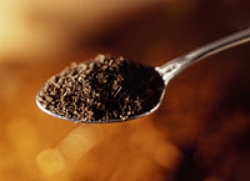
    Talking Dirt: There are over four billion micro-organisms in a teaspoon of healthy soil. Courtesy King County, WA
    There are over four billion micro-organisms in a teaspoon of healthy soil.
    Courtesy King County, WA
    It’s time to talk dirt- and I’m not talking politics, but real, factual dirt! Of all our amazing planets ecosystems, there is one that rises above all others. It’s the one your home is standing on, the one you don’t want your kids to track in the house. By now you’ve probably guessed it!

    The diversity and abundance of life that exists within soil is greater than in any other ecosystem. A ‘biological universe’ exists in a gram of soil. Soil biota within this tiny universe transform energy, create and modify their habitat, influence soil health, and aid in the regulation of greenhouse gases. There are more microbes in a teaspoon of soil than there are people on the earth. We’re talking such characters as bacteria, fungi, protozoa, nematodes, earthworms, and arthropods. No wonder kids are so drawn to this miraculous stew of life! My one year old granddaughter can’t resist a mouthful given the opportunity! So let’s dive into a handful of soil.

    Biogeochemical Cycling Courtesy USGS, Public Domain https://www.usgs.gov/media/images/biogeochemical-cycling-diagram-showing-climatic-processes-hydrologic
    Biogeochemical Cycling
    Courtesy USGS, Public Domain
    https://www.usgs.gov/media/images/biogeochemical-cycling-diagram-showing-climatic-processes-hydrologic
    The majority of life on Earth is dependent upon six critical elements: hydrogen, carbon, nitrogen, phosphorus, oxygen, and sulfur that pass through, and are transformed by, soil organisms. This process, called biogeochemical cycling, is defined as the transformation and cycling of elements between non-living and living matter. These processes are dependent upon life in the soil.

    Although we understand the vital services that these organisms provide by breaking down organic debris and recy¬cling nutrients, scientists have only begun to study the rich and unique diversity that is a part of the soil ecosystem. Of particular interest for myself is understanding the functions of certain fungi and their roles in storing atmospheric carbon dioxide.

    As you may have heard in past WAU readings, climate change is a major threat to Utah’s wildlife including birds, cold water fish, pollinators, and pica.

    Conservation Tillage: Minimizing tillage and maintaining a crop residue on the soil surface can greatly reduce erosion impacts Agricultural Management Practices for Water Quality Protection--Watershed Academy Web, Courtesy US EPA
    Conservation Tillage:
    Minimizing tillage and maintaining a crop residue on the soil surface can greatly reduce erosion impacts
    Agricultural Management Practices for Water Quality Protection–Watershed Academy Web, Courtesy US EPA
    And here’s where our farms and ranches have the opportunity to play a crucial role beyond feeding us.
    Deploying what’s called regenerative agricultural practices like tillage reduction, cover crops, companion planting, planned grazing, and keyline plowing—will not only improve soil quality making it more resilient to climate conditions like flooding and drought, but also increase soil’s organic matter which require less fertilizer. This in turn, means less runoff into waterways and greater profitability for farmers.

    Perhaps most important of all, managing farms this way actually draws carbon out of the atmosphere. If all cropland in the U.S. was farmed using these regenerative practices, the greenhouse gas reduction would be equivalent to eliminating nearly 90 percent of our country’s cars. And now some states are considering economic incentives like tax breaks for carbon sequestration farming, and enlisting Farm Bureaus to provide additional support. Will Utah be next?

    This is Jack Greene writing and reading for Wild About Utah.

    Fortuna, A. (2012) The Soil Biota. Nature Education Knowledge 3(10):1, https://www.nature.com/scitable/knowledge/library/the-soil-biota-84078125

    Biogeochemical Cycles, U.S. Global Change Research Program, https://nca2014.globalchange.gov/report/sectors/biogeochemical-cycles#intro-section-2

    How do microbial mats work? Microbial Mat Biogeochemical Cycling, NASA Ames Research Center, https://spacescience.arc.nasa.gov/microbes/about/microbial.html

    Biogeochemical Cycling, Center for Forested Wetlands Research, Southern Research Station, USDA Forest Service, https://www.srs.fs.usda.gov/charleston/research/biogeochemical/

    Subsurface Biogeochemical Research Program, Climate and Environmental Sciences Division, Office of Biological and Environmental Research, U.S. Department of Energy, https://doesbr.org/

    The Carbon Cycle, NASA Earth Observatory, EOS Project Science Office, NASA Goddard Space Flight Center, https://earthobservatory.nasa.gov/Features/CarbonCycle/