Spring’s Gifts

Glacier Lilies, Courtesy Andrea Liberatore, Photographer
Glacier Lilies,
Courtesy Andrea Liberatore, Photographer
I doubt there was a song left unsung as I worked my way up Birch Canyon early am. Testosterone laden birds filled the morning with delight. Robins, finches, meadow larks, song sparrows- what a marvelous symphony! I breathed deeply to fully absorb air filled with titillating odors from last night’s gentle spring rain- nature’s perfume, free and priceless.

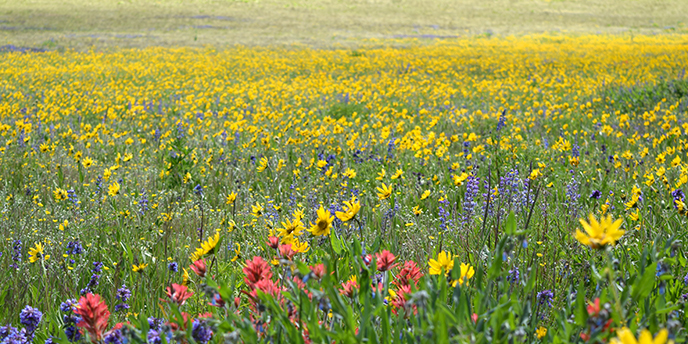
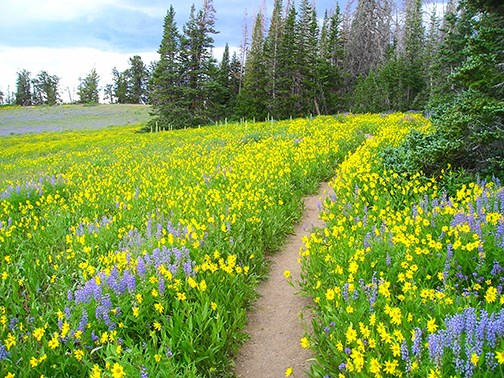
Waters surging down Summit and Birch creeks released from winter’s cold grip. Further along, I take notice of recent bloom- glacier lilies exploding with bluebells soon to follow. Yellow bells in sage with promise of early Indian paintbrush. Arrowleaf balsamroot and penstemon only a few weeks away.

Thanks to earth’s 23 degree tilted axis spring is in full swing! This combined with the annual journey around our medium sized star brings the rebirth once again. How boring it would be had it been a tilt of zero degrees- negating our seasonal change. We complain as temperatures swing wildly from 60 degree days plummeting to 30’s in the course of a few hours. But please don’t despair- it may return to pleasantness almost as quickly.

I would not care to be a meteorologist in San Diego where temperatures rarely deviates more than a few degrees, winds are calm, and precipitation comes primarily during winter in dribbles. I relish the beauty and drama of a cumulonimbus cloud burst pummeling me with a deluge of rain pushed by strong wind spawned by a warm, moist air mass colliding with another cool and dry. Grand symbols crashing as lightening energizes countless trillion molecules of nitrogen and oxygen. How could something minute as a gas particle make such a ruckus! Miracles abound.

A spring trek across Zion N.P. last week to welcome spring on the south end. Townsend solitaires, scrub and Steller jays, mountain chickadees, and courtship drumming of woodpecker species were there to welcome me. White throated swifts launched from towering cliffs with occasional canyon wrens emitting cascading, descending notes from their vertical realm.

All three species of nuthatches were present- white and red breasted with small flocks of gregarious pygmies in ponderosa pine forest, busily searching bark crevasses for delectable grubs and insect eggs.

Indian potato and spring beauty were found among the sage near 8000 feet beneath lava point. These delectables were enjoyed by Native Americans. I sampled a few flowers leaving the mini-potato like roots undisturbed. I enjoyed waterleaf stems growing in hardwood forested areas.

After 36 miles of sublime scenery beyond comprehension, I descended into throngs of park visitors from many distant lands evident by their strange dialects. There are no down seasons in Zion these days that I once enjoyed years ago while working as a park seasonal. But the stunning beauty remains, with new greenery showing on cottonwood and boxelder in contrast to the warm glow of massive cliff.

Please don’t inquire of me which season I enjoy most.

This is Jack Greene and I’m wild about Utah!!

Credits:

Pictures: Courtesy & Copyright Andrea Liberatore
Text: Jack Greene, Bridgerland Audubon Society

Additional Reading:

Northern Utah Hikes & Lakes, HikesandLakes.com, https://www.hikesandlakes.com/northern.html

Birch Canyon Road Trail, AllTrails.com, https://www.alltrails.com/trail/us/utah/birch-canyon-road-trail

Poetry of the Forest

Poetry of the Forest: Fall Colors along the Nebo Loop between Payson, UT and HWY 132 between Nephi and Fountain Green. Courtesy USDA Forest Service
Fall Colors along the Nebo Loop between Payson, UT and HWY 132 between Nephi and Fountain Green.
Courtesy USDA Forest Service

There are people who can capture beautiful scenery by painting on canvas, using film photography, and with digital technology. And these forms of art can be visually stunning. But there is a unique perspective of visualizing when written words are read, allowing one’s mind to see not only the exterior of a scene, but the interior heart intended by the writer.

What memories does your mind recall as you listen to the words of these renowned authors about the poetry of the forest?

  • Robert Louis Stevenson – …it is not so much for its beauty that the forest makes a claim upon men’s hearts, as for that subtle something, that quality of the air, that emanation from the old trees, that so wonderfully changes and renews a weary spirit.
  • John Fowles – In some mysterious way woods have never seemed to me to be static things. In physical terms, I move through them, yet in metaphysical ones, they seem to move through me.
  • Walt Whitman – Why are there trees I never walk under but large and melodious thoughts descend upon me?
  • William Wordsworth – One impulse from a vernal wood may teach you more of man, of moral evil and of good, than all the sages can.
  • Marcel Proust – We have nothing to fear and a great deal to learn from trees, that vigorous and Pacific tribe which without stint produces strengthening essences for us, soothing balms, and in whose gracious company we spend so many cool, silent and intimate hours.
  • Washington Irving – As the leaves of trees are said to absorb all noxious qualities of the air, and to breathe forth a purer atmosphere, so it seems to me as if they drew from us all sordid and angry passions and breathed forth peace and philanthropy. There is a severe and settled majesty in woodland scenery that enters into the soul, and dilates and elevates it, and fills it with noble inclinations.
  • James Henry Leigh Hunt – They refresh the commonplaces of life, shed a harmony through the busy discord, and appeal to those first sources of emotion, which are associated with the remembrance of all that is young and innocent. They seem also to present us with a portion of the tranquility we think we are laboring for.
  • Harold Monro – One summer afternoon, you find some lonely trees. Persuade your mind to drowse. Then, as your eyelids close, and you still hover into those three stages of a darkening doze, this side the barrier of sleep,…..pause. In that last clear moment open quick your sight toward where the green is bright and thick. Be sure that everything you keep to dream with is made out of trees.

    Plantng a Tree Coutesy USDA Forest Service
    Plantng a Tree
    Coutesy USDA Forest Service
    *Lucy Larcom – He who plants a tree plants a hope.

  • Henry David Thoreau – In wildness is the preservation of the world. Silence alone is worthy to be heard.
  • English Proverb – He that plants trees loves others beside himself.

     
    Credits:
    Text: Excerpts from the book, “The Forest”, compiled by Michelle Lovric https://www.amazon.co.uk/Forest-Poetry-Earth-Michelle-Levric/dp/1561385077
    Images: Courtesy USDA Forest Service
    Collector & Reader: Ron Hellstern, Cache Valley Wildlife Association

    Additional Reading

    Lovric, Michelle, The Forest, A Celebration of Nature, In Word and Image, https://www.amazon.co.uk/Forest-Poetry-Earth-Michelle-Levric/dp/1561385077

    Poems about Trees, Academy of American Poets, https://www.poets.org/poetsorg/text/poems-about-trees

    Search for Poems about Trees, Poetry Foundation, https://www.poetryfoundation.org/search?query=trees

  • The Invasive Phragmites

    Invasive Phragmites: Great Salt Lake Phragmites Courtesy & Copyright Karin Kettenring
    Great Salt Lake Phragmites
    Courtesy & Copyright Karin Kettenring
    Those unfamiliar with the history of the Utah’s wetlands may see Phragmites and say, “What a beautiful, elegant plant! It looks so graceful blowing along the shore.”

    However, the plant’s attractiveness and ability to absorb pollutants may not compensate for its negative impacts.

    Phragmites is an invasive perennial grass that now thrives in much of the wetlands around the Great Salt Lake and other marshes in northern Utah. It grows in dense clusters and normally reaches 5 to 10 feet in height. If the conditions are right it can reach 15 feet.

    The patches of grass are so dense that wetland managers are called out each year to rescue duck hunters – who are lost in the Phragmites.

    Karin Kettenring, associate professor of wetland ecology in the Department of Watershed Sciences at USU and her research team have been studying Utah Phragmites for the past decade.

    Kettenring explains why Phragmites is a concern, “We fear it is fundamentally changing the habitat of Great Salt Lake wetlands which are renowned for being a home for migratory birds including waterfowl and shore birds.”

    The exotic grass most likely started in the Great Salt Lake wetlands after the flooding of 1983. The flood washed out the marshes. When the water levels receded, the salty water had destroyed all the native vegetation in the wetlands. Phragmites then moved in. By 2011, the exotic grass had spread over 24,000 acres.

    Mowing Phragmites Courtesy & Copyright Karin Kettenring
    Mowing Phragmites
    Courtesy & Copyright Karin Kettenring
    Scientists believe humans inadvertently brought Phragmites to Utah, since birds don’t migrate East and West, and the birds usually don’t eat the seeds. Someone’s boat may have transported the seeds into Utah. They sat dormant in the soil until the conditions were perfect, then the spread of Phragmites began.

    Today an average small patch of Phragmites, about 20 feet square, can spread a couple yards a year just from the stems it sends out above and below the ground. However, research has shown it’s not the stems that cause the most reproduction – but the seeds.

    Karin_Kettenring-in-the-Great-Salt-Lake-Wetlands Courtesy & Copyright Karin Kettenring
    Karin_Kettenring-in-the-Great-Salt-Lake-Wetlands
    Courtesy & Copyright Karin Kettenring
    Karen Mock, associate professor in the Department of Wildland Resources and a long-term collaborator on this project helped Kettenring with the genetic work.

    They tested the genetics of a lot of Phragmites pulled from the same patches and found many different genotypes – proving the plants came from different seeds, not the stems of neighboring plants.

    With these results, Kettenring’s lab discovered the best way to control the invasive grass is to first control the seed production by mowing the grass mid-summer to keep it from spreading. Then in the fall spraying the area with herbicide three years in a row. An herbicide approved for use in wetlands can be used – such as Rodeo.

    If the Phragmites has been there only a few years then the seeds of the native vegetation will still be in the soil, and they’ll come back on their own.

    However, if the Phragmites has been there for a long time then re-seeding of native plants will be necessary.

    To determine the best way to re-seed wetlands, Kettenring partnered with Utah Division of Wildlife Resources, Utah Division of Forestry, Fire & State Lands and David England – one of Kettenring’s past graduate students. England has spent extensive time in the lab determining how to help seeds germinate.

    Emily Martin, Kettenring’s current graduate student will also help with the UDWR reseeding as she searches for techniques to make seeding more effective.

    Ultimately their goal is to restore native plant communities to keep Phragmites from coming back and restore habitat for important migratory birds.

    This is Shauna Leavitt and I’m Wild About Utah.

    Credits:
    Photos: Courtesy & Copyright Karin Kettenring
    Audio: Courtesy and Copyright Kevin Colver
    Text: Shauna Leavitt

    Sources & Additional Reading

    How to control Phragmites
    Kettenring, Karin, Rupp, Larry, Whitesides, Ralph, Hazelton, Eric, Phragmites Control at the Urban/Rural Interface, 2014, https://works.bepress.com/karin_kettenring/92/

    Extensive readings about Phragmites:
    https://works.bepress.com/karin_kettenring/

    Video: USU researchers mowing Phragmites in the Great Salt Lake wetlands. The passenger is Chad Cranney a past graduate student of Karin Kettenring’s:
    https://bft.usu.edu/rqcq9

    *****

    Larese-Casanova, Mark, Phragmites-Utah’s Grassy Invader, Wild About Utah, August 23, 2012, https://wildaboututah.org/phragmites-utahs-grassy-invader/

    Common Reed, Phragmites australis. National Invasive Species Information Center, USDA National Agricultural Library, https://www.invasivespeciesinfo.gov/aquatic/plants/common-reed

    Phragmites Factsheet, US Fish & Wildlife Service, https://www.fws.gov/GOMCP/pdfs/phragmitesQA_factsheet.pdf

    Phragmites Phragmites australis, Aquatic Invasive Species, Utah Division of Wildlife Resources, Sept 17, 2013, https://wildlife.utah.gov/habitat/ans/phragmites.php

    Phragmites Phragmites australis, Plants Database, USDA Natural Resources Conservation Service(NRCS), https://plants.usda.gov/core/profile?symbol=phau7

    A World Without Trees

    Whether you live in a desert, a city, a suburb or a farm, your life would change if you lived in a world without trees. You may be a person who appreciates their ecological connections, or have complete disregard for them. As William Blake said, “The tree, which moves some to tears of joy, is in the eyes of others only a green thing which stands in the way.1

    So, take a moment and consider the way the world would look, and function, without trees. Currently, forests cover about 30% of the Earth’s land surface. But that’s a loss of 1/3 of all trees just since the beginning of the industrial era. The top five largest forests are located in Russia, Brazil, Canada, the U.S., and China.
    Whether you think climate change is natural or human-caused, it affects forests by altering the intensity of fires, creating windstorms, changing precipitation, and enabling introduced species to invade. And the World Resources Institute estimates that tens of thousands of forested acres are destroyed every day.

    Sometimes even fragmenting forests can produce harmful results as die-backs occur along the edges, and certain wildlife species will not breed unless they live in large tracts of forested areas. It has been said that roads, which are a cause of fragmentation, are the pathways to forest destruction.

    Most people know that trees take in Carbon Dioxide for growth, and release Oxygen via photosynthesis. But trees also remove many air pollutants, provide cooling shade and protection from wind and the sun’s harmful Utra-Violet rays. They can be used as privacy screens, they prevent soil erosion, and are the foundation of wildlife habitat on land. Some provide food, can provide serenity and solitude, and have been proven to reduce stress levels. Their fallen leaves decompose into valuable soil. They reduce the Heat-Island Effect in cities, and are more resistant to climate change impacts. Research has shown they improve retail shopping areas, and speed recovery time for those in health care centers.

    For the budget-conscious folks, a mature tree can raise home-property values by as much as $5000. And think about those beautiful Autumn colors.

    View of Argyre Basin on Mars Courtesy NASA/JPL Caltech https://wildaboututah.org/wp-admin/upload.php?item=8521
    View of Argyre Basin on Mars
    Courtesy NASA/JPL Caltech
    Composed from images taken by the Mars Color Imager (MARCI) camera on NASA’s Mars Reconnaissance Orbiter
    Although there seems to be a number of humans who would volunteer to live on planet Mars, would we really want planet Earth to mirror that treeless image?

    Perhaps a re-evaluation of trees is warranted. Ponder these imaginative thoughts penned by well-known writers:
    Ralph Waldo Emerson: At the gates of the forest, the surprised man of the world is forced to leave his city estimates of great and small, wise and foolish. The knapsack of custom falls off his back.

    William Henry Hudson: When one turned from the lawns and gardens into the wood it was like passing from the open sunlit air to the twilight and still atmosphere of a cathedral interior.

    Stephanie June Sorrrell: Let me stand in the heart of a beech tree, with great boughs all sinewed and whorled about me. And, just for a moment, catch a glimpse of primeval time that breathes forgotten within this busy hurrying world.

    One way for us to resolve tree issues, is to plant them. And the best time to plant a tree was twenty years ago. But the next best time to plant them is today.

    “Silence alone is worthy to be heard.” – Henry David Thoreau

    This is Ron Hellstern, and I am Wild About Utah.

    Credits:
    Images: Courtesy
    Text: Ron Hellstern, Cache Valley Wildlife Association

    Additional Reading

    Upton, John, Could Common Earthly Organisms Thrive on Mars?, Pacific Standard, May 21, 2014, https://psmag.com/environment/mars-81952

    Voak, Hannah, A World Without Trees, Science in School, https://books.google.com/books/about/The_Marriage_of_Heaven_and_Hell.html?id=YUa8AQAAQBAJ

    Hudson, William Henry, The Book of a Naturalist, p4, https://books.google.com/books?id=NA4KAAAAMAAJ&pg=PA4&lpg#v=onepage&q&f=false

    https://forestry.usu.edu/