Autumn Leaf Color Change

Fall color in Logan Canyon
Courtesy & Copyright 2007 Linda Kervin

In autumn, the days shorten noticeably and chilly dawns become the norm across most of Utah. Leafy plants now prepare for winter. Their summer of intense metabolic activities gradually give way to winter’s dormancy. Photosynthesis and respiration shut down as nutrients and sugars are withdrawn from leaves, to be shunted to the stem and roots for storage. But how do they anticipate the change in seasons so that they are ready for the rigors of winter?

Photosynthetic plants have a diverse array of pigments that they use to capture energy from most of the spectrum of visible sunlight. Chlorophyll is the most abundant, but its light gathering effectiveness is limited to a narrow band of the light spectrum. Plants employ many additional pigments to capture the energy available from other wavelengths of sunlight. These accessory pigments are brilliantly colored but masked by the sheer abundance of green chlorophyll.

Fall color in Logan Canyon
Courtesy & Copyright 2007 Linda Kervin

One of these pigments, phytochrome, serves as a timekeeper for the plant. When phytochrome absorbs energy in the red band of sunlight, it helps to activate a number of developmental processes in the plant. As the nights lengthen in the fall, there are fewer hours of sunlight to activate the phytochrome and so it transforms to inhibit those same developmental processes.

One result is that chlorophyll is broken down and its components are moved to storage for use in the following spring. Essential nutrients, such as nitrogen and phosphorus, are likewise withdrawn from foliage for later use. With chlorophyll gone, the other colorful leaf pigments are revealed. Now maples, aspens, sumacs and more blaze for a few weeks of riotous glory.

This is Linda Kervin for Bridgerland Audubon Society.

Credits:

Photos: Courtesy & Copyright Linda Kervin

Text: Linda Kervin and Jim Cane, Bridgerland Audubon Society

Additional Reading:

Chemistry of Autumn Leaf Color, How Fall Colors Work, About.com: Chemistry, https://chemistry.about.com/library/weekly/aa082602a.htm

Why Do Leaves Change Color in the Fall?, Anne Marie Helmenstine, Ph.D., About.com: Chemistry, https://chemistry.about.com/od/howthingsworkfaqs/f/fallleafcolor.htm

“Autumn: a season of change” (2000) by Peter J. Marchand, https://www.amazon.com/Autumn-Season-Peter-J-Marchand/dp/0874518709

Where to see autumn leaves in Utah:

  • U.S. 89, Logan Canyon, Brigham City to Logan, Logan to Bear Lake
  • State Route 39, Monte Christo Summit, east of Huntsville
  • State Route 190, Big Cottonwood Canyon, east of Salt Lake City, including Guardsman Pass
  • State Route 210, Little Cottonwood Canyon, east of Salt Lake City
  • State Route 92, the Mount Timpanogos loop a.k.a. the Alpine loop, north, east of Provo
  • State Route 150, the Mirror Lake road, east of Kamas
  • U.S. 40, Daniels Summit, east of Heber City
  • Vernal, Red Cloud Loop (See Dinoland.com)
  • Flaming Gorge – Unitas, State Route 191 and State Route 44
  • State Route 132 Payson to Nephi, the Nebo Loop
  • State Route 31, the Wasatch Plateau, east of Fairview
  • State Route 12, over Boulder Mountain, between Torrey and Boulder (likely the most spectacular of all)
  • The La Sal Mountain loop, east of Moab
  • The Abajo Mountain loop, west of Monticello
  • The canyons of the Escalante River, Grand Staircase-Escalante National Monument, southeast of Escalante

List sources:
Aspens and Fall Foliage in Utah, Jeffrey Otis Schmerker, 2001, https://www.utah.com/schmerker/2001/fall_foilage.htm
Ogden Valley Business Association, https://www.utahfallcolors.com

Fall Colors Tour, Utah in the Fall is a blast of color!, https://www.utah.com/byways/fallcolorstour.htm

National Forest Fall Color Hotline, 1-800-354-4595,https://www.fs.fed.us/r4/conditions/fallcolors.shtml

Species Names

Common Mullein
Courtesy &
Copyright 2010 Holly Strand

Hi, I’m Holly Strand from Stokes Nature Center in beautiful Logan Canyon.

Common Mullein , Our Lady’s Flannel. Velvet Plant. Clown’s Lungwort. Jupiter’s Staff. Shepherd’s Clubs. Beggar’s Blanket. Hare’s Beard, Bear’s ear, and Nature’s Toilet Paper. These are just a few of the names that apply to a single species that is a widely distributed across Europe and Central Asia and naturalized in North America.

Common names are descriptive and often charming, but they are local names and won’t be understood beyond their particular region or in another language. And sometimes common names are downright misleading. For example a koala bear isn’t a bear. And a red panda isn’t a panda.

To avoid confusion, scientists use a unique two word designation—usually taken from Latin or Greek – to identify a species unambiguously. The first word is the name of the genus to which the organism belongs. The genus comprises a group of closely related animals or plants. The second term is chosen by the person that describes and publishes the species account.

Vampyroteuthis infernalis
“vampire squid from Hell”
Illustration by Carl Chun 1911
Public Domain/expired copyright

It is a huge breach of etiquette to name a species after yourself. But the taxonomist can name the organism after the person who actually found it in the field. An example is Mentzelia shultziorum, a blazingstar named after Utah botanist Leila Schultz who first found the plant in Professor Valley in Grand County. Taxonomists can also name the species after a friendly colleague and then hope that the friendly colleague will name one after them.

Often the name will describe some physical characteristics of the species. Earlier this year, a paleontologist unearthed a new dinosaur here in Utah and named it Jeyawati rugoculus. That’s a combination of Zuni and Latin for “grinding mouth, wrinkle eye.”

Other names are based on location: Penstemon utahensis is a penstemon found in our state. Amblyoproctus boondocksius is a scarab, and was apparently found in the middle of nowhere.

Often the name will represent a subjective reaction toward the organism. Vampyroteuthis infernalis translates into “vampire squid from Hell”, Indeed it is rather scary looking cross between a squid and an octopus.

Some scientists get sentimental at naming time. They’ll name species after their loved ones. Or their favorite artists. Thus we have 2 trilobites in the Avalanchurus genus named lennoni and starri. McCartney and Harrison are honored in a neighboring genus.

I’m proud to say that a Utah biologist named a parasitic louse, Strigiphilus garylarsoni. The Far Side cartoonist should not take offense. In a letter to Larson, Dr. Dale Clayton praised him for “the enormous contribution that my colleagues and I feel you have made to biology through your cartoons.”

For sources and archives of past programs see www. Wild About Utah.org

For Wild About Utah and Stokes Nature Center, I’m Holly Strand.

Credits:
Photo: Mullein-Courtesy & Copyright 2010 Holly Strand
Squid Illustration Carl Chun 1911 (Public Domain Courtesy Wikimedia.org)
Text: Stokes Nature Center: Holly Strand

Sources & Additional Reading

Gotch, A.F. 1996. Latin Names Explained: A Guide to the Scientific Classification of Reptiles, Birds & Mammals. NY: Facts on File, Inc.

Isaak, Mark. Curiosities of Biological Nomenclature website. https://www.curioustaxonomy.net/rules.html [Accessed September 15, 2010]

O’Donoghue, Amy Joi. 2010. ‘Grinding mouth, wrinkle eye’ is name of newly discovered species dinosaur. Deseret News, May 27, 2010.

Prigge, Barry A. 1986. New Species of mentzelia (Loasaceae) from Grand County, UT. Great Basin Naturalist Vol. 46, No. 2 pp. 361-365

Utah’s wool-gathering bees

Audio:  mp3 Listen to WildAboutUtah

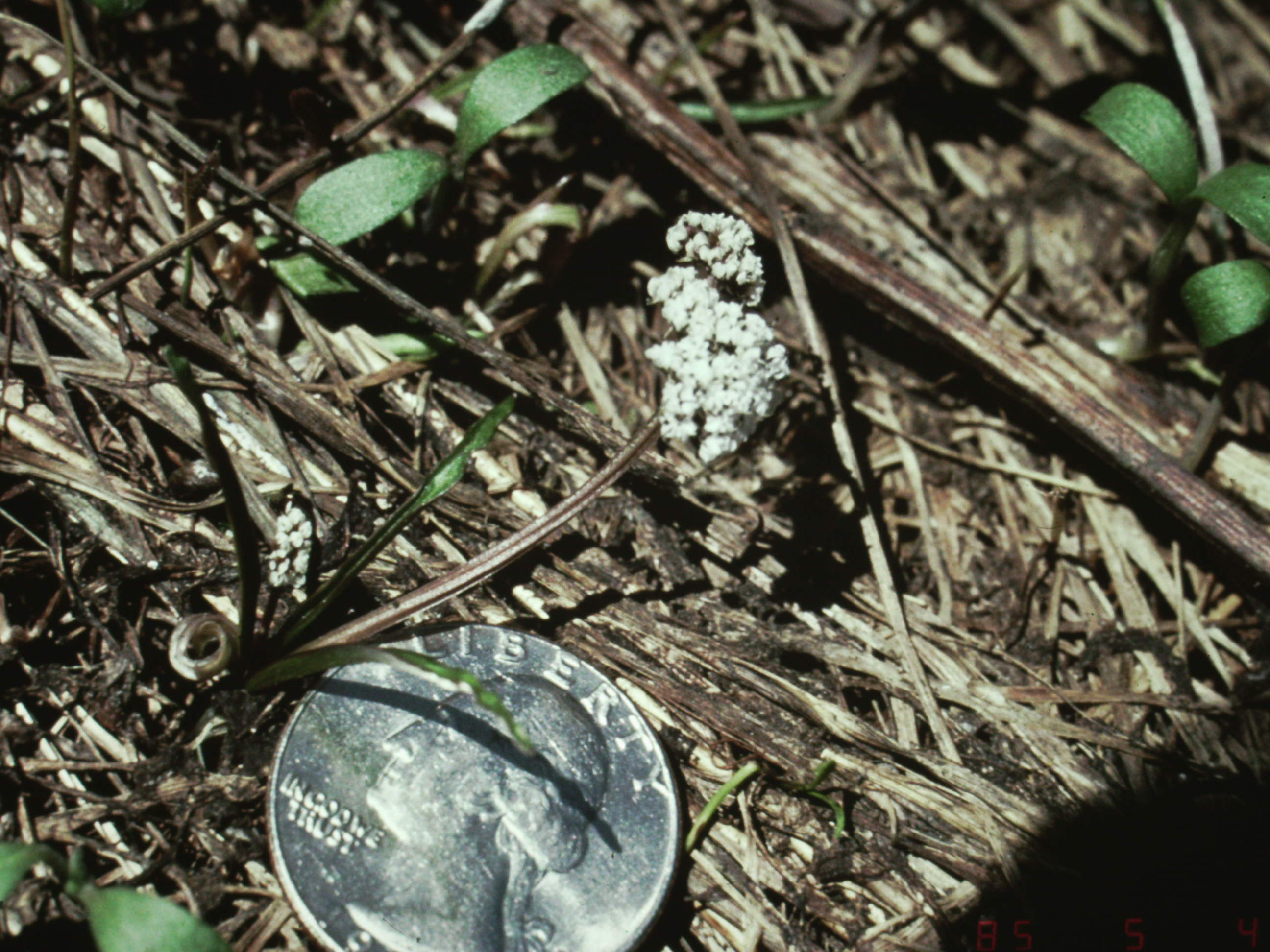
Fluffy contents of the reed nest
of a carder bee
Courtesy & Copyright Jim Cane

Do you grow the ornamental plants called “lamb’s ears” or rose campion in your flower gardens? These plants produce dense mats of buttery soft woolly leaves. That leaf fuzz is avidly sought by so-called “carder bees” of the genus Anthidium. In textiles, carding is the mechanical process of combing through the fibers of cotton or wool to align them before spinning. The female carder bee has multi-toothed mandibles that she uses to shave the leaf hairs, gathering the fluff into a ball to bring back to her nest.

Lamb’s ear leaf shaved of some of its hairs
Courtesy & Copyright Jim Cane

Carder bees nest solitarily in aboveground cavities, typically an old beetle burrow in deadwood. Each female lines her tunnel with the carded plant hairs. Onto this fluffy pillow she assembles a provision of pollen mixed with nectar, which constitutes the food mass soon to be eaten by her progeny, one provision per larva.

Carder bees are stout, round, relatively hairless bees marked in black and yellow. We have several species, the largest being a European escapee that is associated with lamb’s ears. The female’s nesting biology is distinctive enough, but it is the male’s behavior that you will notice first.

Male carder bee at lavender flower
Courtesy & Copyright Jim Cane

Male carder bees are aggressive, territorial suitors. They spend all day in flight, tirelessly patrolling lamb’s ears and garden flowers, particularly culinary sage and Russian sage. Males dart at all carder bees of either gender, as well as other like-sized bees. They pounce upon and wrestle these unsuspecting individuals to the ground. If it is a female of their species, they will endeavor to mate with her. Such is the brazen courtship of male carder bees. Look now for these wool gathering bees in your gardens before summer bids us farewell.

This is Linda Kervin for Bridgerland Audubon Society.
Credits:

Photos: Courtesy & Copyright Jim Cane

Text: Jim Cane, Bridgerland Audubon Society

Additional Reading:

Anthidium_manicatum, BugGuide, BugGuide.net, https://bugguide.net/node/view/7744

Anthidium_manicatum, Discover Life, Polistes Foundation, https://www.discoverlife.org/mp/20q?search=Anthidium+manicatum

Wool Carder Bee (Anthidium manicatum), Solitarybee.com, Paul Betts, (March 2018, website no longer functioning)

Pando-The World’s Largest Organism

Within the Pando Clone
Fishlake National Forest, Utah
Courtesy & Copyright 2010 Ron Ryel
Utah State University

Hi, I’m Holly Strand from Stokes Nature Center in beautiful Logan Canyon.

What we consider to be the world’s largest organism has changed over time. At one point, the largest animal crown went to a 150 ton female blue whale. And General Sherman, a 275 foot tall Giant Sequoia was the largest plant.

In 1992, scientists discovered a fungus in northern Michigan and proclaimed it to be the world’s largest organism. Not nearly as visually stunning as a Giant Sequoia, this type of fungus is a filagree of mushrooms and rootlike tentacles spawned by a single fertilized spore. Over time it had grown to cover 37 acres, most of this below ground. Subsequent mushroom hunts uncovered even larger specimens elsewhere.

Stretching over 1,600 miles and visible from space, I often hear the Great Barrier Reef called the world’s largest organism. But the reef is not a single organism. It is created from the limestone secretions of a great number of different reef-producing coral species.

Fungi, reefs and giant trees are all very worthy biological wonders, but the thing that gets my largest organism vote is right here in Utah. Like the Great Barrier Reef, it’s so vast you really need to see it from a plane or even satellite. Like General Sherman, it has its own name—Pando—-meaning “I spread” in Latin. Pando can be seen is spreading itself in Fishlake National Forest in south central Utah. So what is Pando? And why is it so remarkable?

Pando is a clonal aspen colony. Each “tree” that we see in an aspen forest is not an individual tree at all but a genetically identical stem connected underground to its parent clone. More trees arise from lateral roots, creating a group of genetically identical trees. But, biologically speaking, the colony is just one individual plant.

Recent genetic testing by Dr. Karen Mock of Utah State University confirms Pando’s enormous size- it covers over 106 acres and contains around 47,000 aboveground stems or suckers. When you consider the volume represented by the trees and root system, Pando easily wins the title of world’s largest organism. So far anyway.

Thanks to Dr. Karen Mock of Utah State University’s College of Natural Resources for her help in developing this piece.
For pictures and sources of the remarkable Pando, see www.wildaboututah.org

For Wild About Utah and Stokes Nature Center, I’m Holly Strand.

Credits:
Photo: Courtesy & Copyright 2010 Ron Ryel, Utah State University
Text: Stokes Nature Center: Holly Strand

Sources & Additional Reading

WESTERN ASPEN ALLIANCE is a joint venture between Utah State University’s College of Natural Resources and the USDA Forest Service Rocky Mountain Research Station, whose purpose is to facilitate and coordinate research issues related to quaking aspen (Populus tremuloides) communities of the west. https://www.western-aspen-alliance.org/

American Cetatcean Society. Fact Sheet on the Blue Whale. https://www.acsonline.org [Accessed September 2, 2010]

DeWoody J, Rowe C, Hipkins VD, Mock KE (2008) Pando lives: molecular genetic evidence of a giant aspen clone in central Utah. Western North American Naturalist 68(4), pp. 493–497. https://digitalcommons.usu.edu/aspen_bib/3164
https://sci-hub.se/https://doi.org/10.3398/1527-0904-68.4.493

Grant, M., J.B. Mitton, AND Y.B. Linhart. 1992. Even larger organisms. Nature 360:216. https://www.nature.com/nature/journal/v360/n6401/abs/360216a0.html AND https://doi.org/10.1038/360216a0
https://sci-hub.se/https://doi.org/10.1038/360216a0

Grant, M. 1993. The trembling giant. Discover 14:83–88. Abstract:https://www.discovermagazine.com/the-trembling-giant-40013
https://digitalcommons.usu.edu/aspen_bib/2394/

Habeck, R. J. 1992. Sequoiadendron giganteum. In: Fire Effects Information System, [Online]. U.S. Department of Agriculture, Forest Service, Rocky Mountain Research Station, Fire Sciences Laboratory (Producer). Available: https://www.fs.fed.us/database/feis/ [Accessed September 2, 2010].
https://www.fs.usda.gov/database/feis/plants/tree/seqgig/all.html [Accessed Oct 12, 2025]

Mock, K.E., C . A. Rowe, M. B. Hooten, J. DeWoody and V. D. Hipkins. Clonal dynamics in western North American aspen (Populus tremuloides) Molecular Ecology (2008) 17, 4827–4844 https://digitalcommons.usu.edu/wild_facpub/163/
https://sci-hub.se/https://doi.org/10.1111/j.1365-294X.2008.03963.x

Volk, T. J. 2002. The Humongous Fungus–Ten Years Later. Inoculum 53(2): 4-8. https://msafungi.org/wp-content/uploads/Inoculum/53(2).pdf

The Associated Press, Study finds huge aspen grove continues to decline, The Salt Lake Tribune, Oct 22, 2018,
https://www.sltrib.com/news/2018/10/22/study-finds-huge-aspen/

Davis, Nicola, Sound artist eavesdrops on what is thought to be world’s heaviest organism, The Guardian, May 10, 2023, https://www.theguardian.com/environment/2023/may/10/sound-artist-eavesdrops-on-what-is-thought-to-be-worlds-heaviest-organism-pando-utah

The Sweet Song Of The Largest Tree On Earth, Science Friday, National Public Radio, May 12, 2023, https://www.sciencefriday.com/segments/listen-to-the-pando-largest-tree/