Kokanee Life Cycle

Kokanee Salmon above Porcupine Reservoir
Copyright 2008 Mary-Ann Muffoletto

Hi, I’m Holly Strand from the Quinney College of Natural Resources at Utah State University.

A highly compelling mating drama is taking place now in select mountain reservoirs. Utah’s colorful kokanee salmon are at the very peak of their upstream migration. Yearning to find the gravel bar in which they were born, these fish follow their noses. For the smell of that gravel birthplace–and the surrounding stream–is imprinted in young kokanee brains. Biologists call this smell the “home stream olfactory bouquet.”

Once a female kokanee is satisfied with the surrounding “olfactory bouquet,” she digs a nest in the gravel with her tail. As she digs one or more of these nests, individual males will try to guard her in order to secure their paternity. Part of the spectacle of kokanee-watching comes from the darting and biting and jostling among males attempting to get access to females. Once the eggs are laid and fertilized the female covers them with gravel.

This is the end of the line for the new parents. Within a few days of egg laying the female will die. And the male will follow soon after. Expired fish provide food for predators and scavengers such as gulls, ravens, and coyotes. Any leftover salmon will decompose and fertilize the stream waters, leading to plankton growth, which—in turn–will nourish the new crop of young salmon.

In Utah, kokanee eggs hatch between November and January. The tiny new salmon will spend their first weeks of life hiding in the gravel feeding off the remains of their egg yolk sack. After a few weeks they will emerge from the gravel to feed on plankton. By spring, these youngsters—called fingerlings– will be an inch and a half long. During spring runoff the fingerlings are swept downstream until they spill into a lake or reservoir. Now they will stay here in the open water for 2-4 years, feeding on zooplankton until they reach maturity.

For these first stages of life kokanee are dark to greenish blue on the head and back, silver on the sides and silvery or white underneath.
But at summer’s end, the spawning salmon will undergo their astonishing transformation. The males’ bodies will turn a bright red-orange. Their shape will change as well. They will acquire humped backs, hooked jaws, and elongated teeth. The females also turn red although the color may not be as striking. By late August both males and females are congregating at the mouth of the spawning stream preparing to embark on the final–and most important–mission of their lives.

For more information and locations for kokanee viewing go to www.wildaboutUtah.org. You’ll also see a video of kokanee spawning in the Little Bear River*, the main tributary of Porcupine Reservoir.

For Wild About Utah, I’m Holly Strand.

* Many people call this Cinnamon Creek. However the Little Bear River feeds Porcupine reservoir. Cinnamon creek joins the Little Bear, as a tributary, a little bit up stream and East of Porcupine reservoir.

Credits:

Photo: Courtesy and Copyright 2008 Mary-Ann Muffoletto, Photographer
Video: Courtesy and Copyright 2013 Charles Hawkins, Photographer
Video: Courtesy and Copyright 2013 Holly Strand, Photographer
Text: Holly Strand, Quinney College of Natural Resources at Utah State University

Where to see kokanee salmon spawning (adapted from Utah Div. of Wildlife Resources website)

The Kokanee spawning runs in Sheep Creek, Indian Creek, Strawberry River and the upper East Fork Little Bear River occur in late August through early October. Flaming Gorge Reservoir has a late-season spawning population which spawns in the Green River and along the shores of the reservoir in late October through November.

Sheep Creek is in northeastern Utah, about six miles south of Manila. The viewing site is at the Scenic Byway turnout where Sheep Creek crosses under state Route 44.

Porcupine Reservoir: Just pass Avon, turn left (there’s a sign) and head east to the reservoir. Pass the dam and follow the shelf road past the end of the reservoir. There will be a wide level area where you can park and walk down to the Little Bear River to see the salmon.

Sept. 22 is Kokanee Salmon Viewing Day.at the U.S. Forest Service visitor center at Strawberry Reservoir. Utah Div. of wildlife Biologists will be on hand to show you the salmon and answer any questions. https://wildlife.utah.gov/dwr/news/42-utah-wildlife-news/906-see-kokanee-at-strawberry.html Even if you can’t make it to this event, salmon should be visible in the Strawberry River, and other tributaries to Strawberry, from now until the first part of October.

Sources & Additional Reading

Sept. 22 is Kokanee Salmon Viewing Day.at the U.S. Forest Service visitor center at Strawberry Reservoir. Utah Div. of wildlife Biologists will be on hand to show you the salmon and answer any questions.
https://wildlife.utah.gov/dwr/news/42-utah-wildlife-news/906-see-kokanee-at-strawberry.html [Accessed September 19, 2013]

Resources:
Fuller, P., G. Jacobs, J. Larson, and A. Fusaro. 2013. Oncorhynchus nerka. USGS Nonindigenous Aquatic Species Database, Gainesville, FL.
https://nas.er.usgs.gov/queries/factsheet.aspx?SpeciesID=915 Revision Date: 3/7/2012 Note: Oct 29, 2024 New link https://nas.er.usgs.gov/queries/factsheet.aspx?SpeciesID=915

Sigler, John W. and William F. Sigler. 1987. Fishes of the Great Basin: A Natural History. Reno, NV: University of NV Press. https://unpress.nevada.edu/9780874176940/fishes-of-the-great-basin/

Sloman, Katherine A., Rod W. Wilson, Sigal Balshine. 2006. Behaviour and Physiology of Fish. San Diego, CA: Elsevier Academic Press. https://shop.elsevier.com/books/fish-physiology-behaviour-and-physiology-of-fish/sloman/978-0-12-350448-7

Steward, Ron. 1994. Kokanee. Utah Division of Wildlife Resources. Wildlife Notebook Series No. 10. https://utah.ptfs.com/awweb/main.jsp?flag=collection&smd=1&cl=all_lib&lb_document_id=12657&itype=advs&menu=on
[accessed September 19, 2013] Downloaded and found at https://wildaboututah.org/wp-content/uploads/kokanee-dwr-booklet1.pdf

Ross, Crystal, Where to see Utah’s spawning kokanee salmon, Wildlife Blog, Utah Division of Wildlife Resources, August 29, 2019, https://wildlife.utah.gov/news/wildlife-blog/755-where-to-see-utah-s-spawning-kokanee-salmon.html [accessed October 29, 2024]

Insect Mimicry

American Hoverfly, Courtesy National Park Service, nps.gov/long/naturescience/insects.htm
American Hoverfly
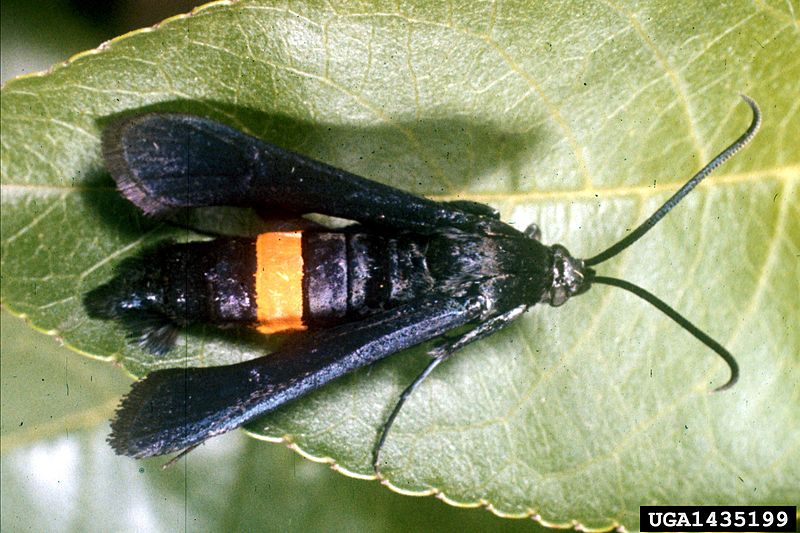
Courtesy National Park ServicePeach Tree Borer, Courtesy Cooperative Extension, Copyright 2009 Clemson UniversityPeach Tree Borer
Courtesy USDA Cooperative Extension
© 2009 Clemson University

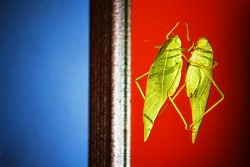
Katydid, Courtesy Stokes Nature Center, Scott Biggs, Photographer Katydid
Courtesy Stokes Nature Center
Scott Biggs, Photographer

Monarch Butterfly, Courtesy Utah Division of Wildlife Resources, J. Kirk Gardner, Photographer Monarch Butterfly
Courtesy Utah Division of Wildlife Resources
J. Kirk Gardner, Photographer
Licensed Under CCL 3.0

Click for a closer view of a Tiger Swallowtail Butterfly, Courtesy Utah Division of Wildlife Resources, J. Kirk Gardner, Photographer Tiger Swallowtail Butterfly
Courtesy Utah Division of Wildlife Resources
J. Kirk Gardner, Photographer
Licensed Under CCL 3.0


Insects are the most diverse class of organisms on earth, with more than 900 thousand known species. With that many different kinds of bugs, it’s no wonder that they take on such a vast array of shapes, sizes, and colors. From Luna moths to fruit flies to millipedes, the diversity of this class of life is immense. Some insects have developed a shape and coloring so deliberate that it’s almost astounding. These insects are mimics – bred to look like something they aren’t, in an attempt to get a leg up on the survival game.

Insects can mimic all kind of things – stick bugs, for example, make such convincing twigs that you’ll never know they’re around until they move. Katydids look just like bright green leaves, and there are some species of caterpillar that in their youngest stages look just like splatters of bird droppings. But the mimics that I find most interesting are those who mimic other insects.

There are two main types of insect-to-insect mimicry. Batesian mimicry occurs when one harmless species mimics another dangerous one. Species that look like something fierce can capitalize on that insect’s dangerous reputation and potentially be safer from predators because of it. A common Utah pest, the peach tree borer, is a moth that very closely resembles a wasp in both its morphology and behavior. Harmless, nectar-eating hoverflies exhibit the black and yellow body stripes of a bee. Apparently, it’s not just humans who want to stay away from the business end of a wasp or a bee – many insect predators, too, give them a wide berth.

Ants also have a fierce reputation in the animal world, and so attract a lot of mimics. A number of spider species not only mimic ants in morphology and behavior, but some also give off ant pheromones, making them smell like friend rather than foe. While many ant-mimicking spiders go undercover as a way to hide from their own predators, some do use their disguise as a way to access the nest of their prey.

Batesian mimicry is a delicate balance. Predators need to catch a wasp or two before they associate that color pattern with dangerous prey. If there are too many tasty mimics around, the predators will stop associating black and yellow stripes with a dangerous object and the mimic’s ploy would fail to work.

A slight variation on Batesian mimicry are insects with false faces and false eyes. Tiger swallowtails – those large yellow and black butterflies – have red and blue spots on each of their hind wings at a place farthest from their body. These spots, combined with the skinny black ‘tails’ from which the species gets its common name, are meant to look like the eyes and antennae of another, possibly larger and more fierce, insect. This imagery is meant to frighten off predators, but also in the case of an attack, to spare the most important part of the butterfly’s body.

The second, less common, form of insect-to-insect mimicry is called Müllerian mimicry. This occurs when two equally distasteful insects come to resemble one another. Most of us are familiar with the monarch butterfly. As caterpillars, they feed exclusively on toxic milkweed. The caterpillars take the toxins into their bodies and retain them as adults, making them not only bad-tasting but also poisonous. Predators have learned to associate that distinct orange and black wing pattern with a bad experience, and therefore leave them alone. Viceroy butterflies look incredibly similar to monarchs – the only difference being an extra line of black on the hindwings of a viceroy. While once thought to be Batesian mimics, recent studies have shown that viceroys are equally unpalatable. Their similarity in looks to monarchs, then, serves to reinforce the distasteful nature of both species.

Mimicry is of course, not restricted to the insect kingdom. Some plants have gotten into the mimicry business in order to trick insects. The hammer orchid, which grows in Australia, has a flower that mimics a female bee. Male bees, in mistakenly trying to mate with the flower, collect pollen that they then carry with them to the next, ensuring pollination of this sneaky plant. So this ingenious tactic some insects use to gain a leg up in the game of survival can also be used against them to the advantage of others. Isn’t life amazing…

For more information and photos of some insect mimics, visit our website at www.wildaboututah.org. For the Stokes Nature Center and Wild About Utah, this is Andrea Liberatore.

Many thanks to Don Viers for his input on this piece.

Credits:

Photos: Courtesy and copyright as marked

Text: Andrea Liberatore, Stokes Nature Center

Additional Reading:

Imes, Rick (1997) Incredible Bugs: The Ultimate Guide to the World of Insects. Barnes & Noble Books. New York, NY

Pyle, Robert Michael (1981) National Audubon Society: Field Guide to Butterflies, North America. Alfred A. Knopf. New York, NY

Viers, Don (2013) Personal conversations

Ritland, David B., Brower, Lincoln P. (1991) The Viceroy butterfly is not a Batesian mimic. Nature, vol. 350, 497-8. Available online at: https://www.nature.com/nature/journal/v350/n6318/abs/350497a0.html

Cushing, Paula E. (2012) Spider-ant associations: An Updated Review of Myrmecomorphy, Myrmecophily, and Myrmecophagy in Spiders. Psyche, vol. 2012. Available online at: https://www.hindawi.com/journals/psyche/2012/151989/

NRCS Partners with Farmers, Ranchers to Aid Monarch Butterflies, Posted by Jason Weller, Chief, Natural Resources Conservation Service, on November 12, 2015, USDA Blog, https://blogs.usda.gov/2015/11/12/nrcs-partners-with-farmers-ranchers-to-aid-monarch-butterflies/

Botanical Velcro® aids seed dispersal

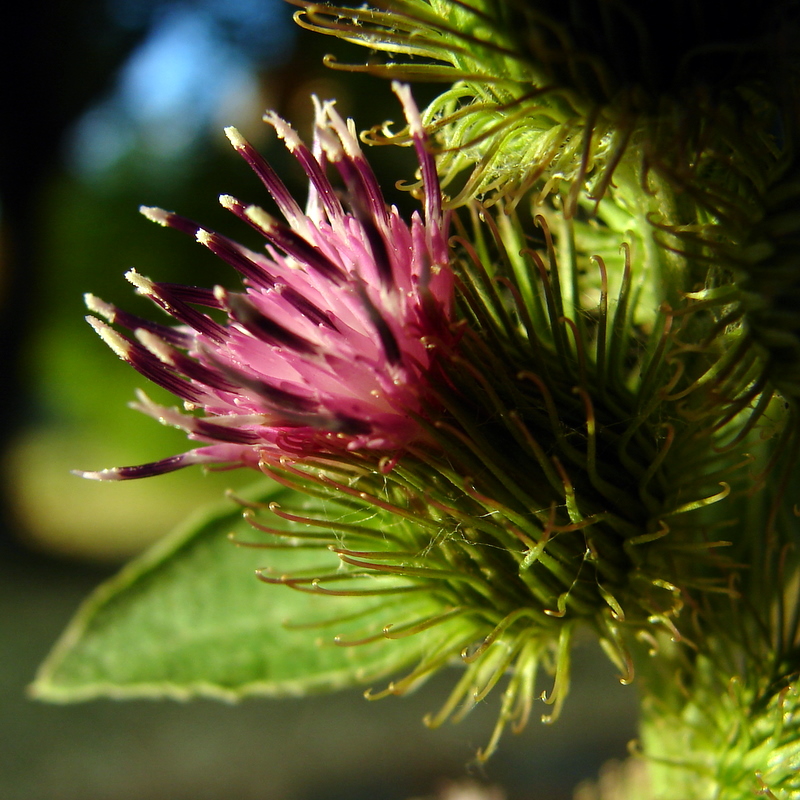
Click for a closer view of Burdock flowers, Courtesy and Copyright 2009 Jim Cane
Burdock Flower
Courtesy & Copyright 2009 Jim Cane

The splendid blooming meadows of summer are fulfilling their reproductive imperative now as they mature and disperse the fruits and seeds that resulted from pollination. Plants can’t walk or actively fly, so to disperse from the mother plant, seeds need to catch a ride. Wild gourds bob down flooding arroyos, thistledown floats on the wind, and red barberry fruits hope to catch the eye of a hungry song bird.

Certainly the most annoying means of dispersal is employed by seeds that stick in fur and socks. Some like cheatgrass are driven home by sharp barbed seeds that poke and hold like the porcupine’s quill. Others form evil pointy burrs, like those of puncturevine, that can flatten a bicycle tire. And then there is burdock. This European weed infests moister disturbed sites in Utah. Its burrs cling tightly to hair and clothing.

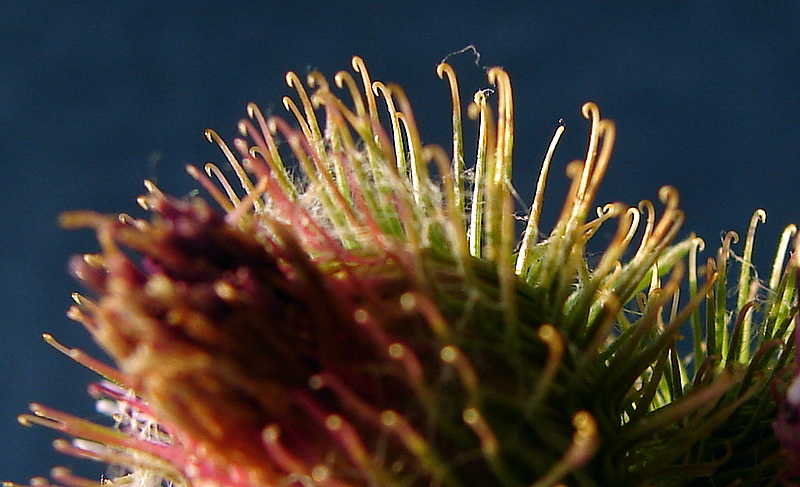
Click for a closer view of Burdock hooks, Courtesy and Copyright 2009 Jim Cane
Burdock Hooks
Courtesy & Copyright 2009 Jim Cane

Sixty years ago, the Swiss engineer, George de Mestral, became intrigued by the seed heads of cockleburrs and burdocks. They had entangled his dog’s fur and stuck to his pant legs during a montane hunt. How did those burrs cling so steadfastly? Aided by a hand lens, you can see what de Mestral saw: ranks of hook-tipped bristles that snag clothing and fur. Burdocks inspired de Mestral’s invention of Velcro, whose patented nylon bristles are hooked over just like burdock’s and latch on just the same. When next you are beset by burdock burrs, inspect one closely and admire the inventiveness of nature. Then please terminate its dispersal by placing it where the seeds of this weed can’t germinate and grow!

This is Linda Kervin for Bridgerland Audubon Society.
Credits:

Photos: Courtesy & Copyright Jim Cane

Text: Jim Cane, Bridgerland Audubon Society

Additional Reading:

Velcro ® brand is a registered trademark of Velcro Industries B.V. www.velcro.com

Velcro USA Inc. Celebrates 50th Anniversary, (Press Release)

Invention of Velcro ® brand Fasteners, Fastech of Jacksonville, Inc., https://www.hookandloop.com/extra/inventionnew.html

Greater Burdock, Arctium lappa L. NRCS Plants Database, https://plants.usda.gov/java/profile?symbol=ARLA3

Seed Dispersal, Missouri Botanical Garden, https://www.mbgnet.net/bioplants/seed.html

Pinyon Jays

Click for larger picture, Pinyon Jay courtesy and copyright 2005 Marlene Foard - as found on www.utahbirds.org
Pinyon Jay, Tabiona, Utah
Courtesy & © 2005 Marlene Foard
As found on UtahBirds.org

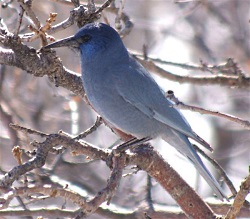
Click for larger picture, Pinyon Jay Courtesy US FWS, Dave Menke, Photographer Pinyon Jay
Gymnorhinus cyanocephalus
Courtesy US FWS
Dave Menke, Photographer

Few birds have such a strong association with one plant that the plants name becomes part of the birds name. Sage grouse is one, Acorn Woodpecker another, but the Pinyon Jay is our topic today. Pinyon Jays are usually found in close association with pinyon-juniper forests throughout the Great Basin and the nutritious nuts of the pinyon pine are their preferred food. The blue and grey birds collect and cache pinyon nuts in summer and fall for later consumption. They have an uncanny recovery accuracy and excellent spatial memory, which allows them to rediscover these scattered caches and eat pinyon nuts all year. They do not recover all the stored seeds, however, and therefore aid in the dispersal of pinyon pines.

Pinyon Jays have a complex social organization and are highly gregarious. [Pinyon Jay Audio Courtesy Kevin Colver]

They spend their lives in large flocks of up to 150 or more individuals. Nesting is communal, although rarely are there more than 2 or 3 nests per tree. Breeding season is in late winter. Many birds spend their entire lives in the flock into which they were born.

Pinyon Jays are not migratory, but they tend to be nomadic; traveling to wherever there is a good crop of pinyon nuts. They will also eat a wide variety of seeds, insects and berries to supplement their diet and can be found in adjoining sagebrush, ponderosa pine forest and riparian habitats. The conservation status of Pinyon Jays is considered vulnerable. Destruction of pinyon-juniper forests for grazing and changes in fire regimes have resulted in loss of habitat. And what is a Pinyon Jay to do without its pinyon nuts?

Thank-you to Kevin Colver for the use of his bird recordings.

This is Linda Kervin for Bridgerland Audubon Society.

Credits:

Pictures: Courtesy and Copyright © 2005 Marlene Foard, as found on utahbirds.org
Also Courtesy US FWS, David Menke, Photographer
Bird Recordings: Kevin Colver https://wildstore.wildsanctuary.com/collections/special-collections
Theme: Courtesy & Copyright Don Anderson as performed by Leaping Lulu
Text & Voice: Linda Kervin, Bridgerland Audubon Society

Additional Reading:

Gymnorhinus cyanocephalus (Pinyon Jay), Fire Effects Information, USDA Forest Service, https://www.fs.fed.us/database/feis/animals/bird/gycy/all.html

Avian Cognition Laboratory, Northern Arizona University, https://www4.nau.edu/acl/index.htm

Pinyon Jays, Utah Bird Profiles, UtahBirds.org, https://utahbirds.org/birdsofutah/BirdsL-R/PinyonJay.htm