Ruffed Grouse and the Christmas Bird Count

Ruffed Grouse and the Christmas Bird Count: Ruffed Grouse, Bonasa umbellus
Ruffed Grouse
Bonasa umbellus
Courtesy Utah Division of Wildlife Resources
I set out this week to investigate why so many gifts in ‘The 12 Days of Christmas’ are birds. You know the song: there are swans a swimming, geese a laying, calling birds, French hens, turtle doves, and that partridge in the pear tree. Well, I never did find the answer. But what I did find was some interesting information about a native bird often incorrectly referred to as a partridge –a bird that is supremely well adapted to life in winter. Ruffed Grouse and the Christmas Bird Count

Ruffed grouse resemble partridges in that they are ground-dwelling game birds of similar size and stature. Their name comes from a collar of long feathers surrounding the necks of males who fluff them out when seeking mates in spring. The birds come in two color phases, differentiated mainly by their tail feathers, which can be either gray or chestnut brown. While not well understood, a grouse’s color phase seems to be linked to climate. Grouse with gray tails are more prevalent in areas defined by cold winters, while brown grouse are more common in warmer climates.

Now that snow is blanketing the landscape across much of their territory, the ruffed grouse is in its element. Harsh winters that adversely affect populations of other ground-dwelling game birds such as quail, pheasant, and turkeys, don’t seem to faze ruffed grouse. Their ability to survive is dictated by a number of special adaptations. The first is on their feet, where each winter nubby feathers called pectinations grow on the sides of the birds’ toes. Looking like strange combs, the bristles act as snowshoes, allowing the grouse to walk on top of even the softest snow. More special feathers grow on grouse legs like personal leg-warmers, and also near the bird’s beak, covering its nostrils. Scientists believe the feathered mustache enables grouse to breathe in warmer air than they otherwise would, thus keeping their internal temperature more stable.

Changes in weather bring about some changes in behavior as well. Warmer months find the birds resting in evergreens or thick brush. But in winter, when a foot or more snow covers the ground, grouse roost in the snow. The birds create small burrows which hide them from predators, offer protection from frigid winter winds, and keep them surprisingly snug and warm. Many a backcountry skier or snowshoer has been startled by a hidden grouse bursting noisily from its snowy lair.

The birds’ diet also changes seasonally from a summer sampling of green foliage, seeds, berries and insects, to the protein-rich dormant flower buds of trees such as aspen and birch. Grouse also won’t hesitate to eat the sweet flower buds of domestic trees like apples, and were at one time considered a pest in New England orchards. And so it’s actually not out of the question that within ruffed grouse territory, you might wake up one Christmas morning to find a ‘partridge’ in your pear tree.

Speaking of birds and the holiday season, it’s nearly time for the Audubon Society’s annual Christmas Bird Count. Over the next few weeks, tens of thousands of volunteers around the country will join in this 113-year-old tradition, collecting data on the types and numbers of birds living in their area. This data allows scientists to monitor and track populations over time and space. Participants can be seasoned birders, first timers, or anything in-between. In Logan, Ogden, Salt Lake, and Zion National Park, the count takes place Saturday, December 15th. Other locations around the state will host their events between now and January 5th. To find a count near you, visit birds.audubon.org and click on Christmas Bird Count. For the Stokes Nature Center and Wild About Utah, this is Andrea Liberatore.

For the Stokes Nature Center and Wild About Utah, this is Andrea Liberatore.

Ruffed Grouse and the Christmas Bird Count-Credits:

Theme: Courtesy & Copyright Don Anderson Leaping Lulu
Images: Courtesy Utah Division of Natural Resources

Text & Voice:     Andrea Liberatore,
            Stokes Nature Center in Logan Canyon.

Ruffed Grouse and the Christmas Bird Count-Additional Reading:

Furtman, Michael. ( 1999) Ruffed Grouse: Woodland Drummer. Stackpole Books, Mechanicsburg, PA.
https://www.amazon.com/Ruffed-Grouse-Woodland-Michael-Furtman/dp/0811731227

Ruffled Grouse, Utah Division of Wildlife Resources, Utah Department of Natural Resources, https://fieldguide.wildlife.utah.gov/?species=bonasa%20umbellus [Link updated January 2024]

New York State Department of Environmental Conservation (2012) Ruffed Grouse. Available online at: https://www.dec.ny.gov/animals/45436.html

National Audubon Society’s Christmas Bird Count:
https://birds.audubon.org/get-involved-christmas-bird-count-find-count-near-you

Utah Christmas Bird Counts:
https://utahbirds.org/cbc/cbc.html

Logan Christmas Bird Count:
Bridgerland Audubon Society Logan Christmas Bird Count 15 Dec 2012

Mule Deer

Mule Deer Herd
Odocoileus hemionus
Photo Courtesy US FWS

Mule Deer Herd
Odocoileus hemionus
Photo Courtesy US FWS
Gary Zahm, Photographer

Mule Deer Herd
Odocoileus hemionus
Photo Courtesy US FWS
David Heffernan, Photographer

Hi, this is Mark Larese-Casanova from the Utah Master Naturalist Program at Utah State University Extension.

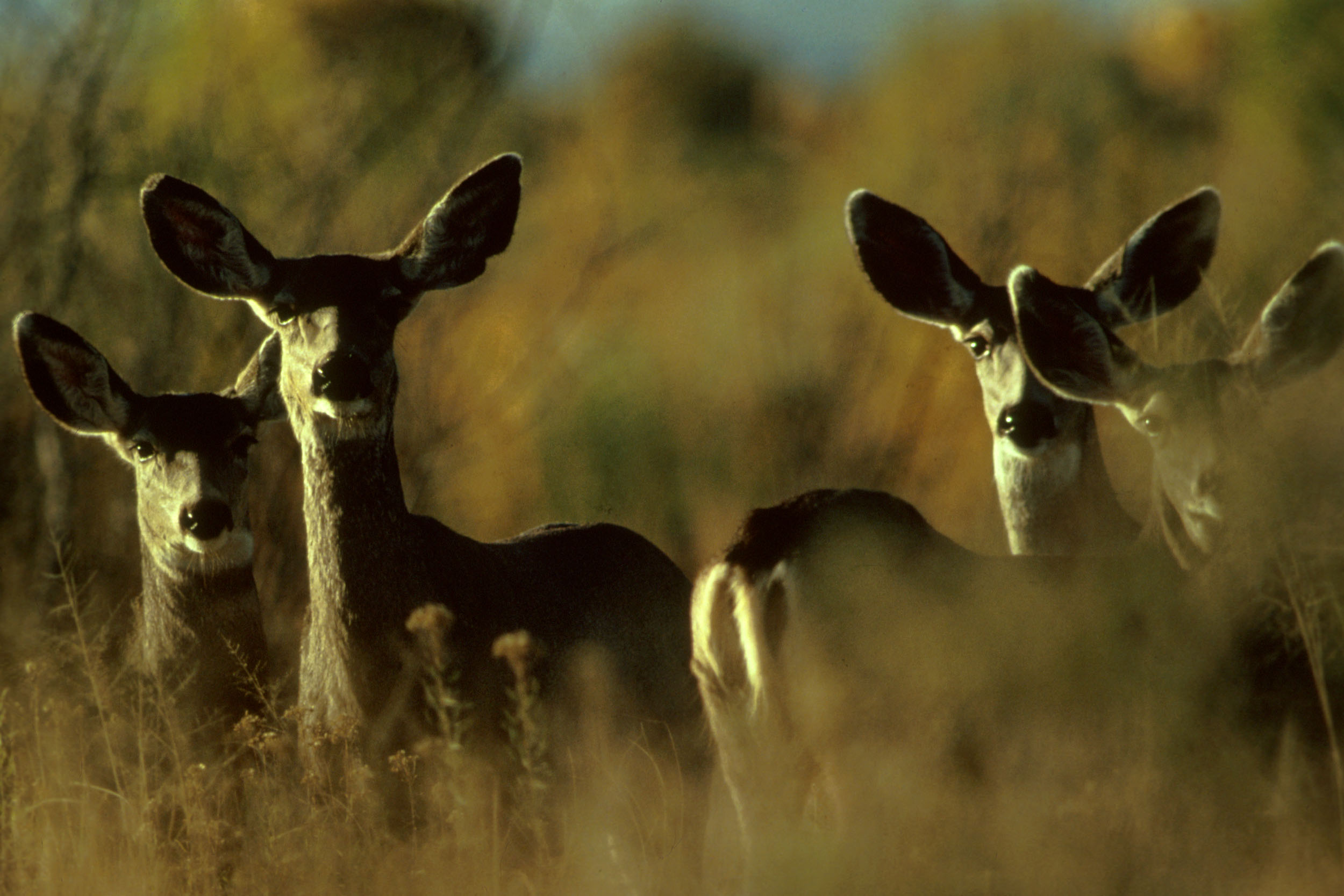
It’s that time of year again, the leaves have fallen from the trees, the snowy holidays are on their way, and love is in the air for one of Utah’s vital wildlife species. Odocoileus hemionus, commonly known as Mule Deer are the smallest members of the Cervid family in Utah, after moose and elk. Their name is derived from their large ears which resemble those of a mule.

Mule deer have a coat that ranges from dark grey, to a lighter tan color, a white rump patch, and tail with a black tip.

In the months of November and December Mule deer are active in their breeding season known as the rut. During the summer and early fall males will typically live away from does and fawns, and begin to “play” fight with other males to establish a hierarchy of dominance. Once the rut begins males will seek out does, and become more aggressive and compete with one another for females to breed with. The less dominant males are usually aware of their status, and will be chased away by larger bucks. However males that are similar in size will posture to one another, lock antlers and fight to establish breeding rights with the doe.

Mule deer are not monogamous in nature. Males will breed with any female that will accept them. Does can also breed with multiple bucks, providing the possibility of multiple births from different fathers. The receptive period for does is known as estrus, and typically lasts for less than a day, and sometimes only a few hours. If the first estrus cycle is missed does can go through another cycle in about four weeks. When the rut comes to an end, bucks will return to being solitary until they shed their antlers in late winter.

In Utah, does typically give birth in June and will leave the herd to be alone. The older does commonly have twins, while younger does have only one fawn. After the fawns are born the cycle of life starts again.

For Wild About Utah, I’m Mark Larese-Casanova.

Credits:

Images: Courtesy US FWS, Gary Zahn and David Heffernan, Photographers
Text:     Mary Jackson, Justin Hicken, Utah State University

Additional Reading:

LEARN MORE, Find out more about mule deer and what the DWR is doing to help them, Utah Division of Wildlife Resources, Department of Natural Resources, State of Utah, https://wildlife.utah.gov/16-wildlife.html?start=14

Ongoing Efforts to Help Utah’s Deer Herds, Utah Division of Wildlife Resources, Department of Natural Resources, State of Utah, https://wildlife.utah.gov/md-help.html

Mule Deer Statewide Management Plan, Utah Division of Wildlife Resources, Department of Natural Resources, State of Utah, https://wildlife.utah.gov/pdf/bg/mule_deer_plan.pdf

Mule Deer, Utah Species, Utah Division of Wildlife Resources, Department of Natural Resources, State of Utah, https://fieldguide.wildlife.utah.gov/?species=odocoileus%20hemionus

Blue, Blue, My World is Blue…

Blue, Blue, My World is Blue…Indigo Bunting
Passerina cyanea
Courtesy US FWS
Steve Maslowski, Photographer

Spring Azure(Male)
Celastrina ladon
Courtesy Wikimedia,
D. Gordon E. Robertson, Photographer
Licensed under Creative Commons
Attribution-Share Alike 3.0 Unported

Holly: Hi, I’m Holly Strand.

If I were to ask you what your favorite color is, odds are your answer would be blue. All around the world most people prefer blue over any other color.

Maybe this is because blue is quite unusual in nature. We rarely see blue in animals or plants. Animals are brown, ruddy or grayish—sometimes white or black makes an appearance. Plants are green, brown, red and yellow. So the blue exceptions really stand out.

There are two main ways to be blue. The first way is thorough pigmentation. Pigments are chemical substances that selectively absorb light. We see color based on the light wavelengths that are not absorbed but reflected. For it is these reflected wavelengths that hit our eyes.

Blue flowers are the result of anthocyanin pigments. These pigments usually reflect red or purple, but in Uinta’s Alpine Forget-me-nots they create a pure sky blue that will stop you in your tracks.

The other way to be blue is through a physical rather than chemical approach. A physical or structural color is produced when incoming light interacts with nanoscale biological structures on an object’s surface. In birds, different shapes and sizes of tiny air pockets and keratin in feathers can cause different shades of blue. The lazuli bunting gets its bright blue head and back via structural color. So do indigo buntings and mountain bluebirds.

Some birds change color depending upon the angle at which you look at them. This shimmering iridescence is caused by a more complex interplay of light and feather structure which sends light bouncing off into different directions. Some of the light waves coincide to intensify color; nd others crash and cancel each other out. In Utah look for iridescent blue on the head and back of the tree swallow and on the black-billed magpie’s wing and tail.

Iridescence is quite common in insects—think of colorful beetle and butterfly wings . The dazzling morpho is the most striking example of an iridescent blue. While we don’t have morphos in Utah, we do have several species of butterfly in a subfamily group of the gossamer winged butterflies. This group is appropriately called “ the blues.”

By now Utah’s blue creatures have mostly expired or flown south. However, you can still get your blue color fix. Just look up! Utah’s sky is a deep and satisfying blue due to our aridity and high elevation.

For Wild About Utah, I’m Holly Strand.

Credits:

Image: Courtesy and Copyright 2003 Michael Kuhns, Extension.usu.edu
Text: Holly Strand

Sources & Additional Reading:

Color
Angier, Natalie. True Blue Stands Out in an Earthy Crowd. NY Times. Oct 22, 2012
https://www.nytimes.com/2012/10/23/science/with-new-findings-scientists-are-captivated-by-the-color-blue.html?emc=eta1

Fields, Helen. Why Are Some Feathers Blue? https://www.smithsonianmag.com/science-nature/Why-Are-Some-Feathers-Blue.html [accessed November 15, 2012]

Murphy, Pat, and Paul Doherty. 1996. The Color of Nature: An Exploratorium Book San Francisco: Chronicle Books

WebExhibits. Causes of Color. https://www.webexhibits.org/causesofcolor/15A.htm l [accessed November 15, 2012]

Color Preference
Grieve, K.W. (1991), “Traditional Beliefs and Colour Perception,” Perceptual and Motor Skills, 72 (4], 1319-23.

Krishna, K.P. (1972), “Colour Preferences as a Function of Age and
Sex,” Journal of the Indian Academy of Applied Psychology, 9 (1), 10-13.

Madden, Thomas, Kelly Hewett, and Martin S. Roth. 2000. Managing Images in Different Cultures:
A Cross-National Study of Color Meanings and Preferences. Journal of International Marketing. Vol. 8. No 4 pp. 90-107

Fall Frost

Frost on a Hairy Leaf
Copyright © 2012 Andrea Liberatore

Frost on a Leaf
Copyright © 2012 Andrea Liberatore

Frost Damage on a Tomato
Copyright © 2012 Andrea Liberatore

Evergreens take hardiness
to the Extreme
Two-needle Pinion Pine
Copyright © 2009 Linda Kervin

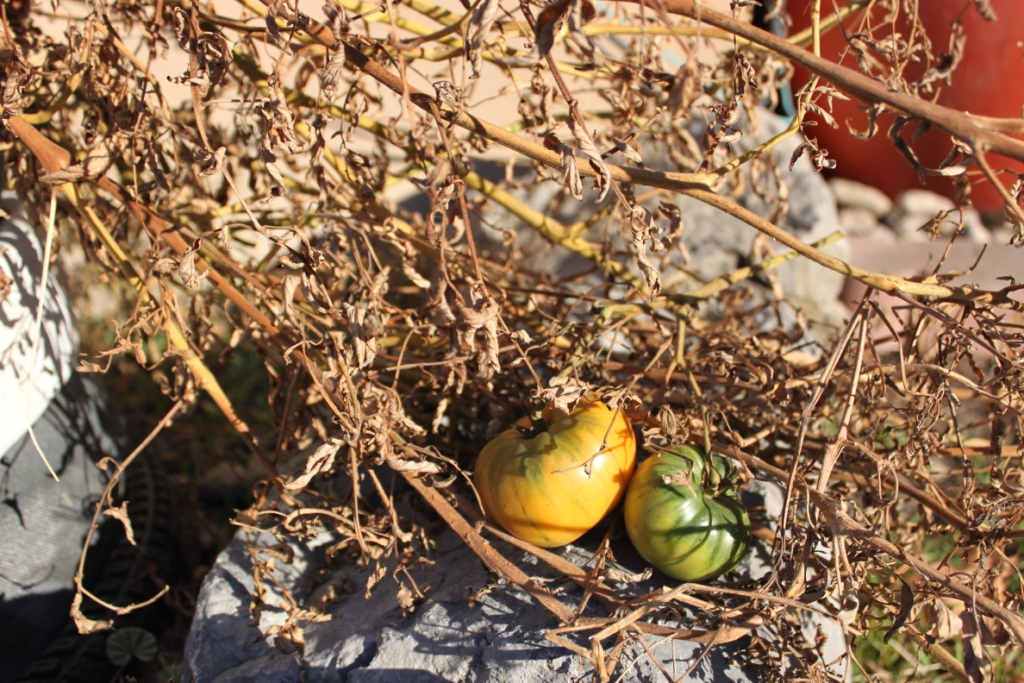
Fall has descended in earnest across Utah. Leaves have flashed their colors and dropped to the ground. Juncos have replaced the flycatchers on my backyard’s best perches, and my garden has been cleaned up and tilled under. As I watched the fall weather affect plants in my vegetable garden, I began to wonder about the different reactions they had to the changing temperatures. My tomatoes and squash turned brown and wilted at the merest suggestion of cold temperatures. Other plants, like kale, carrots and onions are still bright and fresh, even after an early snowfall. What is it about some plants that allow them to withstand frost, while others succumb right away?

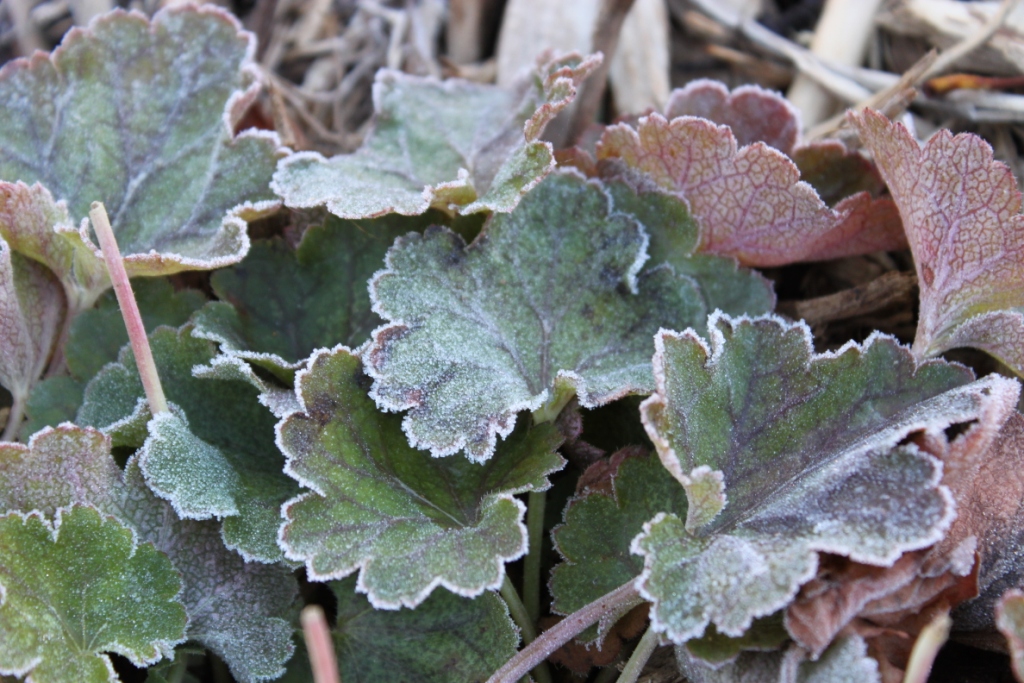
Frost occurs when the temperature of an object – in this case a plant leaf – falls below the dew point of the air. Moisture from the atmosphere collects on the surface of the leaf and freezes when temperatures drop below 32 degrees. Just seeing frost on a plant doesn’t necessarily mean it will die – it’s the internal tissue temperature that counts. Like humans, plants are made mostly of water – upwards of 80-90% in an herbaceous plant like lettuce. When temperatures drop, the water inside plant cells expands as it freezes, tearing cell walls and causing irreparable damage.

The amount of harm done to a plant depends on many different factors and is generally referred to as a plant’s hardiness. Species or individuals that are more compact will incur damage at a lower temperature than others due to their reduced surface area. Those growing close to the ground are more protected by their proximity to the warm earth. Plants with darker colored leaves such as the deep greens of spinach and chard may be hardier because their leaves absorb and retain heat better than lighter-colored leaves. Fuzzy or hairy leaves also fend off cold temperatures better than their smooth counterparts.

Perhaps the best defense of all is found in plants that protect themselves with natural antifreeze. When frost hits these plants, the relatively pure water in the space between leaf cells freezes first, which in turn draws more water out of the surrounding cells. The remaining cellular fluid contains a high concentration of sugars and other molecules, which reduces the fluid’s freezing point and protects the cell’s contents from ice.

Evergreens, of course, take hardiness to the extreme, utilizing a number of different tactics to remain alive and photosynthesizing throughout the winter. These tactics include compact leaf size, a thick leathery consistency, and a waxy coating that both insulates and prevents water from escaping into the dry winter air.

Frost damage to less hardy plants can be postponed by human interventions such as covering with blankets, but as the cold spells get longer and more frequent, damage is inevitable. Everything has its season, and now is the time to harvest the last of those hardy fall greens and tuck the garden in for the coming winter.

For the Stokes Nature Center and Wild About Utah, this is Andrea Liberatore.

Credits:
Images: Courtesy &
            Copyright 2012 Andrea Liberatore
            Copyright 2009 Jim Cane
Text:     Andrea Liberatore,
            Stokes Nature Center in Logan Canyon.

Additional Reading:


Savonen, Carol (2012) Some plants make natural antifreeze to cope with winter’s wrath. Oregon State University Extension Service. Available online at: https://extension.oregonstate.edu/gardening/node/847


Frost And Your Plants: What You Need To Know, Farmer’s Almanac, November 17, 2021, https://www.farmersalmanac.com/frost-temperature-outdoor-plants-9788

Huber, Kathy (Feb 16, 2002) What Happens When a Plant Freezes. The Houston Chronicle. Available online at: https://www.chron.com/life/gardening/article/What-happens-when-a-plant-freezes-1635570.php