Tales of the Packrat: The Legacy of Early Grazing on Utah’s Rangelands

Legacy of Early Grazing on Utah's Rangelands: Pack Rat Midden,  Photo Courtesy and Copyright 2009 Ken Cole - All Rights Reserved
Pack Rat Midden
Copyright © 2009 Ken Cole
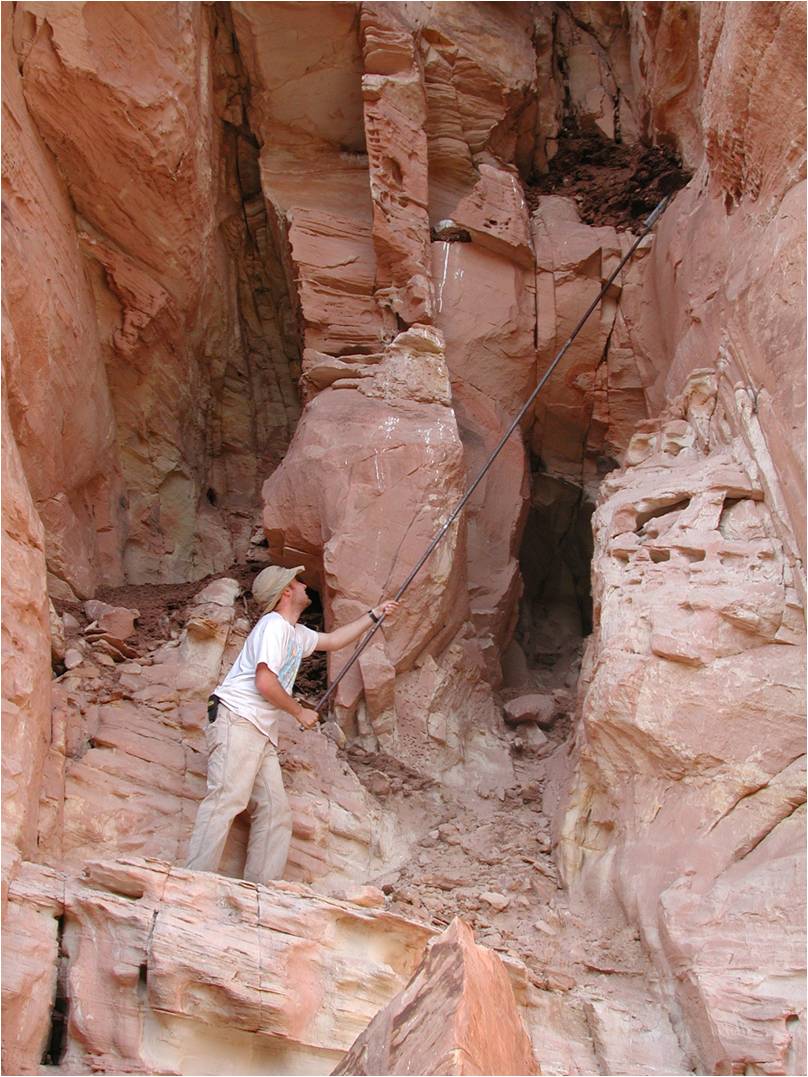
Reaching for a Pack Rat Midden, Click to Zoom, Photo Courtesy and Copyright 2009 Ken Cole - All Rights Reserved Reaching for a Pack Rat Midden
Copyright © 2009 Ken Cole

One of the best storytellers in Utah’s national parks is not a ranger, but the lowly packrat.The Legacy of Early Grazing on Utah’s Rangelands
Their stories of past plant communities are written in their middens. The midden is a heap of leaves, twigs, seeds and fruits the packrat discards outside its nest. Protected in a desert cave or rock crevice and preserved by a rat’s own urine, this heap is a detailed and accurate time capsule of the past local flora.

Ken Cole with the US Geological Survey is a fluent translator of the packrat’s stories. Ken and colleagues sampled old packrat nests around Glen Canyon National Recreation Area and Capitol Reef National Park. By carbon-14 dating, the nest ages are known to span the last 10,000 years. As controls, they also collected nests from mesa tops inaccessible to livestock. Ken and colleagues then carefully translated these packrats’ stories by identifying and counting the plant fragments in these fossil nests.

At both Capitol Reef and Glen Canyon, old packrat nests revealed pre-settlement plant communities that were rich in diverse grasses, wildflowers and shrubs. Then these floras changed. Beginning 150 years ago, vast herds of sheep and cattle tromped and chewed their way across the unfenced rangelands of Utah in numbers unimaginable today. We know that palatable plant species and those susceptible to trampling suffered declines, because they are absent from middens from that time period. Unpalatable shrubs multiplied. Despite curtailed grazing in subsequent decades at Capitol Reef and Glen Canyon, packrats show us that the flora still has not recovered. Like Aesop’s fables, this cautionary lesson of the packrat’s ecological tale remains clear and relevant today. We should all listen.

This is Linda Kervin for Bridgerland Audubon Society.
The Legacy of Early Grazing on Utah’s Rangelands
Credits:

Photos: Courtesy and Copyright Ken Cole
Text: Julio Betancourt USGS and Jim Cane, Bridgerland Audubon

Additional Reading:

Betancourt, Julio L., Thomas R. Van Devender, and Paul S. Martin, eds. Packrat Middens: The Last 40,000 Years of Biotic Change, University of Arizona Press, 1990 https://www.uapress.arizona.edu/books/BID40.htm

Pack Rat Middens, Colorado Plateau in Land Use History of North America, Ken Cole, USGS/Northern Arizona University, https://cpluhna.nau.edu/Tools/packrat_middens.htm

Introduction [to Carbon 14 Dating], Tom Higham, Radiocarbon Laboratory, University of Waikato, New Zealand https://www.c14dating.com/int.html [Sep 24, 2009]

Colorado Pikeminnow

Colorado Pikeminnow, Image courtesy US FWS, J.E. Johnson, Photographer

Colorado Pikeminnow
Ptychocheilus lucius
Image courtesy US FWS,
J.E. Johnson, Photographer

One of the largest minnows in the world, the Colorado pikeminnow was once found throughout the Colorado River basin. This is no bait minnow. Also known as the Colorado squawfish, it reputedly grew to a whopping 6 feet in length with a weight topping 80 pounds and a life span of 40 years. The largest caught in recent times have been only 3 feet long and 9 pounds.

Colorado pikeminnows once flourished throughout the Colorado River and most of its major tributaries. Historically, these abundant, torpedo-shaped fish were prized for their fine flavor. They were an important food fish for Native Americans and welcomed at restaurants as far away as San Francisco. Also called white salmon by early settlers due to their migratory behavior, pikeminnows journeyed 200 miles to spawn in turbid backwaters.

Then we built dams which blocked the migratory runs of pikeminnows. Below the Grand Canyon, the last wild Colorado pikeminnow was caught in 1976. The proliferation of dams has drastically restricted their range. Moreover, reservoirs flood what was suitable river habitat, and their dams alter river flows and water temperature downstream.

The Colorado pikeminnow was one of the first fish given full protection under the Endangered Species Act in 1973. Today, there are two remaining wild populations. One resides in the upper reaches of the Colorado river system, the other in the Green River system. Efforts underway to restock Colorado pikeminnow in the San Juan River basin appear to be successful.

A broadly based coalition of partners established the Upper Colorado River Endangered Fish Recovery Program in 1988. This program focuses on 4 species of fish: humpback chub, bonytail, Colorado pikeminnow and razorback sucker. Their goal is to restore and manage stream flows and habitat, reduce competition from some non-native fish species and increase populations using hatchery raised young. If they are successful, this giant piscine predator will once again take its rightful place in the upper Colorado River ecosystem.

This is Linda Kervin for Bridgerland Audubon Society.

Credits:

Photos: Courtesy US FWS, images.fws.gov
Theme: Courtesy & Copyright Don Anderson Leaping Lulu
Text & Voice: Linda Kervin, Bridgerland Audubon Society

Additional Reading:

Other Wild About Utah Pieces by Linda Kervin

Colorado Pikeminnow, Wikipedia, wikipedia.org/wiki/Colorado_pikeminnow

Researchers Capture Fourth Largest Endangered Colorado Pikeminnow in San Juan River Since 1991, US Fish & Wildlife Service, December 13, 2010, https://www.fws.gov/mountain-prairie/pressrel/10-84.htm [Link Updated December 2023]

Colorado pikeminnow (Ptychocheilus lucius), Upper Colorado River Endangered Fish Recovery Program, 2012, https://www.coloradoriverrecovery.org/general-information/the-fish/colorado-pikeminnow.html [Link Updated December 2023]

Colorado Pikeminnow, Nevada Department of Wildlife, Formerly held at https://www.ndow.org:80/wild/animals/facts/fish_colorado_pike_minnow.shtm [Not working December 4, 2023]

Colorado Pikeminnow, Species, Utah Division of Wildlife Resources, https://fieldguide.wildlife.utah.gov/?species=ptychocheilus%20lucius [Link Updated December 2023]

https://wildlife.state.co.us/Fishing/SpeciesID/Pages/FishID.aspx [Not working December 4, 2023]

https://wildlife.utah.gov/fishing/nonnative/endangeredfishfacts.pdf [Not working December 4, 2023]

Colorado Pikeminnow endangered in Carbon, Daggett, Emery, Garfield, Grand, San Juan, Unitah and Wayne Counties, Utah’s Species of Greatest Conservation Need Species by County,
https://wildlife.utah.gov/pdf/WAP/utah-sgcn-list-by%20county-10-23.pdf

Sunflowers, the late summer feast

Sunflowers, the late summer feast: Click for a larger view of the sunflower garden. Image courtesy and copyright Jim Cane
Stand of ornamental sunflowers
in Cache Valley
Image courtesy and Copyright Jim Cane

Click for a larger view. Image courtesy and copyright Jim CaneHoney bee foraging at sunflower
Image courtesy and Copyright Jim Cane


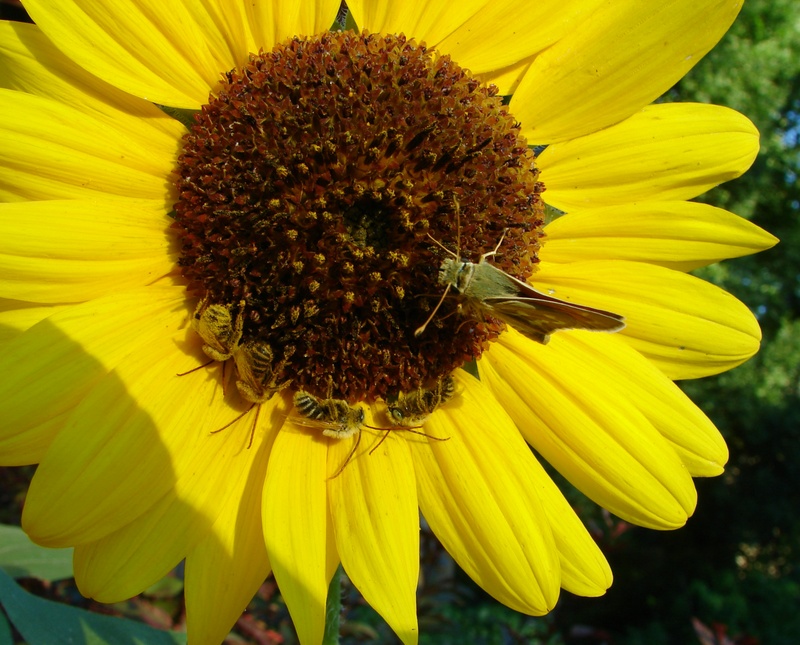
Click for a larger view. Image courtesy and copyright Jim CaneMale Melissodes bees and a skipper
butterfly sleeping on a sunflower at dusk
Image Courtesy and Copyright Jim Cane

Now, in late summer, the sunny golden blooms of sunflowers adorn gardens, roadsides and wild places across much of the United States. Utah is home to five sunflower species, four of them annuals. You are most likely to see Helianthus annuus, the aptly named “common sunflower”. Early domestication of common sunflower by Plains Indians led to the major oilseed crop that the world enjoys today.

Humans are not the only species seated at the sunflower dining table, however. The grub of one specialist weevil bores in sunflower stalks; as do larvae of 2 long-horned beetles. Another weevil hollows out the seeds. A third decapitates the flowerhead before ovipositing. One moth’s caterpillar gnaws the roots; several cutworm species topple seedling sunflowers, and several more kinds of butterfly caterpillars skeletonize sunflower leaves. In your garden, though, sunflowers generally escape pestilence. Chickadees and both American and Lesser Goldfinches cling to the ripe seed heads to pluck out the nutritious seeds. Listen for the plaintive call of the Lesser Goldfinch which is very distinctive.

[Lesser Goldfinch, Audio recording courtesy Kevin Colver, https://wildstore.wildsanctuary.com/collections/special-collections: Songbirds of the Southwest Canyon Country]

All those sunflower seeds are the direct result of pollination by bees. In the American West, more than 200 species of native bees visit sunflowers for nectar or pollen, a remarkably large fauna for any flower. None is more charming than the male of the bee genus Melissodes. They are discernible by their extra long antennae. Melissodes males dart among sunflowers all day long, seeking willing mates. Come sunset, the males bed down on the flower heads to snooze. They become drowsy enough to pet with your fingertip, and being males, have no sting. So if you have sunflowers at hand, chances are you have Melissodes bees around too. Look over your sunflowers this evening, and you may be lucky enough to find these dozing bachelor bees with their extra long antennae.

This is Linda Kervin for Bridgerland Audubon Society.

Credits:

Audio: Courtesy Kevin J. Colver, 7loons.com and On Amazon.com
Photos: Courtesy and Copyright Jim Cane
Text: Jim Cane, Bridgerland Audubon Society

Additional Reading:

LeBuhn, Gretchen, Greenleaf, Sarah, Cohen, David, The Great Sunflower Project, Department of Biology, San Francisco State University, https://www.greatsunflower.org/

Charlet, Larry D., Brewer, Gary J., Sunflower Insect Pest Management in North America, Radcliff’s IPM World Textbook, University of Minnesota, https://ipmworld.umn.edu/chapters/charlet2.htm

Beavers: The Original Army Corps of Engineers

Beavers: The Original Army Corps of Engineers: Click for larger picture, Beaver with branch in water, Courtesy US FWS
Beaver with branch in water
Courtesy US FWS,
Steve Hillebrand, Photographer


Hi, I’m Holly Strand from Stokes Nature Center in beautiful Logan Canyon.

Beavers and beaver dams are a common feature of the Utah landscape. You’ll see the dams on smaller streams and side channels, constructed of branches, downed trees and mud. The still, deep water of the resulting pond creates ideal conditions for a beaver lodge. Beavers can escape and hide from predators by slipping into the pond and disappearing into the lodge. Beavers also use their ponds to cache their favorite
food—aspen and willow.

Because of their tree cutting and dam making skills, humans tend to have two divergent opinions of beavers: 60-pound nuisance or environmental engineer.

Click for larger picture, Beaver Lodge, Courtesy US FWS
Beaver lodge
Courtesy US FWS
Hans Stuart, Photographer

Beavers are considered a nuisance when they gnaw down trees that humans want to keep. Dams can flood roads or stop up irrigation canals. When beaver activity conflicts with human interests, they—the beavers–are likely to be trapped and killed.

However, beaver activity has many positive environmental consequences that we are just beginning to appreciate. Wetlands created by beaver dams help soak up sediments, improving downstream water quality. Because of beaver dams, the winter snowpack isn’t lost in a short spring pulse, This results in a more constant stream flow through the summer –and that’s important as Utah’s climate is predicted to become drier. Finally, beaver dams enhance habitat for many other fish and wildlife species and plants.

Click for larger picture, Beaver in pond, Courtesy US FWS
Beaver in pond
Courtesy US FWS
Steve Hillebrand, Photographer

According to Dr. Joe Wheaton, a geomorphologist at Utah State University, there’s a lot of untapped potential for employing beaver engineers in stream and floodplain restoration. Say you want to restore a stream by reconnecting it with its floodplain. You need to excavate channels, redirect stream flow, revegetate and nurture the
area for a long period of time. To accomplish this, you often need a
number of highly trained professionals and some large Tonka toys.

Alternatively –under the right conditions– you might transplant a
colony of beavers and let them apply their vigorous work ethic to your
landscape and get quite satisfying results.

Recognizing that nuisance beavers can be rehabilitated into hard
working wetland engineers and stream habitat restorationists, the Utah
Division of Wildlife Resources has rolled out the state’s first beaver
management plan in 2010. This plan encourages live trapping of entire
families of beavers in nuisance areas and moves them to specific sites where their
environmental services can be appreciated and put to use.

Click for larger picture, Beaver in snow, Courtesy US FWS
Beaver in snow
Courtesy US FWS

Thanks to the USU College of Natural Resources for supporting this Wild about Utah topic.

For Wild About Utah and Stokes Nature Center, I’m Holly Strand.

Credits:
Images:
Text: Stokes Nature Center: Holly Strand

Sources & Additional Reading


ARKive Images of Life on Earth, Information Sheet on Castor Canadensis (including some outstanding videos) https://www.arkive.org/ – (BBC Natural History Unit)

  • American Beaver – Overview
  • American Beaver in the Lodge with Young
  • American beaver felling trees and storing food for the winter
  • American beaver scaring moose away from its lodge
  • American beaver returning to its lodge with food

  • Collen, P. and R.J. Gibson. 2001. The general ecology of beavers (Castor spp.), as related to their influence on stream ecosystems and riparian habitats, and the subsequent effects on fish – a review. Reviews in Fish Biology and Fisheries 10: 439–461, 2001. https://web.archive.org/web/20230202160926/https://www.researchgate.net/publication/227028536_The_general_ecology_of_beavers_Castor_spp_as_related_to_their_influence_on_stream_ecosystems_and_riparian_habitats_and_the_subsequent_effects_on_fish_-_A_review [ Accessed May 1, 2010]

    Prettyman, B. 2009. Utah wildlife: Leave it to the beavers. Article in Salt Lake Tribune, October 16, 2009. https://www.sltrib.com/ci_13570110 [ Accessed April 29, 2010]

    Smithsonian Castor Canadensis Information Page https://www.mnh.si.edu/mna/image_info.cfm?species_id=32 [ Accessed April 29, 2010]

    Big Bend Habitat Restoration Project: A Natural Work of Heart, Open Spaces-A Talk on the Wild Side, US FWS, https://www.fws.gov/news/blog/index.cfm/2016/3/25/Big-Bend-Habitat-Restoration-Project-A-Natural-Work-of-Heart [Accessed March 31, 2016]

    Beaver Dams Strengthened by Humans Help Fish Rebound
    60-Second Science – July 25, 2016 – By Jason G. Goldman02:29 https://www.scientificamerican.com/podcast/episode/beaver-dams-strengthened-by-humans-help-fish-rebound/ Also available through the podcast https://itunes.apple.com/us/podcast/60-second-science/id189330872?mt=2

    Goldfarb, Ben, Eager: The Surprising, Secret Life of Beavers and Why They Matter, Chelsea Green Publishing, March 8, 2019, https://www.amazon.com/Eager-Surprising-Secret-Beavers-Matter/dp/1603589082/ref=asc_df_1603589082/