Desert Tortoises

Click for a larger view of an adult Desert Tortoise. Courtesy & Copyright 2009 Kevin Durso, Photographer
Adult Desert Tortoise
Gopherus agassizii
Courtesy & Copyright 2009
Kevin Durso, Photographer

Click for a larger view of an adult Desert Tortoise. Courtesy & Copyright 2009 Kevin Durso, PhotographerAdult Desert Tortoise
Gopherus agassizii
Courtesy & Copyright 2009
Kevin Durso, Photographer
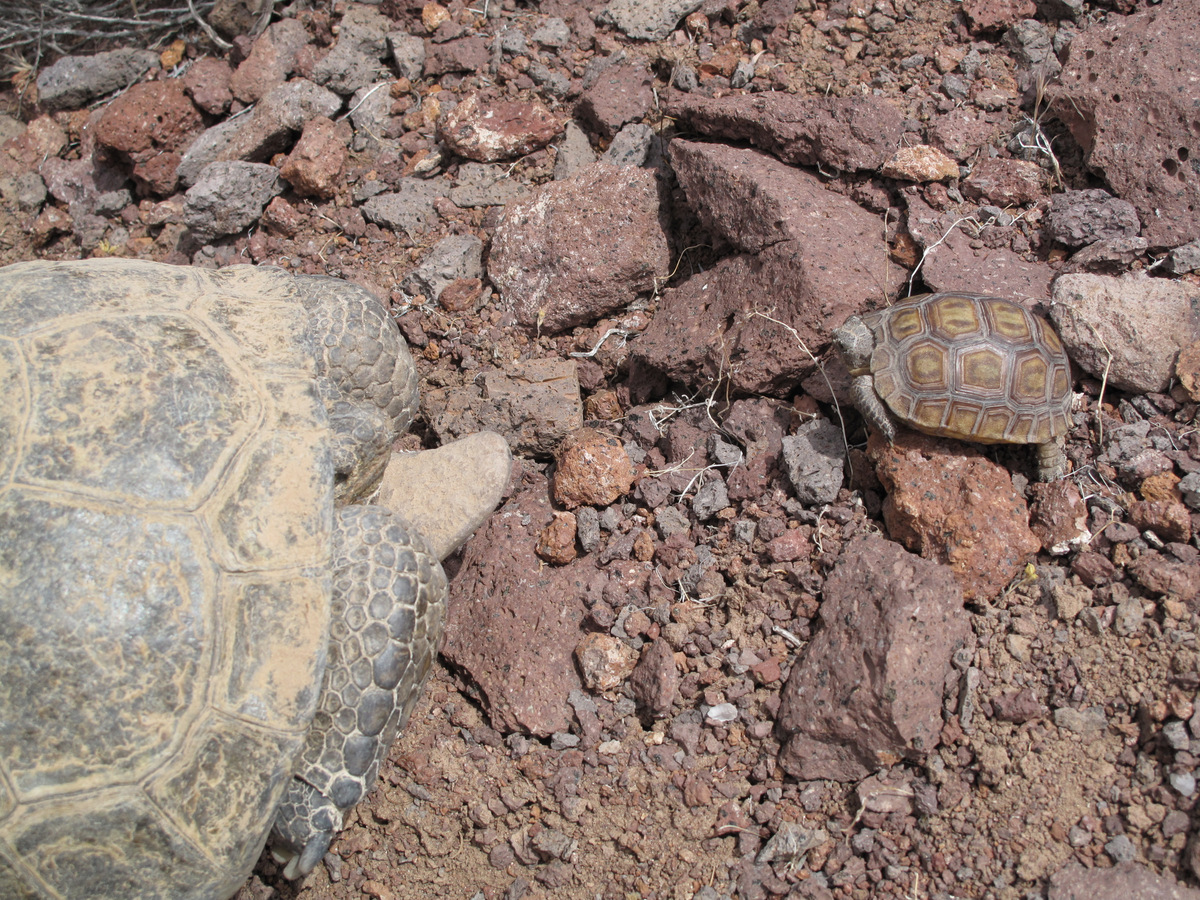
Click for a larger view of an adult and juvenile Desert Tortoise. Courtesy & Copyright 2009 Andres Durso, PhotographerAdult & Juvenile Desert Tortoise
Gopherus agassizii
Courtesy & Copyright 2009
Andrew Durso, Photographer

Click for a larger view of a juvenile Desert Tortoise. Courtesy & Copyright 2009 Andres Durso, PhotographerJuvenile Desert Tortoise
Gopherus agassizii
Courtesy & Copyright 2009
Andrew Durso, Photographer

Tortoises are turtles that live their whole lives on land. Most tortoises are native to Africa and South America, but several are North American including the Desert Tortoise whose range extends to southwestern Utah. Their shells consist of enlarged scales called scutes. These scutes are tan, black, or dull orange, and etched with many concentric lines, like the growth rings of a tree. Desert Tortoises look like grizzled old men, even the Oreo-sized hatchlings, which over several decades will grow to football size.

Desert Tortoises mate in the spring, and a few months later, the female lays her 5 or 6 eggs in a funnel-shaped pit dug in the sand. The sex of the baby Desert Tortoises is determined by the sun’s heating rather than by genetics – cooler incubation yields males, hotter eggs produce females, with a mix of sexes developing at intermediate temperatures.

Desert Tortoises primarily eat the flowers of desert plants such as globemallow and threeawn. Because most desert plants only bloom briefly each spring, tortoises must eat a lot between April and June, although they can be active during all but the coldest months. Being toothless, they grind up their vegetarian fare using a specialized bone embedded in their jaw muscles. Like cows and other herbivores, they depend on microbes in their gut to digest the cellulose in their diet. Even more than food, water is precious to a Desert Tortoise. They have little to spare, sometimes going for months without urinating, but will pee defensively if handled. Resist the temptation to pick them up or you will rob the poor animal of its water supply for the entire year.

Once found throughout the Mojave and Sonoran deserts, Desert Tortoises are much less common than they were a century ago. They have not fared well with urbanization, highways, and off-road vehicle traffic. An upper respiratory tract disease can also be lethal, especially when crowded or stressed, as in captivity. Desert Tortoises are now protected by the US Endangered Species Act.

Today’s program was written by Andrew Durso of USU’s biology department.

Credits:

Theme: Courtesy & Copyright Don Anderson Leaping Lulu
Images: Courtesy & Copyright Andrew Durso and Kevin Durso
Text: Andrew Durso, https://www.biology.usu.edu/htm/our-people/graduate-students?memberID=6753

Additional Reading:

Gopherus agassizii, Turtle Conservancy, https://www.turtleconservancy.org/news/tag/Gopherus+agassizii

Grover, Mark C., DeFalco, Lesley A, Desert Tortoise(Gopherus agassizii): Status-of-Knowledge, Outline With References, USDA, 1995, https://www.fs.usda.gov/research/treesearch/30627

Desert Tortoise, Gopherus agassizii, Mojave National Preserve, https://www.mojavenp.org/Gopherus_agassizii.htm

Gopherus agassizii (COOPER, 1861), The Reptile Database, Peter Uetz and Jakob Hallermann, Zoological Museum Hamburg,
https://reptile-database.reptarium.cz/species?genus=Gopherus&species=agassizii

Desert Tortoise, Species, Utah Division of Wildlife Resources, Utah Department of Natural Resources, https://fieldguide.wildlife.utah.gov/?species=gopherus%20agassizii

Desert Tortoise Information and Collaboration, Mojave Desert Ecosystem Program, https://www.mojavedata.gov/deserttortoise_gov/index.html

Red Cliffs Desert Reserve, http://www.redcliffsdesertreserve.com

Tracking Wildlife in Winter

Jumping Mouse Tracks
Photo Courtesy & Copyright 2011
Mark Larese-Casanova

Moose Tracks in Snow
Photo Courtesy & Copyright 2011
Mark Larese-Casanova

Cottontail Rabbit Browse & Scat
Photo Courtesy & Copyright 2011
Mark Larese-Casanova

Hi, this is Mark Larese-Casanova from the Utah Master Naturalist Program at Utah State University Extension.

The cold depth of winter is a time when many animals are hiding- either hibernating until the thaw of spring, or finding shelter and warmth in burrows, under logs, or in the tangled branches of evergreen trees.

However, snow falls in much of Utah, and even a dusting can reveal the stories of wildlife in winter. It’s a bit like solving a mystery. By reading the clues of animal tracks, we can know not only the type of animal that made them, but also where they were going and what they were doing.

The most obvious clue is the size of a track. Smaller animals make smaller tracks, and also sets of tracks that are generally closer together.

The shape of an animal track is also very revealing. Members of the canine family, including domestic dogs, coyotes, and fox, show four toes in front, each with a visible claw. Felines, including bobcats and mountain lions, also show four toes, but no claws. Tracks from members of the weasel family, such as mink, ermine, and skunks, show five toes, each with a claw. Raccoon, squirrel, and mouse tracks almost look like they were made by tiny human hands. The long tails of some animals, including deer mice, jumping mice, and weasels, often leave a characteristic line through the center of a set of tracks.

Combining the size and shape of tracks reveals further details about wildlife. The three inch long cloven hoof print of a mule deer is easily recognizable. An elk track looks almost identical, but is about four inches long. A similar moose track is even larger at six inches long.

Figuring out which animal made a track is only half of the story. If we follow tracks, we’ll surely find clues about an animal’s daily life. Wildlife often gather around sources of water that aren’t frozen, which are critical to winter survival. Perhaps rabbit tracks lead under a spruce tree where browsed branches and droppings indicate a frequent feeding spot. Maybe mouse tracks lead from tree to rock to log as it avoids owls and hawks.

While we are much more likely to see wildlife during the warmer months, winter gives us a chance to unravel the story of daily survival during the most difficult time of the year in Utah.

For Wild About Utah, I’m Mark Larese-Casanova.

Credits:
Images: Courtesy and Copyright Mark Larese-Casanova
Text:     Mark Larese-Casanova

Additional Reading:

Canadian Wildlife Federation: Tracking Down Winter Wildlife. https://www.cwf-fcf.org/en/action/how-to/outside/tracking-down-winter-wildlife.html

Murie, O. J. (1982). Animal Tracks. Peterson Field Guides. New York, NY: Houghton Mifflin. https://www.amazon.com/Peterson-Field-Guide-Animal-Tracks/dp/061851743X

Vermont Nature and Outdoors: Tracking Winter Wildlife. https://www.ruralvermont.com/vermontweathervane/issues/winter/97012/vins97012_tracking.shtml

Winter Song Birds

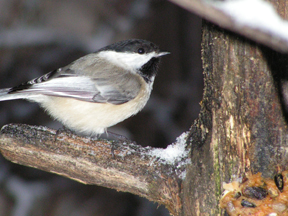
A Black-capped Chickadee, Bridgerland Audubon Society

A Black-capped Chickadee
Bridgerland Audubon Society

In the icy, short days of winter, you may think that Nature itself has curled up to hibernate. Our gardens are drab and deciduous trees are stripped down to bare limbs and twigs. Many songbirds have bid us farewell and flown south. In truth, what remains to be seen and heard of nature here in winter is more subtle and less boisterous. Now is the time to learn calls and songs of birds that reside here year-round, to hear them in solo performances, before the confusing springtime symphonies of birdsong.

This first bird calls its own name [sound: “Chick-a-dee-dee-dee” #9 Songbirds of the Rocky Mountain Foothills]. Black-capped Chickadees take sunflower seeds one at a time from our feeders. When out snowshoeing or skiing in our forests, inquisitive chickadees are welcome companions. They bring joy to a wintry day.

Frequently, a winter chickadee flock includes other birds. [Sound: “annk-annk” #48 Songbirds of Yellowstone] This bird sounds like a child’s squeak toy, but that nasal call belongs to the Red-breasted Nuthatch. Look for this chunky small bird at your suet feeder, or cruising up and down tree trunks in its search for insects.

We also have a minimalist in our winter bird repertoire [Sound: “tew” #62 Songbirds of Yellowstone]. That single note belongs to the Townsend’s Solitaire, which looks like a lean robin, colored the somber gray of an overcast sky. In winter, solitaires dine predominately on juniper berries. Their call stakes out their winter feeding territory. They are regulars at our heated birdbath, perhaps washing down all those puckery berries. If you are lucky, you may also hear their musical warbling, which is more common in warmer months. (Kevin Colver: Songbirds of Yellowstone)

You often hear chickadees, nuthatches and solitaires before you see them, as their plumage is neither colorful nor splashy. If you notice these calls on a winter’s day, it is because you are quiet and focused on the nature around you, leaving civilization’s hubbub behind. Thank-you to Kevin Colver for his wonderful bird recordings.

Credits:

Bird Sounds: Courtesy and Copyright 2008 Dr. Kevin Colver, Songbirds of the Rocky Mountain Foothills and Songbirds of Yellowstone and the High Rockies https://wildstore.wildsanctuary.com/collections/special-collections

Text: Jim Cane, Bridgerland Audubon Society https://www.bridgerlandaudubon.org

Additional Reading:

Black-capped Chickadee, All About Birds, Cornell Lab of Ornithology, https://www.birds.cornell.edu/AllAboutBirds/BirdGuide/Black-capped_Chickadee.html

Red-breasted Nuthatch, All About Birds, Cornell Lab of Ornithology, https://www.birds.cornell.edu/AllAboutBirds/BirdGuide/Red-breasted_Nuthatch.html

Townsend’s Solitaire, All About Birds, Cornell Lab of Ornithology, https://www.birds.cornell.edu/AllAboutBirds/BirdGuide/Townsends_Solitaire.html

Ruffed Grouse and the Christmas Bird Count

Ruffed Grouse and the Christmas Bird Count: Ruffed Grouse, Bonasa umbellus
Ruffed Grouse
Bonasa umbellus
Courtesy Utah Division of Wildlife Resources
I set out this week to investigate why so many gifts in ‘The 12 Days of Christmas’ are birds. You know the song: there are swans a swimming, geese a laying, calling birds, French hens, turtle doves, and that partridge in the pear tree. Well, I never did find the answer. But what I did find was some interesting information about a native bird often incorrectly referred to as a partridge –a bird that is supremely well adapted to life in winter. Ruffed Grouse and the Christmas Bird Count

Ruffed grouse resemble partridges in that they are ground-dwelling game birds of similar size and stature. Their name comes from a collar of long feathers surrounding the necks of males who fluff them out when seeking mates in spring. The birds come in two color phases, differentiated mainly by their tail feathers, which can be either gray or chestnut brown. While not well understood, a grouse’s color phase seems to be linked to climate. Grouse with gray tails are more prevalent in areas defined by cold winters, while brown grouse are more common in warmer climates.

Now that snow is blanketing the landscape across much of their territory, the ruffed grouse is in its element. Harsh winters that adversely affect populations of other ground-dwelling game birds such as quail, pheasant, and turkeys, don’t seem to faze ruffed grouse. Their ability to survive is dictated by a number of special adaptations. The first is on their feet, where each winter nubby feathers called pectinations grow on the sides of the birds’ toes. Looking like strange combs, the bristles act as snowshoes, allowing the grouse to walk on top of even the softest snow. More special feathers grow on grouse legs like personal leg-warmers, and also near the bird’s beak, covering its nostrils. Scientists believe the feathered mustache enables grouse to breathe in warmer air than they otherwise would, thus keeping their internal temperature more stable.

Changes in weather bring about some changes in behavior as well. Warmer months find the birds resting in evergreens or thick brush. But in winter, when a foot or more snow covers the ground, grouse roost in the snow. The birds create small burrows which hide them from predators, offer protection from frigid winter winds, and keep them surprisingly snug and warm. Many a backcountry skier or snowshoer has been startled by a hidden grouse bursting noisily from its snowy lair.

The birds’ diet also changes seasonally from a summer sampling of green foliage, seeds, berries and insects, to the protein-rich dormant flower buds of trees such as aspen and birch. Grouse also won’t hesitate to eat the sweet flower buds of domestic trees like apples, and were at one time considered a pest in New England orchards. And so it’s actually not out of the question that within ruffed grouse territory, you might wake up one Christmas morning to find a ‘partridge’ in your pear tree.

Speaking of birds and the holiday season, it’s nearly time for the Audubon Society’s annual Christmas Bird Count. Over the next few weeks, tens of thousands of volunteers around the country will join in this 113-year-old tradition, collecting data on the types and numbers of birds living in their area. This data allows scientists to monitor and track populations over time and space. Participants can be seasoned birders, first timers, or anything in-between. In Logan, Ogden, Salt Lake, and Zion National Park, the count takes place Saturday, December 15th. Other locations around the state will host their events between now and January 5th. To find a count near you, visit birds.audubon.org and click on Christmas Bird Count. For the Stokes Nature Center and Wild About Utah, this is Andrea Liberatore.

For the Stokes Nature Center and Wild About Utah, this is Andrea Liberatore.

Ruffed Grouse and the Christmas Bird Count-Credits:

Theme: Courtesy & Copyright Don Anderson Leaping Lulu
Images: Courtesy Utah Division of Natural Resources

Text & Voice:     Andrea Liberatore,
            Stokes Nature Center in Logan Canyon.

Ruffed Grouse and the Christmas Bird Count-Additional Reading:

Furtman, Michael. ( 1999) Ruffed Grouse: Woodland Drummer. Stackpole Books, Mechanicsburg, PA.
https://www.amazon.com/Ruffed-Grouse-Woodland-Michael-Furtman/dp/0811731227

Ruffled Grouse, Utah Division of Wildlife Resources, Utah Department of Natural Resources, https://fieldguide.wildlife.utah.gov/?species=bonasa%20umbellus [Link updated January 2024]

New York State Department of Environmental Conservation (2012) Ruffed Grouse. Available online at: https://www.dec.ny.gov/animals/45436.html

National Audubon Society’s Christmas Bird Count:
https://birds.audubon.org/get-involved-christmas-bird-count-find-count-near-you

Utah Christmas Bird Counts:
https://utahbirds.org/cbc/cbc.html

Logan Christmas Bird Count:
Bridgerland Audubon Society Logan Christmas Bird Count 15 Dec 2012