Pocket Gopher

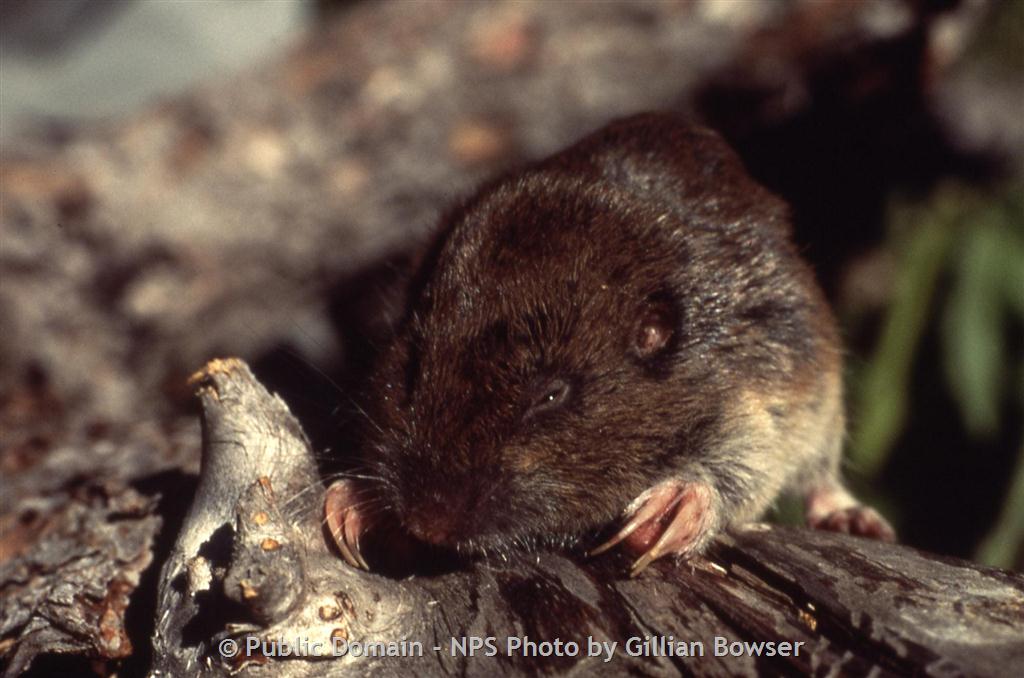
Northern Pocket Gopher, Thomomys talpoides. Courtesy NPS, Gillian Bowser, Photographer
Northern Pocket Gopher
Thomomys talpoides
Courtesy NPS
Gillian Bowser, Photographer

Click for a larger view of Pocket Gopher Surface Mound with Open Entrance Hole. Courtesy Lyle Bingham, Photographer Pocket Gopher Mound
with open entrance hole
Courtesy
Lyle Bingham, Photographer

While hiking mountains meadows in spring, you will likely encounter earthen tubes that meander across the soil surface. These are remnants of the winter tunnels of pocket gophers. Often called ropes, these dirt cores result from pocket gophers burrowing for food all winter long. They dig under the snow, backfilling their tunnels with dirt. Another surface clue to pocket gophers’ presence are the hills of soil that they push to the surface. The tunnel opening in the hill is closed with an earthen plug.

Pocket gophers are superbly adapted for their subterranean lifestyle. Their eyes and ears are tiny. In compensation for poor eyesight, they have long whiskers or vibrissae on their snout. The vibrissae are very sensitive to touch and allow them to navigate in their dark tunnels. In reverse, they rely on their stubby, hairless tails to guide them as they run backwards.

These little rodents have formidable tools for digging. Their front claws are long and stout and powered by impressive shoulder muscles. As with all rodents, the incisor teeth grow constantly, offsetting the abrasion of biting through hard soil and roots. Cleverly, the lips close behind their front teeth which keeps their mouth clean of dirt. These gophers really do have pockets: fur-lined cheek pouches which they use to carry food to the storage areas of their burrows.

Pocket gophers are vegetarians, eating roots and bulbs below ground and stems and leaves above. Their plant diet and tunneling cause many farmers and homeowners to consider them a terrible nuisance, but pocket gophers also contribute to a healthy ecosystem. One pocket gopher will move up to 4 tons of soil each year, alleviating soil compaction. They bring fresh mineral soil to the surface and fertilize belowground with their droppings and leftover stashes of vegetation. Their tunnels provide habitat for other animals that live underground. Many mammals, birds and snakes dine on pocket gophers.

If you find a gopher mound, try watching quietly. If you are really lucky, as our Wild About Utah web guru, Lyle Bingham was, you may see one pop its little head out for a quick look around.

Credits:

Images: Courtesy NPS, Gillian Bowser, Photographer
Theme: Courtesy & Copyright Don Anderson Leaping Lulu
Text: Linda Kervin, Bridgerland Audubon Society https://www.bridgerlandaudubon.org
Video:

Additional Reading:

Pocket Gophers – About Exploring the Nature of Wyoming
University of Wyoming Extension

Northern Pocket Gopher — Thomomys talpoides. Montana Field Guide. Montana Natural Heritage Program and Montana Fish, Wildlife and Parks. Retrieved on April 30, 2013, from https://fieldguide.mt.gov/detail_AMAFC01040.aspx

About Exploring the Nature of Wyoming, University of Wyoming Extension, https://www.youtube.com/watch?v=frfxuO6oYkA

Wiscomb, Gerald W., Messmer,Terry A., Pocket Gophers, Wildlife Damage Management Series, Utah State University Cooperative Extension, https://extension.usu.edu/files/publications/publication/NR_WD_005.pdf

Pocket Gophers, Identification, School IDM, Utah Pests, Utah State University Cooperative Extension, https://extension.usu.edu/pests/schoolipm/structural-pest-id-guide/pocket-gophers

On Being Misunderstood:: Pocket Gophers, The Metropolitan Field Guide, https://www.metrofieldguide.com/on-being-misunderstood-pocket-gophers/

Pocket Gophers, Living with Wildlife, Washington Department of Fish & Wildlife, Washington State, https://wdfw.wa.gov/species-habitats/living/species-facts/pocket-gophers

Why Some Birds Flock in the Vee Formation

Why Some Birds Flock in the Vee Formation: Canada Geese Flying in a V Formation. Courtesy & Copyright, Brenda Bott, Photographer
Canada Geese Flying in
a V Formation
Courtesy & Copyright © Brenda Bott, Photographer
Spring is that magical season when avian migrants return north from more balmy climates. Utah’s migrants range from ponderous pelicans to tiny hummingbirds, honking geese to crying curlews. Many arrive as they departed, in flocks.Why Some Birds Flock in the Vee Formation

Kevin Colver: Songbirds of Yellowstone, Canada Goose)

But why fly in a flock at all? One reason is predator evasion, the same reason that minnows school and elk, bison and deer bunch in herds. Embedded in a swirling mass of birds called a swarm flock, an individual bird is less likely to be picked off by an aerial predator, such as a falcon or a Cooper’s Hawk. A raptor diving into a swarm flock risks collision and injury. Targeting a bird in a swirling group is visually difficult too. Flying in a flock gains safety, but at what cost? Pigeons flying in a swarm flock take shallower, more frequent wing strokes than a solo bird. Faster wing beats probably provide more control to better negotiate turbulent aerial traffic, but extra flapping costs more in energy.

In contrast, pelicans and other big birds often fly in tidy formation flocks. Flying in a vee formation, a trailing pelican’s heart beats 13% slower than the lead bird. That’s because a trailing pelican flaps less than the leader. Unlike pigeons, then, a pelican flying in a formation flock uses less energy, not more. Big birds with slow wing beats share aerodynamic attributes with airplanes. Some of the air under their wings swirls out from under the tips, creating a spiraling vortex that trails the wing tip. Flying in a tight vee formation, each trailing bird gets a bit of lift from the upwash created by that vortex, and so it can flap a little less and glide a little more. Lead birds tire more quickly, so leaders change periodically. Leaders lose their zip, not their way. In a vee, birds also have their flock mates in good view, which is needed for the tight precision of a formation flock.

(Kevin Colver: Songbirds of Yellowstone, Sandhill Crane)

Pelicans, swans, geese, cranes, ibis, ducks, godwits, they all ply the Utah sky in formation flocks. They may be bird-brained, but our bigger migrants know a thing or two about aerodynamics.

Credits:
Images: Courtesy & Copyright Brenda Bott, Photographer
Text: Jim Cane, Bridgerland Audubon Society https://www.bridgerlandaudubon.org

Video:

Spectacular flock (called a “murmuration”) of starlings, Sophie Windsor Clive & Liberty Smith, https://www.youtube.com/watch?v=iRNqhi2ka9k As viewed from Islandsandrivers.com. Contains advertisements.

Van Ijken, Jan, Flight of the Starlings, National Geographic, Nov 15, 2016, https://youtu.be/V4f_1_r80RY
See also https://www.janvanijken.com/film-projects/the-art-of-flying/theartofflyingfullversion/

Additional Reading:

Avian flight by John J. Videler. 2005. New York, Oxford University Press. 258 pp.
Contents:

  • Acquisition of knowledge
  • The flight apparatus
  • Feathers for flight
  • Aerodynamics
  • Evolution of bird flight
  • Bird flight modes
  • The bird flight engine
  • Energy required for flight
  • Comparing the metabolic costs of flight

Usherwood JR, Stavrou M, Lowe JC, Roskilly K, Wilson AM. 2011. Flying in a flock comes at a cost in pigeons. Nature. 2011 Jun 22;474(7352):494-7. https://www.researchgate.net/publication/51242928_Flying_in_a_flock_comes_at_a_cost_in_pigeons

Weimerskirch H; Martin J; Clerquin Y; Alexandre P; Jiraskova S. 2001. Energy saving in flight formation. Nature. 413: 697-698. https://eol.org/data_objects/16885552

Dark-eyed Juncos

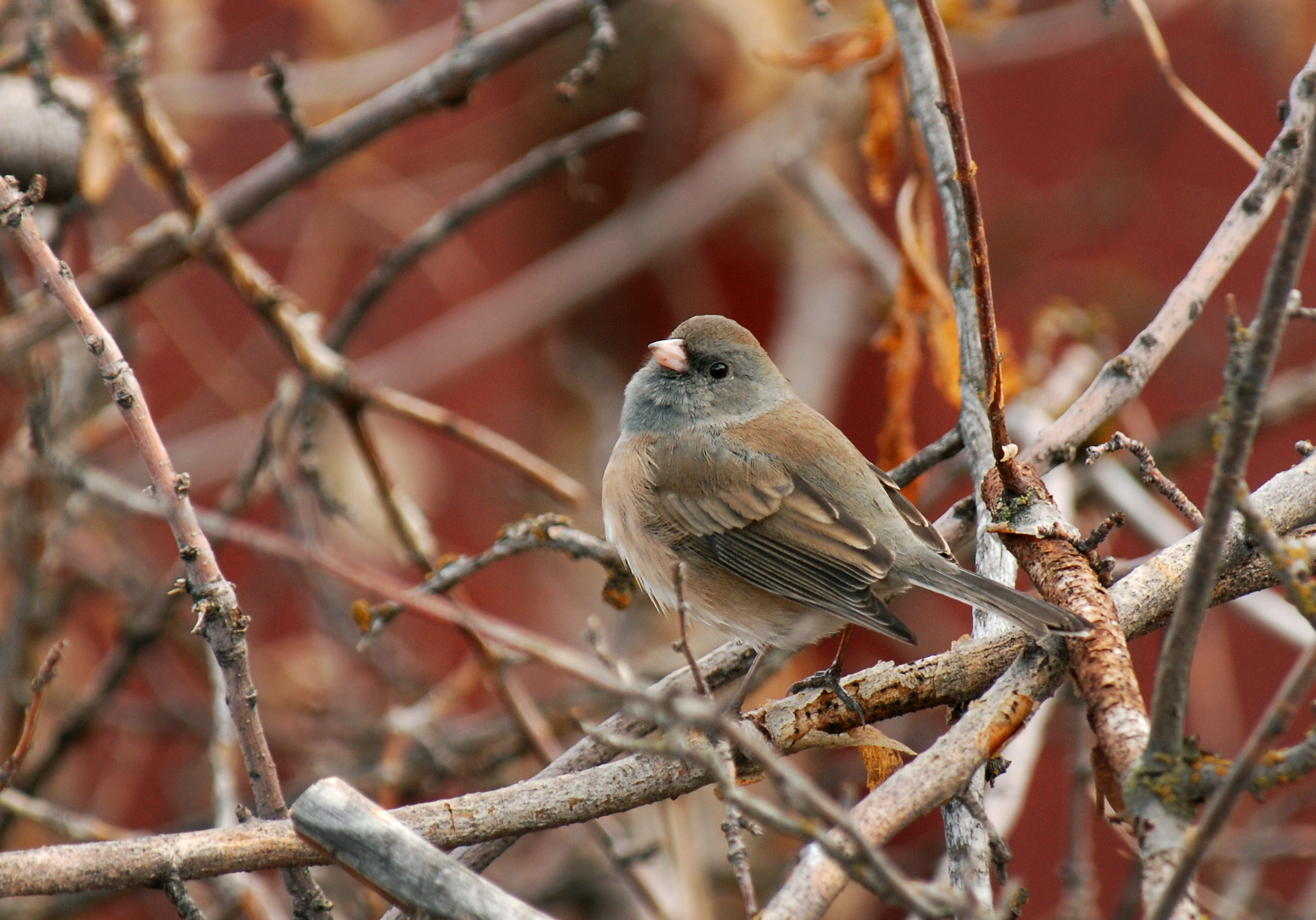
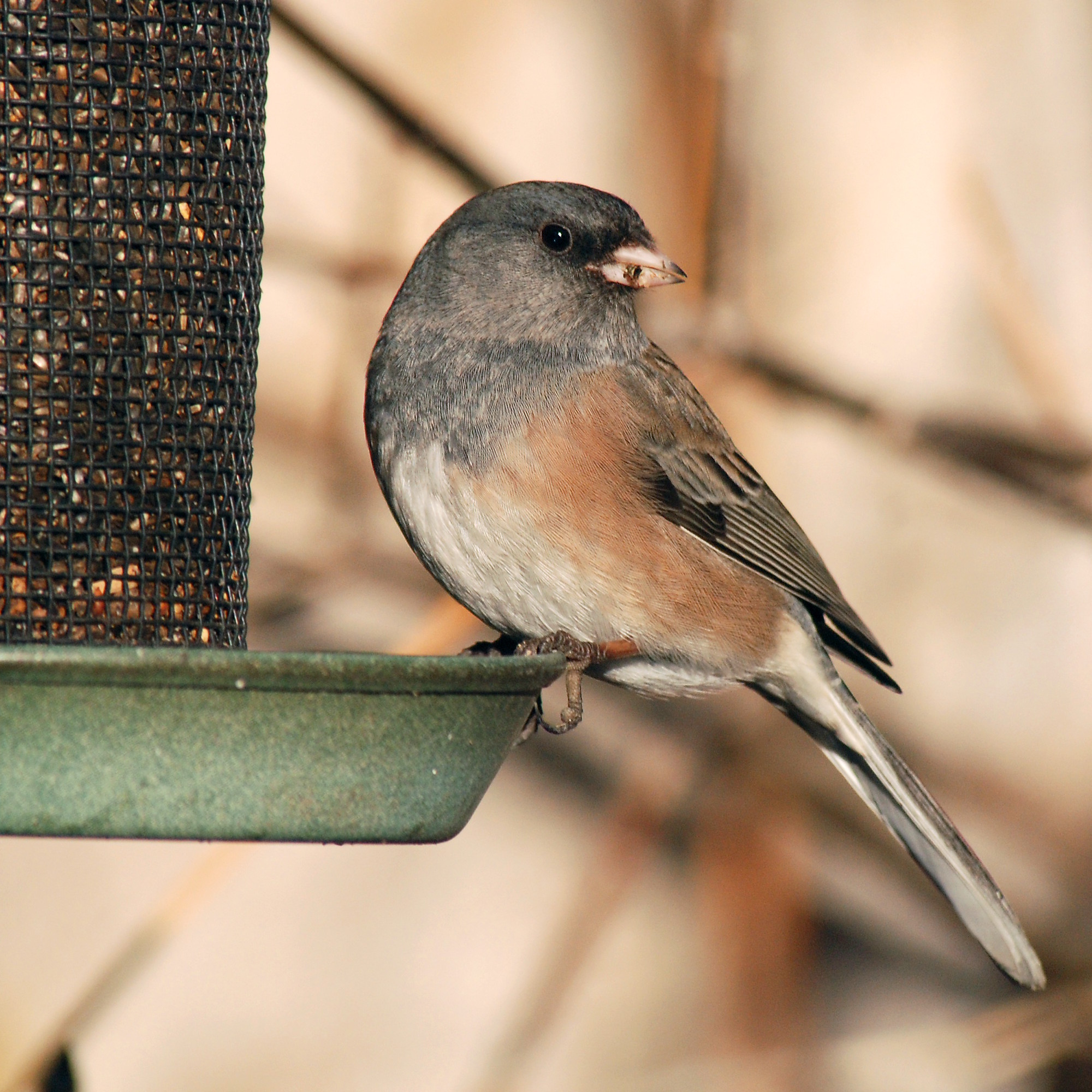
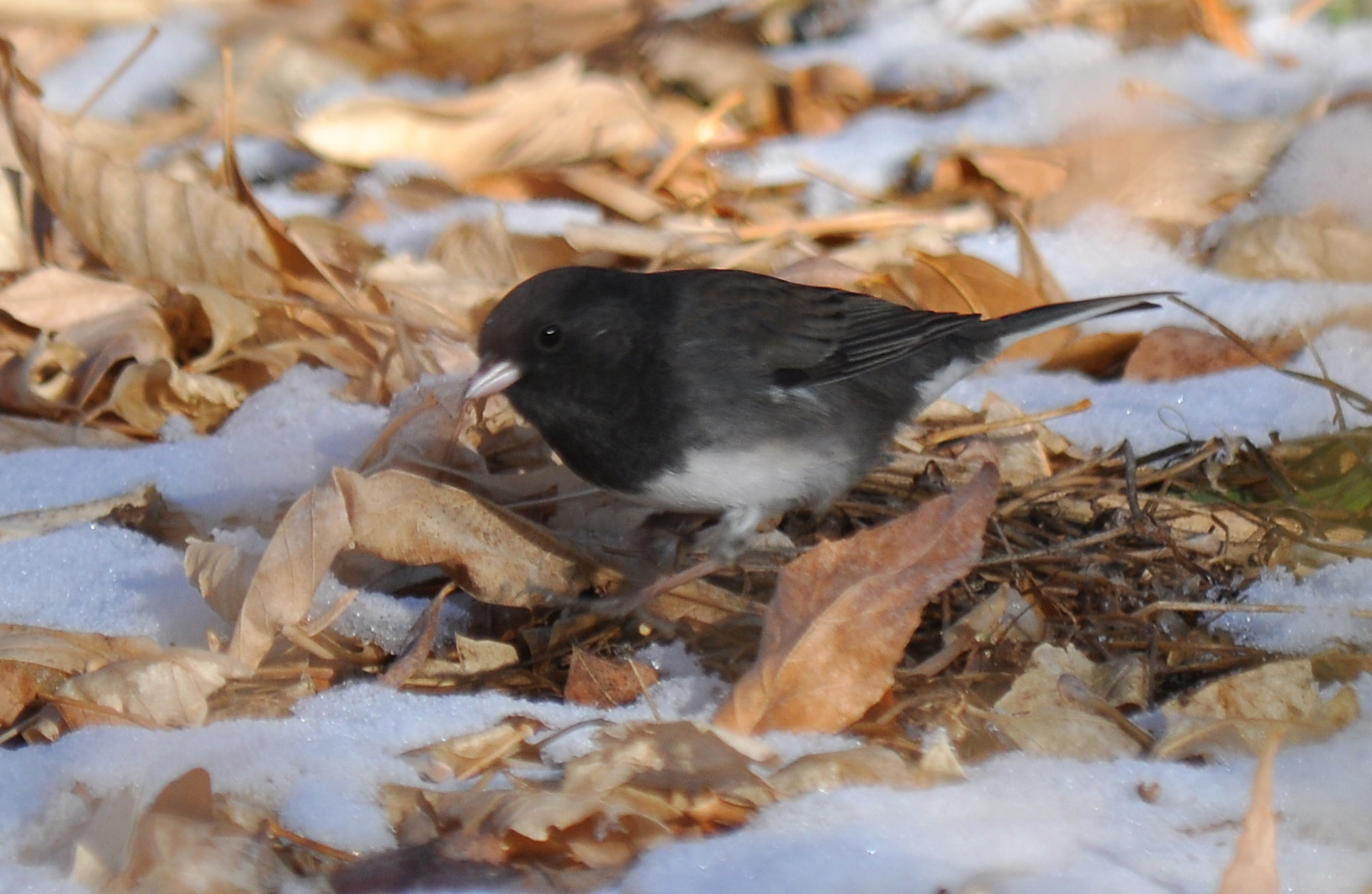
Click for a larger view of a Dark-eyed 'Oregon' Junco Male, Junco hyemalis montanus, Courtesy and copyright 2008 Ryan P. O'Donnell
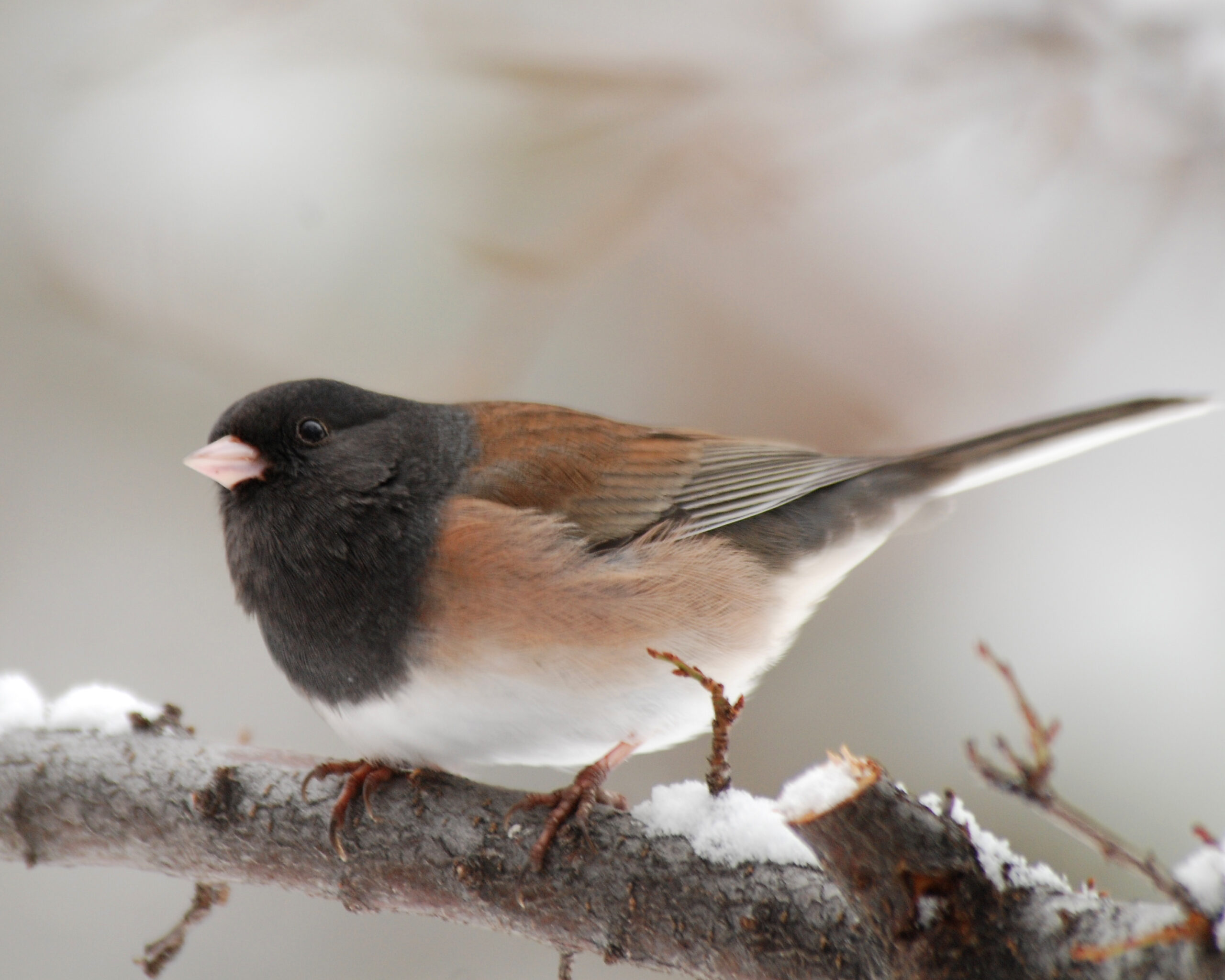
Dark-eyed Junco “Oregon” Male
Junco hyemalis montanus
Courtesy & © 2008 Ryan P. O’Donnell, Photographer 

Click for a larger view of a Dark-eyed 'Oregon' Junco Female, Junco hyemalis montanus, Courtesy and copyright 2011 Ryan P. O'DonnellDark-eyed Junco “Oregon” Female
Junco hyemalis montanus
Courtesy & © 2011 Ryan P. O’Donnell, Photographer 

Click for a larger view of a Dark-eyed 'Pink Sided' Junco, Junco hyemalis mearnsi, Courtesy and copyright 2011 Ryan P. O'DonnellDark-eyed Junco “Pink Sided”
Junco hyemalis mearnsi
Courtesy & © 2011 Ryan P. O’Donnell, Photographer 

Click for a larger view of a Dark-eyed 'Cassiar' Junco, Junco hyemalis cismontanus, Courtesy and copyright 2011 Ryan P. O'DonnellDark-eyed Junco “Cassiar”
Junco hyemalis cismontanus
Courtesy & © 2011 Ryan P. O’Donnell, Photographer 

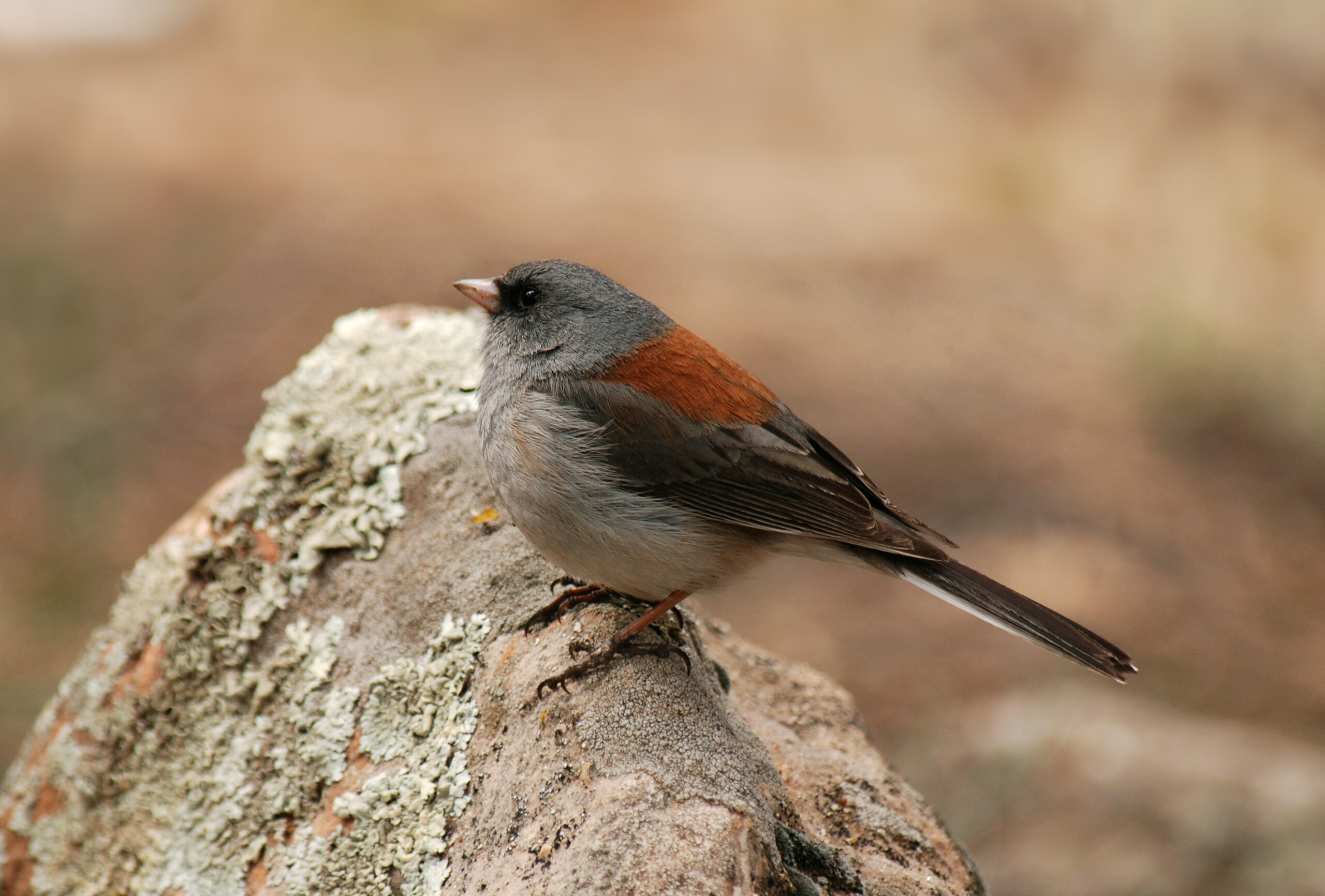
Click for a larger view of a Dark-eyed 'Gray-headed' Junco, Junco hyemalis caniceps, Courtesy and copyright 2011 Ryan P. O'DonnellDark-eyed Junco “Gray-headed”
Junco hyemalis caniceps
Courtesy & © 2011 Ryan P. O’Donnell, Photographer 

My backyard bird feeders are a busy place this time of year. I enjoy keeping track of who visits – especially as a relative newcomer to the Utah bird scene. Last winter, however, I was baffled by the identity of what turned out to be a fairly ordinary bird.

Dark-eyed juncos are a common sight throughout the United States, but as it turns out, they exhibit an incredible geographic variation in plumage colors. There is a ‘slate-colored race’ which I was used to seeing in the Midwest – uniformly gray above with a white underbody. During Utah winters, the ‘Oregon race’ is common, with its black hood, brown back and peachy sides. Another ‘gray-headed race’ sports varying shades of gray with a distinct reddish brown patch on its back.

Depending on who you ask, there are up to fifteen different races, also called sub-species, of dark-eyed junco – all quite visually distinct, but all considered to be the same species. It wasn’t always this way, however. In the late 1950’s what we now call dark-eyed juncos were recognized as four different species, and in the 1890’s there were six.

These changes beg the question, at what point does speciation occur? And the answer lies in the ability of these birds to interbreed. One scientific definition of a species is those organisms or populations of organisms that are “potentially capable of interbreeding.”

Unique plumage patterns have evolved in a number of geographic locations across the junco’s range, however all of the dark-eyed junco variants could potentially interbreed if they happened to meet. Indeed in places where these geographic territories overlap inter-breeding does take place resulting in blends of the usually-distinct color patterns.

Juncos aren’t the only bird species with recognized color variants. Any raptor enthusiast will be familiar with variations in plumage colors that many birds of prey exhibit, such as merlins and red-tailed hawks. What makes dark-eyed juncos unique is that they are being studied as a possible case of speciation in progress. It turns out that there is more than just a difference in color among dark-eyed juncos. Some sub-species also exhibit variation in song patterns, social behavior, body size, and migration patterns, any of which may eventually cause these groups to stop interbreeding and allow a new species to emerge.

To see pictures of dark-eyed junco subspecies, visit our website at www.wildaboututah.org. Thank you to Rocky Mountain Power Foundation for supporting the research and development of this Wild About Utah topic.

For the Stokes Nature Center and Wild About Utah, this is Andrea Liberatore.

Credits:

Photos: Courtesy & © Ryan P. O’Donnell
Theme: Courtesy & Copyright Don Anderson as performed by Leaping Lulu https://wildaboututah.org/about-us/#trout-n-berry-days
Voice & Text:    Andrea Liberatore, Stokes Nature Center, logannature.org
This episode was first published January 12, 2012.

Additional Reading:

The following references were accurate as of the date of publication or most recent update.

Atwell, J.W., O’Neal, D.M, and Ketterson, E.D. (2011) Animal Migration as a Moving Target for Conservation: Intra-species Variation and Responses to Environmental Change, as Illustrated in a Sometimes Migratory Songbird. Environmental Law. Vol. 41:289 p. 289-319, formerly at: https://www.amazon.com/Animal-migration-moving-target-conservation/dp/B005C29H7I
PubMed Central, National Library of Medicine, https://pmc.ncbi.nlm.nih.gov/articles/PMC5637735/

Alderfer, Jonathan (editor) (2005) National Geographic Complete Book of Birds. National Geographic Press. Dark-eyed junco information available online at: https://animals.nationalgeographic.com/animals/birding/dark-eyed-junco/

Cornell Lab of Ornithology, All About Birds: Dark-eyed Junco. https://www.allaboutbirds.org/guide/Dark-eyed_Junco/id/ac

History of Name Changes for Juncos. Cornell Lab of Ornithology. formerly at: https://www.birds.cornell.edu/pfw/News/junco_taxonomy.pdf
Updated by Cornell Lab of Ornithology to be at https://www.feederwatch.org/wp-content/uploads/2013/09/junco_taxonomy.pdf

Til Death Do Us Part

Audio:  mp3 Listen to WildAboutUtah

Tundra Swan Pair
Cygnus columbianus
Courtesy US FWS
Tim Bowman, Photographer

Hi, I’m Holly Strand.

Each year we celebrate Valentine’s Day by expressing our love and devotion to a significant other. While humans are the only species that actually celebrate it, we aren’t the only animals who bond together as couples. Monogamy–or long term pair bonding as animal behaviorists call it–is practiced by over 90 % of birds. Along with a modest number of mammals, including wolves, beavers, voles and gibbons. Even a few fish pair up.

Monogamy may have evolved for different reasons among different groups of animals. For some, female dispersal may have played a role. If females are few and far between–as is the case with white tail ptarmigans–there is a tendency to pair up. Perhaps additional potential mates are too far away too bother. For males, monogamy can save a lot of time and energy. Monogamous males don’t have to fight over females or bother with first time courtship rituals. And by closely guarding a single female , males can protect their genetic investment.

There are advantages for females too. With a mate, you can get a little assistance around the nest or den. Male partners can help incubate eggs, guard against predators and help feed the kids. The fact that male and females are equally suited to care for chicks may explain why monogamy is so much more common among birds. The male improves his chances for reproductive success by investing in just one female’s little ones. The situation is different in mammals. Mammal males just can’t step in and help as much with gestation and lactation. So perhaps that’s why only 3% of mammal species form pair bonds.

The offspring of monogamous pairs tend to be pretty helpless at birth. Having two caregivers means that the you can take more time to mature. This long, slow development leads to larger brain sizes. Humans demonstrate this phenomenon very well as we parent our children longer than any other species on earth!

The tundra swan is Utah’s best example of monogamy in the wild. Young tundra swans date around a bit when they are young, but they eventually settle down with a single mate for life. They build and defend a nest together and raise the kids. But then they stick together the rest of the year as well. Greetings and courtship rituals such as head bobbing and dipping and ritual bathing strengthen their commitment toward each other.

You can see these beautiful swans in massive numbers twice a year when they migrate through Utah. Tens of thousands of them stop by the Great Salt Lake on their way to either the Arctic tundra or to central California.

For sources, pictures, and archives of past programs, go to www.wildaboututah.org

For Wild About Utah, I’m Holly Strand.

Credits:

Image: Courtesy US FWS, images.fws.gov
Text: Holly Strand

Sources & Additional Reading

Limpert, R. J. and S. L. Earnst. 1994. Tundra Swan (Cygnus columbianus), The Birds of North America Online (A. Poole, Ed.). Ithaca: Cornell Lab of Ornithology; Retrieved from the Birds of North America Online: https://bna.birds.cornell.edu/bna/species/089

Mocka, Douglas, and Masahiro Fujiokab. 1990. “Monogamy and long-term pair bonding in vertebrates” Trends in Ecology & Evolution. Volume 5, Issue 2, February 1990, Pages 39–43

Reichard, Ulrich and Christoph Boesch. 2003. Monogramy: mating Strategies and Partnerships in Birds, Humans and Other Mammals. Cambridge University Press.

Schultz, Susanne and Robin I.M. Dunbar. 2010. “Bondedness and sociality”
Behaviour, Volume 147, Number 7, 2010 , pp. 775-803(29).

Schultz, Susanne and Robin I.M. Dunbar. 2010. Social bonds in birds are associated with brain size and contingent on the correlated evolution of life-history and increased parental investment. Biological Journal of the Linnean Society. Volume 100, Issue 1, pages 111–123, May 2010.