Bat Netting within Antelope Island State Park

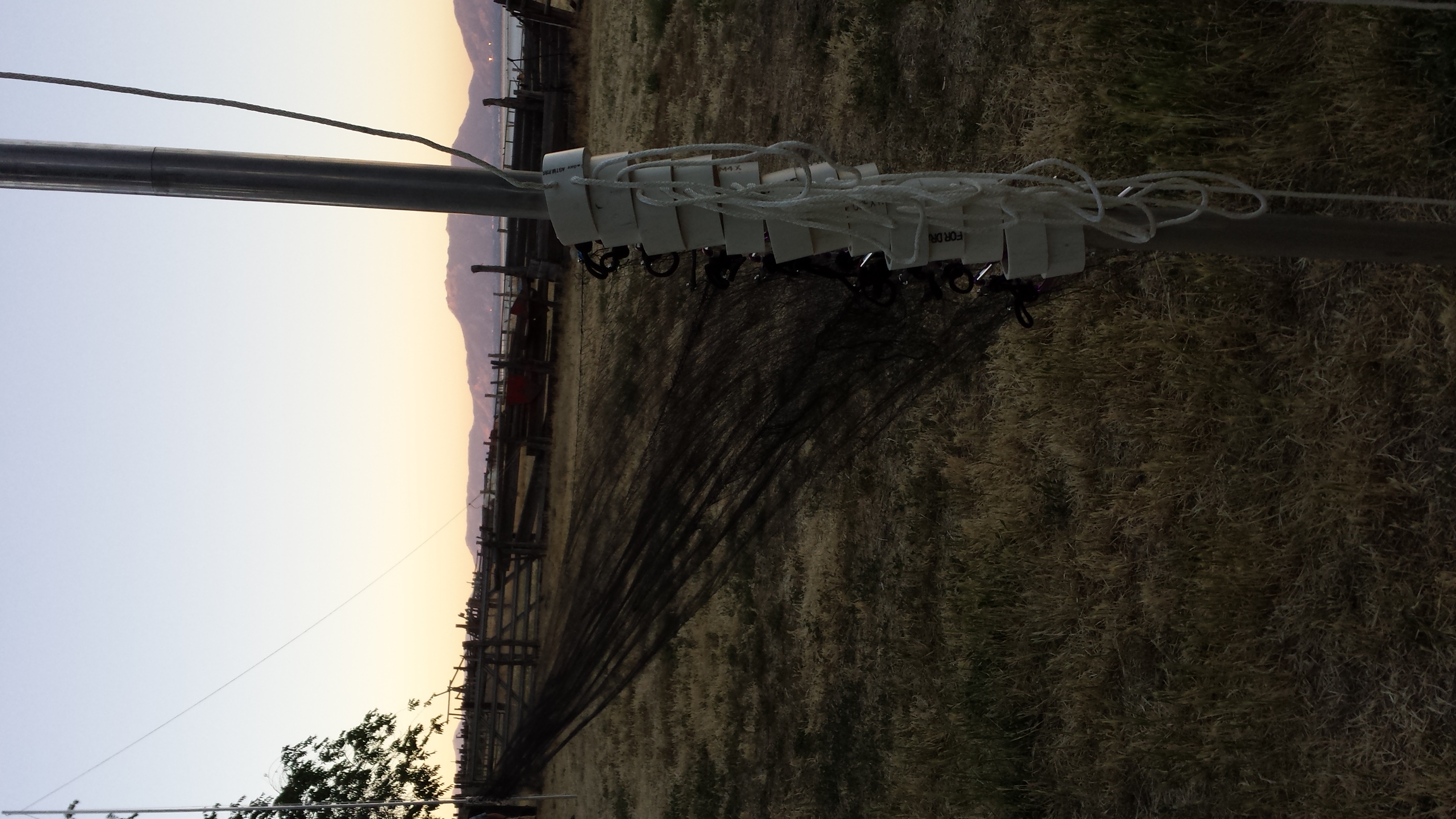
Bat netting on Antelope Island: After the sun sets, fine mist nets are raised high into the air to capture passing bats. Courtesy and © Jessie Bunkley, Photographer
After the sun sets, fine mist nets are raised high into the air to capture passing bats.
Courtesy and © Jessie Bunkley, Photographer

[Sounds of a bat echolocating]

Jessie Bunkley – The sound you are hearing is a bat echolocating through the darkness of the night. Bats use sound to detect their surroundings. They produce frequencies that are much higher than what we’re able to hear and as those sound waves hit objects in front of them and reflect off the bats interpret the echoes to sense their environment. What you’re hearing is a bat detector that has taken these high frequency sounds and cut them down to a level that we can hear.

Adam Brewerton – I’m Adam Brewerton. I’m the wildlife conservation biologist for the Northern Region with the Division of Wildlife Resources.

Jessie – And I’m Jessie Bunkley. I’m a wildlife technician with UDWR.

Bat netting on Antelope Island: Large ears and prominent nose glands are conspicuous features of this appropriately name Townsend’s big-eared bat. Her thumbs are also visible as she holds them in front of her face. Courtesy and © Jessie Bunkley, Photographer
Large ears and prominent nose glands are conspicuous features of this appropriately name Townsend’s big-eared bat. Her thumbs are also visible as she holds them in front of her face.
Courtesy and © Jessie Bunkley, Photographer

Adam – And our bat survey tonight out at Antelope Island we’ve been pretty successful so far. We’ve caught a little brown bat and we’ve caught seven Townsend’s big-eared bats. It’s part of the statewide species distribution and occupancy study and we’ve got several survey locations that have been randomly selected out of a grid system. So Antelope Island is just one of those randomly selected sites. In addition to that it’s also close and convenient for people to come out and learn about bats so that’s why we’ve invited [the] public to come out and join us tonight.

Jessie – To capture the bats we’ve set up several mist nets, which are very long, fine nets. We have stacked the nets two or three nets high and we use a pulley system to raise and lower them.

Adam – They fly into the net and they get caught and tangled. We go get the bats out as gently as we can and we come back for the measuring and weighing and identifying. It helps us to track relative species occurrence throughout the state. So being able to say that the species is doing well or declining or increasing. We can really only say that based off of how frequently we catch it in different places relative to other species.

[Bats echolocating and squeaking in the background]

Bat netting on Antelope Island: A Townsend’s big-eared bat (Corynorhinus townsendii) is carefully untangled from a mist net. Courtesy and © Jessie Bunkley, Photographer
A Townsend’s big-eared bat (Corynorhinus townsendii) is carefully untangled from a mist net.
Courtesy and © Jessie Bunkley, Photographer

Jessie – Bats are the second most diverse group of mammals, right behind rodents. There are over twelve hundred species of known bats throughout the world and this represents about twenty percent of all mammals. In Utah we have eighteen species that regularly occur in the state.

Adam – The wing membranes connect all their fingers together so their hand is shaped very much like ours, their thumb sticks up with a little claw hook on it, and then that membrane stretches between their finger digits. They’re cool because they’re interesting, they’re unique, they’re the only mammals that fly, they’re skeletal structure is totally different than other mammals, they echolocate, they’re intelligent, social, they live in a completely foreign world that we can’t really understand how they view the world through echolocation. What makes them interesting too is just so much that we don’t know and [there is] so much more to learn about them.

Jessie – For Wild About Utah that was Adam Brewerton and I’m Jessie Bunkley signing off from Antelope Island State Park.

Bat netting on Antelope Island: Adam Brewerton, the conservation biologist for the Utah Division of Wildlife Resources Northern region, holds a Townsend’s big-eared bat after taking measurements and examining her. Courtesy and © Jessie Bunkley, Photographer
Adam Brewerton, the conservation biologist for the Utah Division of Wildlife Resources Northern region, holds a Townsend’s big-eared bat after taking measurements and examining her.
Courtesy and © Jessie Bunkley, Photographer

Bats & Echolocation, Holly Strand, Wildaboututah, https://wildaboututah.org/bats-and-echolocation/

Bat Echolocation recordings from the Western Soundscape Library at the University of Utah Marriott Library,

Credits:
Images: Courtesy US FWS and USDA Forest Service
Text: Jessie Bunkley. Wildlife technician, Utah DWR/Jessie Bunkley, Graduate Teaching Assistant, BNR, Utah State University

Sources & Additional Reading

Bat Conservation International. 1997. Bat Chat: An Introduction to Echolocation
https://www.batcon.org/, https://www.batcon.org/resources/media-education/learning/bat-squad/bat-squad-ep-4-bat-chat-join-the-bat-squad

Wilson, Don E. 1997 Bats in Question: The Smithsonian Answer Book. Smithsonian Institution Press, Washington, DC https://www.amazon.com/Bats-Question-Smithsonian-Answer-Book/dp/1560987391

Bats Live, Prince William County Public Schools, Manassas, VA, https://batslive.pwnet.org/

Bat Week 2015
Sometimes misunderstood, bats are important and fascinating animals. Watch this video to learn some bat facts, find out what challenges are facing bats today and what you can do to help #savethebats.
Bat Week Video

Bats are Important/Fascinating, Bat Conservation International, Inc. 2016, https://www.batweek.org/index.php/about/bats-are-fascinating

13 Facts About Bats, US Department of the Interior, Blog, 10/24/2016, https://www.doi.gov/blog/13-facts-about-bats

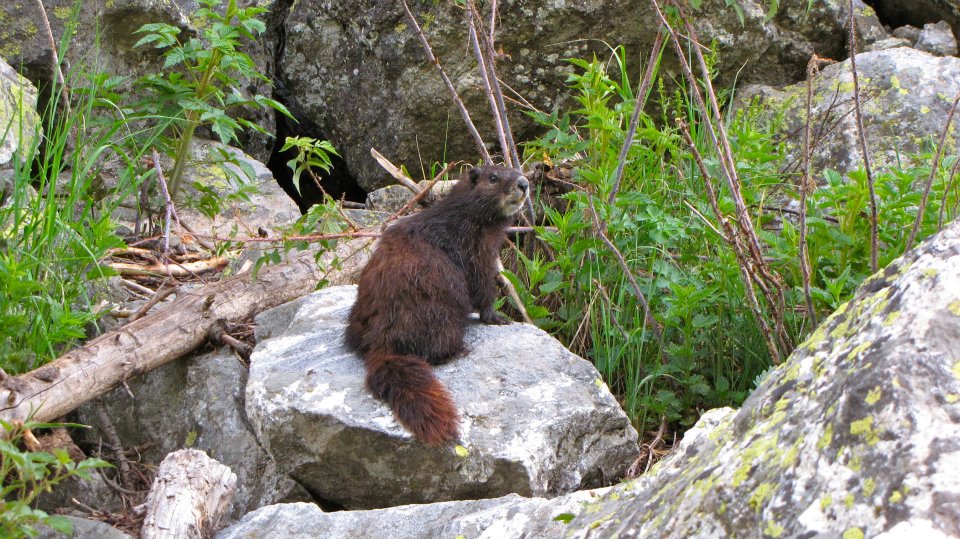
Yellow bellied Marmot

Yellow-bellied Marmots, Photo courtesy and copyright Roslynn Brain, Photographer
Yellow-bellied Marmots
Photo courtesy and copyright
Roslynn Brain, Photographer

Yellow-bellied Marmots, Photo courtesy and copyright Roslynn Brain, PhotographerYellow-bellied Marmots
Photo courtesy and copyright
Roslynn Brain, Photographer

Yellow-bellied Marmots, Photo courtesy and copyright Roslynn Brain, PhotographerYellow-bellied Marmots
Photo courtesy and copyright
Roslynn Brain, Photographer

Yellow-bellied Marmots, Photo courtesy and copyright Roslynn Brain PhotographerYellow-bellied Marmots
Photo courtesy and copyright
Roslynn Brain, Photographer

If you have explored the mountains of Utah, you’ve inevitably heard the iconic high-pitched chirp associated with Utah’s Yellow-Bellied Marmot.

Sporting chubby cheeks, large front teeth, a reddish-brown tail that spins like a helicopter rotor when fleeing, a greyish-brown back, white patch of fur between the eyes, and a yellow-orange belly, these sun-loving, flower-chewing mammals exude a Buddhist-type nature, especially when compared to their frantic neighbors, the pika.

Yellow-bellied marmots belong to the mammalian order Rodentia, in the squirrel family Scirudae. This family includes all species of prairie dog, chipmunk, and the woodchuck. Marmots fall under the genus “marmota.” The scientific name of yellow-bellied marmots is “Marmota flaviventris.” Although the origin of the term marmota is not certain, one accepted interpretation stems from a similar Latin word meaning “mountain mouse.” Flaviventris means “yellow belly” in Latin.

There are 15 species of marmot worldwide, all in the northern hemisphere. Most live in mountainous areas such as the Alpine marmot found only in Europe, though some live in rough grasslands. Although commonly believed to be in the same genus, the prairie dog is not classified in the genus Marmota, but in the related genus Cynomys.

When alarmed, yellow-bellied marmots emit a shrill whistle which earned them the nickname “whistle pigs,” by early settlers. Sometimes they make a “chucking” sound, which could explain another nickname, “rock chuck.” Additional monikers for marmots include “whistlers”, “mountain marmots”, and “snow pigs.”

Yellow-bellied marmots live at average elevations of 6,000-13,000 feet throughout western North America. They are often found in highland meadows and steppes, and almost always near rocks. Burrows are usually constructed in areas with plentiful plants which comprise the marmot’s main diet: herbaceous grasses and forbs, flowers, legumes, grains, fruits, and insects. Marmots spend the summer months sunning on warm rocks and fattening up in preparation for winter hibernation which can last up to 8 months.Thus, they are especially plump in the fall, right before hibernation, and reach weights of around 8-11 pounds. They may also estivate in June in response to dry conditions and a lack of green vegetation, only to reappear later in the summer when food is once again plentiful.

The typical social structure of yellow-bellied marmots includes a single male with a range of one up to four females. Males are territorial and aggressively protect their harem from other male marmots and smaller predators such as the ermine. Other predators to the yellow-bellied marmot include coyotes, foxes, badgers, bears, and eagles. Females raise their annual offspring of 3-8 jointly with other females within the harem. Baby marmots or pups are born relatively undeveloped and require large amounts of care until they emerge from the nest three weeks later. Only about half of marmot pups survive and become yearlings. If they make it through the first year, marmots may live up to 15 years of age.

Given that they spend about 80% of their life in a borrow, 60% of which is in hibernation, consider yourself lucky the next time you encounter a chubby, sun-bathing, whistling marmot!

For Utah State University Extension Sustainability, this is Roslynn Brain.

Credits:
Images: Courtesy and copyright Roslynn Brain, Photographer
Text:     Roslynn Brain, Utah State University Extension Sustainability


Additional Reading:

Yellow-bellied Marmot, Species, Utah Division of Wildlife Resources, Utah Department of Natural Resources, https://fieldguide.wildlife.utah.gov/?species=marmota%20flaviventris

Marmot Burrow, UCLA, Daniel Blumstein, https://www.marmotburrow.ucla.edu/watching.html

Marmot, Rocky Mountain National Park, https://www.nps.gov/romo/learn/nature/marmot.htm

Yellow-bellied Marmot (Rockchuck), Deseret News, 14 Mar, 1998,
https://www.deseretnews.com/article/629775/Yellow-bellied-Marmot-Rockchuck.html

Desert Tortoise Research in the Red Cliff Desert Reserve

Desert Tortoise Research in the Red Cliff Desert Reserve: Ann walks a transect looking for desert tortoises in the Red Cliffs Desert Reserve in southwestern Utah. Courtesy & Copyright Jessie Bunkley, Photographer
Ann walks a transect looking for desert tortoises in the Red Cliffs Desert Reserve in southwestern Utah. Courtesy & Copyright Jessie Bunkley, Photographer

Desert Tortoise Research in the Red Cliff Desert Reserve: Ann McLuckie, a wildlife biologist with the Utah Division of Wildlife Resources, uses a mirror to direct sunlight into the depths of a desert tortoise burrow. Courtesy & Copyright Jessie Bunkley, Photographer Ann McLuckie, a wildlife biologist with the Utah Division of Wildlife Resources, uses a mirror to direct sunlight into the depths of a desert tortoise burrow. Courtesy & Copyright Jessie Bunkley, Photographer

Click for a larger view of an adult Desert Tortoise. Courtesy & Copyright 2009 Kevin Durso, Photographer Adult Desert Tortoise
Gopherus agassizii
Courtesy & Copyright 2009
Kevin Durso, Photographer

Hi, I’m Ann McLuckie and I work with the Division of Wildlife Resources working primarily on desert tortoises within the Red Cliff Desert Reserve. (Sound of walking in the background) We’re going out in the field today and we’re going to do a transect. We’ve done transects since 1997 and our ultimate goal is to estimate population densities and those densities will allow us to look at how tortoises are doing and then if we get densities over time we can see are the populations increasing, decreasing, or are they stable. What we’ve learned is that we have had some pretty dramatic events, such as wildfires in 2005 and a severe drought in 2002, that have impacted tortoise populations. So we’ve seen tortoises fairly stable until those two events and since we’ve actually had fairly stable populations, but at lower densities.

Oh – here’s a fresh tortoise scat! So where there’s a fresh tortoise scat there’s got to be a tortoise close by. (Sound of walking) Oh, I think I see a tortoise. I think it’s in a burrow. I’m going to get the mirror (sound of Ann setting down her backpack and unzipping it). Oh yep, there it is and I think we can get it because it’s right by the edge. Let’s see I’m going to crawl into the burrow here. Let me get my gloves (sound of gloves being removed from a plastic bag and rocks scraping). Ok there, I think I’ve got it.

So when we get a tortoise we take three measurements, two width measurements and one length measurement called the carapace length. The carapace is the upper shell of the tortoise and it gives us an idea of how old the tortoise is. So I’ll measure the tortoise. Ok. (Sound of calipers on the tortoise shell). Oh, this looks like an adult tortoise. Let see, let me sex it. The tortoise shell is made of the carapace, which is the upper shell, and then the plastron, which is the lower shell or the belly of the shell basically, and the gular is the bony plates that are under the chin. So males have a concave plastron and that allows it to mate with females so it can fit over the female shell and males also have a large gular.

We give each tortoise that we encounter a unique file number. On the edge of the carapace are what we call marginal scutes and those are just smaller sections of the shell and each of those marginal scutes is assigned a number. Whatever marginal scutes we file we add up those scutes and that gives that tortoise a unique number. So the number that this tortoise that we’re filing right now is going to have, let’s see, (sounds of flipping through datasheets) it’s going to have 3096, so that will be its number. (Sounds of filing the scutes). Ok, I think that’s about it. And we have encountered tortoises that have been previously filed and we have a whole database of those tortoises so we can just go back to our database and figure out when that tortoise was first encountered, where it was first encountered, and get to know a little bit about that tortoise.

I’m Ann McLuckie in the Red Cliff Desert Reserve signing off on Wild About Utah.

Credits:
Images: Courtesy & Copyright Jessie Bunkley
Text: Jessie Bunkley. Wildlife technician, Utah DWR/Graduate Teaching Assistant, BNR, Utah State University with assistance from Ann McLuckie, Utah Division of Wildlife Resources

Sources & Additional Reading

Red Cliffs Desert Reserve, https://www.redcliffsdesertreserve.com

Desert tortoise monitoring plan, Red Cliff Desert Reserve, Washington County, Utah (Publication / Utah Division of Wildlife Resources), Richard Fridell, 1998, https://www.amazon.com/tortoise-monitoring-Washington-Publication-Resources/dp/B0006R3LYO

World Turtle Database, EMYSystem Species Page: Gopherus agassizii, https://emys.geo.orst.edu/ (Search for “Desert Tortoise”)

Grover, Mark C., DeFalco, Lesley A, Desert Tortoise(Gopherus agassizii): Status-of-Knowledge, Outline With References, USDA, 1995, https://www.fs.fed.us/rm/pubs_int/int_gtr316.pdf

Desert Tortoise, Gopherus agassizii, Mojave National Preserve, https://www.mojavenp.org/Gopherus_agassizii.htm

Gopherus agassizii (COOPER, 1861), The Reptile Database, Peter Uetz and Jakob Hallermann, Zoological Museum Hamburg,
https://reptile-database.reptarium.cz/species?genus=Gopherus&species=agassizii

Desert Tortoise, Animal Species, Utah Division of Natural Resources, https://fieldguide.wildlife.utah.gov/?species=gopherus%20agassizii

Desert Tortoise Information and Collaboration, Mojave Desert Ecosystem Program, https://www.mojavedata.gov/deserttortoise_gov/index.html

Shrubby-Reed Mustard: The Best Little Plant You’ve Never Heard of (Aug 2016)

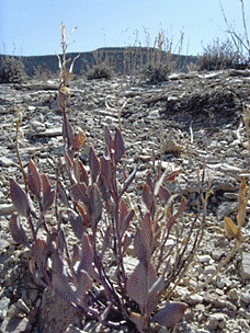
Shrubby-Reed Mustard Bush, Hesperidanthus suffrutescens
Shrubby-Reed Mustard Bush
Hesperidanthus suffrutescens
Courtesy & Copyright Matt Lewis

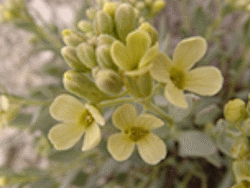
Shrubby-Reed Mustard Blossoms, Hesperidanthus suffrutescens Shrubby-Reed Mustard Blossoms
Hesperidanthus suffrutescens
Courtesy & Copyright Matt Lewis

Shrubby-Reed Mustard Blossoms Closeup, Hesperidanthus suffrutescens Shrubby-Reed Mustard Blossoms
Hesperidanthus suffrutescens
Courtesy & Copyright Matt Lewis

Tucked into isolated pockets of the Uintah Basin’s arid wildlands is the best little plant you’ve never heard of. Known to exist only in Duchesne and Uintah Counties, Shrubby-reed Mustard seems to occupy only the semi-barren “islands” of white shale in areas of the Green River Formation’s Evacuation Creek region. The endangered plant features thick, almost succulent, blue-green leaves and small yellow flowers.

“The habitat of Shrubby-reed Mustard is visually striking,” says USU alum Matt Lewis, a botanist with the Bureau of Land Management in Vernal, Utah. “It grows in very shallow, fine-textured soils and shale fragments that form narrow bands in the desert shrub community.”

Among the first plants to flower in spring, the perennial herb is visited by large number of insects, including many native bee species that forage for pollen. Scientists believe these bees may be critical in the plant’s reproduction and survival.

Lewis says the plant, also known as Toad-Flax Cress and Uintah Basin Waxfruit, offers an understated beauty to the stark landscape. With a shrub-like form and multiple stems, Shrubby-reed Mustard grows to about 20 centimeters in height. Its leaves, which feel almost like leather, change to a bright purple in the fall.

The plant is also enticingly fragrant, Lewis says. “Its scent reminds me of roses mixed with apples and pears.”

Despite its fragile status, Shrubby-reed Mustard is a long-lived plant. USU ecologist Geno Schupp says some individual plants may be one hundred years old.

The elusive species has outlived scientists’ attempts to classify it and has undergone several taxonomic changes. It currently boasts the scientific name Hesperidanthus suffrutescens, placing it solidly in the mustard family.

Lewis knows of no history of Shrubby-reed Mustard as a culinary or medicinal herb, though documented reports of such uses for mustard plants date back to ancient times. The plant appears to provide welcome forage for some four-legged creatures, he says, as he recently witnessed plants that had been grazed completely and ripped from the ground.

“Whether that was due to livestock or native ungulates, I’m not sure.”

Credits:
Images: Courtesy & Copyright Matt Lewis
Text:     Mary-Ann Muffoletto, Utah State University College of Natural Resources
Credits:
Matt Lewis, botanist, Bureau of Land Management, Vernal, Utah.
Eugene “Geno” Schupp, professor, USU Department of Wildland Resources.

Additional Reading:

https://www.fws.gov/mountain-prairie/factsheets/ShrubbyReed-mustardFactSheet.pdf

https://www.fws.gov/mountain-prairie/species/plants/shrubbyreedmustard/5YearReview2010.pdf