Nature Sings to Assuage Our COVID Fears

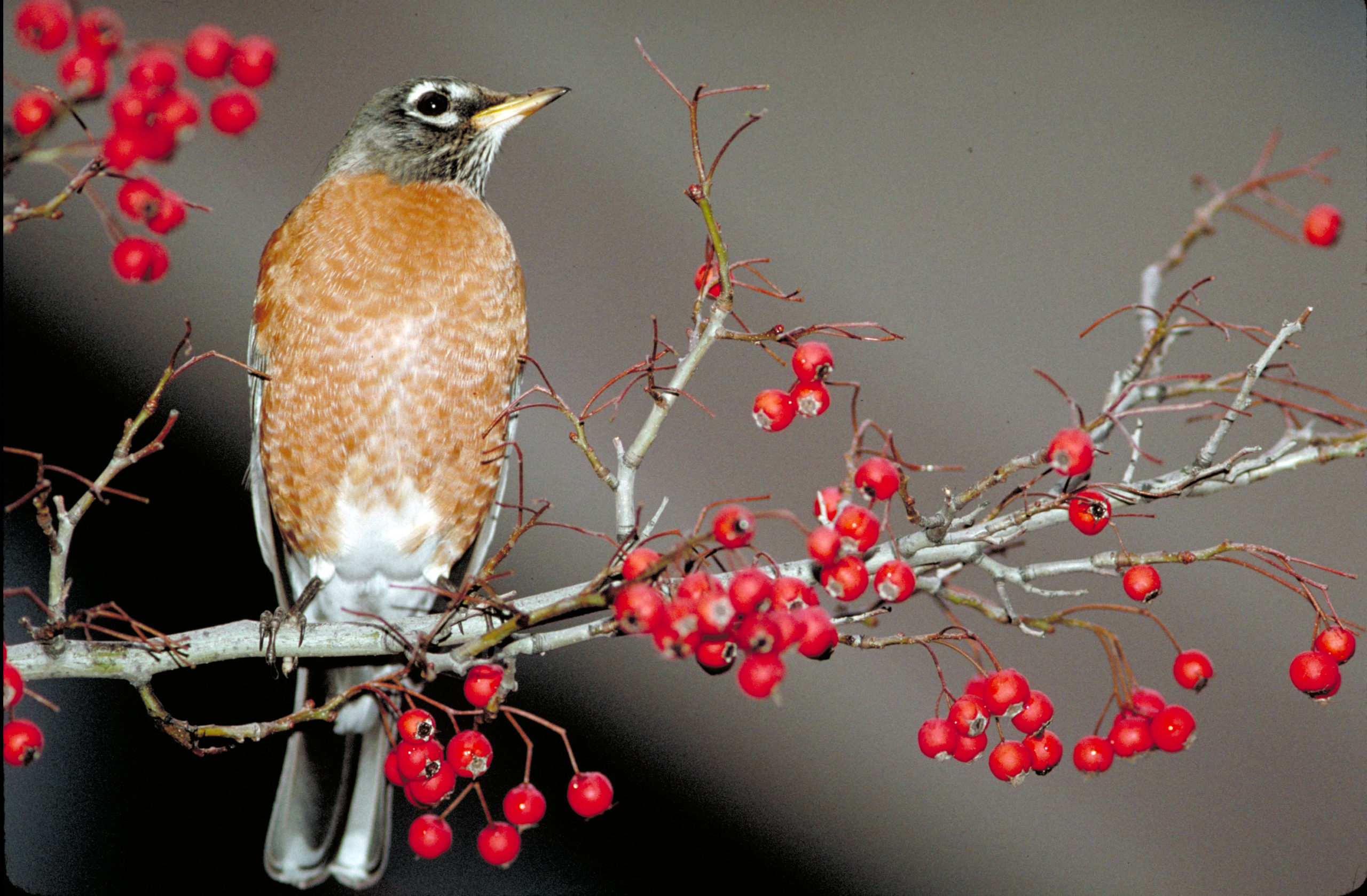
Nature sings: American Robin Turdus migratorius Courtesy US FWS Dr. Thomas G. Barnes, Photographer
American Robin
Turdus migratorius
Courtesy US FWS
Dr. Thomas G. Barnes, Photographer

Robins, house finch, and lesser goldfinch singing with gusto! Dippers on the stream blasting their melodious notes from watery perches on Summit Creek. An eastern blue jay bops out to wish me good morning in a nearby Park, its rarity always a treat, instantly teleporting me back to earlier days in Michigan. Meadowlarks reveal their hearts in song in fields below as I work my way up a canyon ridge. A fox sparrow with ear shattering song competes for “America’s Got Talent”.

On another outing, three individuals walking ahead of me pause to locate loud hammering high in a dead cottonwood. A flicker woodpecker- our largest and loveliest of the woodpecker family, beats his head against the tree hoping to attract a lady!

Totally unaware of COVID-19, which has inverted our human worlds, the bird world is right on schedule with their spring business of propagating more bird song.

Male House Finch Courtesy US FWS Gary Kramer, Photographer
Male House Finch
Courtesy US FWS
Gary Kramer, Photographer

Thank goodness, my usual escape into local Canyons has not been disrupted. Early spring plants are there to greet me- glacier lily, spring beauty, violet. Many more will emerge in coming weeks. Over 30 species will be blooming from now to early June accompanied by as many species of birds and butterflies.

We take a Sunday drive through our valley wetlands where abundant waterfowl rest and feed- pintails, mallards, gadwells, Northern shovelers, American widgeon, cinnamon teal, and the ever-present and magnificent Canada geese. A pair of Sandhill Cranes emerges which will be populating our valley by the hundreds as spring progresses. Many will remain to nest and raise their colts. 

Yes, these are tumultuous times- socially, economically, fear for our health. My usual spring activities have all but disappeared – travel, students, and direct contact with family members.

Lesser Goldfinch Courtesy US FWS Robert F Burton, Photographer
Lesser Goldfinch
Courtesy US FWS
Robert F Burton, Photographer

Spring is a transformation from winter’s death grip back to renewed life. This year I sense another transformation that gives me hope. Throngs of neighbors and others have invaded our canyons with kids, dogs, bikes, boards, horses, with joy in their hearts as they break free from COVOD’s bondage. Keeping the appropriate social distancing, their warm smiles and desire to chat reflect nature’s magic. Strangers become instantaneous friends. It’s reminiscent of my time in Europe where these outdoor activities are far more common. I sense a cultural shift.

Spring is here- my favorite season has returned filled with song, passion, Easter, and a rebirth of optimism- strong tonic for these difficult days. Our Earth Mother is being honored well before Earth Day!

Jack Greene for Brigerland Audubon and thank goodness for Utah Wilds!

Credits:

Pictures: Courtesy US FWS, Dr Thomas G Barnes, Gary Kramer, Robert F. Burton, photographers
Contains Sound: Courtesy Kevin Colver
Text: Jack Greene, Bridgerland Audubon Society | Utah State University Sustainability

Additional Reading:

American Robin, All About Birds, Cornell Lab of Ornithology, https://www.allaboutbirds.org/guide/American_Robin/id

House Finch, All About Birds, Cornell Lab of Ornithology, https://www.allaboutbirds.org/guide/House_Finch/id

Lesser Goldfinch, All About Birds, Cornell Lab of Ornithology, https://www.allaboutbirds.org/guide/Lesser_Goldfinch/id

Jack’s Nuthatches In Three Varieties

Jack's Nuthatches In Three Varieties: White-breasted nuthatch	 Sitta carolinensis Courtesy US FWS David Brenzinski, Photographer
White-breasted nuthatch
Sitta carolinensis
Courtesy US FWS
David Brenzinski, Photographer
Inverted woodpecker, a phrase I use to describe the feeding habits of the amazing nut hatch family. I first became aware of this lovely little songbird growing up in Michigan, where the white-breasted nut hatch was common fare in the north woods. Their little laughing notes were most welcome as I sat on my deer stand where I would watch them search bark crevices for yummy morsels of grubs, insect eggs or seeds they had wedged in for tomorrow’s snack.

Jack's Nuthatches In Three Varieties: Red Breasted Nuthatch Courtesy US FWS Dave Menke, Photographer
Red Breasted Nuthatch
Courtesy US FWS
Dave Menke, Photographer
Now having lived many years in Utah, it is the red-breasted nut hatch that has replaced this eastern cousin for the most part. Their “yank, yank, yank” vocalizations light up my life whenever and wherever they occur. They prefer conifers but will gladly substitute a deciduous tree, especially those with more furrowed bark. Where there is food or water, infrequently a white-breasted will appear, especially in our higher elevations, although I’ve had them join the red-breasted at our feeder during winter months – a rare treat.

Jack's Nuthatches In Three Varieties: Pygmy nuthatch, Sitta pygmaea, Courtesy US FWS Lee Karney, Photographer
Pygmy nuthatch
Sitta pygmaea
Courtesy US FWS
Lee Karney, Photographer
If one spends much time in our Ponderosa pine forests in central and southern Utah, another family member can be found. Unlike the other two more solitary species, these tiny pygmies occur in small flocks and are very chatty. Highly social, the pygmy nut hatch appear to enjoy a food frolic as they fly from tree to tree for feeding and social interaction. Thus, Utah’s blessed with all three North American species of nut hatch.

If you observe them as they search the main stem of a tree, my inverted woodpecker title will be justified. Rather than moving from top to bottom of the tree facing up as do the woodpeckers, the nut hatch prefers head down from top to bottom. They also like hanging upside down on a horizontal limb. Why? Evolution keeps us mysteries well-guarded. I conjecture partitioning might be part of the answer: a phenomenon where bird species will utilize different parts of the tree to avoid competing for resources with other species.

As with all of life, I pay attention to how our shifting climate has been observed or predicted to affect their populations and distribution. As long as there are conifers breeding season, nut hatches are content. They can be found in dry Ponderosa pine foothills, in moist boreal bogs, around tree line in the mountains, and even in planted Christmas tree plantations. Audubon’s seven-year generated climate model shows an overall northward drift of the species’ range with more disruption and range loss in summer than in winter. The nut hatch is a habitat generalist in winter, so summertime climate is the chief concern going forward. However, whether the species adapts in the decades ahead will be determined in large part by the conifer forest health in a changing climate. The projection for species range change from 2000 to 2080 is 19% of summer 2000 range remaining stable and 58% of winter range projected to be stable. It’s my plan to follow them wherever they may go.

Wild about Utah is brought to you in part by our listeners and the Moab area travel council, whose support of tourism events and recreation in Grand county promotes and protects the natural beauty for visitors from across the state of Utah. Information available online at discovermoab.com

This is Jack Green, reading and getting wilder about Utah as days pass.

Credits:

Pictures: Courtesy US FWS, David Brenzinski, Photographer
Contains Sound: Courtesy Kevin Colver
Text: Jack Greene, Bridgerland Audubon Society //Utah State University Sustainability

Additional Reading:

White-breasted Nuthatch, All About Birds, Cornell Lab of Ornithology, https://www.allaboutbirds.org/guide/White-breasted_Nuthatch/id

Red-breasted Nuthatch, All About Birds, Cornell Lab of Ornithology, https://www.allaboutbirds.org/guide/Red-breasted_Nuthatch/id

Pygmy Nuthatch, All About Birds, Cornell Lab of Ornithology, https://www.allaboutbirds.org/guide/Pygmy_Nuthatch/id

Red-breasted Nuthatch, Sitta canadensis, eBird, Cornell Lab of Ornithology, https://ebird.org/species/rebnut

Rosy Finches

Rosy Finches

Rosy Finches: Gray-crowned Rosy-Finch Leucosticte tephrocotis Courtesy & Copyright Jack Binch, Photographer
Gray-crowned Rosy-Finch
Leucosticte tephrocotis
Courtesy & Copyright Jack Binch, Photographer
Eating the “humble crow”! Not literally- I hear they are rather tough and stringy. In my last reading titled “Wren Love”, I was confused by a flock of birds acting much like canyon wrens, but exhibiting a most unusual communal behavior. A later visit to the same ice covered cliff, only this time with optics, revealed them to be the gray crown rosy finch. I apologize for my carelessness!

As recompense, I must give this beautiful finch its due and to repay you, dear listener!

I first met this beauty above 13,000’ on my way to Mt. Whitney’s summit in the Sierra Nevada range. It was a pleasant surprise as I wasn’t aware this species existed until locating it in a bird guide a few weeks later. I was within ten feet and they showed little concern with my proximity. Many years later I met them again during a Christmas bird count high on a ridge in the Bear River Range of N. Utah. A bird of the mountains, I surmised.

Rosy Finches: Black Rosy-Finch Leucosticte atrata Courtesy & Copyright Jack Binch, Photographer
Black Rosy-Finch
Leucosticte atrata
Courtesy & Copyright Jack Binch, Photographer
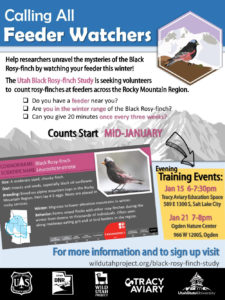
This winter our local Audubon chapter donated seed for a USU research project on its cousin, the black rosy finch, long considered a variation of the same species until genetic studies proved otherwise. The gray crowns far out-number the black who have a highly restricted range. The black rosy-finch is one of the least-understood birds in North America. Its reproduction, demography, population status, survival rates, distribution, and migratory tendencies, all deserve further study. These data gaps limit not only our understanding of the species, but also the ability to conserve and manage this gorgeous bird.

Researchers have conducted serious studies less than once per decade since 1925, when the first nests were recorded. Between then and 2002, three researchers had documented only 23 nests. This least-known, least-accessible bird of remote high country, may prove a bellwether for a retreating alpine ecosystem. Its mountaintop habitats are especially vulnerable to the effects of a warming climate. You may join this study by googling the “Wild Utah black rosy finch” project.

Like the Black Rosy, the Gray-crowned Rosy-Finches nest in crevices on cliffs and talus among glaciers and snowfields above timberline, mostly in Canada and Alaska. They glean wind-transported insects on snowfields and meadows, particularly at the edge of snow patches. Later in the season they capture insects from vegetation including flying insects, as well as continuing to feed on seeds. Winter foods are mostly seeds taken from the ground, from stalks protruding through the snow, and at high elevation bird feeders. In the non-breeding season, they sometimes occur in large, mixed flocks composed of other rosy-finch species, namely black and brown capped.

If you are fortunate enough to encounter this remarkable beauty, you will have a good day indeed, and if a black rosy finch, please report it to Janice Gardner at (801) eight-two-one 8569.

This is Jack Greene for Bridgerland Audubon, and I’m Wild about Utah!

Rosy Finches-Credits:

Images: Rosy Finches, Courtesy & Copyright © Jack Binch
Audio: Contains Audio Courtesy and Copyright Kevin Colver
Text:     Jack Greene, Bridgerland Audubon Society and Utah State University, Sustainability

Rosy Finches-Additional Reading:

Gardner, Janice, Rosy Finch Study, Wild Utah Project, Fall/Winter 2019/2020, https://www.wildutahproject.org/black-rosy-finch-study

Strand, Holly, A Big Year in Utah, Wild About Utah, October 27, 2011, https://wildaboututah.org/a-big-year-in-utah/

Black Rosy-Finch Identification, All About Birds, Cornell Lab of Ornithology, Cornell University, https://www.allaboutbirds.org/guide/Black_Rosy-Finch/id

Grey-Crowned Rosy-Finch Identification, All About Birds, Cornell Lab of Ornithology, Cornell University, https://www.allaboutbirds.org/guide/Gray-crowned_Rosy-Finch/id

Rosy Finch Study Wild Utah Project

Logan River’s Evolving Geomorphology

Logan Rivers evolving geomorphology: Logan River’s Evolving Geomorphology: Children enjoying Logan River as they search for insects among the dropped sediments of the Logan River. Courtesy & Copyright Shauna Leavitt, Photographer
Children enjoying Logan River as they search for insects among the dropped sediments of the Logan River.
Courtesy & Copyright Shauna Leavitt, Photographer
Logan River’s geomorphology, or landform, has changed very little over the past 150 years in the mountain canyons. But where the river leaves the mountains and drops down onto Cache Valley’s floor, its geomorphology has changed dramatically.

A river’s geomorphology is how it interacts with its environment, how it changes and moves over time, how it picks up sediment and debris when its flowing fast then releases the sediments downstream where the river slows and spreads over open-flat landscapes.

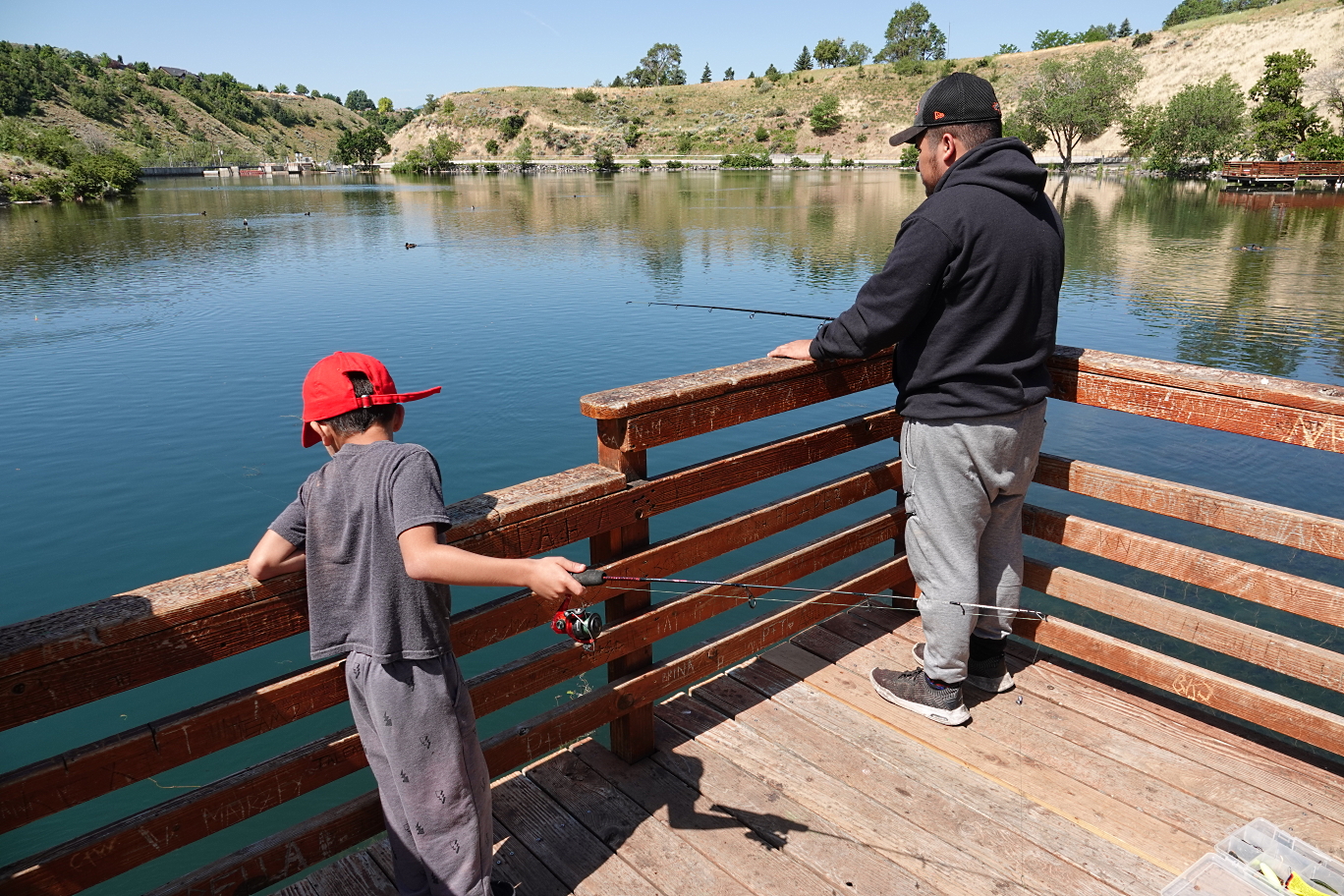
Logan Rivers evolving geomorphology: Logan River’s Evolving Geomorphology: Father and son enjoying a day of fishing on the reservoir behind First dam in the mouth of Logan Canyon Courtesy & Copyright Shauna Leavitt, Photographer
Father and son enjoying a day of fishing on the reservoir behind First dam in the mouth of Logan Canyon
Courtesy & Copyright Shauna Leavitt, Photographer
The route of Logan River is noteworthy. Peter Wilcock, department head of Watershed Sciences in the Quinney College of Natural Resources explains, Logan River cuts through a large amount of the Bear River mountain range [in northeastern Utah and southeastern Idaho] and is by far the biggest drainage from the range.

The river’s size has made a mark on the mountain. When all the tributaries and springs come together, the result is the fast-flowing river with great force for erosion. If you compare Logan Canyon with other canyons coming out of the Bear River Range such as Green Canyon or Providence Canyon you can see Logan Canyon is close to 600 feet lower than all the other canyons. The volume and force of Logan River cut through the beach material that ancient Lake Bonneville left behind, the other drainages have been too small to cut through the ancient short line.

In the early 1800s, the lower part of Logan River flowed freely, meandering and spreading across the Cache Valley floor. As it entered the valley, the river would form into an alluvial fan spreading like fingers over the valley floor and meeting the natural functions of a river to transport water, sediments and nutrients.

As each decade passed an increasing number of buildings, roads and complex infrastructures were built to keep up with the growing population. And to protect this infrastructure, people attempted to restrict the movements of the river. In many places, the river was straightened or channelized even as its water was re-routed for irrigation.

The dams placed along the river and at the mouth of Logan Canyon slowed the river before it reached the valley floor. As a result, a large percentage of the sediments which would have dropped on the valley floor, are now captured behind the river’s dams and fill the reservoirs.

Frank Howe, chairman of the Logan River Task Force, explains how this impacts the river’s geomorphology, “Water released from the dams is free of deposits; the river is now “hungry” – hungry for new sediments. It’s now capable of picking up large amounts of sediments which causes erosion problems miles below the dams.”

The Logan River Task Force, consisting of representatives from Utah State University, Logan City, Cache County, State and Federal Agencies, six non-profit organizations, corporations and interested citizens came together to find solutions to the erosion problem and other river issues. To address these issues, they prepared a “long-term plan for the Logan River to balance ecological and social values and capture what Cache Valley community wants the river to become. “

Rivers, by nature, are dynamic. They move back and forth especially where the slope is gentle. Over time, this meandering movement delivers fine sediments, across the river’s floodplains creating rich soils diverse in vegetation and wildlife. By changing the river’s geomorphology, we’ve altered the rivers dynamics, as well as how and where it delivers sediments.

Fortunately, parts of the Logan River’s geomorphology can be restored. River restoration will be the topic of our fourth and final segment for the Logan River series on Wild About Utah.

This is Shauna Leavitt and I’m wild about Utah.

Logan River’s Evolving Geomorphology-Credits:
Photos: Courtesy & Copyright ©
Audio: Courtesy & Copyright © Friend Weller, Utah Public Radio
Text: Shauna Leavitt, Utah Cooperative Fish and Wildlife Research Unit, Quinney College of Natural Resources, Utah State University
Co-Authored by: Frank Howe, chairman of the Logan River Task Force, adjunct associate professor, and university liaison for Utah Division of Wildlife Resources.

Logan River’s Evolving Geomorphology-Additional Reading

Leavitt, Shauna, A Short History of the Logan River, Wild About Utah, November 4, 2019, https://wildaboututah.org/short-history-of-logan-river/

Leavitt, Shauna, The Ecology in and around the Logan River, Wild About Utah, December 2, 2019, https://wildaboututah.org/the-ecology-in-and-around-the-logan-river/

Williams, Edmond J, Geomorphic Features and History of the Lower Part of Logan Canyon, Utah, Thesis, MS Science 2964, Donald R. Olsen Chair, Department of Geology, Utah State University, https://digitalcommons.usu.edu/etd/6644/

James P. Evans, James P. McCalpinl, David C. Holmes, Geologic Map of the Logan 7.5′ Quadrangle, Cache County, Utah, Department of Geology, Utah State University, Utah Geological Survey, Utah Department of Natural Resources, 1996, https://ugspub.nr.utah.gov/publications/misc_pubs/mp-96-1.pdf

Hylland, Rebecca, What are Igneous, Sedimentary & Metamorphic Rocks?, Glad You Asked, Utah Geological Survey, https://geology.utah.gov/map-pub/survey-notes/glad-you-asked/igneous-sedimentary-metamorphic-rocks/

Map of the Deltas formed in Lake Bonneville by the Logan River, U.S. Geological Survey, ca. 1890, Held in the Utah State University, Merrill-Cazier Library, Special Collections and Archives
https://digital.lib.usu.edu/digital/collection/Bear/id/109/