Grizzly Bear Courtesy Pixabay Angela AMBQuinn, ContributorLadies and gentlemen, boys and girls, the puppet show is about to begin!
It was Pioneer Day in Mendon, and the puppeteer’s loud cry brought the little kids running to the puppet theater on the town square. They settled down on the grass in a hushed silence as the narrator began:
This is a true story. It took place in early pioneer days in Mendon about 130 years ago.
And now introducing: the bravest man in Mendon, Tom Graham. He was so brave he would grab a rattlesnake by the neck and spit tobacco juice right down its throat.
A hidden water pistol shot a stream of water out into the audience, which caused some oohs and ahhs in the front row.
The Tom Graham puppet took a bow and disappeared
And now introducing: the biggest and baddest bear in Cache Valley at the time, The Big Slough Grizzly!
The puppeteers booed loudly. If there was any doubt that the bear puppet was the villain in the story, these doubts soon disappeared.
A small wooly lamb popped up and the bear pounced on it. Baaaaa went the lamb as it sank out of sight. The same thing happened to a calf and a small pink pig.
It was time for the hero, Tom Graham to take action.
Tom and another puppet popped up. Let’s go find that bad bear, Tom said.
They bobbed across the stage in single file, looking at the ground. Then they saw a bear paw print and they jerked back.
It’s 8 inches wide! And 12 inches long!! Not counting the claw!!!
We need to go get help, they said as they ran off the stage
In the meantime, Tom went down to the watery sloughs below Mendon to get some firewood. Bad luck. He ran right into the Big Slough Grizzly. The bear took a mighty swing at Tom and knocked his head right off his shoulders!
Now the Tom puppet was made out of a leg of panty hose. So Tom’s long neck stretched out a good two feet as his head flew out over the audience before snapping back and disappearing.
This caused quite a sensation in the audience. In fact, I used to judge the success of each show by how high the kids came off their seats.
But the story wasn’t over. After Tom lost his head, every man in Mendon picked up his rifle and headed for the slough. They found the bear’s den. Two very brave men stepped into the entrance and got a couple shots off. The bear did not come out.
Another man pushed his old flea bitten mare up to the entrance. This brought the bear out. The men opened fire.
It got really noisy as two young boys in the puppet theatre shot off their cap pistols like mad. The Big Slough Grizzly keeled over and sank out of sight. That was the end of the story.
This is Mary Heers, puppeteer (now retired), bringing you this Pioneer Day true bear story for Wild About Utah.
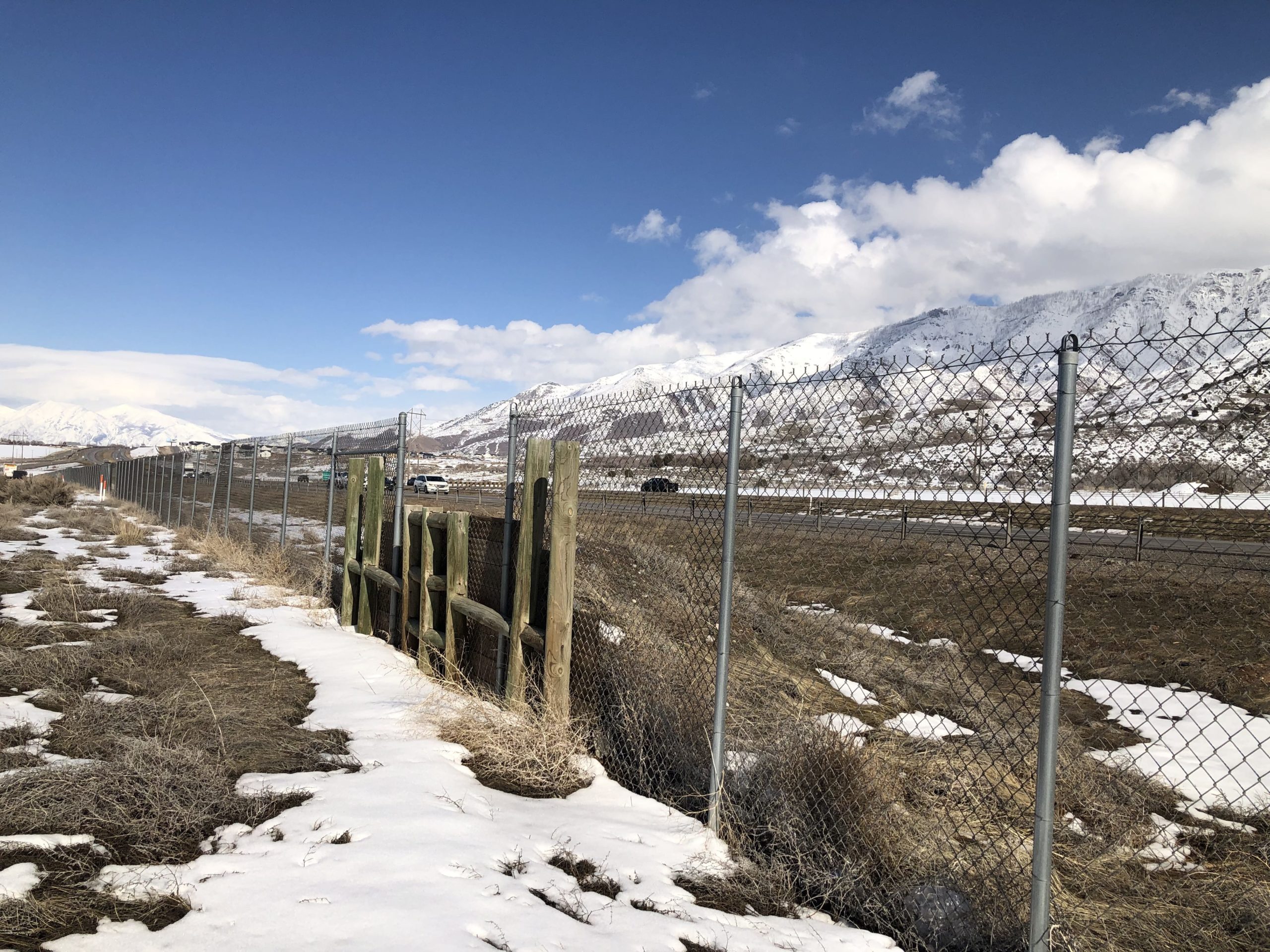
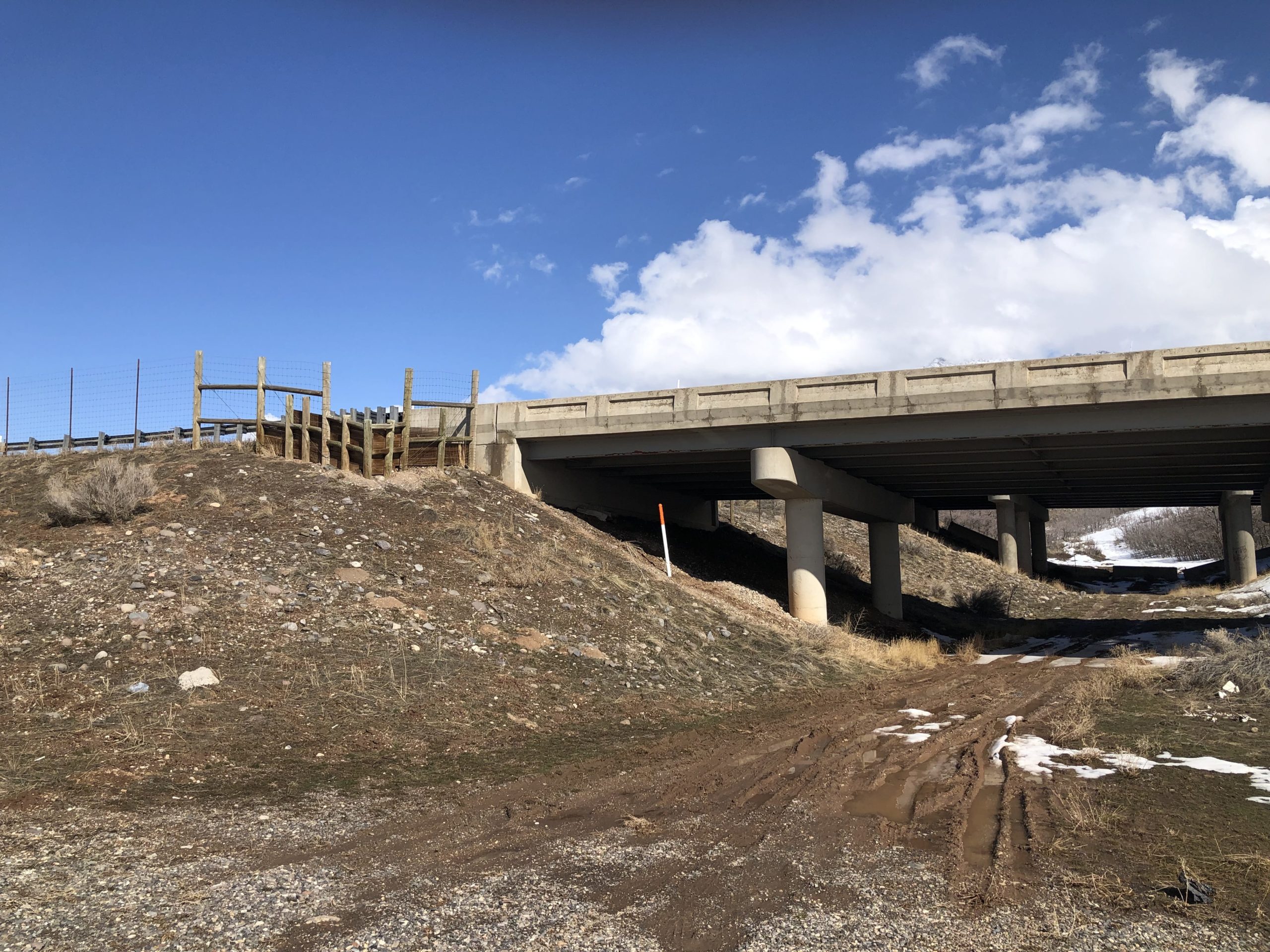
Underpass and Jump Ramp Near Santaquin WMA Courtesy & Copyright Lyle Bingham, Photographer
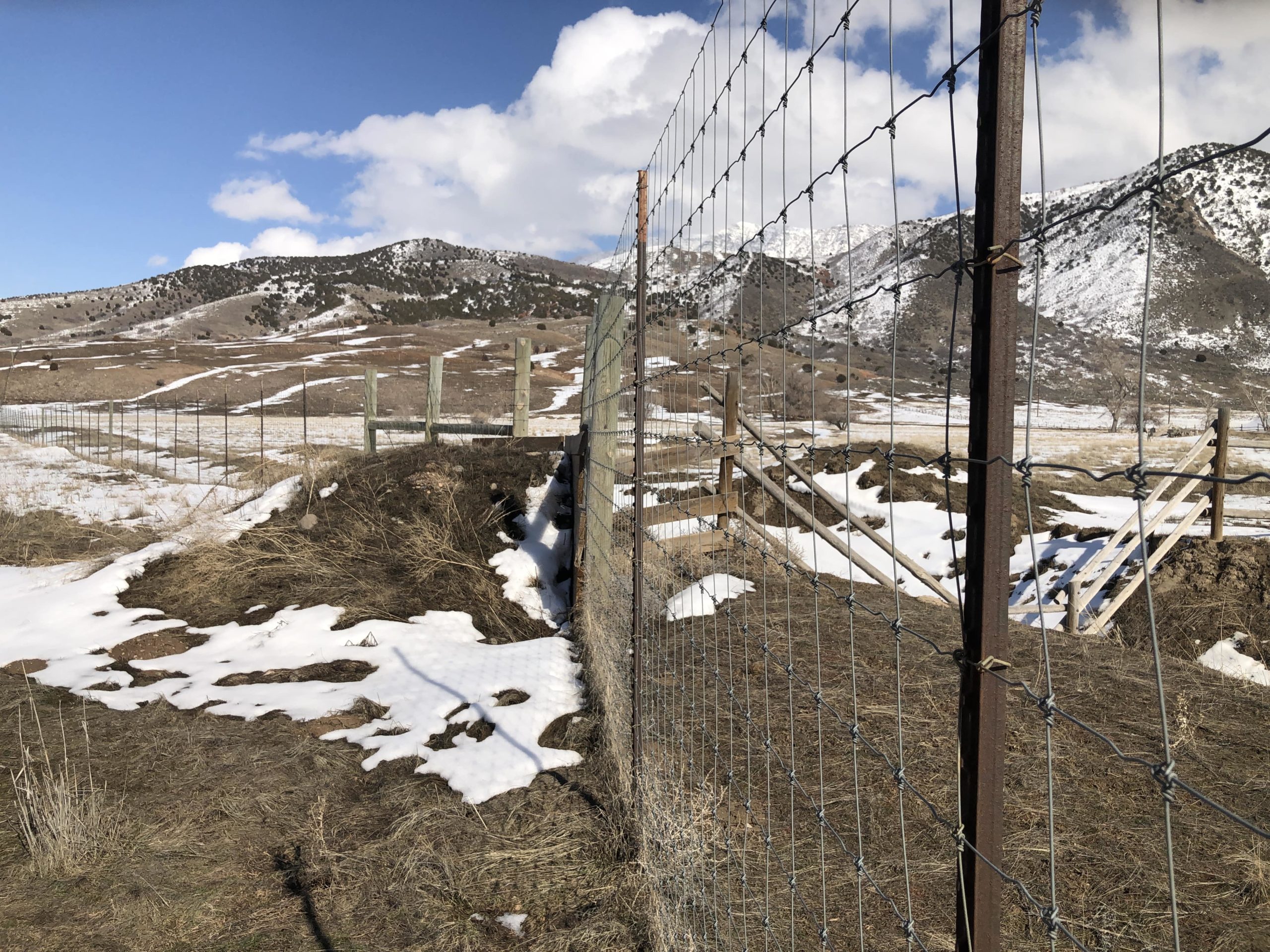
Rural Road Leading to Santaquin Wildlife Management Area Courtesy & Copyright Lyle Bingham, PhotographerDeer and other wildlife have been migrating across our state much longer than humans. When people drove horse-drawn wagons and slower vehicles, wildlife could easily pass without a problem. However, with the introduction of fenced highways and their increased speed and traffic, problems quickly arose. In this case, the problem is mostly with mule deer, because they comprise 90% of the animals migrating in Utah. Robert Frost wrote that “Good fences make good neighbors.” But neighbors need to cooperate to maintain a fence, and even with fences in place, what if the neighbors are animals? The problem is how to keep migrating deer from jumping fences and causing accidents.
Animal/vehicle encounters cause over 5,000 animal deaths in Utah each year. Beyond the loss of life, it is also an economic problem, not only for wildlife management but also for vehicle owners. Some estimate the deer are worth more than $2,500 each. Joshua Coursey wrote in the Deseret News, that the “estimated cost of collisions with mule deer in Utah reached close to $50 million in 2021.” That’s why the Utah Department of Transportation (UDOT) and the Division of Wildlife Resources (DWR) have worked for decades to reduce wildlife/vehicle encounters. As noted, fencing alone does not work; consequently, highway managers have had to find ways to get trapped deer across and away from fenced roads.
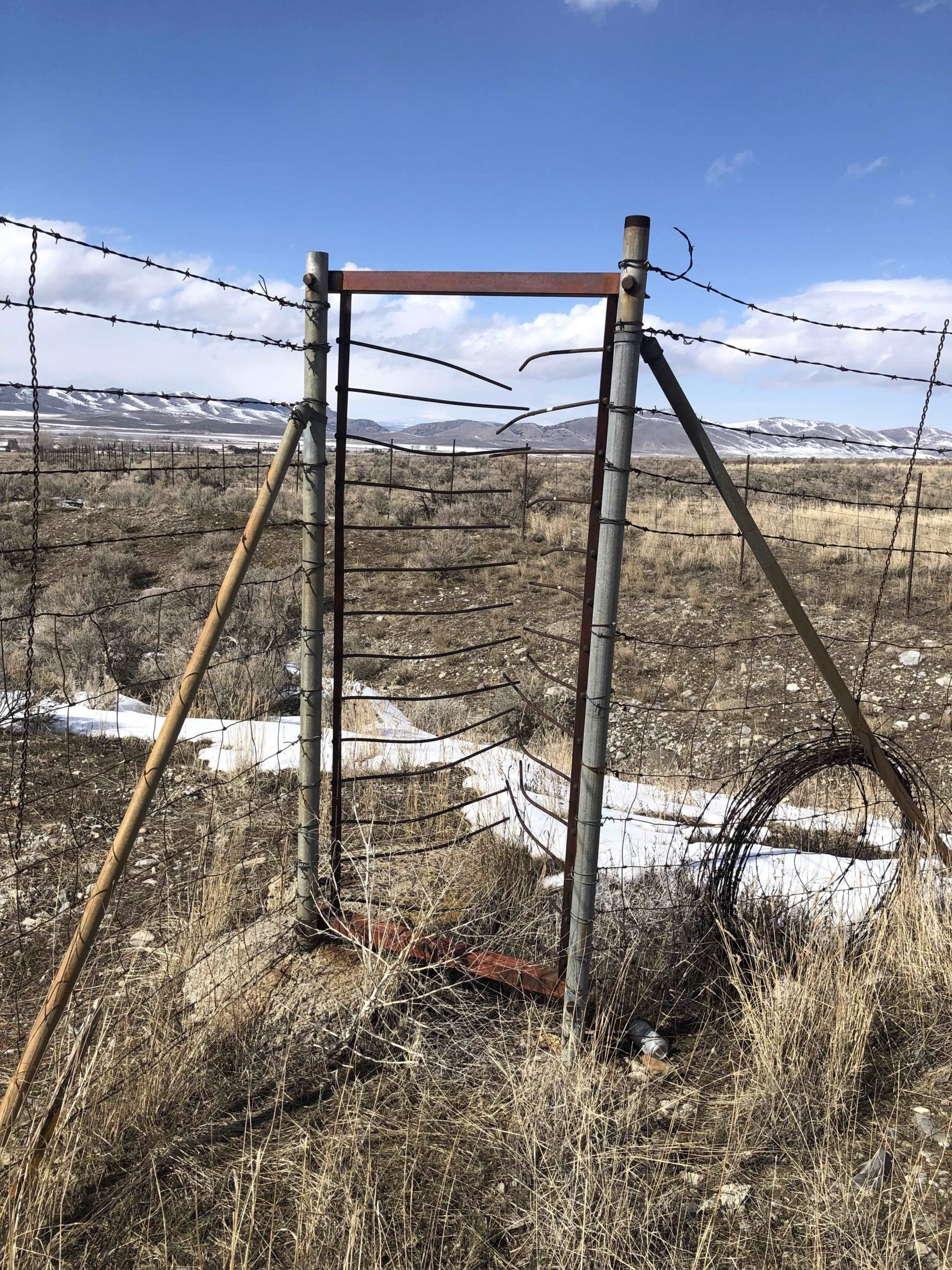
When USU researchers studied escape mechanisms in Sardine canyon, they found earthen escape mounds were superior to one-way, metal gates. Climbing a hill is more natural to deer than pushing through a metal gate. These mounds enable a one-way jump to safety. However, escape alone does not solve the driving force of migration.
A more effective way to handle migrating animals is to guide them above or below the road. UDOT explains: “Studies have shown there is a 90% reduction in wildlife/vehicle collisions when there is a crossing structure and fence in the area.” Since 1975, when UDOT built its first wildlife overpass near Beaver, Utah, deer, moose and elk, along with bear and mountain lions have begun to use wildlife underpasses and overpasses. More recently, a larger overpass was built in Parley’s Canyon on I-80. Videos show a variety of animals who successfully traverse that overpass.
But escape ramps and overpasses aren’t the only tools available. Passage is also possible using creek beds or culverts crossing under roads. Tall fences are effective in guiding animals toward structures and preventing roadway access. Then, to encourage faster adoption, contractors have found they can walk a herd of cattle through the structure, overpowering human scents
When on I-15, I-80, I-70, or in our canyons, watch for overpasses, underpasses, one-way gates and exit ramps. They demonstrate a few ways the DWR and UDOT are working together to preserve human and animal lives.
This is Lyle Bingham, and I’m Wild About Utah and our 15 years on Utah Public Radio.
Buford, Daniel, Cramer, Patricia, and Simpson, Nova, Integrating Wildlife Connectivity and Safety Concerns into Transportation Planning Processes, Federal Highway Administration, US Department of Transportation, Winter 2023, https://highways.dot.gov/public-roads/winter-2023/04
“A dynamic part of a National Cooperative Highway Research Program sponsored research project titled; ‘Evaluation of the Use and Effectiveness of Wildlife Crossings.'”, https://www.wildlifeandroads.org/
DWR: “It’s the video seen around the world! This compilation of footage shows various animals using the wildlife crossing constructed in 2018 over Interstate 80 near Parleys Summit. What’s especially notable with this crossing is how many animals are already using it; usually it takes several years for wildlife crossings to become widely used.
This video went viral near the end of 2020, and was celebrated as great progress in the problem of wildlife-vehicle collisions. Special thanks to the Utah Division of Wildlife Resources, Utah Department of Transportation and Summit County for the footage.” https://wildlifemigration.utah.gov/stories/parleys-summit-wildlife-crossing/
UDOT: Baker Canyon Wildlife Crossing Installation
DWR: “Utah’s highways are vital to the health of the state. They can present a significant barrier for wildlife migration. In order to prevent automobile/wildlife collisions and to increase habitat availability for animals, Wildlife biologists and the Utah Department of Transportation have designed and installed several overpasses and underpasses to allow wild animals to safely cross the highway.”
Consider the Yellow-billed Cuckoo [koo-koo], one of the World Migratory Bird Day Ambassador species, to highlight the importance of water and riparian habitat for birds. A long-distance migrant, the Yellow-billed Cuckoo breeds in the United States, Mexico, and the Caribbean, and migrates through Central America to reach its wintering grounds in South America. It seeks wooded habitats with water nearby, where it feasts mostly on insects, especially caterpillars, during the spring and summer, transitioning to a more fruit- and seed-heavy diet in the fall and winter.
The Yellow-billed Cuckoo was selected for this year’s World Migratory Bird Day campaign to help shed light on the decline of riparian habitats along our rivers, streams, and freshwater lakes, particularly in the American West, where species that rely on these areas are experiencing population declines and are in possible danger of extirpation from some states. These western riparian species include Summer Tanager, Yellow Warbler, Willow Flycatcher, Yellow-breasted Chat, and Yellow-billed Cuckoo. Loss of native forest to farmland, housing, and other development has led to significant population declines in these species, especially in the case of the Cuckoo, which relies on large patches of streamside forest for breeding.
The Yellow-billed Cuckoo is becoming an increasingly rare bird in the American West. We need to increase awareness and encourage decision makers to explore ways to protect riparian areas, remove invasive species, restore habitat, and conserve water. World Migratory Bird Day 2023 aims to contribute to these efforts by highlighting the importance of water conservation and habitat management for migratory birds, and by providing resources to help promote these important issues. Bird Day is every day, but especially mid-May and mid-October. Learn more at migratorybirdday.org, and learn more about how to conserve water for sustaining bird life!
I’m Hilary Shughart with the Bridgerland Audubon Society, and I am Wild About Utah!
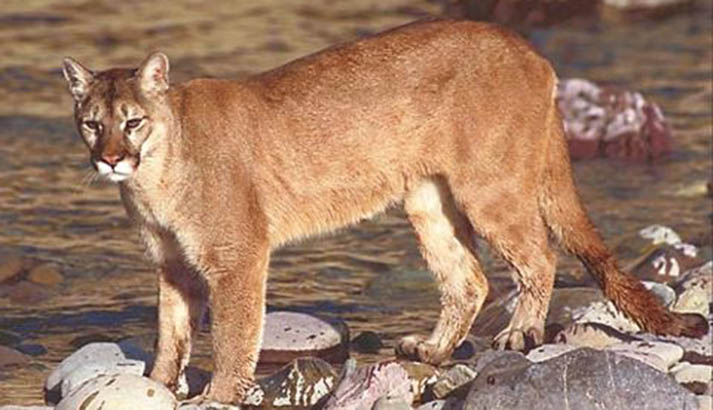
“In research recently published in the prestigious journal, Oecologia, we show that mountain lions are ecosystem engineers that create essential habitat for carrion-dependent beetles. It is the first research to show that an apex predator plays the role of engineer. In collaboration with graduate researcher, Josh Barry, and Dr. Melissa Grigione at Pace University, we collected and identified 24, 209 beetles across 18 sites, representing 215 unique beetle species. The carcasses abandoned by mountain lions were not just food for beetles, but the very places beetles spent their lives, hiding from predators, seeking mates, raising young, and morphing from larvae into adult forms that dispersed in search of the next carcass to begin the cycle all over again.”
Barry, J.M., Elbroch, L.M., Aiello-Lammens, M.E. et al. Pumas as ecosystem engineers: ungulate carcasses support beetle assemblages in the Greater Yellowstone Ecosystem. Oecologia 189, 577–586 (2019). https://doi.org/10.1007/s00442-018-4315-z
Mountain Lions as Ecosystem Engineers, MarkElbroch.com, , [Accessed April 29, 2023]
Mountain Lion Conservation, MarkElbroch.com, , [Accessed April 29, 2023]
I soon bumped into a friend who had a friend in Preston who trained and occasionally raced his team of 14 Alaskan Huskies.
This musher graciously offered to give me a ride on one of his training runs. I showed up all smiles as he was harnessing his team. The dogs were excited to go and actually howling with happiness. The musher asked if I wanted to get in – or ride up the trail a bit on a snowmobile with his teenage son to a more level spot. In a rare moment of sanity, I opted for the snowmobile.
The machine had just pulled out of the yard when I heard his son say, “Oh, No!”
I looked back in time to see the sled tip over, sending the musher sliding across the driveway and under my car parked at the end of it. I jumped off the snowmobile as the dogs shot past us with the empty sled. The dogs were gaining on a truck up ahead, then shot past it with the snowmobile in hot pursuit.
I was left standing in a snowbank wondering if I’d wandered into a James Bond movie.
My first encounter with sled dogs had gone a lot smoother. I was visiting Denali National Park in Alaska and the rangers were introducing us to one of the dog teams that they still use to patrol the park.
But the most famous sled dogs are the freight teams that carried anti-toxin from Anchorage to Nome during an outbreak of Diphtheria in 1925. The dog teams ran a thousand miles and are credited with saving hundreds of lives.
For the last 50 years, modern mushers have retraced this journey in the ultimate sled dog race, the Ididarod. The best account I’ve read about the world of training sled dogs and running the Ididarod is Gary Paulsen’s book Winterdance. Just before going on a training ride, he discovered, “the gangline was trembling, quivering like a string on a guitar. It fairly hummed and I felt there was great power there. The trees in the yard went by in a mad blur and we left the yard at warp speed.”
Paulsen also lets us in on the deep relationship mushers form with their dogs: “As they understand you will give them meat when they run, and love when they run, and your soul when they run – as they learn to feel that, understand that, know that – they are no longer sled dogs – they become distance dogs, dogs that cannot, will not be stopped.” Paulson ran the Iditarod in 1983. It was a wild ride that took 17 days. But he finished.
Meanwhile, back in Preston, our teenage hero had caught up with the runaway team, made a flying leap from the snowmobile onto the empty sled, and somehow managed to stop the team. Pretty soon the musher and I caught up.
“Do you still want to get in?” he asked.
“Sure,” I said.
And we were off. The dogs settled into a steady trot. From then on it was all Sun and Snow and the sheer Joy of sliding quietly through the magnificent winter scenery.