Riparian Zones and a Critter Quiz

Hello, this is Jim Goodwin.

In a minute I’ve got a critter quiz for you, but first, a word about the huge importance of riparian areas in semi-arid Utah, the second driest state in the union. Utah State’s Extension Service calls riparian zones the green ribbon of life alongside a stream. They are shadier, cooler and moister than adjacent environments.

And with a diverse mix of plants and animals, our few riparian corridors are heavily used by wildlife for food, rest and shelter.

Ok, now for our critter quiz.

What is the largest rodent in North America? Here’s a hint: they can be up to four feet long and weigh 40 to 60 pounds.

Did that do it? No? Alright, this clue will: They spend much of their life in water. They have a beautiful brown coat, a broad flat hairless tail and big orange buck teeth that continually grow, which is why they chew and chew and chew.

Click for larger picture, Beaver with branch in water, Courtesy US FWS, Steve Hillebrand, Photographer
Beaver with branch in water
Courtesy US FWS,
Steve Hillebrand, Photographer
Good, you got it . . . it’s the North American beaver. Or as Utah environmental author Chip Ward calls them: the Flat Tail Climate Hero for the restoration of damaged watersheds. Beaver are amazing aquatic engineers, second only to humans in their ability to manipulate their environment.

In our nation’s history, they’ve played a big role in literarily shaping our western landscape.
Joe Wheaton, Utah State wildlife and a beaver expert, rightly calls the work of the beaver “cheap and cheerful restoration” of our heat stressed watersheds.

In the wild, these mostly nocturnal animals, normally live five to ten years.
Fortunately, they are rarely killed for their pelts these days. Beaver are usually monogamous. They will produce up to 10 babies. The young kits will stay home until they are two or so, before they will take off on their own.

Beaver are master aquatic builders. the original geo-engineers. They build dams to flood areas for protection from predators, for access to their food supply, and to provide safe underwater entrances to their dens. Their dams create beautiful riparian habitat for many other animals, birds, fish amphibians, insects and plants. The flooded areas slow the flow of water and sediment downstream and raise the area water table.

Aspen, cottonwood, willow and dogwood are their preferred tree. Those trees regenerate quickly after beaver topple them. When their ponds freeze over, beaver jam smaller branches into the mud at the bottom of their pond for food storage.

Beaver dams can be 5 to 10 feet high and 150 feet across. They are constructed with branches, stones, and plants and plastered together with mud. Over 1200 beaver dams have been counted in northern Utah’s Bear River mountains alone. The World’s largest beaver dam in Canada is 2,789 feet in length. That’s more than 9 football fields.

Yes, sometimes beaver can be a nuisance to human property and activities. Often, learning to live with beaver and the many benefits they can bring, can be a solution. There are simple time-tested ways to prevent flooding. But if nothing works, they can be live trapped and moved to another area. There’s no need to shoot them.

Be a “beaver believer.” Here are some organizations you can check with to learn more:
Utah State wildlife researchers Wally McFarland and Joe Wheaton have created something called the Beaver Restoration Assessment Tool to track beaver dam building activities and their effects throughout the state.
The Bear River Watershed Council in Cache Valley and Mary O’Brien with the Grand Canyon Trust in southern Utah are excellent organizations to contact.

I’m Jim Goodwin for Wild About Utah.

Credits:
Image: Courtesy US FWS, Steve Hillebrand, Photographer
Text:     Jim Goodwin
Additional Reading:

Beaver Restoration Assessment Tool, https://brat.joewheaton.org/

Bear River Watershed Council, https://www.brwcouncil.org/

Grand Canyon Trust, https://www.grandcanyontrust.org/

Beaver Castor canadensis, National Geographic, https://animals.nationalgeographic.com/animals/mammals/beaver/

Big Bend Habitat Restoration Project: A Natural Work of Heart, Open Spaces-A Talk on the Wild Side, US FWS, https://www.fws.gov/news/blog/index.cfm/2016/3/25/Big-Bend-Habitat-Restoration-Project-A-Natural-Work-of-Heart [Accessed March 31, 2016]

Beaver Dams Strengthened by Humans Help Fish Rebound
60-Second Science – July 25, 2016 – By Jason G. Goldman02:29 https://www.scientificamerican.com/podcast/episode/beaver-dams-strengthened-by-humans-help-fish-rebound/ Also available through the podcast https://itunes.apple.com/us/podcast/60-second-science/id189330872?mt=2

Capitol Reef

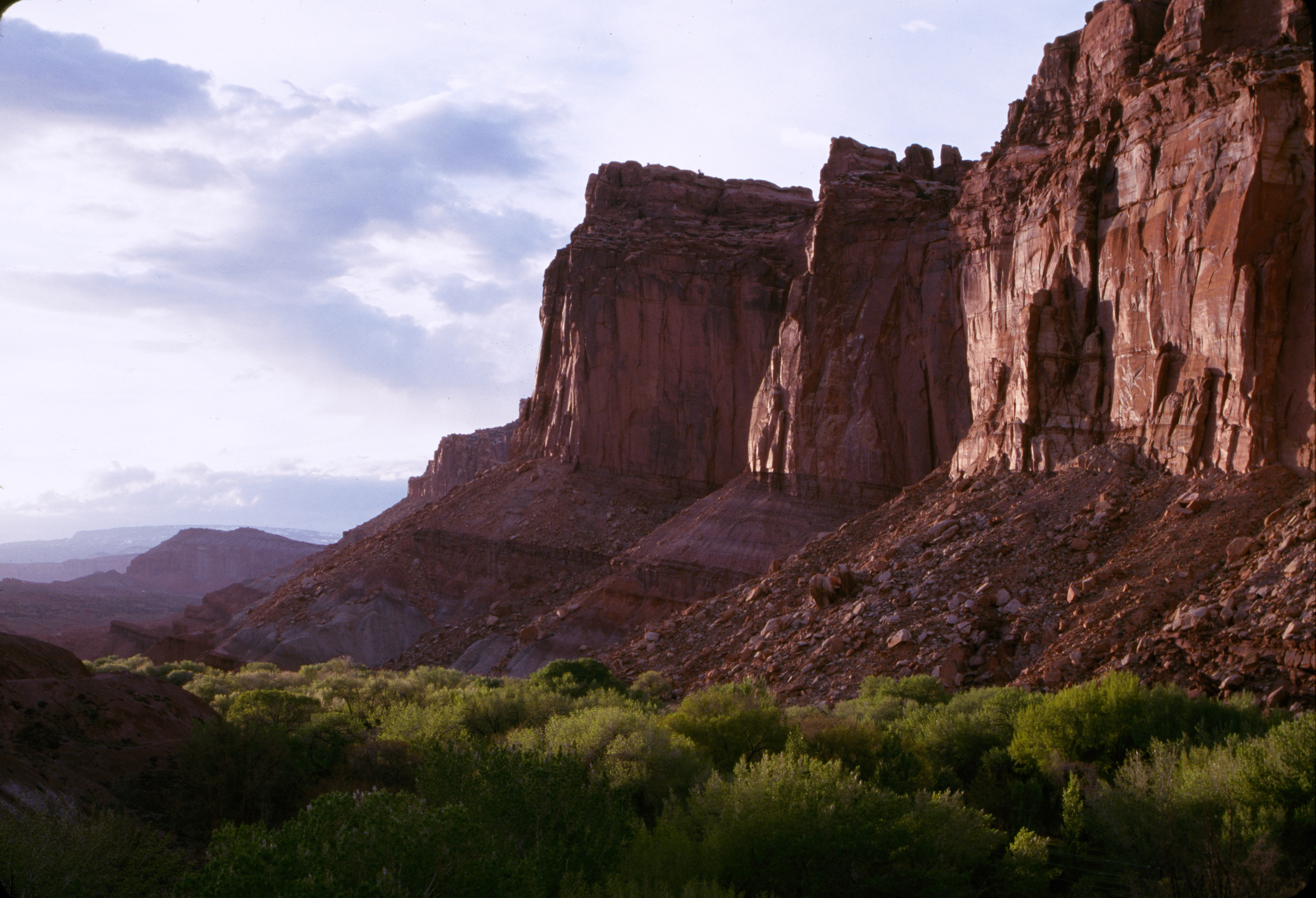
Fruita and the Wingate Cliffs
Capitol Reef National Park
Photo Courtesy US NPS

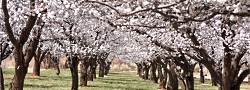
Orchard
Capitol Reef National Park
Photo Courtesy US NPS

Early settlers to the landscape we know as Capitol Reef National Park in south-central Utah planted cherry, apricot, peach, pear, apple, and walnut trees as a cash crop for survival along the Fremont River bottoms. Visitors today are often surprised by the fruit trees in light of the surrounding desert climate, and campers can pick apples and peaches from their campsites in the orchards. But the green fields and fruit trees also attract deer, marmots, and other small critters, which are easy to spot and are comfortable with humans in their environment.

Though the deer roam free in the tall grass between apple trees, there are other species that are a bit more dangerous lurking nearby. Mountain lions and black bears skillfully stalk around this historic district of Fruita without being seen. Mountain lions have been spotted within a half-mile of the popular campground, yet little is known about the species within the confines of Capitol Reef. With so many questions unanswered about the predator and prey relationship in the unique landscape, the park has received a Disney Nature Impact Grant to enlighten us.

Lori Rome, the park’s chief of interpretation, says, “We are setting up 10-20 infrared motion detected camera traps in surrounding areas. This is a non-invasive way to learn basic information about the species.”

The cameras will provide useful evidence and reveal the patterns of the quiet predators in the park. The public will be engaged through a citizen science project using social media and public interpretive programming, for example helping to survey deer populations.

If you’ve seen Disney Nature’s movie Bears, you, too, helped contribute to the Disney Nature Impact Grants program. Fourteen national parks are receiving funding via proceeds from the movie. Disney Nature has pledged a contribution to the National park Foundation, the official charity of America’s national parks, through the Disney Worldwide Conservation Fund, for each person who saw the film during its first week in theaters.

This type of support helps preserve and protect Capitol Reef and the rest of the National Park System. The Disney Nature Impact Grant enables parks to conduct much-needed conservation projects, such as studying mountain lions at Capitol Reef.

Each park selected to receive a grant through this program had to demonstrate a clear need for the money, and how it would make a profound difference in habitat restoration, wildlife protection or conservation research. With this assistance, we should be able understand predator’s actions in Capitol Reef National Park.

For Wild About Utah and National Parks Traveler, I’m Kurt Repanshek.

Credits:
Image: Courtesy and Copyright Kurt Repanshek, www.nationalparkstraveler.com
Text:     Kurt Repanshek, NationalParksTraveler.com.


Additional Reading:

Capitol Reef And 13 Other National Parks Receive Impact Grants From Disney Nature’s Movie “Bears”, Submitted by Carli Jones, June 26, 2014, NationalParksTraveler.comhttps://www.nationalparkstraveler.com/2014/06/capitol-reef-and-13-other-national-parks-receive-impact-grants-disney-natures-movie-bears25263

Capital Reef National Park, https://www.nationalparkstraveler.com/park/capitol-reef-national-park

Capital Reef National Park, https://www.nps.gov/care/index.htm

Mammals in Capital Reef National Park, https://www.nps.gov/care/naturescience/mammalchecklist.htm
Amphibians in Capital Reef National Park, https://www.nps.gov/care/naturescience/amphibians.htm
Fish in Capital Reef National Park, https://www.nps.gov/care/naturescience/fish.htm
Birds in Capital Reef National Park, https://www.nps.gov/care/naturescience/birds.htm
Reptiles in Capital Reef National Park, https://www.nps.gov/care/naturescience/reptiles.htm

Arches Wildlife

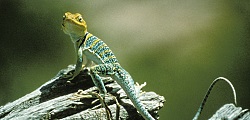
Western Collared Lizard
Arches National Park
Photo Courtesy US NPS

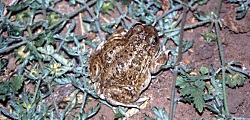
Spadefoot Toad
Arches National Park
Photo Courtesy US NPS

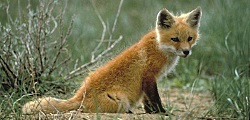
Red Fox
Arches National Park
Photo Courtesy US NPS
Lee Kaiser, Photographer

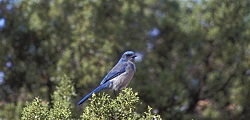
Western Scrub Jay
Arches National Park
Photo Courtesy US NPS
Neal Herbert, Photographer

Petroglyphs
Arches National Park
Photo Courtesy and Copyright Kurt Repanshek, Photographer
NationalParksTraveler.com

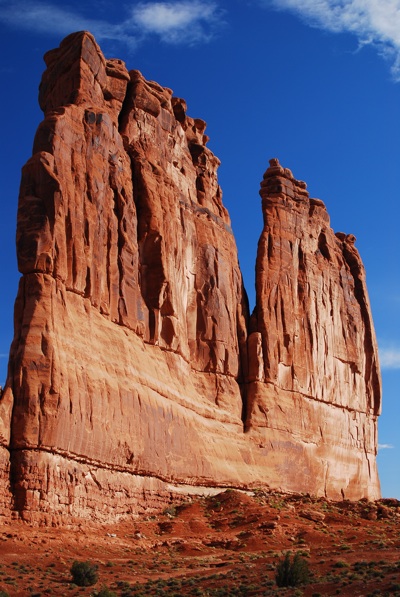
The Organ
Arches National Park
Photo Courtesy and Copyright Kurt Repanshek, Photographer
NationalParksTraveler.com

Stairs to Window Arch
Arches National Park
Photo Courtesy and Copyright Kurt Repanshek, Photographer
NationalParksTraveler.com


As with its neighbor, Canyonlands National Park, Arches National Park conceals most of its wildlife from visitors. That said, lizards are easy to spot, as are mule deer in the cool times of the day. And if you spend a little time before breakfast, or after dinner, you just might see coyotes, porcupines, desert cottontails, black-tailed jackrabbits, and many songbirds.

Because of the high heat during the summer months, most of these animals will be most visible when humans are not typically out and about. Desert animals have a variety of adaptations to deal with the hot weather and aridity. A key adaptation is that most animals are nocturnal, being most active at night. Nocturnal animals in Arches include kangaroo rats, woodrats (also called packrats), and other small desert rodents, skunks, ringtails, foxes, bobcats, mountain lions, bats and owls.

Some desert animals are “diurnal”, or primarily active during the day. These include rock squirrels, antelope squirrels, chipmunks, lizards, snakes, hawks, and eagles.

Many animals have are only active in certain temperature ranges, and they alter their active times of day depending upon the season. During winter months, snakes and lizards are in an inactive state of “torpor,” or sluggishness or even dormancy. But they become active during the day during the late spring and early fall, and then become “crepuscular,” or active mainly during the nighttime hours, to avoid the daytime heat of summer.

Insects, too, alter their times of activity. Mosquitoes, as you no doubt know, may be out from dawn through dusk, depending on the temperatures. But they are not active after the sun goes down.

In spite of Arches’ rather inhospitable appearance, almost 50 species of mammals live in the park’s landscape. But the hot climate and lack of water favors small mammals. Because of their size, these animals are less able to migrate, but have an easier time finding shelter, and require less food and water to live. Rodents are numerous: there are eleven species of mice and rats.

Desert bighorn sheep are one of the larger mammal species to be seen. They are frequently spotted along Highway 191 south of the park visitor center, and call Arches home all year long. They roam the talus slopes and side canyons near the Colorado River, forage for plants, and negotiate the steep, rocky terrain with the greatest of ease.

While Arches may not be considered a prime bird watching hot spot, 273 species have been seen in the park, which includes seasonal, year-round residents, and migrants.

Much of this diversity is due to the riparian corridors like Courthouse Wash and the Colorado River (which forms the park’s southern boundary). Mornings along these corridors often are filled with birdsongs during spring and summer. You might spot blue grosbeaks, yellow-breasted chats, and spotted towhees. Listen carefully and you’ll hear the trill of the canyon wren echoing from the sandstone walls. Great blue herons hunt the shallows for fish, while Cooper’s hawks deftly maneuver through the tangle of trees beyond the riverbanks.

There is life in the desert, if you know where, and more importantly, when, to look for it.

For Wild About Utah and National Parks Traveler, I’m Kurt Repanshek.

Credits:
Images: Courtesy US NPS
Images: Courtesy and Copyright Kurt Repanshek, www.nationalparkstraveler.com
Text:     Kurt Repanshek/Patrick Cone, NationalParksTraveler.com.


Additional Reading:

https://www.nationalparkstraveler.com/browse/Arches%20National%20Park

https://www.nps.gov/arch/index.htm

Winter Encounters With Moose

Winter Encounters With Moose
Moose in Parking Log
Photo Courtesy US FWS
Ronald Laubenstein, Photographer

Winter Encounters With MooseCow Moose and Calf
Photo Courtesy US FWS
Tim Bowman, Photographer

Winter Encounters With MooseBull Moose
Courtesy & © 2007 Jason Pietrzak

Hi, I’m Ru Mahoney with Stokes Nature Center.

If you’ve ever had the opportunity to visit Stokes Nature Center in the Uinta-Wasatch-Cache National Forest, you know that we’re located about a third of a mile up a narrow trail cut out of a steep slope of the Bear River Mountains on one side and dropping down into the rocky waters of the Logan River on the other. Which is why it’s always a particularly sobering experience, when making a winter morning trek up the aptly named River Trail to the nature center to find my way blocked by 1200 pounds of antlered bullish brown bulk, standing 6 feet at the shoulder. In case you’ve never happened upon a moose yourself, they are what happens when Mother Nature decides that the bulk of an NFL player and the legs of a supermodel should get together in one massively large and absurdly leggy Deer-zilla. And while I’ve never met a moose who’s bored browsing and indifferent glance didn’t make it pointedly, and yes, a little painfully obvious that I was far more impressed with them than they’ve ever been with me, they can pose a threat to the incautious admirer. While I don’t encounter moose every month of the winter, I do hear well-intentioned nature center visitors talk frequently about their own encounters, which too often include accounts of trying to get closer to snap a great picture.

Moose are the largest member of the deer family in North America, and are found in the north and northeastern forests of Utah. Despite their size and top heavy appearance, they thrive in watery environments. An adult moose doesn’t hesitate to wade into deep water to browse on aquatic vegetation and can often be spotted swimming effortlessly across lakes and marshes to get to prime grazing or escape a perceived threat. Their hollow hair makes them incredibly buoyant swimmers and keeps them well insulated against the cold both in and out of the water. In winter months they may leave frozen high alpine lakes and seek out forage on evergreens and bark, making encounters on lower elevation hiking trails more likely.

Male moose rut in the fall, tirelessly seeking out willing females. Easily distinguished by their large antlers, which can spread to more than 4 feet across, a bull moose in rut can become unexpectedly aggressive. Signs of aggression include laying back their ears, raised hair along their neck and licking their snout. Female moose don’t have the impressive antlers of their male counterparts, but don’t let that fool you into thinking they’re docile. A mother moose with her spring calf is quite possibly the most dangerous moose, and will use her powerful legs and sharp hooves to trample anything she thinks might be a threat to her babe. This includes the unlucky hiker or – more often – an unleashed dog.

Wild Aware Utah, a nonprofit offering education on how to reduce conflict with wildlife, recommends responding calmly to encounters with moose, talking loudly to let them know you’re there and leashing pets. Often the moose will move along on its own, uninterested in conflict. But if you find yourself in the bullseye of a moose’s ire, the best course of action is to back away slowly. And if you’re unlucky enough to be charged, get behind a tree or solid obstacle. Moose can run up to 35 miles an hour, which means you’re unlikely to outrun one, no matter how much adrenaline is fueling your flight.

To learn more about moose and how to prevent conflict with other Utah wildlife, visit WildAwareUtah.org.

For Wild About Utah and Stokes Nature Center, I’m Ru Mahoney.

Credits:
Images: Courtesy US FWS,
              Courtesy and Copyright 2007 Jason Pietrzak
Text:     Ru Mahoney, Stokes Nature Center in Logan Canyon.


Additional Reading:

Wild Aware Utah, (Hogle Zoo, Utah DNR, Utah State University Cooperative Extension,) https://www.wildawareutah.org/

Hardware Ranch Wildlife Management Area Management Plan, Prepared by The Hardware Ranch Stewardship Team
and Logan Simpson Design, Inc., Utah Division of Wildlife Management, Mar 20, 2012, https://wildlife.utah.gov/hardwareranch/comment/HRWMA_management_plan.pdf

Utah Moose Statewide Management Plan, Utah Division of Wildlife Management, Utah Department of Natural Resources, Nov 30, 2017, https://wildlife.utah.gov/hunting/biggame/pdf/moose_plan.pdf

Hersey, Kent R., Utah Division of Wildlife Resources statewide management plan for moose (2000), Utah. Division of Wildlife Resources, https://digitallibrary.utah.gov/awweb/guest.jsp?smd=1&cl=all_lib&lb_document_id=10838

Wolfe, Michael L, Hersey, Kent R., Stoner, David C., A History of Moose Management in Utah, Department of Wildland Resources, Utah State University, Logan, Utah 84322-5230; 2Utah Division of Wildlife Resources, Salt Lake City, Utah, https://www.researchgate.net/publication/257449101_A_HISTORY_OF_MOOSE_MANAGEMENT_IN_UTAH

Prettyman, Brett, What’s making Utah’s moose numbers rise and fall?
Study will track populations of animals with radio collars in Uintas and Wasatch Front, Dec 17, 2012, https://www.sltrib.com/sltrib/news/55461427-78/aoude-decline-moose-north.html.csp

Pietrzak, Jason, Moose in Utah, Wild About Utah, Sep 30, 2008, https://wildaboututah.org/moose-in-utah/

Wildlife in Utah, Utah.com, https://www.utah.com/wildlife/northern.htm