The Cutthroat Trout

The Cutthroat Trout-a Local Favorite: Yellowstone Cutthroat Trout, Oncorhynchus clarki bouvieri
Yellowstone Cutthroat Trout
Oncorhynchus clarki bouvieri
Courtesy USDA Forest Service
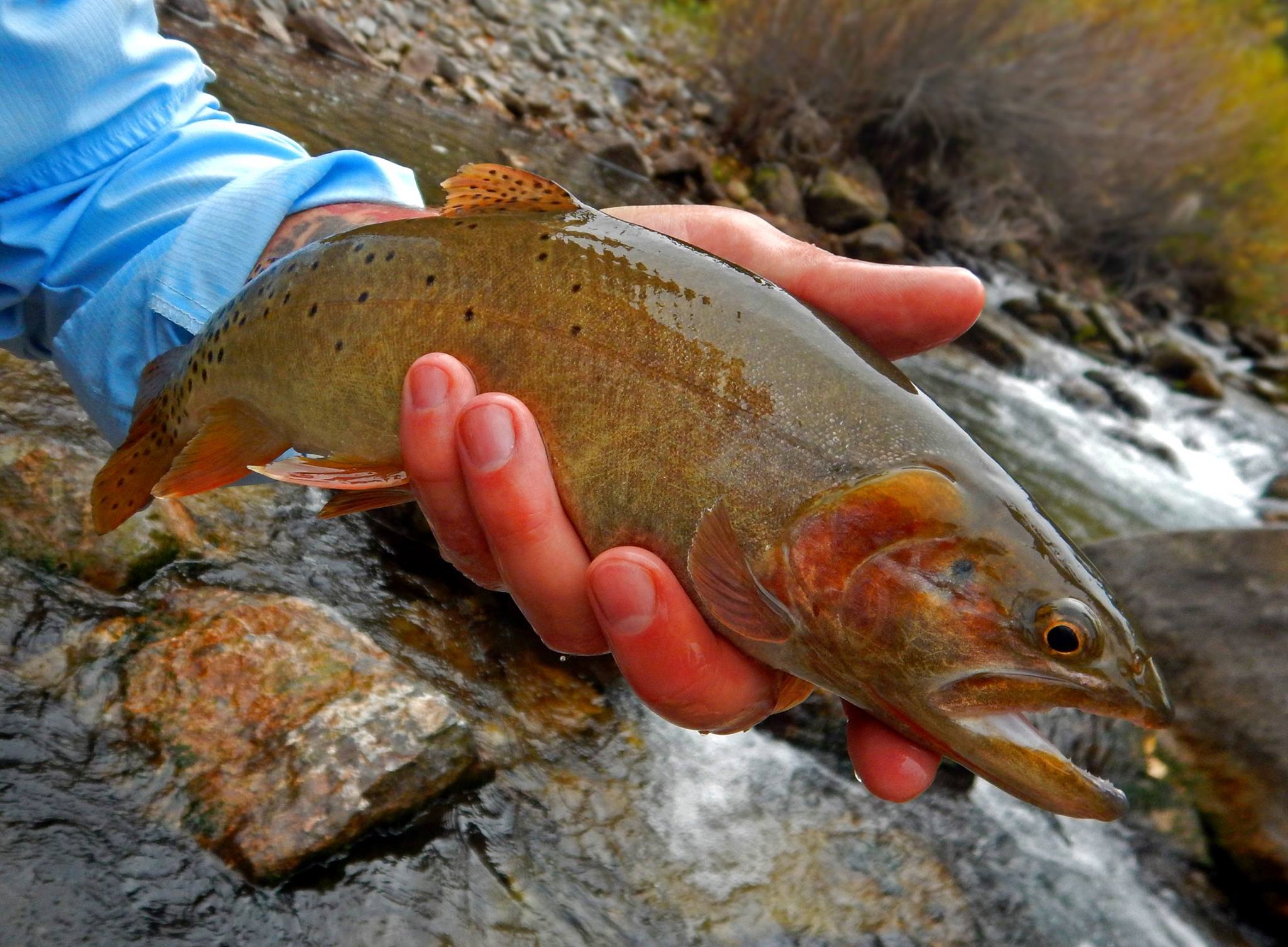
 
Cutthroat Trout A “no-trouts-land” on the Logan River, Copyright (c) Chadd VanZanten, Photographer vanzanten-cutthroat_trout Cutthroat Trout on the Logan River, Copyright (c) Chadd VanZanten, Photographer
 
Colorado River Cutthroat Trout, Oncorhynchus clarki pleuriticusColorado River Cutthroat Trout
Oncorhynchus clarki pleuriticus
Courtesy US BLM Rawlins, WY Office
 
Utah streams offer excellent year-round fishing opportunities for every level of angler. According to the Department of Natural Resources, Utah’s waters are home to approximately 80 different species of fish, but it is the trout fishing that is the biggest attraction for fishermen. Of the trout species swimming in our rivers and lakes, the cutthroat trout is a local favorite and the only trout native to the state.

The cutthroat trout represents the most diverse trout species in North America. They are a freshwater fish of the Salmonidae family that live in cold, clear streams and lakes across the west. Cutthroat trout are distinguished from other trout species by two red slashes prominently striping the lower jaw after which they are named. All cutthroat trout share a single common ancestor, but historic population isolation gave rise to 14 subspecies, each endemic to their own geographic region and river drainage.

There are four subspecies that exist in Utah. Only three of these are considered native to the state: the Colorado River cutthroat, the Yellowstone cutthroat, and Utah’s state fish, the Bonneville cutthroat. In Utah, the Colorado River cutthroat trout can be found in some of the smaller streams and tributaries of the Green River, the San Juan River, and the Colorado River drainages. Their bright coloration and posterior black spotting distinguish these cutthroats from others.

Pure, native Yellowstone cutthroat trout are present in small numbers in the streams of the North Slope of the Raft River Mountains in northwestern Utah. However, this subspecies is more widely distributed across the state due to extensive stocking. Yellowstone cutthroat trout can be differentiated by larger-sized black spots concentrated near the tail and their gold, gray, and copper tones.

The Bonneville cutthroat trout evolved in the Bonneville Basin of Utah, Wyoming, Idaho, and Nevada. Its primary ancestors were a population of lake dwelling cutthroat trout living in the late-Pleistocene aged Lake Bonneville. The Bonneville cutthroat trout is less vividly colored and has spots that are more sparsely and evenly distributed across the body than other cutthroats. Thought to be extinct in the 1970s, populations of the Bonneville cutthroat trout are now estimated to exist in around 35% of their historic range, including the nearby Weber and Provo Rivers.

Like so many species, the native cutthroat trout of Utah are under significant pressure due to drought, habitat loss, disease, and competition with non-native species. Though only the Colorado River cutthroat is included on the Utah State Sensitive species list, conservation of all of Utah’s native cutthroat populations is a focal point for state wildlife resource managers.

For Wild About Utah, I’m Anna Bengtson of Park City.

The Cutthroat Trout-a Local Favorite-Credits:
Images: Courtesy USDA Forest Service, US Bureau of Land Management & Chadd VanZanten.
Text: Anna Bengston

Additional Reading:

Anna Bengston’s Postings on Wild About Utah, https://wildaboututah.org/author/anna-bengston/

Utah Fishing Regulations, Utah Division of Wildlife Resources, Department of Natural Resources, State of Utah, https://wildlife.utah.gov/fishing/fishing-regulations.html.

Fishes, Utah Division of Wildlife Resources, n.d. Web. 7 July 2014: https://fieldguide.wildlife.utah.gov/?class=actinopterygii.

Bonneville Cutthroat Trout, Utah Species, Utah Division of Wildlife Resources, Department of Natural Resources, State of Utah, https://fieldguide.wildlife.utah.gov/?species=oncorhynchus%20clarkii%20utah

Colorado River Cutthroat Trout,, Utah Species, Utah Division of Wildlife Resources, Department of Natural Resources, State of Utah, https://fieldguide.wildlife.utah.gov/?species=oncorhynchus%20clarkii%20pleuriticus.

Yellowstone Cutthroat Trout, Utah Species, Utah Division of Wildlife Resources, Department of Natural Resources, State of Utah, https://fieldguide.wildlife.utah.gov/?species=oncorhynchus%20clarkii%20bouvieri

Greenback Cutthroat Trout, Western Native Trout, https://www.westerntrout.org/gc-trout.html.

Cutthroat Trout, Colorado Parks and Wildlife, https://cpw.state.co.us/learn/Pages/ResearchCutthroatTrout.aspx.

Cutthroat Trout (Oncorhynchus clarkii) – FactSheet. Cutthroat Trout (Oncorhynchus clarkii) – FactSheet. U.S Geological Survey, 14 June 2013. Web. 7 July 2014: https://nas.er.usgs.gov/queries/FactSheet.aspx?speciesID=890.

Bonneville cutthroat trout (Oncorhynchus clarki utah), U.S. Fish & Wildlife Service, US Department of the Interior, https://www.fws.gov/species/bonneville-cutthroat-trout-oncorhynchus-clarkii-utah

Brown, Dylan. Shocking habitat projects help increase native Cutthroat populations. Standard Examiner, 14 May 2014. Web. 7 July 2014: https://www.standard.net/lifestyle/recreation/2014/may/13/shocking-habitat-projects-help-increase-native-cutthroat-populations/.

Chorney, Chad. For the Love of Cutthroat Trout Unlimited Blog, 29 Jan. 2013. Web. 7 July 2014: https://westslope.tu.org/comment/1556.

Echoes of Lake Bonneville

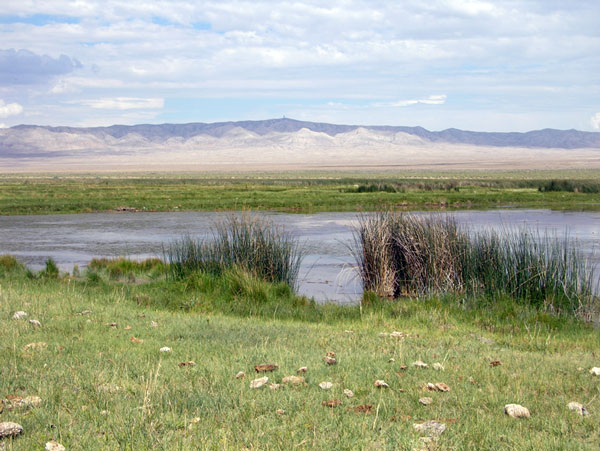
Echoes of Lake Bonneville: North Spring, Fish Springs National Wildlife Refuge, Utah. Courtesy Utah Geological Survey
North Spring, Fish Springs National Wildlife Refuge, Utah. Courtesy Utah Geological Survey

Leland Harris wetlands, Snake Valley, Utah, Courtesy Utah Geological SurveyLeland Harris wetlands
Snake Valley, Utah
Courtesy Utah Geological Survey

Least Chub, Courtesy and Copyright Mark C. Belk, PhotographerLeast Chub
Courtesy & © Mark C. Belk, Photographer
Echoes of Lake Bonneville

Hi, I’m Holly Strand of the Quinney College of Natural Resources at Utah State University.

Deserts are dry by definition receiving an average of less than 10 inches of precipitation a year. In Utah’s cold West Desert, this skimpy amount of moisture slakes the thirst of sagebrush, saltbush or greasewood, but not much else. However, just like the Sahara, the West Desert has its oases. In certain lowland valleys you’ll find complexes of pools and marshes. There isn’t enough rain to form these freshwater sanctuaries. The water comes from giant underground aquifers.

Underneath the West Desert, the aquifer system acts as a storehouse for runoff from the surrounding mountains. As rainwater or snow melt enters or “recharges” the aquifer system, water pressure can build up in some areas. This pressure moves water through cracks and tunnels within the aquifer, and sometimes this water flows out naturally in the form of springs.

These desert springs–and the resulting pools and marshes–permit concentrations of animals and plants not possible under normal desert conditions. You’ll find sedges, rushes cattails and many other wetland plants. Both migratory and year round birds congregate here. There are even a couple of frog species—the Colombian spotted frog and the northern leopard frog.

But most remarkable are the desert spring residents that have survived from the days when the West Desert formed the floor of giant Lake Bonneville. Surveys have revealed a number of relict snails and other mollusks that still persist from that time. Some, like the Black Canyon Pyrg exist at a single spring complex only; they are found nowhere else on earth.

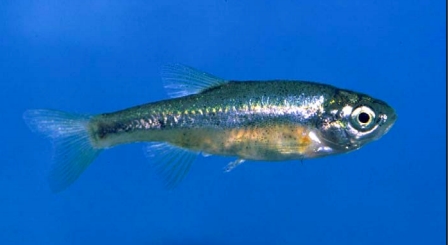
Certain native fish were also left high and dry by Lake Bonneville’s recession. The least chub is a good example. Now the sole member of its genus, this 3-inch long survivor is an unassuming but attractive little minnow. It is olive-colored on top and sports a gold strip on its steel-blue sides. It swims in dense but orderly schools in either flowing or still water. It can withstand both temperature variations and high salinity. The ability to tolerate different physical conditions has undoubtedly helped the least chub survive the post-Lake Bonneville millennium. Even so, the least chub was hanging on in only six different locations until Utah’s Division of Wildlife Resources reintroduced it to several more sites within its historic range. The Division and its conservation partners are still working to reduce threats to the least chub, to other spring residents and to the spring habitats themselves.

For more information and pictures go to www.wildaboututah.org

Thanks to Chris Keleher of Utah’s Department of Natural Resources for his help in developing this Wild About Utah story.

For Wild About Utah, I’m Holly Strand.

Credits:

Theme: Courtesy & Copyright Don Anderson Leaping Lulu
Image: Least Chub, Mark C. Belk, Professor of Biology, Brigham Young University
Image: Wetlands, Courtesy Utah Geological Survey https://geology.utah.gov/
Text: Holly Strand, Quinney College of Natural Resources at Utah State University

Sources & Additional Reading

Bailey, Carmen L., Kristine W. Wilson Matthew E. Andersen. 2005. CONSERVATION AGREEMENT AND STRATEGY FOR LEAST CHUB (IOTICHTHYS PHLEGETHONTIS) IN THE STATE OF UTAH Publication Number 05-24 Utah Division of Wildlife Resources a division of Utah Department of Natural Resources https://wildlife.utah.gov/pdf/fish/least_chubs.pdf

Jones, Jennifer, Rich Emerson, and Toby Hooker. 2013. Characterizing Condition in At-risk
Wetlands of Western Utah: Phase I UTAH GEOLOGICAL SURVEY a division of Utah Department of Natural Resources,https://geodata.geology.utah.gov/pages/view.php?ref=8364

Nature Serve entry for Least Chub: https://explorer.natureserve.org/servlet/NatureServe?searchName=Iotichthys+phlegethontis

Hanks, Joseph H. and Mark C. Belk. 2004. Threatened fishes of the world: Iotichthys phlegethontis Cope, 1874 (Cyprinidae) in Environmental Biology of Fishes, Vol. 71. N. 4., Kluwer Academic Publishers. https://dx.doi.org/10.1007/s10641-004-1030-x

Sigler W. F. & J. W. Sigler. 1996. Fishes of Utah, A Natural History. University of Utah Press, Salt Lake City. 375 pp. https://www.amazon.com/Fishes-Utah-A-Natural-History/dp/0874804698

Wasatch Front Canyons Geologic Tour, Virtual Tour created from Published Booklet (pdf) Geologic Guide to the Central Wasatch Front Canyons, Utah Geological Survey, State of Utah, https://utahdnr.maps.arcgis.com/apps/MapTour/index.html?appid=5cf1570b998346d98478a5abd50bf096

Geologic guides to the central Wasatch Front Canyons, Utah Geological Survey, 2005, https://geology.utah.gov/popular/utah-landforms/virtual-tour-central-wasatch-front-canyons/ [updated January 2024]

Kokanee Life Cycle

Kokanee Salmon above Porcupine Reservoir
Copyright 2008 Mary-Ann Muffoletto

Hi, I’m Holly Strand from the Quinney College of Natural Resources at Utah State University.

A highly compelling mating drama is taking place now in select mountain reservoirs. Utah’s colorful kokanee salmon are at the very peak of their upstream migration. Yearning to find the gravel bar in which they were born, these fish follow their noses. For the smell of that gravel birthplace–and the surrounding stream–is imprinted in young kokanee brains. Biologists call this smell the “home stream olfactory bouquet.”

Once a female kokanee is satisfied with the surrounding “olfactory bouquet,” she digs a nest in the gravel with her tail. As she digs one or more of these nests, individual males will try to guard her in order to secure their paternity. Part of the spectacle of kokanee-watching comes from the darting and biting and jostling among males attempting to get access to females. Once the eggs are laid and fertilized the female covers them with gravel.

This is the end of the line for the new parents. Within a few days of egg laying the female will die. And the male will follow soon after. Expired fish provide food for predators and scavengers such as gulls, ravens, and coyotes. Any leftover salmon will decompose and fertilize the stream waters, leading to plankton growth, which—in turn–will nourish the new crop of young salmon.

In Utah, kokanee eggs hatch between November and January. The tiny new salmon will spend their first weeks of life hiding in the gravel feeding off the remains of their egg yolk sack. After a few weeks they will emerge from the gravel to feed on plankton. By spring, these youngsters—called fingerlings– will be an inch and a half long. During spring runoff the fingerlings are swept downstream until they spill into a lake or reservoir. Now they will stay here in the open water for 2-4 years, feeding on zooplankton until they reach maturity.

For these first stages of life kokanee are dark to greenish blue on the head and back, silver on the sides and silvery or white underneath.
But at summer’s end, the spawning salmon will undergo their astonishing transformation. The males’ bodies will turn a bright red-orange. Their shape will change as well. They will acquire humped backs, hooked jaws, and elongated teeth. The females also turn red although the color may not be as striking. By late August both males and females are congregating at the mouth of the spawning stream preparing to embark on the final–and most important–mission of their lives.

For more information and locations for kokanee viewing go to www.wildaboutUtah.org. You’ll also see a video of kokanee spawning in the Little Bear River*, the main tributary of Porcupine Reservoir.

For Wild About Utah, I’m Holly Strand.

* Many people call this Cinnamon Creek. However the Little Bear River feeds Porcupine reservoir. Cinnamon creek joins the Little Bear, as a tributary, a little bit up stream and East of Porcupine reservoir.

Credits:

Photo: Courtesy and Copyright 2008 Mary-Ann Muffoletto, Photographer
Video: Courtesy and Copyright 2013 Charles Hawkins, Photographer
Video: Courtesy and Copyright 2013 Holly Strand, Photographer
Text: Holly Strand, Quinney College of Natural Resources at Utah State University

Where to see kokanee salmon spawning (adapted from Utah Div. of Wildlife Resources website)

The Kokanee spawning runs in Sheep Creek, Indian Creek, Strawberry River and the upper East Fork Little Bear River occur in late August through early October. Flaming Gorge Reservoir has a late-season spawning population which spawns in the Green River and along the shores of the reservoir in late October through November.

Sheep Creek is in northeastern Utah, about six miles south of Manila. The viewing site is at the Scenic Byway turnout where Sheep Creek crosses under state Route 44.

Porcupine Reservoir: Just pass Avon, turn left (there’s a sign) and head east to the reservoir. Pass the dam and follow the shelf road past the end of the reservoir. There will be a wide level area where you can park and walk down to the Little Bear River to see the salmon.

Sept. 22 is Kokanee Salmon Viewing Day.at the U.S. Forest Service visitor center at Strawberry Reservoir. Utah Div. of wildlife Biologists will be on hand to show you the salmon and answer any questions. https://wildlife.utah.gov/dwr/news/42-utah-wildlife-news/906-see-kokanee-at-strawberry.html Even if you can’t make it to this event, salmon should be visible in the Strawberry River, and other tributaries to Strawberry, from now until the first part of October.

Sources & Additional Reading

Sept. 22 is Kokanee Salmon Viewing Day.at the U.S. Forest Service visitor center at Strawberry Reservoir. Utah Div. of wildlife Biologists will be on hand to show you the salmon and answer any questions.
https://wildlife.utah.gov/dwr/news/42-utah-wildlife-news/906-see-kokanee-at-strawberry.html [Accessed September 19, 2013]

Resources:
Fuller, P., G. Jacobs, J. Larson, and A. Fusaro. 2013. Oncorhynchus nerka. USGS Nonindigenous Aquatic Species Database, Gainesville, FL.
https://nas.er.usgs.gov/queries/factsheet.aspx?SpeciesID=915 Revision Date: 3/7/2012 Note: Oct 29, 2024 New link https://nas.er.usgs.gov/queries/factsheet.aspx?SpeciesID=915

Sigler, John W. and William F. Sigler. 1987. Fishes of the Great Basin: A Natural History. Reno, NV: University of NV Press. https://unpress.nevada.edu/9780874176940/fishes-of-the-great-basin/

Sloman, Katherine A., Rod W. Wilson, Sigal Balshine. 2006. Behaviour and Physiology of Fish. San Diego, CA: Elsevier Academic Press. https://shop.elsevier.com/books/fish-physiology-behaviour-and-physiology-of-fish/sloman/978-0-12-350448-7

Steward, Ron. 1994. Kokanee. Utah Division of Wildlife Resources. Wildlife Notebook Series No. 10. https://utah.ptfs.com/awweb/main.jsp?flag=collection&smd=1&cl=all_lib&lb_document_id=12657&itype=advs&menu=on
[accessed September 19, 2013] Downloaded and found at https://wildaboututah.org/wp-content/uploads/kokanee-dwr-booklet1.pdf

Ross, Crystal, Where to see Utah’s spawning kokanee salmon, Wildlife Blog, Utah Division of Wildlife Resources, August 29, 2019, https://wildlife.utah.gov/news/wildlife-blog/755-where-to-see-utah-s-spawning-kokanee-salmon.html [accessed October 29, 2024]

Aquatic Insects, Harbingers of Health

Aquatic Insects, Harbingers of Health
Skwala (Large Springflies)
Stonefly Nymph
Courtesy & Copyright
Robert Newell
As found on
TroutNut.com

Aquatic Insects, Harbingers of HealthMayfly nymph
Courtesy & Copyright
Leo Kenney, Vernal Pool Association

Aquatic Insects, Harbingers of HealthNorthern caddisfly Larvae

Limnephilidae
Photo Credit:
Howard Ensign Evans,
Colorado State University,
Bugwood.org
Used under
Creative Commons Attribution 3.0
License.

Hi, this is Mark Larese-Casanova from the Utah Master Naturalist Program at Utah State University Extension.

As we officially enter summer, it’s easy to notice nature at its peak. Wildflowers are in bloom, birds are feeding their young, and insects fill the air. Life is especially robust near our wetlands, lakes, and streams.

Our aquatic, or wet, ecosystems provide habitat to abundant plants and animals. Only 1% of Utah is wet, but over 80% of all wildlife in Utah depend on aquatic ecosystems for at least part of their life cycle. However, the quality of Utah’s aquatic habitats is often affected by chemical pollution or excessive nutrients and sediment.

Some organisms, including many aquatic insects, only live in the healthiest of aquatic habitats. Many of the insects we see in summer live in the water when young, during the larval or nymph stage, before becoming adults. Three insects in particular- mayflies, stoneflies, and caddisflies- require especially clean, cold streams low in nutrients and high in dissolved oxygen to survive.

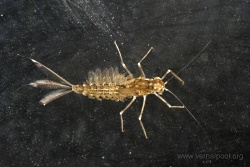
Mayflies are aquatic as nymphs and emerge from the water to live as adults for just a day. The external feather-like gills of the nymphs can be seen fluttering along the sides of their abdomen. They feed by scraping algae from rocks.

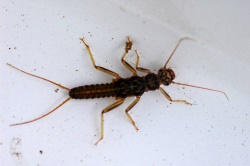
Stonefly nymphs are well adapted to living among the rocks of swift-moving streams. Their hooked legs grasp the slick rocks as they shred apart plant litter that falls into the stream.

Caddisfly larvae spin a sort of spider silk to glue rocks or sticks together to form a case in which they live. They will also build webs underwater to collect small particles of food that drift by.

The quality of a stream habitat can be assessed by counting the number of different species, or types, of mayflies, stoneflies, and caddisflies. A greater number of species generally means that habitat and water quality are higher. Dramatic decreases in insect diversity from season to season or year to year can signal a decline in stream health. Monitoring aquatic insects over time gives us an accurate picture of the long-term health of our stream ecosystems.

For more information about monitoring water quality and aquatic insects, visit Utah State University Water Quality Extension’s website. Once there, you’ll find a wealth of information about monitoring Utah’s aquatic ecosystems, including Utah Water Watch, a statewide volunteer citizen science program.

For Wild About Utah, I’m Mark Larese-Casanova.

Credits:
Images: Northern caddisfly larvae, Howard Ensign Evans,
            Colorado State University
            Creative Commons Attribution 3.0 License.
            Stonefly Nymph, © Robert Newell, displayed on Troutnut.com
            Mayfly nymph, © Leo Kenney Vernal Pool Association
Text:     Mark Larese-Casanova, Utah Master Naturalist Program
            at Utah State University Extension.


Additional Reading:

Larese-Casanova, M. Utah Master Naturalist Watersheds Wildlife Field Guide. Utah State University Extension. 2012. https://extension.cart.usu.edu/Details.cfm?ProdID=41&category=0

USU Water Quality Extension. Utah Stream Team Manual. https://extension.usu.edu/waterquality/htm/citizen_monitoring/ust

Voshell, J. R. A Guide to Common Freshwater Invertebrates of North America. The McDonald and Woddward Publishing Company. 2002. https://www.amazon.com/Guide-Common-Freshwater-Invertebrates-America/dp/0939923874